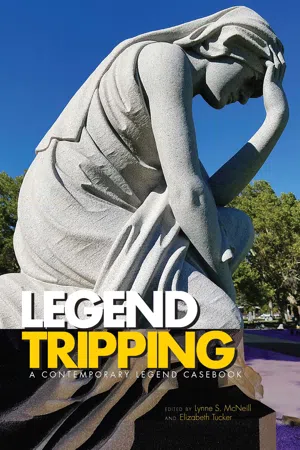
Legend Tripping: A Contemporary Legend Casebook explores the practice of legend tripping, wherein individuals or groups travel to a site where a legend is thought to have taken place. Legend tripping is a common informal practice depicted in epics, stories, novels, and film throughout both contemporary and historical vernacular culture. In this collection, contributors show how legend trips can express humanity's interest in the frontier between life and death and the fascination with the possibility of personal contact with the supernatural or spiritual.
The volume presents both insightful research and useful pedagogy, making this an invaluable resource in the classroom. Selected major articles on legend tripping, with introductory sections written by the editors, are followed by discussion questions and projects designed to inspire readers to engage critically with legend traditions and customs of legend tripping and to explore possible meanings and symbolics at work. Suggested projects incorporate digital technology as it appears both in legends and in modes of legend tripping.
Legend Tripping is appropriate for students, general readers, and folklorists alike. It is the first volume in the International Society for Contemporary Legend Research series, a set of casebooks providing thorough and up-to-date studies that showcase a variety of scholarly approaches to contemporary legends, along with variants of legend texts, discussion questions, and projects for students.
Contributors: S. Elizabeth Bird, Bill Ellis, Carl Lindahl, Patricia M. Meley, Tim Prizer
WHEN LINDA DÉGHSTARTEDTEACHINGAT INDIANA UNIVERSITY in the mid-1960s, she wanted to learn what kinds of stories people told in the rural area around Bloomington. Having worked closely with narrators of folktales in rural Hungary, she had developed highly effective fieldwork methods. As she got to know students in Indiana University’s Introduction to Folklore class, she realized that many of them knew significant folk legends and would enjoy collecting more from friends and family members. Dégh inspired her graduate students to collect and study legends of rural Indiana and other areas. With the help of graduate assistants, she founded the journal Indiana Folklore, published from 1968 to 1980. Although Indiana Folklore (Dégh 1980b) published a variety of material, it became a treasure trove of legends and legend analyses, some of which examined young people’s visits to haunted places. In addition to these publications, other studies by Dégh’s students addressed visits that would eventually be called legend trips: most by young people but some by older adults.
Haunted Bridges
One of Dégh’s first articles about Indiana folk legends, “The Haunted Bridges near Avon and Danville” (Dégh 1969a), appeared in the journal’s second volume. This article presents nineteen-year-old Gary E. Brown’s collection of haunted bridge legends and Dégh’s analysis of the meaning of visits to the bridges: the first analysis of this kind. Gary Brown collected haunted bridge legends as part of his work in Introduction to Folklore. The legend complex represented in Brown’s paper is loosely based upon Ernest Baughman’s Motif E266.2(a), “Ghost of laborer on bridge who fell and was killed during construction of bridge leads people to commit suicide.” Based on the ancient concept of human sacrifice to ensure that a newly constructed edifice will be safe, these legends about bridges near Avon and Danville suggest that spirits within the bridges appear or make noises if visitors disturb them. Visitors may see a ghostly form or hear chains rattling. Some legends about the bridges’ construction concern a worker who died and was thrown into fresh concrete; others tell of a baby thrown in by a young mother.
Here is an excerpt of Brown’s transcript of his interview with his friend Scott about the haunted bridge near Avon:
GARY:. Did you ever go in the bridge?
SCOTT:. Yeah, the first time I went out there it was real cold and in the winter time. We had to jump across a 5 foot jump to get there.
GARY:. Did anything unusual happen?
SCOTT:. Well, you had to crawl and there were these big chambers, and the guys in front would hide and scare the living —— out of you when you went into the chamber.
GARY:. Did you take any girls, Scott?
SCOTT:. No, hell, I live in the country; I don’t have to drive 40 miles to a country road.
GARY:. Scott, did you ever hear any stories about the haunted bridge?
SCOTT:. Well, this guy takes a girl out parking under the bridge and they were listening to the radio. There was a news bulletin that an escaped convict was in that area. He was highly dangerous because he had a steel hooked arm. After some time the boy and girl heard a noise outside the car. They were so scared they didn’t look up, they just drove on. The guy was so shook up he pulled into the first filling station that they came to, and when the guy opened his door the steel hook that was on the mad man’s arm fell off.
GARY:. Scott, where did you hear this story and who told you?
SCOTT:. We were sitting under the bridge and those two stories were told while we were sitting there by Charlie Sheppard. (Dégh 1969a, 61–62)
As the above excerpt shows, expeditions to visit the haunted bridges near Avon and Danville could be exciting and perilous, involving jumps and climbs into inner chambers. Friends in the front of the line would scare friends who were still making their way into the chambers. Once they all made it inside, the young people would share legends. Scott tells a variant of the famous legend “The Hook.” This is just one of many legends associated with the haunted bridges, including stories about a woman in white and a creature called the Mud Man. Brown’s paper demonstrates the richness and variety of legends told by young people visiting places that are known to be haunted.
Figure 1.1. The haunted bridge near Avon, Indiana. Photo by Jesse A. Fivecoate.
The most important part of this early article by Linda Dégh is her analysis of what happens when young people go to notorious haunted locations:
The stories in the bridge legend cluster, as many of the modern legends popular among young people . . . have two distinct parts. The first part recounts a supernatural (or extraordinary) event that occurred in the past and that serves as an explanation of a present phenomenon attributed to it. The scene featured by the tellers is appropriate for the common basis of all stories telling about violent death caused by suicide, murder, execution, car or train accidents. All of them happen in the dark of the night and the narrators suggest that the tragic event is being re-enacted at certain nights, appropriate for the revenants to return. The account of the tragedy is usually brief and sober; it simply states the facts of people meeting their untimely death at the appointed place, without going into details in search of the background of human tragedies. Also, the statement on the haunt is quite matter-of-fact.
Not so is the second part of the narratives, which relates the personal experience of the teller as he explores the phenomenon. Although it hardly contains real narrative motifs, this part reflects the emotional involvement of the narrator. In the bridge haunt stories, as well as in many similar modern American legends, the latter part of the legend becomes extremely important as it includes an account of the active and real physical participation on the part of the narrator and his associates.
This dichotomous structure of both form and content of the folk legend is rarely elaborated in full. Variants of the individual tellers are usually incomplete and uneven, depending on their personal interest. Under the emotional impact of the experience, informants might feel more strongly affected by they have witnessed during their visit to the place than by the narratives passed onto them. Because of the personal involvement of the tellers, their variable attitudes are directly related to the formulation of the texts and, therefore, are of major interest to the folklorist.
As is commonly known, the formal imperfection of the traditional legend genre is due to the reason for its telling: the communication of a message—a warning and/or advice of some kind. To make this message of considerable importance more effective, the narrator poses as an eyewitness to the legend action, testifying to its veracity. Nevertheless, the type of modern American folk legend group under discussion polarizes the constituent elements, making a clear distinction between (1) the legend proper and (2) the explorations of the teller. The experience that induces the teller to speak up is in our particular case not a passive one that happened unexpectedly to the guileless narrator. The narrator of a traditional folk legend would use his encounter with the bridge ghost as a point of departure: “There is a spook on this bridge” or “My grandfather tells about a ghost he saw on the bridge” or “When I came home around midnight I heard a scream on the bridge” and so on. He also would repeat this evidence as a conclusion of the story, ending with the spelling out of the advice.
Our raconteur . . . is eager to challenge danger and step forward to claim his share in the experience. He expects to be scared by what he is prepared to meet and is most active to induce the apparition to give himself a good scare. The participant narrator is not an accidental visitor to the haunted place; he shows a remarkable familiarity with ghost lore. The scene itself, as described in all variants, suggests the horror to be met. Old and side-road bridges qualify as the site of haunts, like deserted old houses or cemeteries, way out in the country, overgrown with weed, hedges and trees in a deep valley or on a hilltop. A dangerous curve on a dirt road, leading to the bridge sets up the “general scary conditions” necessary for the experience. Dark, foggy, moonless nights or nights when the moon is full and moving shadows reflect the windblown trees are equally fitting to the occasion. At this point, reaching the second part of his story, the narrator switches to the first person in his account. However, he is not alone on his dare; what he tells about is the collective experience of a group—two or three carloads of young people. What they want is to sense the chill of fear, and conversely, to prove defiance of fear. In spite of the group solidarity in the endeavor, the challengers break up and have to meet the danger individually. They explore the inside and the environs of the bridge, ready for the scare. They might even play cool in taking written notes on individual experiences or in checking whether the rumors concerning the haunt were true or not.
Figure 1.2. Close-up of the inner compartments of the haunted bridge near Avon, where legend trippers have shared stories. Photo by Jesse A. Fivecoate.
All the above implies that the bridge-visitors condition themselves mentally for a vision they desire to have. They also perform a series of designated acts known to be effective to prompt the ghosts to appear. The hour and the weather conditions should be carefully selected; there is an indication that Halloween night might be the appropriate time for an effective visit. (Halloween as the time of haunt is mentioned in Indiana legends; however, the scarce number of references do not yet allow us to assume what seems to be likely: that visits to haunted places belong to Halloween customs). The rituals bridge visitors perform include walking under the bridge, climbing into the chambers, reciting ghost stories, etc. The parked car seems to be an adequate shelter from which the explorers might urge the ghost to appear: they roll up the windows, honk the horn three times or shine the lights three times.
In view of the active interest in the supernatural so typical of young people in their teens and early twenties, one is tempted to infer that there is a profound belief that maintains the popularity of the haunt legends. The frank statements of the informants, however, indicate that the quality of belief is immeasurable as a factor in legend maintenance. Almost all respondents said: there might be a grain of truth in the stories but all they saw might have been just an illusion. Many informants noted that haunt stories are favorite subjects of general conversation within their group and what they heard often influenced them in what they have seen. They really were not sure whether they heard or experienced the facts of their version. They probably never considered seriously the question of their own belief and if their mental attitude ere important at this conjecture; routine folklore interviews would certainly not reveal adequate information. The point is: belief or disbelief, the visit to the haunted bridge, is a kind of test, one of the initiation rituals among the many young males have to pass as they leave childhood and make their way toward adulthood. The exploit is not only a dare but also very enjoyable fun. Feeling the chill of a “good scare” is definitely welcome to youths in this civilized, comfortable and rather uneventful affluent world. To escape boredom and enjoy adulthood, what could be more exciting than to make use of a brand new operator’s license and drive out at night to visit the haunts of the region? Although our informants were of both sexes, we believe that the active dare is more a male than a female exploit, whereas the telling of the stories belongs to both boy and girl get-togethers. (Dégh 1969a, 77–81)
Dégh’s suggestion that driving out at night to visit haunted places is “more a male than a female exploit” fits the legend collections available at that time as well as American popular culture’s focus on male daredevils during the 1950s and early to mid-1960s. During the years since then, female daredevils have joined their male counterparts, and folklorists have documented young and older women’s legend trips. One notable study ten years after the publication of Dégh’s article is Sue Samuelson’s (1979) “The White Witch: An Analysis of an Adolescent Legend.”
House of Blue Lights
Like her article about haunted bridges, Dégh’s article about the notorious House of Blue Lights in Indianapolis (1969b) addresses a kind of haunting that appeals greatly to readers and listeners. Just as many towns have bridges with a reputation for being haunted, many have houses known as the “haunted house” of the community. Because they are community-based, some haunted house legends never become known in a broader geographical area, but because the House of Blue Lights has such fascinating details, it has transcended its local boundaries.
Figure 1.3. Sign that gives the haunted bridge the “Seal of the Town of Avon.” Photo by Jesse A. Fivecoate.
First, some background about the house, which was first described by Magnús Einarsson-Mullarky (1968) in his article “The House of Blue Lights” in the inaugural issue of Indiana Folklore. Large, somewhat isolated, and equipped with a swimming pool and other special features, the house fascinated Indianapolis residents, especially teenagers. Skiles E. Test, the house’s owner, died in the spring of 1964. The son of an affluent and influential Indianapolis family, he lived on a farm, where he raised Saint Bernard dogs and took care of stray dogs and cats. He lived alone after being married and divorced twice. According to an article in the Indianapolis Star quoted in Dégh’s article, an auction held after Test’s death drew about 30,000 people; by midafternoon, most of Test’s “enormous stockpile of aspirin tablets, catsup, office equipment, artwork and household furnishings” had been taken away, The newspaper article also explained that the house had taken its name from blue lights that Mr. Test enjoyed putting up during the Christmas season (Dégh 1969b, 13). Except for the Christmas decorations, which appear on numerous American homes during the winter h...
Table of contents
Cover
Title Page
Copyright Page
Dedication
Contents
Acknowledgments
Introduction
1 Early Studies
2 Legend Tripping in Ohio: A Behavioral Survey
3 Adolescent Legend Trips as Teenage Cultural Response: A Study of Lore in Context
4 Legend Trips and Satanism: Adolescents’ Ostensive Traditions as “Cult” Activity
5 Playing with Fear: Interpreting the Adolescent Legend Trip
6 “Shame Old Roads Can’t Talk”: Narrative, Experience, and Belief in the Framing of Legend Trips as Performance
7 Ostensive Healing: Pilgrimage to the San Antonio Ghost Tracks
8 Contemporary Ghost Hunting and the Relationship between Proof and Experience
9 “There’s an App for That”: Ghost Hunting with Smartphones
10 Living Legends: Reflections on Liminality and Ostension
Discussion Questions and Projects
References
About the Authors
Index
Trusted by 375,005 students
Access to over 1.5 million titles for a fair monthly price.
Study more efficiently using our study tools.
Frequently asked questions
Yes, you can cancel anytime from the Subscription tab in your account settings on the Perlego website. Your subscription will stay active until the end of your current billing period. Learn how to cancel your subscription
No, books cannot be downloaded as external files, such as PDFs, for use outside of Perlego. However, you can download books within the Perlego app for offline reading on mobile or tablet. Learn how to download books offline
We are an online textbook subscription service, where you can get access to an entire online library for less than the price of a single book per month. With over 1.5 million books across 990+ topics, we’ve got you covered! Learn about our mission
Look out for the read-aloud symbol on your next book to see if you can listen to it. The read-aloud tool reads text aloud for you, highlighting the text as it is being read. You can pause it, speed it up and slow it down. Learn more about Read Aloud
Yes! You can use the Perlego app on both iOS and Android devices to read anytime, anywhere — even offline. Perfect for commutes or when you’re on the go. Please note we cannot support devices running on iOS 13 and Android 7 or earlier. Learn more about using the app
Yes, you can access Legend Tripping by Lynne S. McNeill, Elizabeth Tucker, Lynne S. McNeill,Elizabeth Tucker in PDF and/or ePUB format, as well as other popular books in Social Sciences & Folklore & Mythology. We have over 1.5 million books available in our catalogue for you to explore.