This book explores recent developments in South African Pentecostalism, focusing on new prophetic churches. The chapters engage with a number of paradigm shifts in Christology, identified as complementing Christ, competing with Christ, removing Christ and replacing Christ. What are the implications of these shifts? Does it mean that believers no longer believe in Christ but in their leaders? Does it shift believers' faith towards materiality than the person of Christ? This volume will be valuable for scholars of African Christianity and in particular those interested in the neo-prophetic movement and Christology in a South African context.
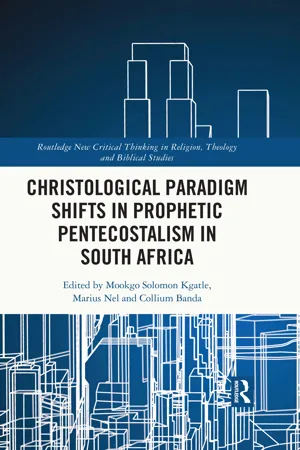
eBook - ePub
Christological Paradigm Shifts in Prophetic Pentecostalism in South Africa
- 216 pages
- English
- ePUB (mobile friendly)
- Available on iOS & Android
eBook - ePub
Christological Paradigm Shifts in Prophetic Pentecostalism in South Africa
About this book
Information
1The paradigmatic shift of some New Prophetic Churches from the ipsissima verba of Scripture to a non-existent Christology
DOI: 10.4324/9781003212973-1
1.1 Introduction
This chapter argues that the Christology of some New Prophetic Churches (NPCs; also called neo-Prophetic/Pentecostal churches) in South Africa established by South African pastors and other pastors from elsewhere in Africa has become non-existent. These non-denominational churches and ministries have sprung up all over South Africa, and are mushrooming exponentially mainly in urban Thoko Mkhwanazi-Xaluva, the chairperson of the Commission for the Promotion and Protection of the Rights of Cultural, Religious and Linguistic Communities (the CRL Rights Commission) told News24:
In the charismatic sector, you start up and report to no one, you report to heaven. If I have a calling tonight, by tomorrow I can buy a tent and a sound system, I can call myself bishop, a prophet, whatever – and I’m good to go …. 2
According to the various vision statements of these prophets, they each brand themselves as having valid reasons for their presence as they are serving a particular niche need (usually personal empowerment, promoting the agenda of a particular political party, prophecy, healing, the gospel of prosperity and community outreach programmes, etc.). Kgatle sums it up as follows:
These churches are known for their refusal to affiliate with established denominations in South Africa. Some of these churches also refuse to be part of the South African Council of Churches (SACC). They are also known for ministering relevantly to the needs of the people as opposed to classical Pentecostalism that is perceived as western and irrelevant. These are churches that offer an alternative to daily challenges of public life like sickness, joblessness, poverty, etc. These churches also offer a range of prayers for the affluent so that they can protect their wealth and keep on growing economically. In this way each non-denominational church or ministry develops a theme and vision that clearly sets apart from others.3
They are neither regulated nor registered/accredited.4 Most of these pastors have either a long history as members of mainline churches or felt a need to establish an independent church or ministry on their own terms.5 In most cases, they have little or no formal/accredited theological qualification and pastoral training. These churches and ministries have subsequently developed either an understanding of Christ parallel to the existing core Christology paradigms or sometimes to various degrees. In the light of complementing Christ, competing with Christ and even replacing Christ as the centre of the Christian religion and faith experience (Jn. 14:6). National media platforms have sadly become the place where so many of our differences and biases have been displayed to the detriment of the Christian unity of the faith that Christ prayed for (Jn. 17:20–22).
My very honest purpose for writing this chapter is to open up an opportunity for the multivocality of different researchers from various fields of specialisation to arise (biblical hermeneutics, missiology and systematic theology) and to inspire them to probe this very current topic multi-directionally. The main issue that makes Christology such an important topic in systematic theology is the confessional answers we give to the key questions that Christ asked: “Whom do people say that I am? …. Whom do you say that I am? [emphasis added]” (Mark 8: 27–30). These questions are crucial for Christians within the context of the Christ-event that generally covers his birth, life, ministry, suffering on the cross, death, resurrection, ascension and his reign at the right hand of the Father.
This investigative study has been carried out using in-depth interviewing and participant observation as qualitative research methods. Selected groups of neo-Pentecostal religious leaders, church committee members and ordinary members of various age groups and social status have been selected for this purpose. Survey research, stratified sampling and purposive sampling have been used to do hypothesis testing of data for the validation of findings. This chapter is underpinned by the transformative paradigm as the theoretical framework to evaluate the impact and critically challenge the deification of these neo-Pentecostal leaders. Issues of social justice, and the advocacy of critical systemic thinking and practice are focal points of discussion. This systemic research approach is aimed at exploring how the gullible followers of the abusive NPC prophets can be empowered. I am basing my Afrocentric philosophical argument and investigative research on critical social theory to evaluate the teachings about Christ in the neo-Pentecostal churches. It is on this basis that I shall argue against the doctrinal abuse of Christ in these churches, in addition to the prophets’ abuse of the socio-historic trust which their vulnerable and gullible followers put in them.
The major findings of this chapter are that some neo-Pentecostal leaders are pursuing an agenda of doing away with Christ, silencing Him, complementing Him and competing with Him. As a result, we cannot even speak of a Christology in these NPCs and neo-Prophetic ministries; rather a Christodicy.6 In order to demonstrate how much the neo-Prophetic churches’ teachings about Christ have deviated from that which has historically been accepted as normative, I will now discuss a few epochal paradigms of Christology (as a discipline of systematic theology), starting with the Council of Nicea.
1.2 Key historical paradigms in South African Christology
There are what I would call epochal or paradigmatic answers to the question, “Who is Christ?” that has been given by both theologians and lay Christians. My focus in this chapter is the confessional answers given by Christians to this central question at various epochs of history. John Mbiti puts it so well, “Theology falls or stands on how it understands, translates and interprets Jesus Christ at a given time, place or human situation”.7 It is important to note that the question of who Christ is, has first been asked by Christ himself, talking to his followers. Thus, the ipssisima verba level of authenticity of this question has never been doubted. It, therefore, serves as the basis for the Christology I resonate with.
I will start by focusing on missionary Christology and the Eurocentric Christian faith confessions that have served as a foundational basis for the Afrocentric, anthropocentric and pragmatic Christological confessions. This acknowledgement of the missionary Christology and Eurocentric faith confessions of Christ as consolidated in the Nicene Creed by the Council of Nicea will continue to serve as a point of reference in this chapter. In view of the developments that have taken place from Eurocentric to Afrocentric Christologies in Africa, I will thus argue against the validity of various neo-Prophetic teachings about Christ that are not only in contention with one another but also keep on evaporating as each prophet commercialises Christianity for personal gain.8 This highly questionable path to prosperity leads to a Christian faith experience that is “dominated by self-advancement, self-esteem and self-sufficiency, individualism, materialism and universalism”.9
1.2.1 The Christology of the Council of Nicea
The first paradigm of Christology emanated out of the Nicene Creed that was formulated by the First Ecumenical Council of Nicea (325 AD) to resolve the heretical teachings of Arianism and Donatism. Emperor Constantine convoked this council to develop what I would call a Christendom and politically unifying Christology to ensure “one emperor and one state religion”.10 This was a mutually beneficial strategy that brought unity in the empire and peace to the church. The emphasis here is on Christ as both divine and human:11 Jesus Christ of Narazeth that was born of Mary is believed to have been sent forth into this world by God the Father for our redemption and adoption as children of the heavenly Father (Jn. 1:1416; Gal. 4.4–5 and Mk. 1:11). He was fully human in nature and yet fully divine as the Son of God (Phil. 2:5–8). He is the second person in the Holy Trinity (Mk. 16:16 and Jn. 13:3). This forms the basis of an Incarnational Christology model12 even in African Christianity. Through evangelisation also known as the great commission (Mt. 28: 16–20), Christians are called to proclaim Jesus Christ as our Lord and Saviour who ministered, died and rose from the dead for our sake. Through his ministry and messianic death, he reconciled us to the Father (Lk. 4:16–21 and Zech. 4:4). He is the only Son of God (Mk. 14:61–62). He was acknowledged as the Lord during his ministry (Mt. 8:2 and 15:22). This scriptural doctrine became the core basis of the Christology that was part of the Christian doctrine of the Western colonialists and missionaries.13
1.2.2 The 19th-century missionary Christology in Africa
The second paradigm is the missionary Christology of the 19th century. It lacked contextuality or responsiveness to the African context as the focus was on enlightenment and the promotion of the epistemological (socio-economic, imperialist and doctrinal) worldview of the west. Kalu shows the hermeneutical and epistemological damage that Africans suffered during this evangelisation and the supremacist spiritual rescue by the colonialists. He sums it up as follows:
Reasons for the nineteenth-century revival of the missionary enterprise include scientific discoveries, voyages of exploration, new and aggressive mercantilist economic theories, scientific theories of racism, and competition for the plantation of colonies, as well as humanitarianism, anti-slavery movements, resettlement of liberated slaves, and the desire to convert souls allegedly headed for perdition.14
This Enlightenment Christology viewed Africans as having to be saved out of their cultures and traditions. This became the worst moment of Western and African cultures crossing paths. According to Ezigbo, this missionary Christology of an “enlightened and imperialist Jesus’ concept dehumanised and made Africans to be viewed as inferior to Western missionaries and colonisers”.15
This epochal Christology inflicted serious damage on the existing African indigenous religions on the basis that they were viewed as satanic and totally Anti-Christ, and therefore they couldn’t be transformed. The other missed opportunity on the part of Western missionaries was the fact that they failed to present Christ as the answer to African ontological/religious questions and/or concrete daily life experiences. Taylor has captured this succinctly, saying,
Christ has been presented as the answer to the questions a white man would ask, the solution to the needs that Western man would feel, the Saviour of the world of the European world-view, the object of adoration and prayer of historic Christendom. But if Christ were to appear as the answer to the questions that Africans are asking, what would he look like? If he came into the world of African cosmology to redeem Man as Africans understand him, would he be reco...
Table of contents
- Cover
- Half Title
- Series Page
- Title Page
- Copyright Page
- Contents
- Acknowledgements
- List of abbreviations
- Notes on contributors
- Introduction
- 1 The paradigmatic shift of some New Prophetic Churches from the ipsissima verba of Scripture to a non-existent Christology
- 2 “Who has bewitched you?”: The Christological shift from faith to works in Galatians 3:1–9 applied to South African Pentecostalism
- 3 Towards a deepened Christology on the Cape Flats: The “Spirit of Christ” metaphor in the neo-Pentecostal church
- 4 Wo/Men’s God-given power: Male headship versus female agency in Pentecostal sermons
- 5 Examining the position of prophets in relation to Christology within contemporary South African Pentecostal missions
- 6 African neo-Pentecostalism’s emphasis on prosperity and its implications for its Christology: An African Pentecostal hermeneutical consideration
- 7 Insufficient to ransom Africans?: The neo-Pentecostal fear of generational curses in Africa and Christ’s vicarious atonement
- 8 Christ and the neo-Pentecostal preacher on the platform: Catechists or celebrities?
- 9 From replacing Christ to crisis: Rethinking Christology in some new religious ministries in South Africa
- Epilogue
- Index
Trusted by 375,005 students
Access to over 1.5 million titles for a fair monthly price.
Study more efficiently using our study tools.
Frequently asked questions
Yes, you can cancel anytime from the Subscription tab in your account settings on the Perlego website. Your subscription will stay active until the end of your current billing period. Learn how to cancel your subscription
No, books cannot be downloaded as external files, such as PDFs, for use outside of Perlego. However, you can download books within the Perlego app for offline reading on mobile or tablet. Learn how to download books offline
Perlego offers two plans: Essential and Complete
- Essential is ideal for learners and professionals who enjoy exploring a wide range of subjects. Access the Essential Library with 800,000+ trusted titles and best-sellers across business, personal growth, and the humanities. Includes unlimited reading time and Standard Read Aloud voice.
- Complete: Perfect for advanced learners and researchers needing full, unrestricted access. Unlock 1.5M+ books across hundreds of subjects, including academic and specialized titles. The Complete Plan also includes advanced features like Premium Read Aloud and Research Assistant.
We are an online textbook subscription service, where you can get access to an entire online library for less than the price of a single book per month. With over 1.5 million books across 990+ topics, we’ve got you covered! Learn about our mission
Look out for the read-aloud symbol on your next book to see if you can listen to it. The read-aloud tool reads text aloud for you, highlighting the text as it is being read. You can pause it, speed it up and slow it down. Learn more about Read Aloud
Yes! You can use the Perlego app on both iOS and Android devices to read anytime, anywhere — even offline. Perfect for commutes or when you’re on the go.
Please note we cannot support devices running on iOS 13 and Android 7 or earlier. Learn more about using the app
Please note we cannot support devices running on iOS 13 and Android 7 or earlier. Learn more about using the app
Yes, you can access Christological Paradigm Shifts in Prophetic Pentecostalism in South Africa by Mookgo Solomon Kgatle, Marius Nel, Collium Banda, Mookgo Solomon Kgatle,Marius Nel,Collium Banda in PDF and/or ePUB format, as well as other popular books in Theology & Religion & Religion. We have over 1.5 million books available in our catalogue for you to explore.