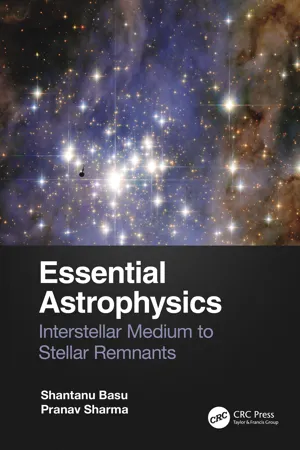
Essential Astrophysics
eBook - ePub

Essential Astrophysics

Interstellar Medium to Stellar Remnants

  1. 176 pages
  2. English
  3. ePUB (mobile friendly)
  4. Available on iOS & Android
eBook - ePub

Essential Astrophysics

Interstellar Medium to Stellar Remnants

About this book

This book takes a reader on a tour of astronomical phenomena: from the vastness of the interstellar medium, to the formation and evolution of stars and planetary systems, through to white dwarfs, neutron stars, and black holes, the final objects of the stellar graveyard. At its heart, this book is a journey through the evolutionary history of the birth, life, and death of stars, but detours are also made to other related interesting topics.

This highly accessible story of the observed contents of our Galaxy includes intuitive explanations, informative diagrams, and basic equations, as needed. It is an ideal guide for undergraduates with some physics and mathematics background who are studying astronomy and astrophysics. It is also accessible to interested laypeople, thanks to its limited equations.

Key features:

  • Includes coverage of some of the latest exciting research from the field, including star formation, exoplanets, and black holes
  • Can be utilised as a stand-alone textbook for a one-term course or as a supplementary textbook for a more comprehensive course on astronomy and astrophysics
  • Authored by a team respected for research, education, and outreach

Shantanu Basu is an astrophysicist and a professor at The University of Western Ontario, Canada. He is known for research contributions on the formation of gravitationally-collapsed objects in the universe: stars, planets, brown dwarfs, and supermassive black holes. He is one of the originators of the migrating embryo scenario of episodic accretion onto young stars. He has been recognized for his teaching excellence and his contributions to the astronomical community include organizing many conferences and training schools.

Pranav Sharma is an astronomer and science historian known for his work on the history of the Indian Space Program. He has curated the Space Museum at the B. M. Birla Science Centre (Hyderabad, India). He is in-charge of the history of Indo-French scientific partnership project supported by the Embassy of France in India. He is a national-award-winning science communicator and has extensively worked on the popularization of astronomy education in India.

Information

Publisher
CRC Press
Year
2021
Print ISBN
9781032105635
9780367768478
eBook ISBN
9781000455526

CHAPTER 1

Introduction

DOI: 10.1201/9781003215943-1

1.1 OVERVIEW

We live on a planet that was formed in a swirling disk of matter around a star that was born in a stellar cluster birthed from a massive interstellar gas cloud. This book traces a path from interstellar matter to star-disk-planet systems and the evolution of the stars that ultimately leads to stellar remnants such as white dwarfs, neutron stars, and black holes.
This story plays out within the confines of our Galaxy, a swirling disk and halo of stars and gas, shown schematically in Figure 1.1. The gaseous disk contains majestic spiral arm patterns, and there are additional components to the interstellar medium, e.g., a large-scale magnetic field and fast-moving charged particles known as cosmic rays. Indirect evidence also implies a much larger Galactic halo of invisible dark matter that contains more mass than all the visible components.
Figure 1.1
Figure 1.1 An illustration of the visible components of our Galaxy. The Sun is located in an outer part of the Galactic disk that is characterized by majestic spiral arms. There is also a bulge of stars near the center, as well as a large sphere-like halo of stars that includes the dense globular star clusters.
The Sun and its associated solar system occupy the middle suburbs of the Galaxy, orbiting the center at a radius of about 8 kpc. The solar system itself has a disk-like structure, but its plane is tilted relative to that of the Galaxy by a remarkable 60.2∘. Nature refuses to give us the simplicity of alignment! The Earth's equator is also tilted relative to the ecliptic, by 23.4∘. Viewed from the Earth, we see all stars, planets, galaxies, gas clouds, etc. occupying a fixed or changing position, as the case may be, on an imaginary celestial sphere that envelops the Earth. Positions are measured on the celestial sphere using coordinates of declination (δ) and right ascension (α) that are counterparts to latitude and longitude, respectively, that are used on the Earth's surface. The celestial equator is an imaginary circle that is the projection of the Earth's equator onto the celestial sphere. Figure 1.2 illustrates the concept of the celestial sphere.
Figure 1.2
Figure 1.2 An illustration of the celestial sphere. The north celestial pole and south celestial pole are located at the extensions of the Earth's north and south pole, respectively. The celestial equator is the great circle that is in the plane defined by the Earth's equator. An hour circle is any great circle that runs through both the north and south celestial poles. The vernal equinox (\vernal) is located at the intersection of the ecliptic and the celestial equator that the Sun crosses once each year while moving into the northern celestial hemisphere. The position of a celestial object (approximately fixed for stars but moving for the Sun, Moon, and planets) can be identified by a declination δ that is the angle above the celestial equator as measured along its hour circle and a right ascension α that is the angle along the celestial equator measured relative to a different hour circle that passes through the vernal equinox.
Figure 1.3 illustrates three great circles on the celestial sphere and the planes that they define. These circles are the celestial equator, the ecliptic (the circle followed by the Sun in its yearly ...

Table of contents

  1. Cover
  2. Half Title
  3. Title Page
  4. Copyright Page
  5. Contents
  6. List of Figures
  7. Preface
  8. CHAPTER 1 ▪ Introduction
  9. CHAPTER 2 ▪ The Interstellar Medium
  10. CHAPTER 3 ▪ Star Formation
  11. CHAPTER 4 ▪ Stars
  12. CHAPTER 5 ▪ Stellar Evolution
  13. CHAPTER 6 ▪ Stellar and Planetary Systems
  14. CHAPTER 7 ▪ Stellar Remnants
  15. Bibliography
  16. Index

Trusted by 375,005 students

Access to over 1.5 million titles for a fair monthly price.

Study more efficiently using our study tools.

Frequently asked questions

Yes, you can cancel anytime from the Subscription tab in your account settings on the Perlego website. Your subscription will stay active until the end of your current billing period. Learn how to cancel your subscription
No, books cannot be downloaded as external files, such as PDFs, for use outside of Perlego. However, you can download books within the Perlego app for offline reading on mobile or tablet. Learn how to download books offline
Perlego offers two plans: Essential and Complete
  • Essential is ideal for learners and professionals who enjoy exploring a wide range of subjects. Access the Essential Library with 800,000+ trusted titles and best-sellers across business, personal growth, and the humanities. Includes unlimited reading time and Standard Read Aloud voice.
  • Complete: Perfect for advanced learners and researchers needing full, unrestricted access. Unlock 1.5M+ books across hundreds of subjects, including academic and specialized titles. The Complete Plan also includes advanced features like Premium Read Aloud and Research Assistant.
Both plans are available with monthly, semester, or annual billing cycles.
We are an online textbook subscription service, where you can get access to an entire online library for less than the price of a single book per month. With over 1.5 million books across 990+ topics, we’ve got you covered! Learn about our mission
Look out for the read-aloud symbol on your next book to see if you can listen to it. The read-aloud tool reads text aloud for you, highlighting the text as it is being read. You can pause it, speed it up and slow it down. Learn more about Read Aloud
Yes! You can use the Perlego app on both iOS and Android devices to read anytime, anywhere — even offline. Perfect for commutes or when you’re on the go.
Please note we cannot support devices running on iOS 13 and Android 7 or earlier. Learn more about using the app
Yes, you can access Essential Astrophysics by Shantanu Basu,Pranav Sharma in PDF and/or ePUB format, as well as other popular books in Physical Sciences & Astronomy & Astrophysics. We have over 1.5 million books available in our catalogue for you to explore.