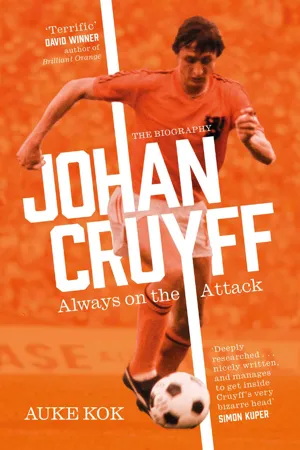
Johan Cruyff: Always on the Attack
eBook - ePub

Johan Cruyff: Always on the Attack

  1. 400 pages
  2. English
  3. ePUB (mobile friendly)
  4. Available on iOS & Android
eBook - ePub

Johan Cruyff: Always on the Attack

About this book

'This terrific biography...well-researched, well written' David Winner
'Deeply researched...nicely written, and manages to get inside Cruyff's very bizarre head' Simon Kuper Argumentative, brilliant, arrogant, visionary. Johan Cruyff was one of the greatest footballers of all time, a worldwide phenomenon and arguably the most famous Dutchman of the twentieth century. Both on the pitch and from the sidelines as a coach, with his brand of Total Football he changed how the game was played and left a lasting legacy. Although Cruyff led a large part of his illustrious career and life in the spotlight, in many ways Cruyff the man and sportsman is still a complete mystery.Based on years of extensive research, this biography the first to cover all aspects of Cruyff's life and work, from his key influence in the greatAjax and Netherlands sides of the 1970sto his role in creating the modern footballing phenomenon that isBarcelona. Drawing on hundreds of interviews with friends from his childhood and school, coaches, teammates, on-pitch opponents, business associates and family members, Auke Kok has written thedefinitivebiography of the skinny impish street footballer that became the genius player, inspirational manager, football philosopher and commercial pioneer that was Johan Cruyff.
Frequently asked questions

Yes, you can cancel anytime from the Subscription tab in your account settings on the Perlego website. Your subscription will stay active until the end of your current billing period. Learn how to cancel your subscription.
No, books cannot be downloaded as external files, such as PDFs, for use outside of Perlego. However, you can download books within the Perlego app for offline reading on mobile or tablet. Learn more here.
Perlego offers two plans: Essential and Complete
  • Essential is ideal for learners and professionals who enjoy exploring a wide range of subjects. Access the Essential Library with 800,000+ trusted titles and best-sellers across business, personal growth, and the humanities. Includes unlimited reading time and Standard Read Aloud voice.
  • Complete: Perfect for advanced learners and researchers needing full, unrestricted access. Unlock 1.4M+ books across hundreds of subjects, including academic and specialized titles. The Complete Plan also includes advanced features like Premium Read Aloud and Research Assistant.
Both plans are available with monthly, semester, or annual billing cycles.
We are an online textbook subscription service, where you can get access to an entire online library for less than the price of a single book per month. With over 1 million books across 1000+ topics, we’ve got you covered! Learn more here.
Look out for the read-aloud symbol on your next book to see if you can listen to it. The read-aloud tool reads text aloud for you, highlighting the text as it is being read. You can pause it, speed it up and slow it down. Learn more here.
Yes! You can use the Perlego app on both iOS or Android devices to read anytime, anywhere — even offline. Perfect for commutes or when you’re on the go.
Please note we cannot support devices running on iOS 13 and Android 7 or earlier. Learn more about using the app.
Yes, you can access Johan Cruyff: Always on the Attack by Auke Kok in PDF and/or ePUB format. We have over one million books available in our catalogue for you to explore.

Information

Print ISBN
9781398501676
eBook ISBN
9781398501669

CHAPTER ONE What do we do with Johan?

In the sporting goods shop where he worked, because a 15-year-old has to do something, they knew him as a quiet, rather unhappy-looking boy. He was working because he had not been a success at school, and he wasn’t making tremendous headway with this first job either. Johan Cruyff had work to do, but that was probably the most positive thing to be said about his time at Perry van der Kar. At its branch on the Ceintuurbaan in Amsterdam there was a strict hierarchy, and for a stockroom employee that was discouraging. Johan was an assistant. The cleaner was the only person lower down the pecking order. There was no sign of the training as a sales clerk that he’d been promised.
He’d started in January 1963, during the coldest winter in living memory, when snowstorms lashed past the shop and the nearby River Amstel was frozen over for weeks. There was barely a chance for Johan to enjoy skating, or even to stare dreamily out of the window as he had done at school. In the basement he helped unpack deliveries from wholesalers: football kits and other sporting gear, toys, or casual wear for ladies and gents. Johan checked that the deliveries were in order, then attached price labels to items and put them on the correct shelves in the storeroom.
It was a sizeable shop, in a working-class neighbourhood of Amsterdam known as De Pijp, and he trudged back and forth from nine to five, up the stairs and down again. He was shut away in a world that bored him.
His index card in the employee records office reflects the position in which he found himself. The black-and-white photo shows a boy with a vulnerable, lacklustre look, suggesting a teenager who would rather be almost anywhere else. The photo also seems to illustrate the norms and values of his upbringing. As in his school photos, he looks clean and neat, in a buttoned-up shirt with an impeccable white collar, his sweater equally spotless, his shiny hair in a side parting. Despite his discomfort, there need be no doubt Johan was polite to the customers. On the street in Betondorp, the neighbourhood where he lived with his mother and his older brother Henny, he could be a show-off, even a pain in the neck, but at school he had generally shown respect for the teachers and here, in the largest sporting goods shop in the city, five storefronts wide, he was never heard to say a rude word. Or many other words either, in fact.
He looks into the photographer’s lens as a boy with slightly questioning eyes, in complete contrast to his reputation in the street where he lived and utterly different from the way the world would later come to know him.
Later. Fifteen-year-old Johan Cruyff must have wondered whether, in a social sense, there ever would be a ‘later’.
Three years before, the employment office, which gave careers advice to schoolchildren from quite a young age, had not been particularly positive about his chances. Johan had been held back in his first year at the Oosterpark ULO school and so had to leave. (ULO stood for uitgebreid lager onderwijs, or advanced primary education, and such schools were intended to turn out broadly educated workers and administrators for trade and industry.) Pupils were not allowed to repeat the first year. It seems this was sufficient reason for his mother to have him examined by a psychologist. At home he was restless and at school had clearly achieved little. So where to go from here? Vocational training perhaps? The careers advice department at the employment office came to the conclusion that Johan was ‘still too childlike’ to choose a specific path in life. ‘Careers in trade’, the report said, ‘or in the transport sector, or retail and warehousing’ might suit him. The same could not be said for technical occupations or precision work in general, since for those he lacked ‘patience, thoughtfulness, neatness and exactitude’. He definitely didn’t excel at languages either, but arithmetic came naturally to him. Mentally and physically, Johan was still ‘far from adult’, which possibly had to do with his playful and ‘emotional’ attitude. Unless he began concentrating more intensively on his schoolwork, his performance would remain below par. ‘He has the intellect to deal with the ULO material, if only he showed sufficient dedication.’
The impression that Johan had failed to apply himself to his studies is confirmed by his final report at primary school. Beside a list of many sixes out of ten, a seven (for arithmetic) and one nine (gymnastics) is written in firm strokes: ‘Johan can do better!’
Johan might well have been able to do better, but if so he cunningly hid the fact from the next set of teachers to take him on. Perhaps Nel Cruyff was still optimistic when in 1960 she registered her 13-year-old son at the W. Y. Bontekoe School. It was what was known as a vocational school, where manual skills and carpentry were a major part of the curriculum and where pupils often merely sat out their time until the end of compulsory schooling (at fourteen in those days). How often, if at all, Johan showed up there is unclear. At any rate, he made another fresh start a year later, after his fourteenth birthday, once more at a ULO school. Frankendael was a school where everything was highly structured, for children who found it hard to concentrate. His performance improved, but as at the Oosterpark ULO school he was fully present only during gym lessons.
The strict regime at the Frankendael school helped, and Johan made it into the second year. At last he met with success, although not of the kind the teachers were hoping for. ‘In class he was a quiet, self-contained boy,’ a classmate remembers. ‘You might easily overlook him. But after the weekend, if he’d done something remarkable at Ajax, a whole gaggle of children would cluster around him. He was the centre of attention then.’

At Christmas, after three and a half years of worry, encouragement and scolding, his mother decided to take him out of school. Three secondary schools, three failures: it was pointless to keep ploughing on.
For Nel Cruyff-Draaijer, a 45-year-old widow, this was a difficult time. But, fortunately, Ajax offered help. Since her husband’s death she had worked as a cleaner at the stadium and, on seeing that there were problems with Johan, the club officials put their heads together. That son of Nel’s was a terrific footballer, as everyone had known since he became a member at the age of ten, but the way things were going, he’d amount to nothing. So what now? What do we do with Johan?
Leo van der Kar knew the answer. The director of Perry van der Kar, a man as amiable as he was vain, from a Jewish family of merchants and diamond dealers, was on good terms with the board at Ajax. In the role of masseur he had kept the calf muscles of top athletes like Fanny Blankers-Koen supple, and since setting up his retail business he’d given jobs to skaters and footballers so that they had an income to facilitate their unsalaried sporting lives. Jopie, as Johan was called at the club, would be able to join them.
Leo van der Kar undoubtedly wanted the best for his youngest employee. Although Johan was clearly bored on the Ceintuurbaan, his monthly wage was raised as of 1 August 1963 from eighty guilders (roughly £8) – not bad in itself for a teenager with hardly any work experience – to a hundred. The new lad was also allowed to help the players of the Ajax first eleven in the shop on Saturdays, if they needed new football boots, say. He thought it was great just to be able to fetch the new boots from the shelves. Those immaculate laces! Those shiny steel studs! But after the men left, Johan had to go back down to his windowless basement.
The one promising thing in his life was a youth contract with Ajax, which he’d wheedled out of the club by his own efforts. Johan wanted to earn money by playing football and because in 1962 Ajax had not been willing to accommodate him, or not quickly enough as he saw it, he’d declared himself, as a 15-year-old, ready to go off and play in Amsterdam-Noord instead. There a club called De Volewijckers had held out the prospect of a new moped. The Ajax board managed to block that move at the last moment, but in that same period the English trainer of Ajax 1, Keith Spurgeon, was eager to take the budding talent with him to his new club, Blauw-Wit. All this tugging at Johan caused panic; the lad must of course stay at Ajax and so he was offered a ‘special youth contract’, as club chairman Jan Melchers would later cryptically call it. Special because his age was raised to sixteen. ‘Everyone in the club knew that story,’ says Johan’s teammate at the time, Hennie Heerland. ‘And everyone understood it too; it was Ajax’s way of helping a family that had fallen on hard times. But it wasn’t talked about.’
The rules of the Royal Dutch Football Association (KNVB) said that no young player could be paid until he reached the age of sixteen. That had been made very clear when paid youth football was introduced in 1961. The signature of Johan’s first youth contract caused problems at home as a result. Uncle Dirk, the brother of Johan’s late father, who had been appointed as his guardian, refused to go along with the faking of his age. Dirk’s daughter Dorie would never forget it, such was the impression made on her by her straitlaced father’s refusal to cross that particular moral boundary. With Dirk Cruyff, ‘no’ meant ‘no’, so if Johan was determined to persist he would have to look for a different guardian.
One was soon found. Barend Tak, also an uncle, married to Nel’s sister Riek, was less troubled by the deceit. Barend Tak was active in Ajax as a youth-team manager. A tough character, he lived a stone’s throw away from Nel in Betondorp. So it was that Johan’s youth contract came to be signed by Nel Cruyff and Barend Tak.
This first contract included a special clause. If Johan studied hard and got his ULO diploma, Ajax would pay him a bonus of 500 guilders, a considerable sum in those days. It showed how much importance the board, and especially his mother, attached to the creation of a broader social foundation for Johan than purely the scoring of goals – something he did with improbable regularity, incidentally. Despite the prospect of a generous reward, however, he continued to do little schoolwork.
On top of his wages from the sports shop he was now earning several tens of guilders a month by doing the one thing in the world that interested him. He was almost certainly the only 15-year-old Amsterdammer in possession of a football contract. Not for the first time, and certainly not for the last, an exception had been made for Jopie.

Ajax, and above all Johan’s mother, had reason to be worried. The chances of the boy being able to pay his own way in the long term by playing football were slim. He was short and skinny for his age, and he was often plagued by headaches. ‘He sometimes went about with an elastic band round his finger,’ his friend of those days Leo HappĂ© remembers. ‘His mother used to tell him it would take the pain away. He was sometimes sent to a doctor of alternative medicine, too.’ Nothing helped. The headaches, which probably had to do with his nervousness, kept coming back. He also had some kind of problem with his insteps. They were rather broad, which his doctor said had to do with weak muscles and flat feet. Add to that a lack of self-control and you would hardly think he was cut out for a career in sport, of whatever kind.
Even if Cruyff were to overcome his physical and mental limitations and mature into a professional footballer, how far might that get him? Life as a professional player in 1962 didn’t amount to much. Eight years after the introduction of paid football, the Netherlands still had not a single full-time professional. Players in the premier division – the Eredivisie – trained in the evenings. In the daytime they were reps, bookkeepers, insurance agents, barkeepers or builders. At Ajax, often called a tradesman’s club, many of the players ran shops. It seemed clear that once he passed the age of about thirty, Johan would find himself doing something like that. As a self-employed retailer of cigarettes or sporting goods, you could convert your local footballing fame into cash. Still, if that was what he wanted, he would need qualifications, diplomas, and he had none, aside from a certificate to say he had completed primary school, a swimming certificate and a road safety certificate.
Not even the country’s greatest postwar footballing heroes were able to live from the sport alone. The graceful forward Faas Wilkes, for instance, had earned serious money for a few years in Italy and Spain, but after living the good life, driving sports cars on the boulevards of southern Europe, he had to knuckle down as the owner of a clothes shop in Rotterdam. The legendary dribbler Abe Lenstra had never wanted to abandon the security of his job working for the Heerenveen local council. In 1962, by then in his early forties, Lenstra was still turning out for the Enschedese Boys, which soon afterwards merged into FC Twente. Later he became a brewery rep. Haarlem goal-getter Kick Smit, on whom, along with Wilkes and Lenstra, the cartoon strip character in Kick Wilstra was based (extremely popular when Cruyff was a boy), was likewise unable to earn enough through his footballing exploits. He spent his days as a sports teacher.
In short, a life built on his sporting talent alone did not look like a viable option for Johan. Everything that was expected of a footballer in the early 1960s – grit, modesty, quiet determination – was to be found in the big blond ball-heading Kick Wilstra, but apparently not in the restless stockroom employee from Betondorp.

Johan was quite often ill and his health did not improve when, as a young teenager, he took up smoking. If he was able to get outside for a moment during breaks at Perry van der Kar, he often went into Piet Ouderland’s tobacconist’s shop nearby in De Pijp. In the company of Ajax footballer Ouderland, Johan could briefly escape the boredom of stockroom work. He would chat and cadge cigarettes, and Ouderland – ‘Ought you to be doing that, lad? I don’t smoke myself, you know’ – gave him the smoking materials he asked for. Puffing away, Johan seemed to be trying to calm his nerves, a struggle that only grew worse.
At Ajax he was becoming more rebellious by the week. Shorts flapping round his matchstick legs, there was no sign of the shy shop worker of the Ceintuurbaan. That questioning look in the photo was not in evidence when he played with the B1 juniors at Ajax. Sometimes he coolly stubbed out a cigarette on the sole of his boots, and he would give referees lip as readily as he did his teammates. They often didn’t understand the game at all, he believed, and he told them so. During training Jopie talked almost incessantly. ‘Hey, Johan, try playing!’ youth coach Jany van der Veen often shouted at him. He would shut up for a bit then, but rarely for long. Van der Veen believed that Johan had everything it took to become a top-class player – everything except for the necessary discipline.
At Ajax they put a great deal of effort into Johan. Otherwise the lad would come to no good and that, of course, would be to the detriment of the club, which had no choice but to fine him, first five guilders, later ten guilders and later still, when the board began to get desperate, to make him write out fifty times, ‘I must behave myself during matches and always play fairly.’
Fifty times over, Johan promised to control himself and respect the codes of the sport, as if he was still at school. He closed with ‘Respectfully yours’ and his signature.

CHAPTER TWO Daddy’s boy

Johan often had the feeling he was living in a village. His home neighbourhood was called Betondorp, literally ‘concrete village’, and most of its street names referred to the countryside: Hooistraat, Graanstraat, Sikkelstraat. There was also the Akkerstraat (field street), around the corner from the Tuinbouwstraat (horticulture street), where Johan grew up, having been born in the local hospital, the Burgerziekenhuis. In this eastern corner of Amsterdam, across the road from the Ajax stadium, you could see farmland as soon as you got beyond the houses. Next to Betondorp was the Oosterbegraafplaats, a huge cemetery with tall trees, and all around was the green of sports fields, gardens, market gardens and woodland.
Yet Johan was a street boy. Between the low, rectilinear housing blocks of Betondorp were streets and pavements where restless youngsters like him could do as they pleased. There were hardly any cars and Johan didn’t need to ring any doorbells; via the backyards, people simply walked into each other’s houses. You might almost call the neighbourhood a paradise for children, since a great effort had been made, by socially engaged architects, to provide ‘light, air and space’, a ‘radical alternative’ to the often miserable living conditions of the overcrowded city.
It was for that reason that Nel and Manus Cruyff had left the cramped and poverty-stricken Amsterdam neighbourhood known as the Jordaan in December 1945 for this small, close-knit community. In recognition of their good deeds during the German occupation, they had been given the chance to move into Akkerstraat 32, a shop with living space that had lain empty for some time. The ground-floor apartment behind the shop could not be described as spacious, but they made it a happy home. Their first child, Henny, born on 11 December 1944, during what has gone down in history as the Hunger Winter, would grow up healthier there than in the Eerste Lindendwarsstraat, where Nel and Manus had sold potatoes and vegetables ever since they were married in 1941. Like the Jordaan, Betondorp had a shop on almost every corner, and with the arrival of the Cruyffs there were now four greengrocers. But although Nel and Manus’s shop was modest, by working hard they were able to make a living from it. They both put in long days. There was no money to hire staff.
When, at one in the afternoon of 25 April 1947, the family rejoiced at the arrival of their second child, Hendrik Johannes, known as Johan, the municipal social services department sent a teenage girl to help with the housework. Babysitter Etty cooked and mashed the brown beans for Henny and bottle-fed Johan so that Manus and Nel were free to serve customers.
Etty had a tough time of it in the Akkerstraat. Henny was not the quietest of children and Johan was out-and-out boisterous. They were both adventurous, a fact that had already cost the life of a kitten. The scene of the crime was a milk boiler, a tall pan with holes in the lid in case the milk frothed up too high. It was used to sterilise milk and toddler Johan wanted to see what would happen if you put a kitten in the hot milk. A horrified Etty intervened, but not in time to save the poor cre...

Table of contents

  1. Cover
  2. Title Page
  3. Epigraph
  4. Foreword
  5. Chapter One: What Do We Do with Johan?
  6. Chapter Two: Daddy’s Boy
  7. Chapter Three: A Special Case
  8. Chapter Four: The Debut
  9. Chapter Five: Go Easy on Johan
  10. Chapter Six: A Hitting Motion
  11. Chapter Seven: Gadabout of the Leidseplein
  12. Chapter Eight: Pig-headed, Egotistical and Contrary
  13. Chapter Nine: ‘We’re Just Going to Buy Two Rings’
  14. Chapter Ten: Loner in the team
  15. Chapter Eleven: How Cruyff Became a Coster
  16. Chapter Twelve: A Rebel?
  17. Chapter Thirteen: Everything Went Smoothly with Number 14
  18. Chapter Fourteen: ‘Doctor, I Feel So Tired’
  19. Chapter Fifteen: The Best in the World
  20. Chapter Sixteen: Jealousy
  21. Chapter Seventeen: Just Ring Barcelona
  22. Chapter Eighteen: And Everything Grew Qarm
  23. Chapter Nineteen: A Global Star
  24. Chapter Twenty: It Was No Longer Going So Well
  25. Chapter Twenty-One: More than a Footballer
  26. Chapter Twenty-Two: Johan Would Go Into Business in a Big Way
  27. Chapter Twenty-Three: Lifted Up by the Greatness of America
  28. Chapter Twenty-Four: Only Cruyff Would Dare
  29. Chapter Twenty-Five: A Magical Self-image
  30. Chapter Twenty-Six: Super-consistent
  31. Chapter Twenty-Seven: Playful Dictator
  32. Chapter Twenty-Eight: Enjoying and Suffering
  33. Chapter Twenty-Nine: Man of God and of Humankind
  34. Chapter Thirty: Probably Immortal
  35. Photographs
  36. Acknowledgements
  37. Sources and Bibliography
  38. Index
  39. Copyright