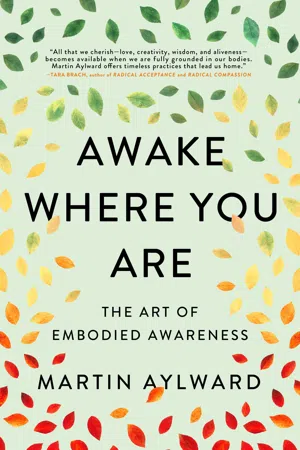
Awake Where You Are
eBook - ePub

Awake Where You Are

The Art of Embodied Awareness

  1. 232 pages
  2. English
  3. ePUB (mobile friendly)
  4. Available on iOS & Android
eBook - ePub

Awake Where You Are

The Art of Embodied Awareness

About this book

The body is of course integral to meditation, but there are only a few books that focus this specifically on the body and the meditative experience. Awake Where You Are addresses that need, and additionally integrates psychological concepts, whichprovides a more familiar entry point for people less familiar with Buddhism. "Embodied awareness is the way back home—intimacy with where and how we are right now, with what is happening and how we are meeting it. My intention is to lead you into the heart of your life. Inside your body, where everything happens—within a quality of listening rather than knowledge, of feeling rather than reaction. This meditative practice is radically transformative."
—Martin Aylward Pulled around by desires and distractions, we're so easily disconnected from ourselves. Life is happening right in front of us, and within us—but still, we manage to miss so much of it. Awake Where You Are provides the antidote, inviting us to go deep into our own bodies, to inhabit our sensory experience carefully; to learn the art of living from the inside out, and in the process to find ease, clarity, and an authentic, unshakeable freedom. The practices in the book literally bring us back into our skin, where we can reconnect with a more rich, meaningful, and peaceful life. Aylward writes with sophisticated subtlety, as well as the heart-opening simplicity and clarity born of deep experience. And this book is more than a meditation guide—it's a guide to living an embodied life. You'll learn about the following areas and practices:
- Understanding and liberating our primal human drives. Aylward explains how the three primary drives—survival, sexual, and social—function within us, and how we can engage their energy to explore, understand, and liberate them.
- Integrating psychological understanding with meditative practice. Awake Where You Are goes beyond the broad brushstrokes of Buddhist psychology, inviting the reader into an exploration of their own particular psychological history and conditioning.
- Investigating the nuances of love. Readers will learn to see the classical Buddhist heart qualities, or brahmaviharas (loving-kindness, compassion, appreciative joy, and equanimity) as distinct flavors of love, and as the natural resting places of a free heart. "Martin is a marvelous teacher and offers us the refreshing wisdom of an embodied life."
— Jack Kornfield, author of No Time Like the Present
Frequently asked questions

Yes, you can cancel anytime from the Subscription tab in your account settings on the Perlego website. Your subscription will stay active until the end of your current billing period. Learn how to cancel your subscription.
No, books cannot be downloaded as external files, such as PDFs, for use outside of Perlego. However, you can download books within the Perlego app for offline reading on mobile or tablet. Learn more here.
Perlego offers two plans: Essential and Complete
  • Essential is ideal for learners and professionals who enjoy exploring a wide range of subjects. Access the Essential Library with 800,000+ trusted titles and best-sellers across business, personal growth, and the humanities. Includes unlimited reading time and Standard Read Aloud voice.
  • Complete: Perfect for advanced learners and researchers needing full, unrestricted access. Unlock 1.4M+ books across hundreds of subjects, including academic and specialized titles. The Complete Plan also includes advanced features like Premium Read Aloud and Research Assistant.
Both plans are available with monthly, semester, or annual billing cycles.
We are an online textbook subscription service, where you can get access to an entire online library for less than the price of a single book per month. With over 1 million books across 1000+ topics, we’ve got you covered! Learn more here.
Look out for the read-aloud symbol on your next book to see if you can listen to it. The read-aloud tool reads text aloud for you, highlighting the text as it is being read. You can pause it, speed it up and slow it down. Learn more here.
Yes! You can use the Perlego app on both iOS or Android devices to read anytime, anywhere — even offline. Perfect for commutes or when you’re on the go.
Please note we cannot support devices running on iOS 13 and Android 7 or earlier. Learn more about using the app.
Yes, you can access Awake Where You Are by Martin Aylward in PDF and/or ePUB format, as well as other popular books in Personal Development & Mental Health & Wellbeing. We have over one million books available in our catalogue for you to explore.

1

This Human Body

images
Who feels it knows it, Lord.
— BOB MARLEY

THE HUMAN CONDITION

Life is unreliable. Pain is unavoidable. All we accumulate we will lose, and all those we love will disappoint us and disappear from our lives — if we don’t go first. We have a frustrating lack of control over what experience comes our way and how we react to it. It is not easy, this human life.
And yet we feel it should be easier.
We succumb to the delusion that others have it easy, imagining our friends or colleagues have somehow figured things out that we haven’t. I so well remember feeling insecure or confused and that I should be different. As if my life could be perfect, if only I could be perfect. (No pressure!) And of course, nobody anywhere has ever managed that — and yet we keep on trying as if it were possible, exhausting ourselves in the process.
Recognizing this truth is quite relieving. All the while I imagine I should have it all figured out, that I ought to be more successful, more attractive, or more intelligent, I can’t help but feel there is something wrong with me. And then of course, there must be someone to blame. Surely it is someone’s fault that my life doesn’t correspond to my idealized version of it. (My fault? My parents? God’s? Those are, after all, the usual suspects). But human life is complex and unpredictable. When we see that life cannot possibly meet our exact wishes and preferences, we relax. We begin to forgive our human frailties and failings and to treat ourselves more gently.
We allow ourselves to be less than perfect.
In this relief, we find that imperfection is completely natural — that it is the inherent nature of having a human life. We move from reaching for perfection, to bathing in the relief at imperfection. The chef at Moulin de Chaves, the meditation retreat center where I live and teach in Southwest France, once wrote on the fridge door, quoting me from a teaching I had just given, “Freedom of being is the absence of anxiety about imperfection.” She thought it was a wipeable marker, but it turned out to be indelible ink and lasted several years. Eventually however, even “permanent” ink succumbs to the infallibility of impermanence.

LOST IN THOUGHT

A journalist visiting the monastery of my early teacher Ajahn Buddhadasa asked him how he would describe the state of humanity. Ajahn’s reply was, “Lost in thought.”
That is the default condition for most of us, most of the time. Like James Joyce’s Mr. Duffy, who “lived a short distance from his body,” we are caught up in abstraction, reaction, and interpretation — lost in ideas rather than immersed in life’s immediacy. We tell ourselves and each other stories about our experience (increasingly documented on Instagram or Facebook) rather than really inhabiting it. We are tense in ways we barely notice — leaving ourselves and losing ourselves until we don’t know any different.
Embodied awareness is the way back home — intimacy with where and how we are right now, with what is happening and how we are meeting it. Ease and intimacy with ourselves is not only possible, it is our most natural state. Yet having spent decades developing our inner discourse, we find ourselves quite attached to it. We could blame our habitually distracted state on “modern life,” and maybe particularly on the internet and the screens that increasingly fill both our work lives and leisure time. We could speculate about how disembodiment is a byproduct of increasingly urban lives and our subsequent estrangement from the natural world. But disconnection is nothing new. The habit of losing ourselves in drama and detail is as old as humanity, developing as language and culture developed, growing as the very human capacity for thought and abstraction itself grew.
We are Homo sapiens sapiens, beings that know that we know, that can not only experience life, but also describe our experience, refer to our experience — and abstract our experience.
So how do you come back to yourself and be at home in your experience? How do you meet the world without leaving yourself?

RELAX . . . AND BE ATTENTIVE

More than twenty-five centuries ago, Buddha was already pointing at how we get lost in thought and inviting us to come back. After years of ascetic practices, trying to “transcend” his body but weakening and abusing it in the process, he changed his approach after remembering resting in the shade of a tree as a teenager. He recalled both the ease and relaxation of being at home in his own skin and the alertness as he let his surroundings meet his senses. These two qualities woke him up to this essence of skillful attention: relaxing into bodily experience and being attentive to what arises.
Most of the ways we know to relax involve some way of going unconscious (having a drink, watching TV, taking a nap). And most ways we know how to focus or concentrate involve some sense of strain. We furrow our brow, screw up our face, concentrate “hard” on something we are doing. Relaxation and focus seem like opposites — if we relax, we are unfocused. If we focus, we are not relaxed.
Yet relaxation and focus can (and in meditative awareness need to) go together. In sports we call it being “in the zone.” There is something deeply compelling about watching an athlete who is both totally committed and absorbed, yet also relaxed, graceful, effortless. Roger Federer is an exquisite example. Skilled musicians also show us this, focused on the melody, the rhythm, the technique, while also completely absorbed in the mood and pleasure of the music.
Sports and music show us the possibility of simultaneous relaxation and focus. Meditative awareness, though, differs in several important ways.
First, there is neither action nor goal into which these qualities are poured. In meditation we relax into and focus on simply being here — on what arises naturally rather than on what we are doing or creating. There is nothing to accomplish, nothing that should happen. We are entering into what is without trying to get anywhere. Hence the classic meditation adage: Nothing to do, nowhere to go, no one to be.
Second, athletes and musicians’ attention is being held by strong stimuli (the running, the tennis match, the song being sung or played). Intensity attracts attention easily (people at the movies have no trouble sitting down and focusing for a couple of hours). But in meditation we are entering into the most ordinary and uncompelling elements of experience — the breathing body, sensations, and sounds. Attending to these nonstimulating elements trains the attention: it becomes steadier, subtler, more penetrating.
A third difference is that we are exploring experience for the purpose of wisdom. We meditate to be awake to the nature of experience, to see reality clearly, to understand ourselves and life in a way that is freeing. This makes meditation distinctly different from other absorbing activities. Some will say “Dance is my meditation,” or “Painting is my meditation, because I get absorbed in it. I forget myself and feel one with the music, the painting, the world.” That is beautiful — but it is not transformational meditation. The main feature of a transformational meditative practice is not to attain an absorption state — the main feature is wisdom. We meet experience deeply not just to feel it, but to understand our relationship to it, and in doing so to let go of the drama and tension we habitually create.
Most of us are so used to holding certain tension patterns that we don’t notice them. A friend of mine was giving someone a massage, and when she lifted the person’s arm, it just stayed there, stiffly. “Relax,” she said. “I am relaxed,” he replied (stiffly!). “What about your arm?” she asked. And then, of course, he could feel it and soften the muscles there. When attention goes somewhere, then we notice. Once we feel and understand the tension, we can soften it.
Check in right now as you are reading this.
How are the muscles in your face? Your shoulders?
If there are tensions, see if they can soften. And as you continue reading, see if you can do so while continuing to sense into bodily life.
In meditation, relaxation and focus support and enhance each other. The more we focus, the more we feel tensions and can relax them. The more we relax, the more conscious we are, and the more we notice. We become aware of subtle tensions and can let them soften, deepening the relaxation and the depth of contact with our experience, which in turn allows us to find other “nonrelaxed” zones. As well as muscular tensions we start to find energetic knots, psychological blockages, emotional holding, and more. There seems to be literally no limit to our capacity to both focus and relax. And our bodily experience is the ground for this whole exploration.
Cultivating both focus and relaxation, we meet experience more fully. We start to taste the truth of one of my favorite statements of the Buddha, one which in some ways gives us the thread and flow of this whole book:
The entire universe
arises and passes
right here
in this body.

EMBODIED ATTENTION

How important, then, that we learn to be right here, in this body! If the whole universe is showing up right here, what a tragedy if I keep missing it through the endless involvement in my own drama. Embodied awareness is the essence of meditation. Body and consciousness cannot be separated — a human body is a conscious body. Take the consciousness away and you have . . . a corpse, a lump of rotting flesh. No consciousness, no body.
If you want to be really at home in your skin, you have to embody your experience. Listening not only with your ears but with your whole being, with your cells. Listening to your sensory life closely, with care, as if to a new language — one of sensation, energy, density and space, mood and feeling, tension and relaxation.
What might that be like, right now? Reading these pages, what is it like to be sitting here? Let your attention drop for a moment into the felt sense of your experience, just as it is. Feel your lower body, and the density of sensation caused by the pressure of your buttocks and thighs on the seat, the cushion, chair, or floor.
Take your time with this. Relax into it. Feel along your arms. Feel your hands holding this book. How much tension is required to keep holding it? Obviously some, or it will drop from your grip. But are there any extra, unnecessary tensions involved? Some habitual tendency to hold yourself a little more tightly than necessary? To draw yourself into the familiar knot of self? And if so, might it soften, even a little?
Can you taste the softening? Feel the ease of letting unnecessary tension drop? Can you let focus and relaxation come together, right now? Sensing your experience, feeling what it is like — letting yourself relax.
What about your face? We often hold tension around the eyes or in the jaw. As you explore, feel from the inside. Invite everything to relax, but without demanding, without expecting any particular result.
See if you can settle a little more fully into the felt experience of sitting here, reading these words, meeting life from inside experience.

INSIDE EXPERIENCE

In the old Buddhist texts, evocative language points us clearly into the intimacy of meditative awareness. The texts distinguish clearly between embodied (yoniso) and disembodied (ayoniso) attention (manisikara).
If you are familiar with yogic tradition and language, you may recognize yoni* as meaning “vagina,” though here it more precisely means “womb.” Embodied attention, then, is literally “from the womb” — that is, grounded down in the lower belly. While mostly our attention is disembodied, disconnected, cut off from the visceral immediacy of our lives, here we are asked to inhabit our center of gravity, to be awake in our womb. Those without the certain female organs may be feeling left out here, but we are talking about an energetic womb, not a biological one — felt as the deepest place in us. The womb is the source of life both literally (we all come directly from the womb)and energetically; this is the center of embodied, or we might say em-bellied, attention.
A woman of about thirty-five, a successful academic with a busy mind, was on retreat with me recently. We explored together how she could drop her attention down into her lower body, using her breathing to settle her attention in her abdomen. Initially she felt nothing, and so I encouraged her to rest he...

Table of contents

  1. Cover Page
  2. Title Page
  3. Contents
  4. Acknowledgments
  5. Introduction: A Journey to Inner Space
  6. 1. This Human Body
  7. 2. The Uncomfortable Body
  8. 3. The Instinctual Body
  9. 4. The Psychological Body
  10. 5. An Awakening Body
  11. 6. This Collective Body
  12. 7. This Body of Love
  13. 8. This Body, This World
  14. 9. This Dying Body
  15. Afterword: A Free Body
  16. Index
  17. About the Author
  18. Copyright