The perfect starting point for your journey into Scala and functional programming.
Summary
In Get Programming in Scala you will learn:
Object-oriented principles in Scala
Express program designs in functions
Use types to enforce program requirements
Use abstractions to avoid code duplication
Write meaningful tests and recognize code smells
Scala is a multi-style programming language for the JVM that supports both object-oriented and functional programming. Master Scala, and you'll be well-equipped to match your programming approach to the type of problem you're dealing with. Packed with examples and exercises, Get Programming with Scala is the perfect starting point for developers with some OO knowledge who want to learn Scala and pick up a few FP skills along the way.
About the technology
Scala developers are in high demand. This flexible language blends object-oriented and functional programming styles so you can write flexible, easy-to-maintain code. Because Scala runs on the JVM, your programs can interact seamlessly with Java libraries and tools. If you’re comfortable writing Java, this easy-to-read book will get you programming with Scala fast.
About the book
Get Programming with Scala is a fast-paced introduction to the Scala language, covering both Scala 2 and Scala 3. You’ll learn through lessons, quizzes, and hands-on projects that bring your new skills to life. Clear explanations make Scala’s features and abstractions easy to understand. As you go, you’ll learn to write familiar object-oriented code in Scala and also discover the possibilities of functional programming.
What's inside
Apply object-oriented principles in Scala
Learn the core concepts of functional programming
Use types to enforce program requirements
Use abstractions to avoid code duplication
Write meaningful tests and recognize code smells
About the reader
For developers who know an OOP language like Java, Python, or C#. No experience with Scala or functional programming required.
About the author
Daniela Sfregola is a Senior Software Engineer and a Scala user since 2013. She is an active contributor to the Scala Community, a public speaker at Scala conferences and meetups, and a maintainer of open-source projects.
Table of Contents
Unit 0 HELLO SCALA!
Unit 1 THE BASICS
Unit 2 OBJECT-ORIENTED FUNDAMENTALS
Unit 3 HTTP SERVER
Unit 4 IMMUTABLE DATA AND STRUCTURES
Unit 5 LIST
Unit 6 OTHER COLLECTIONS AND ERROR HANDLING
Unit 7 CONCURRENCY
Unit 8 JSON (DE)SERIALIZATION
- 560 pages
- English
- ePUB (mobile friendly)
- Available on iOS & Android
eBook - ePub
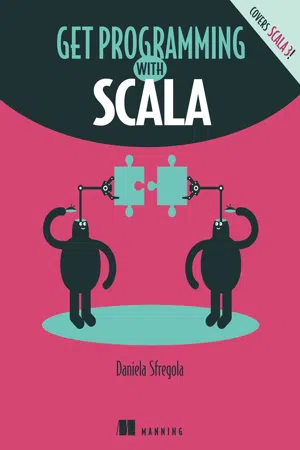
Get Programming with Scala
About this book
Information
Subtopic
Object Oriented ProgrammingIndex
Computer ScienceTable of contents
- inside front cover
- Get Programming with Scala
- Copyright
- dedication
- Contents
- front matter
- Unit 0. Hello Scala!
- 1 Why Scala?
- 2 The Scala environment
- 3 Scala Build Tool (sbt)
- Unit 1. The Basics
- 4 Values and variables
- 5 Conditional constructs and loops
- 6 Function as the most fundamental block of code
- 7 Classes and subclasses to represent the world
- 8 The vending machine
- Unit 2. Object-oriented fundamentals
- 9 Import and create packages
- 10 Scope your code with access modifiers
- 11 Singleton objects
- 12 Traits as interfaces
- 13 What time is it?
- Unit 3. HTTP server
- 14 Pattern matching
- 15 Anonymous functions
- 16 Partial functions
- 17 HTTP API with http4s
- 18 The time HTTP server
- Unit 4. Immutable data and structures
- 19 Case classes to structure your data
- 20 Higher order functions
- 21 What is purity?
- 22 Option
- 23 Working with Option: map and flatMap
- 24 Working with Option: For-comprehension
- 25 Tuple and unapply
- 26 Rock, Paper, Scissors, Lizard, Spock!
- Unit 5. List
- 27 List
- 28 Working with List: map and flatMap
- 29 Working with List: Properties
- 30 Working with List: Element selection
- 31 Working with List: Filtering
- 32 Working with List: Sorting and other operations
- 33 The movies dataset
- Unit 6. Other collections and error handling
- 34 Set
- 35 Working with Set
- 36 Map
- 37 Working with Map
- 38 Either
- 39 Working with Either
- 40 Error handling with Try
- 41 The library application
- Unit 7. Concurrency
- 42 Implicit and type classes
- 43 Future
- 44 Working with Future: map and flatMap
- 45 Working with Future: For-comprehension and other operations
- 46 Database queries with Quill
- 47 The quiz application: Part 1
- Unit 8. JSON (de)serialization
- 48 JSON (de)serialization with circe
- 49 Lazy evaluation
- 50 The IO type
- 51 Working with the IO type
- 52 Testing with ScalaTest
- 53 The quiz application: Part 2
- Index
- inside back cover
Trusted by 375,005 students
Access to over 1.5 million titles for a fair monthly price.
Study more efficiently using our study tools.
Frequently asked questions
Yes, you can cancel anytime from the Subscription tab in your account settings on the Perlego website. Your subscription will stay active until the end of your current billing period. Learn how to cancel your subscription
No, books cannot be downloaded as external files, such as PDFs, for use outside of Perlego. However, you can download books within the Perlego app for offline reading on mobile or tablet. Learn how to download books offline
Perlego offers two plans: Essential and Complete
- Essential is ideal for learners and professionals who enjoy exploring a wide range of subjects. Access the Essential Library with 800,000+ trusted titles and best-sellers across business, personal growth, and the humanities. Includes unlimited reading time and Standard Read Aloud voice.
- Complete: Perfect for advanced learners and researchers needing full, unrestricted access. Unlock 1.5M+ books across hundreds of subjects, including academic and specialized titles. The Complete Plan also includes advanced features like Premium Read Aloud and Research Assistant.
We are an online textbook subscription service, where you can get access to an entire online library for less than the price of a single book per month. With over 1.5 million books across 990+ topics, we’ve got you covered! Learn about our mission
Look out for the read-aloud symbol on your next book to see if you can listen to it. The read-aloud tool reads text aloud for you, highlighting the text as it is being read. You can pause it, speed it up and slow it down. Learn more about Read Aloud
Yes! You can use the Perlego app on both iOS and Android devices to read anytime, anywhere — even offline. Perfect for commutes or when you’re on the go.
Please note we cannot support devices running on iOS 13 and Android 7 or earlier. Learn more about using the app
Please note we cannot support devices running on iOS 13 and Android 7 or earlier. Learn more about using the app
Yes, you can access Get Programming with Scala by Daniela Sfregola in PDF and/or ePUB format, as well as other popular books in Computer Science & Object Oriented Programming. We have over 1.5 million books available in our catalogue for you to explore.