The idea that God, understood as the most perfect being, must create the best possible world is often underacknowledged by contemporary theologians and philosophers of religion. This book clearly demonstrates the rationale for what Justin J. Daeley calls Theistic Optimism and interacts with the existing literature in order to highlight its limitations. While locating Theistic Optimism in the thought of Gottfried Leibniz, Daeley argues that Theistic Optimism is consistent with divine freedom, aseity, gratitude, and our typical modal intuitions. By offering plausible solutions to each of the criticisms levelled against Theistic Optimism, he also provides a vigorous and original defence against the charge that it deviates from the Christian tradition.
Engaging with both the Christian tradition and contemporary theologians and philosophers, Why God Must Do What is Best positions the idea of Theistic Optimism firmly within the language of contemporary philosophy of religion.
eBook - ePub
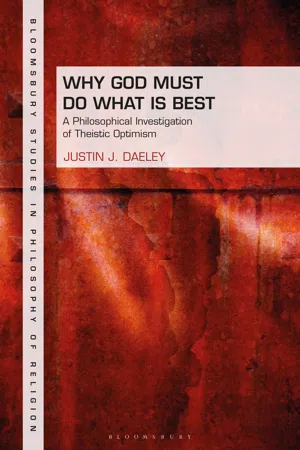
Why God Must Do What is Best
A Philosophical Investigation of Theistic Optimism
- 208 pages
- English
- ePUB (mobile friendly)
- Available on iOS & Android
eBook - ePub
About this book
Information
1
Introduction
1.1 Orientation
This book is a study of what I call Theistic Optimism. Unsurprisingly, Theistic Optimism is the conjunct of theism and optimism, such that the latter claims there not only is an optimal among a set of alternatives but also that the optimal invariably wins out. According to optimism, then, things exist, and exist as they do, because the best must be actual. The theistic element, on the other hand, emphasizes a variation of theism where God, understood as the most perfect being, is a God who does things, that is, a God who acts, wills, and creates. Given this variation of theism, we might say that Theistic Optimism is the outlook that God must do the best (i.e., must do what is optimal). Consequently, if it is better to create rather than not create, then God must create.
With that said, the project primarily sets out to carefully articulate and defend Theistic Optimism against its critics. While such an outlook has an impressive pedigree throughout the Western theistic tradition (as I eventually argue), it is nevertheless not predominant among contemporary theologians and philosophers of religion. Currently, most contemporary theologians and philosophers of religion claim, instead, that either (i) there are a number of good alternatives tied for the best, (ii) the alternatives are incommensurable with one another and so incomparable, or (iii) there are an infinite number of ways in which God could express His goodness via creating, and the created order as it now stands is one such way. According to these three disparate viewpoints, it is not the case that God must do the best simply because there is no best. In addition to these viewpoints, critics of Theistic Optimism argue that there are insurmountable problems that attend this outlook, especially having to do with divine freedom, aseity, praiseworthiness and thankworthiness, along with modality. The common thread that runs through all of these alternative viewpoints along with some of the alleged problems is a commitment to what I will call divine alternativity, such that what God does (e.g., create) could have just as easily been done otherwise (e.g., not create).
I argue, however, that the idea that God must do the best is not as problematic as some contemporary theologians and philosophers of religion claim, since the “must” in question finds its origination and ultimate source within God Himself. There is something about God’s perfect nature, in other words, that requires Him to do that which is best. Therefore, while there is something about God’s perfection (typically though not exclusively His essential moral perfection) that precludes Him from being able to do anything other than the best, He nevertheless exercises His divine excellence without any external coercion. I submit, then, that Theistic Optimism deserves a vigorous and fresh philosophical defense. In this volume I provide one and offer plausible solutions to the contemporary worries it typically encounters.
Before drawing attention to the book’s layout and the conclusions of each chapter, three caveats are in order. First, in saying that Theistic Optimism deserves a fresh philosophical defense, this implies that the primary aim of this volume considers objections and challenges leveled against Theistic Optimism. To put it differently, while I simply describe some of the possible motivations for Theistic Optimism, I do not offer extended and detailed arguments for it. Accordingly, the overarching thesis of the book is a conditional one, namely, if Theistic Optimism holds true, then the charges leveled against it are found wanting. Moreover, I do not offer any critical assessment of the alternative viewpoints to Theistic Optimism that were mentioned earlier. Nevertheless, it goes without saying that the motivations for some particular outlook (in this case, Theistic Optimism) are frequently utilized as objections to some contrary viewpoint. Consequently, it is not surprising that the objections leveled against these alternative viewpoints are also the motivations for Theistic Optimism. I make no claims, however, as to whether or not the motivations for Theistic Optimism are plausible objections to the alternative viewpoints. Second, Theistic Optimism is not to be confused with the psychological sense of optimism. The psychological sense typically emphasizes a cognitive state that reflects a subject’s belief, particularly the belief that things will get better. Accordingly, if this psychological sense of optimism is applied to God, then it conjures up the notion that while things are currently quite gloomy for Him, God is nevertheless hopeful that all will get better in the future. However, to be clear, such an outlook of the divine, though coherent, is not the outlook under consideration. Rather, in philosophical circles the term “optimism” has for almost three centuries been applied (often pejoratively) to the idea that ours is the best possible world. Indeed, the word “optimism” was coined for precisely that purpose by Louis Castel. The third and final caveat is that this volume is not an exercise in theodicy. While some of the insights and conclusions which I offer are undoubtedly relevant to the problem of evil, I leave it to the reader to apply those insights and conclusions if he or she feels it necessary to justify God’s ways.
1.2 Structure and Layout
With that orientation in mind, Chapter 2, which is primarily descriptive, seeks to accomplish two fundamental goals. The first goal is to articulate the nature of Theistic Optimism. That is, I describe as succinctly as possible what Theistic Optimism is and what it is not. In order to reach this first goal, I locate Theistic Optimism in the thought of Gottfried Wilhelm Leibniz (1646–1716), the paradigmatic philosopher who advances the idea that God does the best. The second goal is to highlight three primary motivations for Leibniz’s commitment to Theistic Optimism: (1) that Theistic Optimism best accounts for God’s ontological perfection; (2) that Theistic Optimism best accounts for the Principle of Sufficient Reason; and (3) that Theistic Optimism can find support in Sacred Scripture.
In Chapter 3, I examine what might be for some critics the most obvious problem for Theistic Optimism, namely, the charge that it seriously jeopardizes divine freedom. Indeed, a number of philosophers have argued that if God must do the best, then God cannot be free with respect to doing the best. While defending divine freedom given Theistic Optimism, I draw from Leibniz’s account of freedom (but do not follow him rigidly) and argue that what Leibniz calls spontaneity and intelligence provides solid ground for thinking that God is free. In addition, I demonstrate that a number of contemporary philosophers who argue that God can be free even if divine alternativity is denied are basically Leibnizian in their outlook.
Chapter 4 takes a careful look at another stiff challenge for Theistic Optimism, namely, the charge that it cannot account for divine praiseworthiness and thankworthiness. It is typical within the circles of philosophy of religion to claim that if alternativity is denied (as Theistic Optimism does, indeed, deny), then some agent, such as God, cannot be worthy of praise and thanks for performing some token act, such as creating the best possible world. Taking this objection into account, I argue for the conjunction of Theistic Optimism and divine praiseworthiness and thankworthiness. The conclusion of my argument is founded upon the Judeo-Christian doctrine of divine grace, where I first argue for the conditional premise that if God’s act to create the best world is/was a gracious act, then God is praiseworthy and thankworthy with respect to that act. I then argue for the conjunctive premise that the idea of Theistic Optimism is consistent with that particular act being a gracious act.
In Chapter 5, I proceed by investigating whether or not Theistic Optimism somehow violates a fundamental attribute theists typically call divine aseity. For, a number of theologians have recently asserted what I will call proposition (A): If God must create (or create this particular world), then God cannot have aseity (i.e., be from Himself). Accordingly, there is an inconsistency between divine aseity and the idea that God must do the best. Here, I develop an argument for the consistency of divine aseity and the idea that God must do the best, thus concluding that proposition (A) is false. An exploration into the Judeo-Christian doctrine of creatio ex nihilo will expedite the argument. This doctrine will provide sufficient grounds for thinking that God has aseity. I then argue that the doctrine of creatio ex nihilo is consistent with the idea that God must do the best.
Chapter 6 considers the difficult challenge that Theistic Optimism engenders too many problems with respect to our modal intuitions. One might argue, for instance, that if God must do the best (such as create and create the best world), then it is difficult to comprehend in what sense any other worlds are, in fact, possible. Possible worlds, then, are somewhat of a misnomer in the context of Theistic Optimism. In avoiding this challenge I chronicle three possible responses and provide some discussion as to the costs and benefits of each possible solution. Then, I consider the option of conceding the point and how this option would likely result in amending the idea of possible worlds in favor of something else.
In Chapter 7, I consider a final problem for Theistic Optimism, namely, the charge that it seriously deviates from the Christian tradition. In fact, some critics go so far as to assert that denying divine alternativity results in a heterodox view of God’s freedom. I will argue that Theistic Optimism is, indeed, consistent with the claims of the Christian tradition, and thus show that Leibniz’s outlook is a viable option for that particular theistic tradition. If this is so, then one need not be required to accept the proposition that divine alternativity (with respect to God’s freedom) is the traditional view. The argument is founded upon establishing a set of conditions for what constitutes a view as “traditional,” and demonstrating that Theistic Optimism is consistent with every member of the set of conditions.
Chapter 8 addresses not so much a challenge to Theistic Optimism (like the prior chapters), but, rather, suggests that a certain variation of theism, which I call Theistic Compatibilism, cannot hold to divine alternativity. Consequently, Theistic Optimism ought to be the preferred outlook for the Theistic Compatibilist in the Christian tradition. The primary reason for this conclusion is that the Theistic Compatibilist typically employs the intelligibility problem, thus arguing that alternativity freedom reduces to random, unintelligible events. However, while utilizing the intelligibility problem, what they deny with respect to human choice (i.e., alternativity), they seem to require of God if He is to be free. But can one consistently employ the intelligibility problem with respect to human free choices and at the same time assert and uphold alternativity with respect to God’s freedom? I argue that one cannot and consequently I suggest that Theistic Optimism is the best option for the Theistic Compatibilist.
Finally, in Chapter 9, I offer some concluding remarks and draw attention to two peripheral issues related to Theistic Optimism. Here, I highlight how one might respond to these peripheral issues by offering some brief comments as to how the discussion might proceed with respect to Theistic Optimism.
2
Theistic Optimism and the Leibnizian Legacy
2.1 Introduction
The fundamental aim in this second chapter, which will primarily be descriptive, is to understand the nature and rationale of Theistic Optimism. By accomplishing this goal, in Section 2.2 I locate Theistic Optimism in the thought and legacy of Gottfried Wilhelm Leibniz (1646–1716), the paradigmatic philosopher who advances the idea that God does the best. After explicating the nature of Theistic Optimism, I shall then in Section 2.3 draw attention to four auxiliary features of Theistic Optimism. These auxiliary features will provide a more nuanced picture of Theistic Optimism as generally understood and of Leibniz’s outlook in particular. Section 2.4 chronicles three primary motivations for Leibniz’s commitment to Theistic Optimism. Lastly, in Section 2.5 I close by offering a summary of the chapter.
2.2 The Nature of Theistic Optimism
Theistic Optimism in the most basic sense is the idea that God does the best, that is, God does what is optimal. It can be most famously captured in the thought of German philosopher, Gottfried Leibniz, when he states in the Theodicy that
[I]f we were capable of understanding the universal harmony, we should see that what we are tempted to find fault with is connected with the plan most worthy of being chosen; in a word, we should see, and should not believe only, that what God has done is the best.1
While one can sense in the former quotation that Leibniz is pessimistic about humanity’s epistemic ability to understand the universal harmony, he nevertheless clearly affirms that what God has done is the best. Leibniz’s God, consequently, is a God who wills, intends, acts, and thus creates the best.
Theistic Optimism, moreover, is expressed by Leibniz in a number of different ways throughout his corpus. He highlights, for instance, the notion of God decreeing the best universe when he states, “It is thus one must think creation of the best of all possible universes, all the more since God not only decrees to create a universe, but decrees also to create the best of all.”2 Furthermore, Leibniz draws attention to the concept of the best series and how the reality of sin fits within that series. He says, “The true root of the fall . . . lies in the aboriginal imperfection and weakness of the creatures, which is the reason why sin has its place in the best possible series of events.”3 Leibniz goes so far as to argue that “[I]f God had not selected for creation the best series of the universe (in which sin does occur), he would have admitted something worse than all sin committed by creatures.”4
In addition to the best universe and the best series, Leibniz also expresses Theistic Optimism by focusing on the best plan implying that God acts to achieve particular ends:
Thus love of the best in the whole carries the day over all other individual inclinations or hatreds; it [i.e., love of the best] is the only impulse whose very exercise is absolutely infinite, nothing having power to prevent God from declaring himself for the best; and some vice being combined with the best possible plan, God permits it.5
Lastly, and perhaps the most popular expression, Leibniz speaks of God choosing the best world when he says, “Since . . . God’s decree consists solely in the resolution he forms, after having compared all possible worlds, to choose that one [world] which is best . . . it is plain to see that this decree changes nothing in the constitution of things.”6
What we can see at this point is that Leibniz expresses his Theistic Optimism in at least four different ways throughout his corpus by focusing on the best universe, the best series, the best plan, and the best world. This is not to say, however, that by drawing attention to these four different ways of expressing Theistic Optimism Leibniz collapses the idea of, say, the best world with the best series.7 Rather, it is simply to focus on the fact that these four expressions, while perhaps conceptually different, have among them a common denominator that God does the best. So, whether Theist...
Table of contents
- Cover
- Half-Title
- Series
- Dedication
- Title
- Contents
- Acknowledgments
- 1 Introduction
- 2 Theistic Optimism and the Leibnizian Legacy
- 3 Theistic Optimism and Divine Freedom
- 4 Theistic Optimism, Divine Praiseworthiness, and Thankworthiness
- 5 Theistic Optimism and Divine Aseity
- 6 Theistic Optimism and Modal Collapse
- 7 Theistic Optimism and the Christian Tradition
- 8 Theistic Optimism and Theistic Compatibilism
- 9 Conclusion
- Notes
- Bibliography
- Index
- Index to Scripture
- Copyright
Trusted by 375,005 students
Access to over 1.5 million titles for a fair monthly price.
Study more efficiently using our study tools.
Frequently asked questions
Yes, you can cancel anytime from the Subscription tab in your account settings on the Perlego website. Your subscription will stay active until the end of your current billing period. Learn how to cancel your subscription
No, books cannot be downloaded as external files, such as PDFs, for use outside of Perlego. However, you can download books within the Perlego app for offline reading on mobile or tablet. Learn how to download books offline
Perlego offers two plans: Essential and Complete
- Essential is ideal for learners and professionals who enjoy exploring a wide range of subjects. Access the Essential Library with 800,000+ trusted titles and best-sellers across business, personal growth, and the humanities. Includes unlimited reading time and Standard Read Aloud voice.
- Complete: Perfect for advanced learners and researchers needing full, unrestricted access. Unlock 1.5M+ books across hundreds of subjects, including academic and specialized titles. The Complete Plan also includes advanced features like Premium Read Aloud and Research Assistant.
We are an online textbook subscription service, where you can get access to an entire online library for less than the price of a single book per month. With over 1.5 million books across 990+ topics, we’ve got you covered! Learn about our mission
Look out for the read-aloud symbol on your next book to see if you can listen to it. The read-aloud tool reads text aloud for you, highlighting the text as it is being read. You can pause it, speed it up and slow it down. Learn more about Read Aloud
Yes! You can use the Perlego app on both iOS and Android devices to read anytime, anywhere — even offline. Perfect for commutes or when you’re on the go.
Please note we cannot support devices running on iOS 13 and Android 7 or earlier. Learn more about using the app
Please note we cannot support devices running on iOS 13 and Android 7 or earlier. Learn more about using the app
Yes, you can access Why God Must Do What is Best by Justin J. Daeley in PDF and/or ePUB format, as well as other popular books in Philosophy & Christian Theology. We have over 1.5 million books available in our catalogue for you to explore.