eBook - ePub
Effective Family Engagement Policies
A Guide for Early Childhood Administrators
- 140 pages
- English
- ePUB (mobile friendly)
- Available on iOS & Android
eBook - ePub
About this book
Aligned with the National Association for the Education of Young Children's Principles of Effective Family Engagement, this book helps early childhood administrators create effective family engagement policies that work. For each of the six key principles, this accessible guide walks leaders through the process of creating effective policy to engage families in their program. Filled with workable documents and templates to thoroughly scaffold the entire process, administrators will finish the work ready to implement the policies created, or build a plan tailored to their specific program. Designed for schools discouraged by the lack of engagement with all families, this book helps leaders strengthen the bond among home, school, and community.
Information
1
Building the Foundation for Family Engagement Policy
DOI: 10.4324/9781003133353-1
As with any structure, literal or figurative, it is essential to have a solid foundation on which to build. As stated by the National Association for the Education of Young Children (NAEYC, 2009), the family is the child’s first and primary teacher. Given this, it only makes sense that the family is the foundation of the early childhood program. Everything the program provides should be based on the family as a whole – the service is paid for by them. Ultimately, the goal is to provide an educational program that fully supports Developmentally Appropriate Practice (DAP, NAEYC, 2009). However, the family must be wholly involved as a valuable member of the team.
Throughout this book, I will refer to those working in the Early Childhood Education (ECE) field with the children and families as practitioners. As the profession has grown, there has been debate on what we should be “called” – teachers, professionals, or childcare workers. “Practitioner” indicates what we do, which is to practice what we know is best for young children. As the field continues to create an image of professionalism, one of the most important aspects will be telling families what we do for them. By creating policies to outline the practitioner’s role in service to the family, we define yet another piece of the professional hat we wear. When we further identify what is expected from the family, we communicate the need to be respected for our skills, abilities, and knowledge. Family and families refer to the child’s custodial caregivers, because, as discussed in Chapter 3, no two families are alike. Often the extended family is tasked with assisting with the overall care and education of the child. The community refers to community members, such as those providing family support services and community volunteer groups and organizations. The community members will further be defined throughout the book.
In my four decades of work with young children and their families, one of the most vocalized issues (from both sides) was the disconnect between families and the practitioners working with their children. Neither families nor early childhood practitioners have been able to define what should be done to develop the relationships to support family engagement. The field is supported with documentation to guide best practices in providing services to families and to provide a foundation for ethically providing services to families but no foundational information on how to implement appropriate engagement practices that would benefit both the family and the practitioners in the field.
In 2009, NAEYC conducted a study about family engagement in conjunction with the Pre [K] Now movement on the foundational concepts for family engagement. Halgunseth, Peterson, Stark, and Moodie (2009) reviewed the work of three prior theories on family engagement to create an all-inclusive definition and framework for family engagement. When completed, NAEYC created the Principles of Effective Family Engagement (2010) as a foundation for engaging families. These foundational principles are summarized in the following list (NAEYC, 2010):
- Families are invited to participate in educational decision making and goal setting for their child or children.
- Families are engaged in two-way communication strategies.
- Families and practitioners engage in reciprocal relationships.
- Families are engaged through opportunities for learning in the home and in the community.
- Families are invited to participate in program-level decision making and goal setting.
- A comprehensive system of family engagement is created and implemented.
These are excellent guidelines for understanding what is needed to work with families, supported by research. What is missing is how these principles are applied and implemented. When practitioners look at this list, there is likely a feeling of “we already do all these things.” However, there is a great misunderstanding of what each of these areas means and, more importantly, the real definition of family engagement.
What Does Engagement Mean?
Before practitioners can focus on how to build on these foundational concepts in their own program, it is imperative to understand the difference between family involvement and engagement. According to Goodall and Montgomery (2014), family involvement is loosely defined as the family’s participation in activities, events, and situations created by the early childhood program. Involvement refers to defining the role of family members in conjunction with the program. In contrast, engagement includes creating the feeling of being an integral part of their child’s educational journey. Engagement defines the role of not only the family members but the role of the practitioners and the community in forming reciprocal relationships – a partnership between the practitioners, families, and community members (Demircan & Erden, 2015; Hilado, Kallemeyn, & Phillips, 2013; LaRocque, Kleiman, & Darling, 2011). The differences in these two terms are further outlined in Figure 1.1 (McKay, 2019).
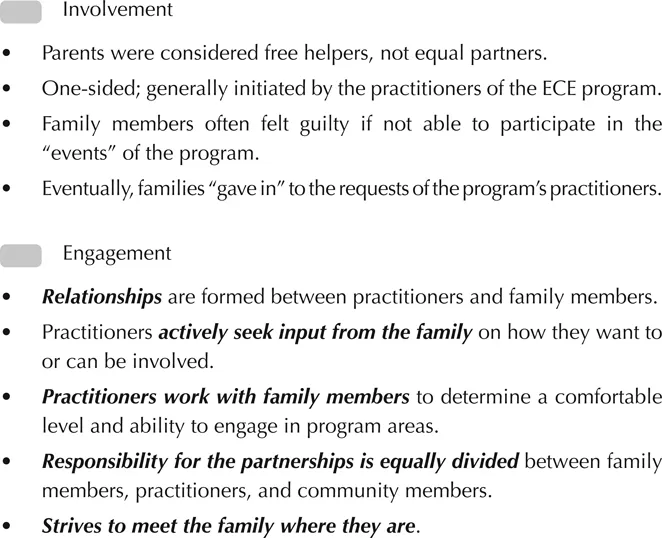
Figure 1.1 Involvement vs. Engagement
Clearly, the definition of engagement revolves around the concept introduced at the beginning of this chapter – the family as the primary foundation. When families are engaged in their child’s education and the program they attend, everyone benefits. Family engagement is strongly supported and defined across the field of Early Childhood Education, as indicated in the following list. According to the U.S. Dept. of Health and Human Services, Administration for Children and Families, Children’s Bureau (2016):
- Family engagement is the systemic inclusion of families in activities that promote children’s development, learning, and wellness. These systems and practices are used to enhance connections between family members, educators, and community members.
- This means including families in the planning, development, and assessment practices of the program.
- Practitioners must engage families as partners, ensuring positive relationships are nurtured between family members, educators, and community members.
- Family Engagement Practices are an indicator of QUALITY in a program.
Subsequently, family engagement is a critical and integral part of quality care and education policies to support children’s learning and development (QRIS, n.d.). The DAP position statement also indicates that family engagement is based on the knowledge of child development and the context in which each child is living (NAEYC, 2009). This knowledge is obtained by developing relationships with families.
Further, NAEYC identifies family engagement as a standard of professional practice. Practitioners are tasked with creating responsive and reciprocal partnerships with family members (Koralek, Nemeth, & Ramsey, 2019). NAEYC’s position statement on equity supports consideration of equity and diversity of the working family and the need to respect the family as the child’s first teacher and acknowledge each family’s definition and understanding of their composition (Koralek et al., 2019). Practitioners can support these components by learning about each family’s values, beliefs, language, and culture. Finally, practitioners must support the family’s right to make decisions about their children’s education, respecting the fact that these decisions may not coincide with professional knowledge.
In a meaningful partnership, both sides will find a mutual solution to any issues that arise. NAEYC advises programs seek accreditation to know and understand that these collaborative relationships should be established and maintained and assurance that families are encouraged to participate fully in the program (NAEYC, 2018). Finally, NAEYC has incorporated family engagement components to guide our practices in the Code of Ethical Conduct Core Values (2011). In general, practitioners have the responsibility to support the bond between child and family. The code also refers to the DAP statement in that practitioners use the context of each child’s family, culture, community, and greater society to understand and support development.
In summary, an ECE program’s policies and procedures should clearly define family engagement as a shared process by practitioners and family members to:
- Participate in a variety of program activities, and events promote and plan common goals for the development, learning, and wellness of children.
- Develop and maintain meaningful partnerships among the family, practitioners, and members of the community.
- Acknowledge and include the context in which each family is living, with respect for culture (values, beliefs, language), the family’s definition, and understanding of their composition.
- Acknowledge the family’s right to make and/or share in the process of making appropriate decisions for their child.
The question at hand, then, is: how do we implement these foundational concepts and truly engage families? Practitioners define policies and procedures for tuition rates, hours of operation, health, safety, and emergency procedures. There should also be clearly defined policies for how families are engaged in their child’s education. Many programs have the “Open Door Policy,” which defines that family members should have access to visit the program anytime care is being provided unannounced. While this is an important component of the policy, it does not define how you will engage the family. Suppose we look at the foundational concepts put forth by NAEYC and others for effective family engagement. In that case, we are left with the task of determining how to use them to build an effective policy. In this book, each component will be used as a building block to create not only policy but also examples of how they can be developed to meet your program’s needs.
Why is policy important? Policies and procedures are action plans and provide a basis for accountability. Policies build a common language and describe, in this case, family engagement as something to be prioritized and used as an educational strategy. A policy defines what is expected of each member in the relationship. To build effective policies and procedures, the basic questions of who, what, where, when, and why must be addressed. For each building block discussed, you will be tasked with identifying the answer and procedures to implement each component. Remember the famous line from the movie Field of Dreams? “If you build it, they will come.” This is likely what you are thinking: if I put all this effort into building this policy, will they engage?
The answer is not black and white, yes or no. There are never any guarantees. However, if you create a plan, some of the barriers that prevent good engagement can be addressed ahead of time. You will never reach/include all the people all the time. But for those you will, the relationships and outcomes will be richer and more successful for all involved.

Figure 1.2 ECE Field of Dreams
Kathryn E. McKay
Ultimately, the goal for creating and implementing an effective family engagement policy is to strengthen the bonds between home and program, family and educator, family and program, and families, program, and the community. As you work through this policy development workbook, use the building blocks image as a guide and understand that you will create twopolicies – one for the family and one for practitioners. Each policy will work in tandem – the Family Policy will outline what will be expected of the family and what they can expect from the program. The second policy is for the expectations of performance by the practitioners. Now, where do we begin? What does your foundation look like? Write out some of your thoughts.

Figure 1.3 Comprehensive System of Family Engagement
References
- Demircan, Ö., & Erden, F. T. (2015). Parental involvement and developmentally appropriate practices: A comparison of parent and teacher beliefs. Early Child Development and Care, 185, 209–225. h...
Table of contents
- Cover
- Half Title
- Title Page
- Copyright Page
- Contents
- Illustrations
- Acknowledgments
- 1. Building the Foundation for Family Engagement Policy
- 2. Supporting the Foundation: The Principles of Family Engagement
- 3. Building a Comprehensive System for Family Engagement
- 4. Beginning With the End in Mind: Vision and Mission Statements
- 5. It All Starts With Relationships
- 6. Effective Communication Practices and Strategies
- 7. Extending Learning in the Home and Community
- 8. Decision Making and Goal Setting With Families
- 9. Decision Making and Goal Setting in the Program
- 10. Introducing and Implementing New Policies
- Appendix A
- Appendix B
- Appendix C
- Appendix D
- Appendix E
- Appendix F
Trusted by 375,005 students
Access to over 1.5 million titles for a fair monthly price.
Study more efficiently using our study tools.
Frequently asked questions
Yes, you can cancel anytime from the Subscription tab in your account settings on the Perlego website. Your subscription will stay active until the end of your current billing period. Learn how to cancel your subscription
No, books cannot be downloaded as external files, such as PDFs, for use outside of Perlego. However, you can download books within the Perlego app for offline reading on mobile or tablet. Learn how to download books offline
Perlego offers two plans: Essential and Complete
- Essential is ideal for learners and professionals who enjoy exploring a wide range of subjects. Access the Essential Library with 800,000+ trusted titles and best-sellers across business, personal growth, and the humanities. Includes unlimited reading time and Standard Read Aloud voice.
- Complete: Perfect for advanced learners and researchers needing full, unrestricted access. Unlock 1.5M+ books across hundreds of subjects, including academic and specialized titles. The Complete Plan also includes advanced features like Premium Read Aloud and Research Assistant.
We are an online textbook subscription service, where you can get access to an entire online library for less than the price of a single book per month. With over 1.5 million books across 990+ topics, we’ve got you covered! Learn about our mission
Look out for the read-aloud symbol on your next book to see if you can listen to it. The read-aloud tool reads text aloud for you, highlighting the text as it is being read. You can pause it, speed it up and slow it down. Learn more about Read Aloud
Yes! You can use the Perlego app on both iOS and Android devices to read anytime, anywhere — even offline. Perfect for commutes or when you’re on the go.
Please note we cannot support devices running on iOS 13 and Android 7 or earlier. Learn more about using the app
Please note we cannot support devices running on iOS 13 and Android 7 or earlier. Learn more about using the app
Yes, you can access Effective Family Engagement Policies by Teresa S. McKay in PDF and/or ePUB format, as well as other popular books in Education & Early Childhood Education. We have over 1.5 million books available in our catalogue for you to explore.