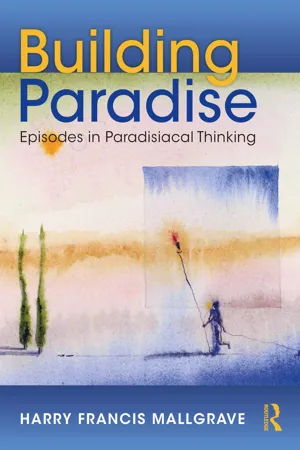
A sweeping historical study, Building Paradise seeks to construct a garden ethic for the design arts. It is an ethic predicated on the idea that, with our recent ecological and biological insights, we can build more intelligently than the status quo of current design practices. The paradisiacal instinct is the motivation behind every artistic impulse. From its theological origins to the present, the idea of paradise—the garden as a place of peace, beauty, and happiness—has acquired numerous meanings. It was a motif expounded in the earliest cultures of Mesopotamia, Egypt, and the Indus Valley, and it later became a dominant feature of Buddhist, Judeo-Christian, and Islamic practices. It informed Greco-Roman mythologies and the design of a Japanese garden; it was a motivation for the Renaissance humanists, and was complicit in visions of a New Arcadia within the landscapes of the Americas. This book, underscoring how the built and urban environments shapes culture, takes a biophilic approach and draws upon the major advances of the human sciences of the last few decades to argue on behalf of a design ethic centered squarely on human needs and aspirations. Written for students and academics within architecture and all related fields, this book focuses on the efforts to build paradise in a material way.
- 286 pages
- English
- ePUB (mobile friendly)
- Available on iOS & Android
eBook - ePub
About this book
Information
1 IMAGINING PARADISE
DOI: 10.4324/9781003178460-1
Sumer
One might seem to be on fragile ground in attempting to trace the paradisiacal instinct back to the beginning of Homo sapiens, but only because it is likely much older than that. In the 1960s, the remnants of the Paleolithic settlement of Terra Amata, dating to around 400,000 years ago were found on a construction site in Nice, France. The archaeologist Henry de Lumley, over the few months during which construction was suspended, unearthed a series of what he deemed to be gabled huts with hearths, situated today on a bluff overlooking the Mediterranean Sea. The hearth in itself, with its offering of warmth and cooked food, seems like an important leap forward, but these settlers and builders were not modern humans. Most likely, they were members of either Homo heidelbergensis or Neanderthals.1 Still, one must wonder if these early humans of no more than five feet in stature, when looking out over a sea eighty-five feet higher than it is today did not view their southern horizon as a garden, one both captivating and transporting the spirit into a state of wonderment.
This finding calls to mind the distinction Mircea Eliade once made between the sacred and profane. He did so to define the “two existential situations assumed by man in the course of his history," but also to make the case that one cannot truly separate the “sacred’’ from “the ritualized building of the human habitation."2 Both are aspects of the human impulse to survive by improving one’s place in the world, and both are deeply rooted in our language. The English word for building, for instance, derives from the Proto-Indo-European bhu. “to dwell," and bheue, “to be, exist, grow." Throughout history, the building of the tomb, the house, the temple, or the city has been seen as the means through which human imagination, at many levels, redeems and reconstructs its vision of a lost or imagined paradise. One thinks in this regard of those southern European caves displaying palpable signs of human vitality and spiritualized thought, beginning close to 40,000 years ago. As Jean Clottes has suggested, people sketched their visions on cave walls for various reasons, one of which was to define a place for communal rituals, consisting no doubt of fire, dancing, and vocal chants or rhythms. The cave at Lascaux has a rotunda near its entrance called the Hall of Bulls, which displays a frieze of delineated masterpieces consisting of seventeen horses, eleven aurochs, six stags, one bear, and one unicorn—a hunters paradise. The bodies of the animals were in some cases enhanced by surface moldings found on the cave walls. Also interesting is the instinct expressed in the narrow, dark, and arduous passages far into the womb of the cave, where, in the interpretation of Clottes, shamans crawled to explore the limits of sacralized consciousness and to mediate a communion “between the world of the living and the world of the spirits.”3 The notion of an afterlife, a sense of a unified cosmos, is an early manifestation of the paradisiacal instinct.
Several writers have suggested that cities of the dead may have antedated cities of the living, and that the dead, in the view of Lewis Mumford, “were the first to have a permanent dwelling: a cavern, a mound marked by a cairn, or some other receptacle. These were landmarks to which the living probably returned at intervals to commune with or placate the ancestral spirits."4 More recently, Robert Pogue Harrison has argued that “the ancient city was built on the foundations of the ancient house, and that the ancient house was built in turn upon the ancestor’s grave."5 The oldest known human habitats, the brushwood dwellings at Ohalo in Israel, date from 25,000 years ago, and the use of stone for housing could not have followed too many centuries thereafter. By the start of the first millennium, at sites such as Jefel Ahman and Dja’je in southern Turkey, we not only have evidence of monumental subterranean sanctuaries carved into the ground but also of the architectural transition from circular to rectangular housing forms.6 Celestial thinking was similarly evident in the circular temples found at Göbekli Tepe, the oldest human-built sanctuaries. The complex was begun sometime after 9600 bc, atop a ridge overlooking a valley a thousand feet below. Its twenty excavated rings contain more than 200 steles with T-shaped profiles, many carved with insects, birds, bulls, and other animals. Circular rings were cut into the hillside, the largest 100 feet in diameter, inside of which circular stone walls formed a labyrinth. At the center of the pavement, standing alone, were two colossal T-shaped steles, likely representing deities. The landscape, located at the northern end of the fertile crescent and not too distant from the wellspring of the Euphrates River, was also attractive. “This area was like a paradise,” says its lead archaeologist Klaus Schmidt, because the area would have had around it gently flowing rivers, herds of gazelles, geese and ducks, fruit and nut trees, and wild barley and wheat.7 The sanctuary seemingly attracted clans of hunter-gatherers from great distances to participate in religious rites, and the building of the complex in itself involved hundreds of people simply to move and carve the works.
Stretching down into the Levant, a series of early towns were built around sacred springs. On the outskirts of Amman, the settlement of Ain Ghazal or “Spring of the Gazelle” attracted bands of hunter-gatherers at an early date and was regularly occupied from 7200 BC. At its height the village encompassed more than thirty acres and housed as many as 3,000 people. Square houses were permanently constructed, adults and children were buried under the floor, and numerous figurines and plaster statues have been unearthed. Its nearby sister town of Jericho was another primordial site formed next to an abundant spring, and was frequented by hunter-gatherers around the start of the tenth millennium. Five hundred years later, the first circular huts of sun-dried brick appeared and, by the start of the ninth millennium, the town was permanently settled with as many as seventy dwellings. Again, the dead were buried beneath the floors of the houses. The undressed stone walls of Jericho, some as tall as twenty feet, were started around 8,000 years ago, and outside the rampart was a moat. Inside the walls was a circular tower deemed to have been used for both ceremonial and cosmological purposes.8
One of the more interesting of the late Neolithic villages is Çatalhöyük in southern Anatolia, which dates to around the turn of the eighth millennium. At its height, it housed as many as 10,000 people. The town once again vividly portrays the paradisiacal undercurrent of domestic building. It was built on a high plateau, and the town’s most arresting feature is that its rectangular houses have no streets. One gained access to them only through roofs that formed a second plateau, from which people descended directly into their homes with ladders. The significance of this higher plane has been likened to Jacob’s dream at Bethel, in which angels ascended and descended to and from heaven by means of a ladder, although here the more practical reasons were defense as well as protection from the heat. 9 Çatalhöyük also had no collective places of worship. In fact, ther seems to have been no distinction between domestic and ritualized space. As at Jericho, the bones of ancestors were buried in the floors, often with burial gifts, and their spirits continued to inhabit the dwelling along with the offspring. Other adornments included statues of fertility goddesses, rams, and bull heads in addition to painted columns and plastered walls. At an excavation level dating to 6200 BC, archaeologists found an image of an erupting volcano—the world’s earliest known landscape painting."10 Another curious feature of the site is that the connecting rooms within each house were not accessed by doors but by smaller openings, forcing one to bend down or even crawl from one room to another. Moreover, many of these rooms, with little or minimal natural light, may indeed have taken on the nocturnal atmosphere of a cave.11 In addition to the cosmology, the main living areas, when lit from above or by a few courtyards, presented a rather cozy living abode of ancient sophistication.
It is also not too far-fetched to suggest that with the fixed habitation of the Neolithic era also came the garden, which was obviously first used for the production of food, but which, because of this urgency, soon acquired other consecrated values. Plants and trees, in mirroring the course of life became emblems of fertility, and nature itself became sacrosanct. Socialization also came into play. When humans began to form towns and cities, the responsibility for the fertility of the fields—their periodic renewal—passed from the individual to anointed leaders who could divine the will of the gods. At this stage, certain plants acquired ineffable values unique to particular deities. From here, it would not take long for still another meaning to emerge, which is the joy of immersing oneself within one’s own human creation—the cultivation of the garden for its sensorial beauty.
Within Judeo-Christian and Islamic accounts of creation, humanity begins with the Garden of Eden, but these accounts were based on older traditions of Mesopotamia and Egypt. Due to a condition of climate cooling in the seventh millennium, tribes migrated from the north into the river valleys of southern Mesopotamia and began the transition toward urban cultures. Here the human race also underwent further changes in lifestyles. The fertile plains, together with the regulation of waterways, yielded the possibility of a grain diet and the pasturing of animals. During this period, the gods of local shrines of smaller towns came to be replaced by the more powerful gods of the sun, moon, and sky, just as local leaders would come to be replaced by the unchallenged authority of kings and pharaohs. It was through their more direct connections to divinities, as religious practices prescribed, that these new leaders derived their moral and political authority.
The invention of writing in both Sumer and Egypt in the fourth millennium yielded the codification of trade and law, but also of scripture and the social organization needed for the complex functioning of the city. Together, they provided the planning and logistical tools for the deployment of thousands of laborers to build the temples, palaces, ramparts, and irrigation canals. Initially what emerged was a series of smaller city-states not unlike those of later Greece and Ionia, in which the majority of the population worked their own fields in addition to participating in civic tasks related to the economy and administration of the state. The temple became the centerpiece of these efforts because every member of the city followed its counsel.
What was gained with this new idea of a city was not a departure from earlier religious practices but, in the Mesopotamian valley at least, a magnification of a grander Edenic impulse. It was the passage, as Numa Denis Fustel de Coulanges has noted, from the family “to the phratry to the tribe to the city.”12 The city not only instituted a structure for collective efforts but also a cosmology of its own. It represented an ordered hierarchy of at least one deity, and by elevating the temple to a higher plane than that used for everyday commerce, it also enhanced the paradisiacal character of the city. The holy mountains of the Mesopotamian valley—the axis mundi, or earthly pillars connecting heaven and earth—were the means through which humans could commune with their gods, and they also elevated the stature of urban residents. They became “objects of civic pride,” as Henri Frankfort once described them.13
The siting of the first Sumerian cities, together with their social structure, were divinely sanctified by the mythology of their creation. By all Sumerian accounts, Eridu was the first city. It was originally (with higher sea levels) a seaport on the Persian Gulf, and it is said to have been built on the actual site of paradise—that is, the garden “wherein grew a glorious tree” bearing frui...
Table of contents
- Cover
- Half Title
- Title Page
- Copyright Page
- Dedication Page
- Table of Contents
- List of Illustrations
- Foreword
- Preface
- Acknowledgments
- 1 Imagining Paradise
- 2 Divine Cities
- 3 Oracles and Augury
- 4 Paradises of Faith
- 5 Renaissances
- 6 Paradise Gardens
- 7 Simply Baroque
- 8 New Arcadia
- 9 Eden Revisited
- 10 Brave New World
- 11 Charteuse Intermezzos
- 12 The Passage of Modernism
- Epilogue: The Garden Ethic
- Index
Trusted by 375,005 students
Access to over 1.5 million titles for a fair monthly price.
Study more efficiently using our study tools.
Frequently asked questions
Yes, you can cancel anytime from the Subscription tab in your account settings on the Perlego website. Your subscription will stay active until the end of your current billing period. Learn how to cancel your subscription
No, books cannot be downloaded as external files, such as PDFs, for use outside of Perlego. However, you can download books within the Perlego app for offline reading on mobile or tablet. Learn how to download books offline
Perlego offers two plans: Essential and Complete
- Essential is ideal for learners and professionals who enjoy exploring a wide range of subjects. Access the Essential Library with 800,000+ trusted titles and best-sellers across business, personal growth, and the humanities. Includes unlimited reading time and Standard Read Aloud voice.
- Complete: Perfect for advanced learners and researchers needing full, unrestricted access. Unlock 1.5M+ books across hundreds of subjects, including academic and specialized titles. The Complete Plan also includes advanced features like Premium Read Aloud and Research Assistant.
We are an online textbook subscription service, where you can get access to an entire online library for less than the price of a single book per month. With over 1.5 million books across 990+ topics, we’ve got you covered! Learn about our mission
Look out for the read-aloud symbol on your next book to see if you can listen to it. The read-aloud tool reads text aloud for you, highlighting the text as it is being read. You can pause it, speed it up and slow it down. Learn more about Read Aloud
Yes! You can use the Perlego app on both iOS and Android devices to read anytime, anywhere — even offline. Perfect for commutes or when you’re on the go.
Please note we cannot support devices running on iOS 13 and Android 7 or earlier. Learn more about using the app
Please note we cannot support devices running on iOS 13 and Android 7 or earlier. Learn more about using the app
Yes, you can access Building Paradise by Harry Francis Mallgrave in PDF and/or ePUB format, as well as other popular books in Architecture & Architecture General. We have over 1.5 million books available in our catalogue for you to explore.