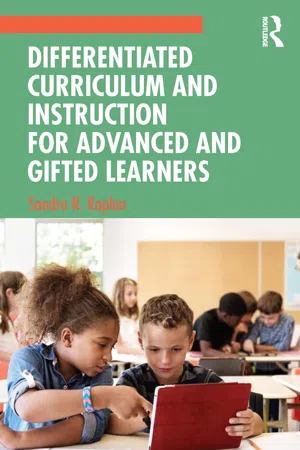
This critical volume provides readers with a deep understanding of why and how to differentiate curriculum and instruction to better meet the academic, social, and emotional needs of advanced and gifted learners. Offering clear, constructure frameworks for learning, chapters focus on four key concepts – review, reinforce, refine, and redefine – which help readers create individualized learning experiences and differentiate standards-based curriculums. Filled with specific examples, lessons, and units of study, this essential guide emphasizes differentiation as a means to differ the What (curriculum) as well as the How (instruction) to successfully respond to the many facets of students' giftedness.
eBook - ePub
Differentiated Curriculum and Instruction for Advanced and Gifted Learners
- 118 pages
- English
- ePUB (mobile friendly)
- Available on iOS & Android
eBook - ePub
Differentiated Curriculum and Instruction for Advanced and Gifted Learners
About this book
Information
1 Differentiation
DOI: 10.4324/9781003111443-1
Differentiation: Definitions, Designs, and Procedures
The accepted definition of differentiation affects the nature and type of experiences that gifted students will encounter and the ramifications that these experiences will have on their intellectual, emotional, and social development within and over time. Conceptions of differentiation have been related to historic and contemporary empirical studies, curriculum theories, and orientations exposed by noted educational scholars. Importantly, each reiteration of the concept of differentiation reflects and extends ideas of others and can provide a new and differing emphasis in relationship to the perceptions and challenges for the education of gifted students. The evolution of new definitions and practices related to differentiation is not intended to be competitive; they evolve out of the ever-present need to clarify the meaning of what correlates most significantly to accommodate the philosophical and pragmatic needs of the gifted. Over time, the definition of giftedness, the diversity among gifted students, changes in the rudimentary or basic curriculum, graduation requirements, acceptance to higher education criteria, and the political, economic, social beliefs, and laws that are supported in communities have been factors that require new and alternative meanings of differentiation.
Appropriate to the introduction and presentation of differentiation is the underlying meaning of the term: differentiation is a means to differ the curriculum to respond to the modifications in the basic or core curriculum so that it recognizes and accommodates the learning needs, interests, and abilities that differentiate learners from each other. The generalization of the definition of differentiation to all students is a more appropriate interpretation of the term than aligning the term only to gifted students. The differences that comprise the composition of learners in classrooms and schools; the need to be culturally responsive to students representing various races, cultures, languages, and abilities; and the rights of students to an education that is responsive to them as individuals and members within groups, a class, a school, and district are essential.
The implementation of differentiation strategies is dependent on many factors. One factor that inhibits the acceptance and practice of differentiation is the attitudinal reference regarding the definition and practice of differentiation. “Academic prejudice” can exist in the various roles of teaching and levels of administration that thwart the acceptance and implementation of differentiation for gifted students. This form of prejudice is rooted in a variety of overtly or covertly stated misconceptions:
- The misconception that acknowledging the abilities of some students reduces the importance of abilities in others
- The misconception that allocation of time and fiscal resources for some students who learn readily diminishes the time and fiscal resources for other types of learners
- The misconception that the performance expectations associated with giftedness generalizes to each and every interest and ability performed by the student identified as gifted
- The misconception that what is designated for the gifted within the differentiated curriculum is appropriate only for the gifted students
- The misconception that behaviors and attitudes designating giftedness are present only in those students who are formally identified as gifted
- The misconception that successful learning and recognized achievement are attained only by gifted students.
Basically, academic prejudice subtly affects the receptivity of both differentiation and gifted students. The subsequent reduction of academic prejudice is reliant on not only the clarity of misconceptions but the appropriate conceptions of both differentiation and the nature of giftedness.
Differentiation should be conceived as a multiple procedural process. Germane to this process is the understanding that differentiation includes a field of options that have been studied and implemented over the years with success by many significant educators of the gifted. The current goal is not to prioritize or refute the existing exemplars of differentiation; the contemporary purpose is to articulate both a philosophical and pragmatic orientation to define and practice differentiation as a feature of curriculum and instruction that recognizes and responds to the range of latent and overt potential, abilities, and interests of diverse gifted and advanced students. The definition of differentiation should accommodate the gifted and generalize to recognize and respond to individual and group differences among all learners. Realization of this goal is dependent on both observing and understanding the dimensions of the individual differences comprising both individual and group needs.
| Recognizing group needs | Recognizing individual needs |
|---|---|
| Defining the age/grade dynamics of the group with respect to norm-referenced expectations of the subject, school, district, and community. | Noting the specific traits of the members of the group with a focus on appropriate adjustments of time for engagement, interests in the major or related curriculum areas, acquisition of prior knowledge, resource required to achieve understanding, areas of strength and need, work/study habits involving time frame, and independent or group working style. |
Philosophy and Pragmatism
The definition of words often is independent on the context in which they are applied. Just as the concept of gifted has undergone differing meanings based on multiple factors, the concept of differentiation also has been attributed multiple definitions over time. Curricular, social, economic, and professional events have been attributed to redefining the concept of differentiation.
| Factors that influence definition and practice | Definitions and practice |
|---|---|
| Population responsiveness | Acknowledging and responding to the traits of students that individualize or personalize learning |
| Socio-political events | Responding to multiple forms of diversity among learners and providing equity for all learners |
| Economics | Responding to the access of funds to create, distribute, and educate professionals to select and use materials |
| Professional development | Incorporating the teachers’ abilities to develop educational proficiencies to attend to individualized and personalized needs of students |
Nomenclature Related to Differentiation
Different and Differ versus Differentiation
As in other professions, words and their definitions are congruent with their contextual references. The word “differentiation” has multiple meanings dependent on who it is meant to relate to and what is meant to activate for the individual or group. Inherent in the word “differentiation” are the words “different” and “differ.” These words both facilitate the definition and the confusion related to the interpretation of differentiation as a strategy or set of strategies to recognize and respond to giftedness and gifted learners. Common to attempts to define adequately the meaning and practice of differentiation is the answer to this question: How does an activity or strategy that is different or differs from activities in the basic or core curriculum contribute to the education or goals set for gifted students? There is a simple response to this question: “A strategy cannot qualify as differentiated simply because it is different than the norm-referenced experiences expected to be accomplished by all students.” Differentiation requires the alignment to the traits that distinguish the nature of giftedness and reinforces learning-to-learn habits and skills. Differentiation also furthers the understanding and application of subject areas or disciplines that require alignment to the traits and learning goals of the gifted student.
Extension or Enrichment
The terms extension and enrichment often are considered “flexible and open-ended” and defined by their alignment with the basic or regular curricular learning activities. Extensions can emphasize an alternative investigative method to apply a particular concept or skill located within a basic learning activity in a more elaborative, sophisticated, or unique manner. Fundamental to the implementation of an extension to the basic curriculum is the need to clarify that this form of differentiation is not perceived as eroding or causing learning gaps for gifted students.
For example, the extended differentiation strategy related to the study of a historical event might include “an analysis of the biographies of individuals primary to the event to determine how personal philosophical and psychological dispositions affect the roles individuals assume in different events.” This differentiation modification may be perceived as minimizing the meaning of the historical event in core curriculum.
Acceleration
The term acceleration is consistently referenced with other descriptions of differentiation. However, the definition of this term is not consistently expressed. Acceleration often is associated with the concept of the pace or speed related to moving across courses of study or the pacing within a designated curriculum or learning experience. The connotation of “fast” often is the synonym for acceleration. Respecting the variance in pacing needed by students to acquire understanding or to achieve mastery parallels many of the traits of giftedness and should be acknowledged. However, acceleration also should be defined as the intensity, degree, or level of sophistication of learning elements provided within a curriculum rather than the speed exhibited to learn the curriculum. Acceleration also can be defined by various stages of involvement with learning different facets of the curriculum.
| Stage I – Orientation – Sweeping over the curriculum to assess the areas that most/least resonate with the learner. These areas are dependent on prior knowledge of both self as a learner and the general concepts included within the presented outline of the topic or unit of study. |
| Stage II – Preferencing – Identifying a specific portion, topic, commentary, or principle that captures the student’s interest for further exploratory investigation to answer questions such as “Why is this information considered to be important or valued?” and “Under what conditions is this information considered most significantly utilized?” |
| Stage III – Linking – Determining the many different ways to associate the selected area in intra- and interdisciplinary areas of study inclusive of the introduction to new topics and skills. This stage deliberately requires students to widen their perspectives on the selected area of study. |
| Stage IV – Elaborating – Investigating the numerous social, economic, political, and philosophical factors that have impacted the selected areas of study and are linked to past and present educational and technological qualitative and quantitative outcomes. |
| Stage V – Deciding – Culminating the study of the selected area with a personal assessment of impact of the area on present and future development of the self as a scholar. |
Individualized vs. Personalized
The differences between individualized and personalized learning experiences sometimes are more discussed than observed among the experiences provided to gifted students. To many educators and students, the term independent study is synonymous with individualized and personalized learning because they both imply some form of choice within an independent study. Personalization differs from individualization in definition and practice. Whereas individualization affords the gifted student circumstances to select an option within a defined curriculum design, personalization affords the gifted student the option to design a curricular experience to reflect their perceived personal abilities, needs, and interests. The contrast between individualized and personalized has implications for gifted students. Clarity of nomenclature defining individualizations versus personalization also can facilitate the intellectual responsibility and goals derived from these two types of learning experiences for gifted students.
Individualization represents the presence of choice within stipulated parameters of a teaching/learning structure or curriculum.
Example: The process of independent study affords gifted student X several but not all opportunities for individualized decisions and practices within the independent study framework. A single facet of an independent study is guided by a designated set of operations stipulated by the teacher and possibly operationalized by a group of students. Gifted student X individually selected the questions to investigate within a teacher-specified topic of study and the designated references provided by the school librarian.
Personalization represents the situation where the gifted learner constructs the learning experience circumscribed by the student’s analysis of data and understanding of academic and learning attributes. A stated conce...
Table of contents
- Cover
- Half Title
- Title Page
- Copyright Page
- Contents
- 1 Differentiation
- 2 Depth and Complexity
- 3 Early Childhood Education
- 4 Instructional Strategies
- 5 Learning to Learn
- 6 Independent Study
- Index
Trusted by 375,005 students
Access to over 1.5 million titles for a fair monthly price.
Study more efficiently using our study tools.
Frequently asked questions
Yes, you can cancel anytime from the Subscription tab in your account settings on the Perlego website. Your subscription will stay active until the end of your current billing period. Learn how to cancel your subscription
No, books cannot be downloaded as external files, such as PDFs, for use outside of Perlego. However, you can download books within the Perlego app for offline reading on mobile or tablet. Learn how to download books offline
Perlego offers two plans: Essential and Complete
- Essential is ideal for learners and professionals who enjoy exploring a wide range of subjects. Access the Essential Library with 800,000+ trusted titles and best-sellers across business, personal growth, and the humanities. Includes unlimited reading time and Standard Read Aloud voice.
- Complete: Perfect for advanced learners and researchers needing full, unrestricted access. Unlock 1.5M+ books across hundreds of subjects, including academic and specialized titles. The Complete Plan also includes advanced features like Premium Read Aloud and Research Assistant.
We are an online textbook subscription service, where you can get access to an entire online library for less than the price of a single book per month. With over 1.5 million books across 990+ topics, we’ve got you covered! Learn about our mission
Look out for the read-aloud symbol on your next book to see if you can listen to it. The read-aloud tool reads text aloud for you, highlighting the text as it is being read. You can pause it, speed it up and slow it down. Learn more about Read Aloud
Yes! You can use the Perlego app on both iOS and Android devices to read anytime, anywhere — even offline. Perfect for commutes or when you’re on the go.
Please note we cannot support devices running on iOS 13 and Android 7 or earlier. Learn more about using the app
Please note we cannot support devices running on iOS 13 and Android 7 or earlier. Learn more about using the app
Yes, you can access Differentiated Curriculum and Instruction for Advanced and Gifted Learners by Sandra N. Kaplan in PDF and/or ePUB format, as well as other popular books in Didattica & Didattica generale. We have over 1.5 million books available in our catalogue for you to explore.