eBook - ePub
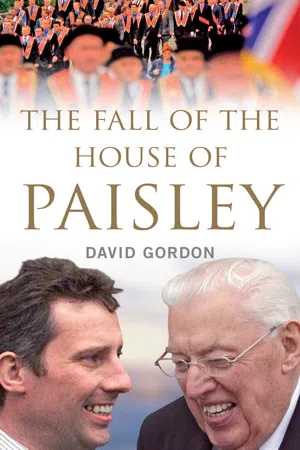
The Fall of the House of Paisley
The Downfall of Ian Paisley's Political Dynasty
- 256 pages
- English
- ePUB (mobile friendly)
- Available on iOS & Android
eBook - ePub
About this book
In this hard-hitting study of political power, award-winning journalist David Gordon studies the political downfall of Ian Paisley and his son and shines an uncompromising light on Northern Ireland's political elite.
Ian Paisley, firebrand Ulster Protestant preacher and politician, spent forty years denouncing compromise as treachery. Then, in March 2007, he agreed a power-sharing pack with Sinn Féin, the political wing of the Provisional IRA. The historic deal earned him plaudits from around the world and the top job in Northern Ireland's new devolved administration. His beloved son Ian Junior took up a ministerial post by his side. Yet within a year, this proud family dynasty had crumbled and collapsed. First Ian Junior resigned as a minister, after months of controversy over his links to a property developer. Then Paisley himself announced his retirement — despite having made repeated pledges to serve a full four years in office.
In this fantastic work of investigative journalism, award-winning journalist David Gordon pinpoints the structural flaws in the House of Paisley and exposes the murky underworld of Northern Irish politics.
Editorial Reviews
'David Gordon … in a fine piece of investigative journalism, doggedly following his nose, taking advantage of freedom of information, and with good contacts in the DUP and Free Presbyterian Church (FPC), seeks to explain why Ian Paisley fell at what appeared to be the moment of triumph.'
Maurice Hayes, Belfast Telegraph
'David Gordon details where the storm came from and why it was so damaging to father and son in The Fall of the House of Paisley. While some readers will — to be blunt — enjoy reliving the difficulties faced by such a pair of individuals, there's more to Gordon's fine book than schadenfreude.'
William Scholes, Irish News
'Gordon's account is as sharp as a blade, cutting deep into the murky world of Stormont.'
Fachtna Kelly and Julian Fleming, Sunday Business Post Agenda
The Fall of the House of Paisley: Contents
Introduction
Chronology
- Welcome to the House of Fun
- The Ghost of Paisley Past
- With God on our Side
- Dodgy Foundations
- Causeway for Concern
- Junior in Bother
- Senior in Bother
- Land Deal Lobbying
- Out with the Old
- St Andrews Bombshell
- Other People's Money
- Surprise in Dromore
- All Fall Down
- Legacy Matters
- Life after PaisleyNotes
Information
Chapter 1
Welcome to the House of Fun
‘…there is a sort of buoyancy in Ulster at the moment…’
IAN PAISLEY, April 20071
Historic moments abounded in Northern Ireland in 2007.
But nothing came close to matching the jaw-dropping moment on Monday 26 March when, at a televised press conference in Stormont, Ian Paisley confirmed the news that a power-sharing deal had been successfully negotiated. The camera panned back to show unbelieving viewers that Sinn Féin President Gerry Adams was sitting beside the DUP leader. That image was thanks in no small part to some clever improvisation behind the scenes.
The DUP had wanted the two leaders to be facing each other, while Sinn Féin insisted on them being side by side. Thanks to a diamond-shaped table formation, the two options were more or less satisfied. Paisley and Adams each sat at the end of their party’s table, bringing them beside each other if not quite side by side. The image management could not stretch to a historic handshake, however.
A deal had seemed anything but inevitable just a few days earlier. Monday 26 March had been Secretary of State Peter Hain’s absolutely final deadline for the restoration of devolution. But the DUP was determined to bust its way through that date. That meant the only way for it to avoid a total collapse of the process was to negotiate directly with Adams and co. on establishing devolution.
‘Today, we have agreed with Sinn Féin that this date will be Tuesday 8 May 2007,’ Paisley announced at the press conference.2 His statement that day was well crafted, giving every sign that he was going to throw himself into the new arrangements 100 per cent. It explained that ‘important preparatory work’ between the parties would get underway in advance of devolution day. ‘This will include regular meetings between the future First and Deputy First Minister,’ he added. That meant Paisley and Sinn Féin’s Martin McGuinness, a one-time top IRA man in Derry.
The famous Paisley rhetoric was expertly employed at the press conference, bridging the pain of the past and hopes for the future. ‘I want to make it clear that I am committed to delivering not only for those who voted for the DUP but for all the people of Northern Ireland,’ he said. ‘We must not allow our justified loathing of the horrors and tragedies of the past to become a barrier to creating a better and more stable future.’ And so the Paisley–McGuinness double act was born.
The First and Deputy First Ministers were soon laughing enthusiastically together at public appearances, even when there did not seem to be anything very funny going on. The nickname ‘Chuckle Brothers’ was coined in the summer of 2007, and attributed to an unnamed Ulster Unionist. This comment was quoted in a BBC Northern Ireland report marking the first 100 days of devolution.3 The original Chuckle Brothers were a comedy double act from children’s TV. The BBC Northern Ireland report also referred to government officials talking about the ‘chemistry’ between Paisley and McGuinness.
Although it eventually caused the DUP problems as it continued over the months, the chuckling did not seem like much of a liability at first. Paisley was demonstrating publicly that he was comfortable in his role, and determined to make it work. He gave an insight into the working relationship in one early interview, hinting at private jocularity within their department, the Office of the First Minister and Deputy First Minister (OFMDFM). ‘We have had agreement at the end of the day after perhaps a fair bit of argument and stating our views but it has been courteous, it has been honest, it has been straight, and it has also been tinged by a measure of sarcasm by both of us.’4
The Stormont honeymoon period went well beyond the two First Ministers. When the devolution project started to struggle in 2008, there was much speculation about a chill between McGuinness and Paisley’s successor, Peter Robinson. But they also evidently got on well during a joint trip to the US in June 2007. The pair represented the new Stormont administration at the opening of a major Northern Ireland promotional drive in the States.5 Robinson declared:
When you visit us—as I hope you will—you will be in no doubt about the astounding progress that is being made. Our two traditions are serving together in a new government. It is a government that is about change, about building, about progress, about promoting a confident and capable Northern Ireland and I believe there is no limit to what we can achieve together.6
In a joint BBC interview with McGuinness in Washington, Robinson said: ‘We have been working together for nearly two months and we haven’t had a row.’7
At times, the joint DUP–Sinn Féin choreography of the early days was almost beyond satire. OFMDFM Junior Ministers Ian Paisley Jnr and Gerry Kelly enthusiastically launched a new ‘superheroes’ comic for primary schoolchildren. A government press release helpfully explained: ‘Herbie Healthy, Sophie Safe, Archie Achiever, Emer the Eco Girl, Donna Does-a-lot and Rory Rights will use their super powers to help in the fight to secure a better society for children and ensure their needs are kept at the heart of government and the community.’8 Even ardent supporters of the peace process sometimes had to suppress memories of Gerry Kelly’s days as an IRA bomber. Likewise, it would have been unhelpful to recall all the abuse that Paisley Jnr and his DUP colleagues had been hurling at Kelly just a few years earlier.
Just in case there is any confusion, incidentally, this was the same Paisley Jnr who in 1999 had condemned the creation of the OFMDFM junior minister posts as a ‘waste of taxpayers’ money’. That was back when those jobs had gone to SDLP and Ulster Unionist MLAs. Paisley Jnr had at that time also described the two posts as ‘superfluous’ and claimed that the Assembly was ‘quickly becoming a white elephant’. His outburst—in December 1999—was echoed by senior Sinn Féin MLA and future minister Conor Murphy. Murphy claimed the junior minister positions were ‘the most blatant case of cronyism and jobbery imaginable’.9 Time had clearly moved on by the summer of 2007—Murphy and Paisley Jnr were Ministers together for a start. Everyone, it seemed, was on-message by then, and any cynicism or criticism was officially frowned upon.
Feelings of optimism went well beyond the confines of Stormont. Paisley Snr was not far off the mark when he told an interviewer: ‘I believe there is a sort of buoyancy in Ulster at the moment among both Roman Catholics and Protestants—that they’re seeing a way forward.’10 The spring weather that year was unusually warm and dry for several weeks. (Like a clumsy metaphor in a bad romantic novel, the summer turned out to be particularly wet and miserable.)
There were other elements to the feeling of optimism that had nothing to do with the Assembly, but nevertheless added to a real sense of optimism. The Northern Ireland football team was enjoying its best run for a generation, thanks to the inspired management of Lawrie Sanchez and the goal-scoring prowess of David Healy. On 28 March, just two days after that Paisley–Adams press conference, Northern Ireland claimed another famous giant-killing home win, defeating Sweden 2–1. In one of his more cringe-making comments of the year, Paisley Jnr said: ‘Northern Ireland is doing fantastically well—just like the DUP. They win all their big games and they have a superhero called Healy, we win all our big games and we have a superhero called Paisley!’11
Football soon provided another metaphor for devolution disappointment. Sanchez quit his Northern Ireland job a few weeks after the Sweden game to seek English premiership glory with London club Fulham. Healy was one of his first signings in his new job. They both flopped, and Sanchez was out of work within months.
Aside from football, there had been plenty more to cheer about on the sporting front in the first half of 2007. Ireland’s cricketers had achieved amazing success at the World Cup in the West Indies, defeating Pakistan and qualifying for the final stages of the tournament. Earlier in the year, sport and Irish history had combined magnificently. Ireland’s rugby team had found a temporary new home in Dublin’s Croke Park and had received a warm welcome in the GAA citadel. England’s rugby players were given a respectful welcome to the stadium and then happily thrashed.
On the music front, meanwhile, Northern Ireland band Snow Patrol had become one of the UK’s biggest rock acts. An article in the Belfast Telegraph noted: ‘They are headlining big summer festivals this year and it seems their songs are being played on the radio around the clock.’12 A Northern Ireland band had not enjoyed such a level of success since The Undertones in the late 1970s.
The optimism extended to the economic sphere as well. Tourists from various parts of the world were no longer a rarity on the streets. Belfast’s locals looked on with bemusement as open-topped tour buses became increasingly common. University of Ulster economist Michael Smyth commented: ‘A buoyancy in civil society about its own worth and own identity—helped by the political settlement and underscored by sporting and other achievements—is certainly a necessary condition for us to start to rebuild. But it’s not sufficient. We need to have a hard slog of selling ourselves to investors.’13 The commonly expressed economic hope was that the province could emulate the ‘Celtic Tiger’ success of the Irish Republic. The phrase ‘global credit crunch’ had not been coined at that stage.
The property market was enjoying the good times too. As the fine wines flowed, there were many after-dinner chats among the middle classes about the incredible sums their homes were now worth. Tales abounded of apartment blocks in various districts being snapped up in no time by buy-to-let investors. Home-owners were being approached by developers, keen to pay well over the asking price—and then knock down the properties to make way for new townhouses and flats.
One newspaper item published three days after the ground-breaking Paisley–Adams press conference epitomised the period perfectly. It reported that bidding on a red-brick detached home on Alliance Avenue in north Belfast had reached £800,000.14 The property had been put on the market three weeks earlier for just £285,000. The rich symbolism lay in the fact that Alliance Avenue sat in the heart of one of the city’s worst sectarian killing zones of the Troubles.
There was much excitement on the retail front as well. Middle-class spending power in particular was being buoyed by the property bonanza. The imminent opening of the province’s first IKEA furniture store was awaited with something close to euphoria in some quarters. And Belfast was looking forward to its new £400 million Victoria Square, bulging with designer clothes stores. Paisley and McGuinness were among the dignitaries present when the trendy centre’s long-awaited opening was finally held in March 2008. Belfast was being marketed as cool. Only the bitterest begrudger would surely have recalled the unique Victorian-era Kitchen Bar that had been controversially demolished to make way for Victoria Square.
The economic illusions that underpinned the apparent good times of 2007 painfully emerged over the course of the first 12 months of devolution. These hard lessons in financial reality will be examined later in this book. But it’s worth noting at this point that few if any sceptical voices were raised at Stormont at the time. Nobody seemed to think that the party might be followed by a hangover.
The positive atmosphere that followed the power-sharing deal also had a manufactured aspect to it. That was primarily because one of the first significant acts of the new power-sharing executive was to put looming household water charges on hold.
The hated ‘tap tax’ formed part of the ‘reform agenda’ enthusiastically pursued by Secretary of State Peter Hain and his Northern Ireland Office (NIO) ministerial team. It proved an effective lever for pushing Assembly members towards devolution. Hain, who arrived in the province following the Labour general election victory in May 2005, never tired of pushing his policy programme.
This was a break with the previous Direct Rule approach, where ministers largely held the fort in the expectation that the Assembly would be returning. ‘Care and maintenance’ was one way of describing the pre-Hain attitude. One senior figure from the Northern Ireland Civil Service coined the phrase ‘warm storage’ to sum up the thinking. Hain was much more proactive, and in the process managed to annoy quite a few people.
A source close to his NIO team insists that this was not an evil plot to hasten devolution’s return. ‘It was always a misunderstanding that this was about doing unpopular things deliberately,’ he says. ‘Decisions were taken on the basis of what was genuinely believed to be the right thing to do.’ This source confirms that Hain’s hands-on approach was a ‘deliberate policy change’. ‘It was agreed in Downing Street, but wasn’t born in Downing Street. They had to be persuaded. What we wanted to look like—and this was the big difference—was that we were enjoying it.’ It was correctly anticipated that this would impact on the mood among Northern Ireland’s political parties. ‘It built a sense, which helped the situation, that this was unfair, that this was their job. It created an itch to get round the table and make those decisions themselves.’
The NIO source points out that aspects of the Direct Rule policy drive were well received, including reductions in hospital waiting times. It is true to say that some Hain initiatives had admirers, not least in the voluntary and environmental sectors. But water charges were far from being the only contentious aspect of his ‘reform agenda’. The list also included the scrapping of the 11-plus transfer test, reform of household rates, and plans to slash the number of councils.
The councils issue was never likely to have people marching in the streets. But it was felt deeply at grass-roots level in politics. Councillors were not excited at the idea of losing their seats and the prestige that went with th...
Table of contents
- Cover
- Title Page
- Dedication
- Contents
- Introduction
- Chronology
- Chapter 1: Welcome to the House of Fun
- Chapter 2: The Ghost of Paisley Past
- Chapter 3: With God on our Side
- Chapter 4: Dodgy Foundations
- Chapter 5: Causeway for Concern
- Chapter 6: Junior in Bother
- Chapter 7: Senior in Bother
- Chapter 8: Land Deal Lobbying
- Chapter 9: Out with the Old
- Chapter 10: St Andrews Bombshell
- Chapter 11: Other People’s Money
- Chapter 12: Surprise in Dromore
- Chapter 13: All Fall Down
- Chapter 14: Legacy Matters
- Chapter 15: Life after Paisley
- Notes
- Copyright
- About the Author
- About Gill & Macmillan
Trusted by 375,005 students
Access to over 1.5 million titles for a fair monthly price.
Study more efficiently using our study tools.
Frequently asked questions
Yes, you can cancel anytime from the Subscription tab in your account settings on the Perlego website. Your subscription will stay active until the end of your current billing period. Learn how to cancel your subscription
No, books cannot be downloaded as external files, such as PDFs, for use outside of Perlego. However, you can download books within the Perlego app for offline reading on mobile or tablet. Learn how to download books offline
Perlego offers two plans: Essential and Complete
- Essential is ideal for learners and professionals who enjoy exploring a wide range of subjects. Access the Essential Library with 800,000+ trusted titles and best-sellers across business, personal growth, and the humanities. Includes unlimited reading time and Standard Read Aloud voice.
- Complete: Perfect for advanced learners and researchers needing full, unrestricted access. Unlock 1.5M+ books across hundreds of subjects, including academic and specialized titles. The Complete Plan also includes advanced features like Premium Read Aloud and Research Assistant.
We are an online textbook subscription service, where you can get access to an entire online library for less than the price of a single book per month. With over 1.5 million books across 990+ topics, we’ve got you covered! Learn about our mission
Look out for the read-aloud symbol on your next book to see if you can listen to it. The read-aloud tool reads text aloud for you, highlighting the text as it is being read. You can pause it, speed it up and slow it down. Learn more about Read Aloud
Yes! You can use the Perlego app on both iOS and Android devices to read anytime, anywhere — even offline. Perfect for commutes or when you’re on the go.
Please note we cannot support devices running on iOS 13 and Android 7 or earlier. Learn more about using the app
Please note we cannot support devices running on iOS 13 and Android 7 or earlier. Learn more about using the app
Yes, you can access The Fall of the House of Paisley by David Gordon in PDF and/or ePUB format, as well as other popular books in Politics & International Relations & Political Biographies. We have over 1.5 million books available in our catalogue for you to explore.