'One of our fellows, while a German flare lit up his trench as it shot over it, saw half a dozen of our raw Irishmen on their knees, praying to the Virgin as if their last hour had come.'
Captain Gerald Burgoyne, C Company, 4th Battalion, Royal Irish Rifles
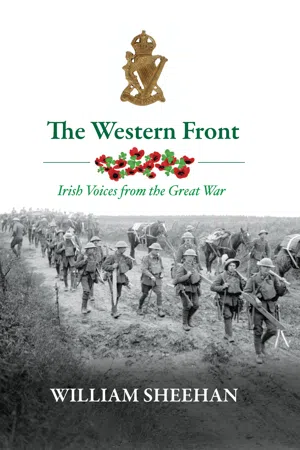
The Western Front tells the human story at the heart of a war that cost the lives of 35,000 Irishmen.
Compiled by one of Ireland's leading military historians, it recounts the experiences of the many ordinary Irishmen from all religions and backgrounds who fought in the Great War. In their own words, these men describe the horror of life in the trenches and their experience of combat during World War One.
The book gives readers a real insight into the hopes, thoughts and fears of the soldiers and officers who served in Irish regiments on the Western Front. Conveying not just the thrill of enlistment and training, but also the harsh reality of life during wartime, The Western Front offers a fascinating portrayal of what it was like to serve in the 'war to end all wars'.
On 4 August 1914, the German Empire invaded Belgium, and the British Government declared war on Germany. The German Army based their combat operations on the Schlieffen plan, and swept through Belgium and into Northern France. The British Expeditionary Force (BEF) had begun to arrive in France from early August and began to co-operate with the French Army in their efforts to protect Northern France. The force included many of the regular Irish battalions, such as the 4th (Royal Irish) Dragoon Guards, the 5th (Royal Irish) Lancers, the 2nd Royal Munster Fusiliers, the 1st Irish Guards, the 2nd Connaught Rangers, the 2nd Royal Irish Rifles and the 2nd Royal Irish Regiment, with the 2nd Royal Inniskilling Fusiliers arriving at the end of August. Many of the other Irish battalions were on imperial service. Indeed the first shot in anger by the BEF was fired by Corporal Edward Thomas of the 4th (Royal Irish) Dragoon Guards on 22 August outside Mons.
The Allied forces however could not hold back the German Army, and were forced to make a fighting retreat, which resulted in battles at Mons (24 August) and at Le Cateau (26 August). On 27 August, the 2nd Royal Munster Fusiliers arguably undertook the single greatest action by Irish arms in the twentieth century when they fought off far superior German numbers at Étreux to cover the retreat of the 1st Division. The action led to the loss of most of the battalion, a fate the 2nd Munster would experience several times during the War.
The tide turned for the Allied forces at the Marne (5–12 September) when the German advance was halted and pushed back, setting the stage for the trench warfare that would dominate the Western Front for the next five years.
Private David Starrett
9TH BATTALION, ROYAL IRISH RIFLES
Yes, the lads of Ulster in 1914 were ready to fight. We were the Ulster Volunteer Force of Carson’s Army. But little did we think we were drilling to fight not our own countrymen but the Germans.
Sergeant McIlwain
CONNAUGHT RANGERS
The smell of the turf fire smoke as I got out of the station and the bustling and noisy crowds busy on market day. It was the same loveable old Galway.
Lieutenant C.A. Brett
3RD BATTALION, CONNAUGHT RANGERS
My mother got me to write to the War Office seeking a commission in the Connaught Rangers, of which her friend Ford-Hutchinson was the Colonel of the 1st BN, and this I did, pointing out to it that I had served for almost four years in the Officers Training Corps at school (which I greatly enjoyed). I went to Dublin early in October and sat my exams (miraculously satisfactorily), staying in the Provost’s House where Dr Traill was lying ill. He died before the end of the month. Immediately on my return I received my Commission by post, with orders to buy myself a uniform and necessary kit (including bed and bedding) and report to the 3rd BN, the Connaught Rangers at Kinsale, County Cork.
Private A.R. Read
‘A’ COMPANY, LONDON IRISH RIFLES
All along the roads people were making a great fuss of the troops. At one halting place a coster came along with a barrowload of fruit and tipped everything among us and asked a policeman to take his barrow and then he enlisted. Cigarettes, chocolates, beer, lemonade and tea was supplied by everyone and although it was gladly accepted it soon began to make us feel uncomfortable and several chaps fell out. We halted at Elstree and made ourselves comfortable in some fields. Being August it was very warm weather and sleeping under the stars was lovely. Next morning on the road again early. The sun came out and we soon began to sweat, and our Regimental Band (which was composed of mostly middle-aged men) got fed up with playing so some of them let the big drum roll down a hill and it got smashed up. This was reported to the Colonel who to punish them gave orders that they were to play, but the row they made was simply awful and after all the boys ‘cut up rough’ the so called music stopped. Besides this Band we had a ‘Bag Pipe Band’ (at this time I think the only Territorial Band of Irish Pipers).
Lieutenant C.A. Brett
3RD BATTALION, CONNAUGHT RANGERS
I got to know my companions and roommates and spent hours off duty discussing drink, sex, and other matters about which it became clear that many of them knew much more than I did. It would not have been hard. Many new recruits were coming in every day; more than 700 joined us from the Falls Road, Belfast, alone. The barracks were very overcrowded, few of the men had uniforms or rifles, and squads in civilian clothes drilled daily with us in the Square.
Private A.R. Read
‘A’ COMPANY, LONDON IRISH RIFLES
In all there were about 20,000 troops. Here we started training in earnest. Bayonet fighting, firing practices, night operations, drills, route marching (which by stages [got] to 25 miles every Saturday morning), also physical drills and running exercises, Sunday being reserved for church parades at St Alban’s Cathedral or leave. Every man was medically examined and if unfit was sent away and others took their places, while we all had to sign forms agreeing to serve overseas.
Private David Starrett
9TH BATTALION, ROYAL IRISH RIFLES
Things were topsy-turvy, nothing good save the grub. ‘Acting’ Sergeants came round half a dozen times a day to ask your name. I doubt if some could spell their own. …The first two–three days was Babel. My! It was a picnic. Others as well as myself did not know what they belonged [to], so roamed together in and about the camp.
Lieutenant J.H. Butler
5TH BATTALION, ROYAL IRISH RIFLES
When the war began I was called up at once and hurried off to Belfast. I was just a few days over 17 then. I was very young indeed and knew nothing of the Army. I had been in the OTC at Haileybury but that was all. Fortunately the 5th BATTN RIR was filled up with recruit officers like me, though I was the youngest. We did some concentrated training and gradually began to know something of what was expected of us. My first independent job was to be in charge of the guard on water works near Lisburn at Stonyford. I had bought a Douglas motorcycle and was retuning one night to my guard when I hit an unlighted cart and knocked myself out. I was in hospital for a few days and then went back to the Battalion.
Being so young I was left in Belfast while the other subalterns went off with draft to France. I was furiously jealous and thought I would never get out to the war.
Lieutenant C.A. Brett
3RD BATTALION, CONNAUGHT RANGERS
In the early days at Kinsale I learned much. A guest night was held in Mess every Thursday night, at which we drank the toast to the King (in port, marsala, or sherry at 7d a glass) when there was a certain amount of horseplay and quite a lot of drink drunk. There I learned how to behave and how to drink. I got very drunk once and was violently sick and was heartily ashamed of myself and decided it was not worth it, though I always gladly drank my drink in moderation. In this connection I remember Christmas Day 1914. Colonel Lewin had to go the rounds of the various men’s and sergeant’s Messes before lunch on Christmas morning. There were 22 in all; at each he had to drink half a tumbler or more of whiskey. In consequence he was quite unable to bite his little finger when half round, but he did the complete round and was then put to bed by his wife.
Private A.R. Read
‘A’ COMPANY, LONDON IRISH RIFLES
Besides ourselves there were another Brigade of Territorials composed of the ‘North and South Staffords’; also ‘Lincoln Regiments’. These chaps were mostly miners and used to go to their trench-digging by train, carrying nothing except an overcoat and haversack. This they used to remind us of, and as a further taunt started a stunt of pinching cap badges. Then the fun started. Free fights were all over the town every night and it was quite the thing to walk out with an entrenching tool handle (a stick about 14 inches long) tucked up a sleeve, and soon the Guard Room was full up, also the Hospital, but I think that we let them see that ‘Cockneys’ could do their share when it came to a scrap, and nearly all of us had a cap badge of theirs as a memento of the ‘Battle of Braintree’.
Private David Starrett
9TH BATTALION, ROYAL IRISH RIFLES
We did not fare badly with our officers, though they had their faults, but whilst detecting the faults of their men, those like Captains Gafficken, Membry and Crozier hid their own.
Lieutenant C.A. Brett
3RD BATTALION, CONNAUGHT RANGERS
I was shortly sent to Dollymount, Dublin on a month’s course of machine gunnery, which pleased me very much. But it had its problems. Dollymount golf course had been converted into Ireland’s first School of Musketry, and this was the first course to be held. We lived and messed in the golf club house, and the club secretary was in charge of catering for which he charged 5/6d a day. Fair enough, but my pay was 5/3d a day. I was told that after the course I could claim ration allowance, but in the meantime I had to find the money to pay my Mess bills, and money was so short that for a time I was unable to afford to take a train into Dublin. However, I greatly enjoyed the course and passed out as a first class instructor of Maxim and Vickers guns. When I got back to Kinsale I was told I had been appointed Battalion machine gun officer and I was given an excellent reservist sergeant (Sgt Mulrooney) and about 30 hand-picked men. This was a splendid job, as no-one but me knew anything whatever of machine guns, and I had to teach my men from scratch.
Private David Starrett
9TH BATTALION, ROYAL IRISH RIFLES
Ballykinlar was a dismal hole, nothing but sandhills hemmed in by Dundrum bay … But it was in that dismal hole our boys were really trained to be one of the best fighting brigades in France.
Private J.L. Stewart Moore
12TH BATTALION, ROYAL IRISH RIFLES
We had a tremendous send-off from Ballymoney Station—half the countryside seemed to have gathered on the platform to say goodbye. There was great emotion and loud cheers as the train pulled out. There was a sort of feeling in the air that Clandeboye was only the first stage and perhaps we would be in Berlin by Christmas; the war could not last longer and we were all keen to get into it before it was over.
Arriving in Belfast we marched across from the Northern Counties to the County Down station and thence to Bangor. When we got to Clandeboye we found everything ready, the tents had been pitched and adequate preparation made, no shortage of essential food, water or blankets and no confusion, a great achievement on the part of those responsible especially when one remembers that there were four battalions in the camp, comprising in all about four thousand men. These battalions were the 11th Rifles from South Antrim, the 12th Rifles from North Antrim, the 13th Rifles from County Down and the Royal Irish Fusiliers from County Armagh. Together they formed the 108th Brigade. Our company was drawn from the Ballymoney, Portrush, Bushmills, Ballycastle area, was commanded by Sidney Lyle of Ballycastle, Miss Boyd’s estate agent. The majority were working class lads who had left school at the age of twelve and had never been away from home before, never slept out of the family bed...
Table of contents
Cover Page
Title Page
Author’s Note
Abbreviations
Introduction
Chapter 1: 1914
Chapter 2: 1915
Chapter 3: 1916
Chapter 4: 1917
Chapter 5: 1918
Glossary of Battles
Biographical Notes
Select Bibliographies
Images
Copyright
About the Author
Dedication
Acknowledgements
About the Publisher
Trusted by 375,005 students
Access to over 1.5 million titles for a fair monthly price.
Study more efficiently using our study tools.
Frequently asked questions
Yes, you can cancel anytime from the Subscription tab in your account settings on the Perlego website. Your subscription will stay active until the end of your current billing period. Learn how to cancel your subscription
No, books cannot be downloaded as external files, such as PDFs, for use outside of Perlego. However, you can download books within the Perlego app for offline reading on mobile or tablet. Learn how to download books offline
Perlego offers two plans: Essential and Complete
Essential is ideal for learners and professionals who enjoy exploring a wide range of subjects. Access the Essential Library with 800,000+ trusted titles and best-sellers across business, personal growth, and the humanities. Includes unlimited reading time and Standard Read Aloud voice.
Complete: Perfect for advanced learners and researchers needing full, unrestricted access. Unlock 1.5M+ books across hundreds of subjects, including academic and specialized titles. The Complete Plan also includes advanced features like Premium Read Aloud and Research Assistant.
Both plans are available with monthly, semester, or annual billing cycles.
We are an online textbook subscription service, where you can get access to an entire online library for less than the price of a single book per month. With over 1.5 million books across 990+ topics, we’ve got you covered! Learn about our mission
Look out for the read-aloud symbol on your next book to see if you can listen to it. The read-aloud tool reads text aloud for you, highlighting the text as it is being read. You can pause it, speed it up and slow it down. Learn more about Read Aloud
Yes! You can use the Perlego app on both iOS and Android devices to read anytime, anywhere — even offline. Perfect for commutes or when you’re on the go. Please note we cannot support devices running on iOS 13 and Android 7 or earlier. Learn more about using the app
Yes, you can access The The Western Front by William Sheehan in PDF and/or ePUB format, as well as other popular books in History & Military Biographies. We have over 1.5 million books available in our catalogue for you to explore.