- 544 pages
- English
- ePUB (mobile friendly)
- Available on iOS & Android
eBook - ePub
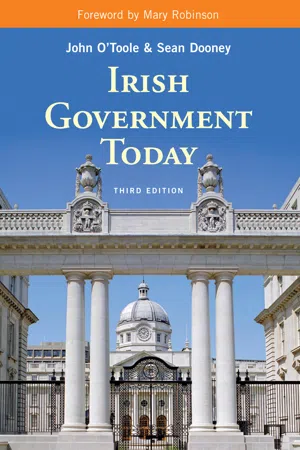
Irish Government Today
About this book
A thoroughly revised and updated edition of this acclaimed text that reflects the extensive changes in the Irish system of government, including strategic management, parliamentary procedures and the management of EU business.
An essential book for understanding the workings of Irish Government, it discusses freedom of information and new developments in information technology and reflects the significant changes that have taken place in the machinery of government in recent years.
An essential book for students of Irish Studies, law, journalism, politics, public sector management and business studies.
The book covers:
- The Government and the Taoiseach
- Ministers and their Departments
- The Dáil and the Seanad
- The Constitution of Ireland
- The President of Ireland
- The Civil Service
- The Judiciary, Courts and Legal Officers
- Local Government
- State Agencies and Bodies
- The Health Services
- Appeals
- The Impact of the European Union
- The Management of Government
Information
1

THE GOVERNMENT AND THE TAOISEACH
Structure and Scope of the Government
The Constitution acknowledges that all powers of government derive, under God, from the people, whose right it is to designate the rulers of the state; that the state is to be governed in accordance with the provisions of the Constitution; that the executive power of the state is exercised by or on the authority of the government; and that the government is responsible to the Dáil. The government consists of not less than seven and not more than fifteen members. It is frequently referred to as the cabinet, though this term does not appear in the Constitution. The members are selected by the Taoiseach, and in the case of a coalition government by agreement between the leaders of the parties involved, and appointed by the President. No specific qualifications, beyond membership of the Oireachtas, are prescribed for membership of the government, but it is generally accepted that, in the selection of ministers, considerations of general ability, suitability for particular portfolios, personal popularity, service to or standing in the party and geographical location are matters taken into account. The Taoiseach may request a minister to resign, and if he or she refuses to do so, the President, on the advice of the Taoiseach, must terminate the minister’s appointment.
The government meets and acts as a collective authority and is collectively responsible for the departments of state. The Constitution contains no specification regarding the number of departments (this depends largely on the preferences of individual Taoisigh), and if there are more than fifteen at any time, individual ministers are assigned responsibility for more than one department. The Taoiseach and the Tánaiste, as well as the Minister for Finance, must be members of the Dáil; the other members of the government must be members of the Dáil or the Seanad, but not more than two may be members of the latter body. (Since the foundation of the state there have, in fact, been only three appointments of senators to the government: Joseph Connolly in 1932, Seán Moylan in 1957 and James Dooge in 1981.) Every member of the government has the right to attend and be heard in each House of the Oireachtas. On the dissolution of the Dáil, ministers continue to carry on their duties and hold office until their successors are appointed.
In addition to its general provision that the government is the chief executive organ of the state, the Constitution contains express provisions relating to the powers, duties and functions of the government in certain matters. For example, in relation to the public finances, the Minister for Finance presents the estimates to the Dáil after detailed consultation with the other members of the government, and it is the government that has final control over the form and amounts of the estimates, as well as the responsibility for them. The Dáil may not authorise the spending of money for any purpose unless such spending has first been authorised by the government and recommended to the Dáil by the Taoiseach.
The distribution of business between the government departments and the designation of members of the government to be the ministers in charge of particular departments are matters governed by law. The law is contained in the various Ministers and Secretaries Acts, the earliest of which was passed in 1924 and the most recent in 2007, which increased from seventeen to twenty the number of ministers of state that may be appointed by the government. The 1924 act designated the eleven departments then set up and indicated the work allocated to each. It provided that the minister in charge of each department would be a corporation sole, i.e. that the minister could sue and be sued as a corporate entity rather than as an individual. Subsequent acts provide for the setting up of new departments and outline their work. Under the Public Service Management Act 1997 managerial responsibility for the department is assigned to the secretary general, while the minister remains responsible for the administration of the department.
The harp is used as the emblem of the state by the government, its agencies and its representatives at home and abroad. It is the principal element of the seals of the office of President and of all government ministers. The harp is also found on the obverse of euro coins minted in Ireland. It has been used as a national symbol for over five hundred years.
The Work of the Government
In addition to the Ministers and Secretaries Acts, there are various acts that confer functions and powers on the government. For example, the government appoints the Data Protection Commissioner, members of the Review Body on Higher Remuneration in the Public Sector, the chairpersons of some state-sponsored bodies, senior officers of An Garda Síochána and the members of the Higher Education Authority and it decides on applications by barristers to become members of the inner bar and to be designated senior counsel. As the chief executive organ of the state, the government also has a considerable amount of work to do besides that which is specifically conferred on it either by the Constitution or by statute. This work includes such diverse duties as considering applications for increases in air fares, allocating emergency aid to groups affected by natural disaster, appointing army officers, approving cultural agreements with countries abroad, refurbishing government buildings and considering visits to Ireland by foreign heads of state.
A major task, which impinges on every citizen, is the consideration of the advice and recommendations of the officials in the Department of Finance and the Office of the Revenue Commissioners relating to the total tax revenue for the year ahead. Within this total, the government decides on the changes to be made in the rates and scope of individual taxes and also on the introduction of new taxes or the abolition of existing ones. Factors that the government takes into account include the estimated expenditure on what are called goods and services for the year ahead, the level of Exchequer borrowing and the desirability of reducing this, the estimates of tax revenue based on existing rates, the effects on the economy and the individual sectors thereof of increasing or decreasing individual rates, the need for equity between the various groups in the community, EU requirements in regard to reduction in rates of value added tax and of excise duties, and political commitments made by the parties in government before an election or as part of a post-election government programme in regard to taxation matters. Such matters are considered by the government over a number of meetings, and the final decisions are announced by the Minister for Finance during the budget speech.
The government is the centre of the administrative system in Ireland. In a sense it is Ireland’s board of directors: formulating policies, promoting legislation and directing the operations of the various departments of state. Farrell (1988b: 42) describes the cabinet as a ‘closed group . . . bound together by shared experience . . . indisputably in charge of the executive organs of the state and usually able to push through its own legislative programme’.
The Public Services Organisation Review Group elaborated on the role of government in its 1969 report (known as the Devlin report):
In addition to the basic functions of defence of the nation against outside aggression and maintenance of law and order, the role of government now embraces the provision of adequate health, education and welfare services. It also embraces the provision of environmental services and assistance of cultural activities. Government must exercise some regulatory function in regard to individual enterprise and ensure that the rights of the individual are exercised with due regard to the general good. It encourages economic activity in the private sector, and there are certain activities which it has undertaken itself.
The government has two main tasks. First, it has to run the country, under the Constitution in accordance with the rules laid down by the Oireachtas and with the resources granted by, and accounted for to, the Oireachtas each year. Secondly, it deals in the Oireachtas with changes affecting the community . . . Through its legislative programme (including financial measures) the government exercises its main influence over the future development of the country; thereby it influences the economy and the structure of society. Acting collectively, the ministers decide what is needed and how it should be achieved; their decisions depend on the quality of the information available to them and on their assessment of the requirements. They will, of course, become aware of these requirements in several ways – through their political machine, through the press and through the representations of the interests concerned – but, primarily, they will need to know the emerging needs of the community through the public service which operates existing programmes.
When Dr Garret FitzGerald formed his first coalition government in 1981 he announced the appointment of Mr Alexis Fitzgerald as special adviser to the government, with the right to attend government meetings. In 1994 Taoiseach John Bruton allowed one minister of state (Pat Rabbitte) to attend cabinet meetings. This post became known as the ‘super junior’ minister of state. The Taoiseach outlined this role to the Dáil as follows:
The Minister of State to the Government attends Government meetings in the same way as the Government Chief Whip. He receives all Government papers and participates in discussions at Cabinet. Like the Government Chief Whip and the Attorney General, he is not entitled to vote should an occasion arise where that would be necessary. However, as this Government is committed to conducting its business on the basis of consensus, the fact that the Minister of State does not have a vote at Cabinet does not have any real significance (Dáil Debates, 25 January 1995, vol. 448).
In the Fianna Fáil/Progressive Democrats coalition government formed in 1997, then Minister of State at the Department of the Environment, Robert Molloy, was given similar treatment in order to give the Progressive Democrats a second presence at cabinet meetings. In 2005 Brian Lenihan assumed the role of ‘super junior’ Minister for Children, Brendan Smith was appointed to a similar position in 2007, as was Barry Andrews in 2008. The post of minister of state was created in 1977 to replace an older post of parliamentary secretary. There were ten minister of state posts in 1977; this number increased to fifteen in 1980, seventeen in 1995, twenty in 2007; it was reduced to fifteen in 2009.
Legislation
Ministerial proposals that call for new or amending legislation must always be submitted to the government. If approval is given, the papers are sent to the Attorney General’s office, where a bill is drafted by the office of the parliamentary counsel. The bill (at this stage known as a ‘white print’) is submitted to the government to approve the text and to authorise the minister concerned to present it to the Dáil (or Seanad) and have it circulated to members.
Before the government brings forward any legislation, it may publish a green paper (a document setting out its proposals and inviting suggestions thereon) or a white paper (a statement of decisions taken). Any such papers are prepared in the promoting department. Bills (other than those dealing with budgetary matters or estimates) are usually, when published, accompanied by an explanatory statement outlining the existing law and how the new bill proposes to change it.
The government has great power and influence in the system. Mitchell (2003: 241) notes:
Irish governments (at least majority governments) have not been heavily constrained or monitored by other institutions and agencies, least of all by Parliament. It is tempting to conclude that the Irish political system has been strong on delegation and weak on accountability. While the system generally appears to have been quite successful, the recent and ongoing attempts at reform need to constrain agents and hold them accountable for their actions in government.
Other Business
The government agenda also includes matters that ministers consider it advisable to bring to their colleagues’ notice. For example, the Minister for Foreign Affairs will communicate information on political developments abroad and their consequences; or the Minister for Justice will inform colleagues about criminal matters. Among the many items regularly laid before the government for scrutiny are the annual reports and accounts of state-sponsored bodies before their presentation to the Oireachtas.
Farrell (1988b: 76) comments:
The available evidence . . . suggests a considerable degree of overload in the Irish cabinet system. The complex, the controversial and the insoluble compete with the current, the commonplace and the critical for scarce time and attention on the government agenda. The internal problems of Northern Ireland, the latest transport strike, the painful disciplines of controlling public expenditure, the dismissal of a postman, the effects of technical developments in the EC policies, the appointment of a Supreme Court judge, the timing of a by-election, the detailed discussion of major legislation and a myriad of other things crowd out considerations of longer-term strategic planning.
There are also what are loosely termed ‘twelve o’clock’ or informal items. The phrase derives from an arrangement whereby the government sets aside time for consideration of matters that are not on the formal agenda which a minister wishes to raise informally and which may be dealt with quickly, for example any matters of current topical interest. Ministers also use this procedure to consult their colleagues informally as to the attitude they should take in relation to matters that come to them for decision on a day-to-day basis in the management of their departments but which might not be regarded as suitable for submission to the government in the normal manner. Ministers may also wish to signal in advance problems that have arisen in their respective areas and in relation to which they may be submitting formal proposals at a later date. Matters thus mentioned might include strikes or pay disputes, petrol prices, proposals for visits abroad on St Patrick’s Day, meetings with deputations or the attitude to be taken on a private member’s bill. Business initiated in this way is rarely the subject of a formal government decision, but any informal decisions are conveyed by the government secretariat to the relevant ministerial offices, usually by teleph...
Table of contents
- Cover
- Title Page
- Contents
- Foreword by Mary Robinson
- Preface
- Acknowledgments
- 1 The Government and the Taoiseach
- 2 Ministers and their Departments
- 3 The Dáil and the Seanad
- 4 The Constitution of Ireland
- 5 The President of Ireland
- 6 The Civil Service
- 7 The Judiciary, Courts and Legal Officers
- 8 Local Government
- 9 State Agencies and Bodies
- 10 The Health Services
- 11 Appeals and Inquiries
- 12 The Impact of the European Union
- 13 The Management of Government
- References
- Copyright
- About the Authors
- About Gill & Macmillan
Trusted by 375,005 students
Access to over 1.5 million titles for a fair monthly price.
Study more efficiently using our study tools.
Frequently asked questions
Yes, you can cancel anytime from the Subscription tab in your account settings on the Perlego website. Your subscription will stay active until the end of your current billing period. Learn how to cancel your subscription
No, books cannot be downloaded as external files, such as PDFs, for use outside of Perlego. However, you can download books within the Perlego app for offline reading on mobile or tablet. Learn how to download books offline
Perlego offers two plans: Essential and Complete
- Essential is ideal for learners and professionals who enjoy exploring a wide range of subjects. Access the Essential Library with 800,000+ trusted titles and best-sellers across business, personal growth, and the humanities. Includes unlimited reading time and Standard Read Aloud voice.
- Complete: Perfect for advanced learners and researchers needing full, unrestricted access. Unlock 1.5M+ books across hundreds of subjects, including academic and specialized titles. The Complete Plan also includes advanced features like Premium Read Aloud and Research Assistant.
We are an online textbook subscription service, where you can get access to an entire online library for less than the price of a single book per month. With over 1.5 million books across 990+ topics, we’ve got you covered! Learn about our mission
Look out for the read-aloud symbol on your next book to see if you can listen to it. The read-aloud tool reads text aloud for you, highlighting the text as it is being read. You can pause it, speed it up and slow it down. Learn more about Read Aloud
Yes! You can use the Perlego app on both iOS and Android devices to read anytime, anywhere — even offline. Perfect for commutes or when you’re on the go.
Please note we cannot support devices running on iOS 13 and Android 7 or earlier. Learn more about using the app
Please note we cannot support devices running on iOS 13 and Android 7 or earlier. Learn more about using the app
Yes, you can access Irish Government Today by John O'Toole in PDF and/or ePUB format, as well as other popular books in Politics & International Relations & American Government. We have over 1.5 million books available in our catalogue for you to explore.