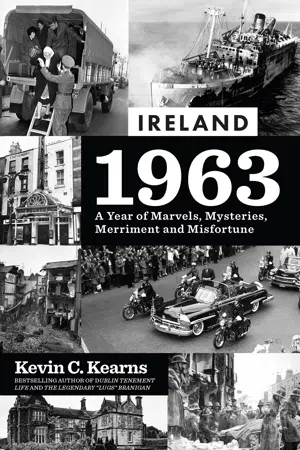
For over 30 years, renowned author and historian Kevin C. Kearns has been recording and publishing the valuable memories and recollections of Dubliners. In his latest book, he revisits the extraordinary year of 1963, bringing to life the voices of the ordinary people who lived through it in a way no conventional history could match.It was a year like no other. Not for any one monumental event, but for an astonishing sequence of occurrences – triumphs and tragedies, joys and sorrows – that spanned all twelve months.Ireland 1963 deftly records the unrelenting roller coaster ride of dramas, traumas and mysteries of that year: a biblical-like flash flood, tenement collapses and victims, the liberating Bingo Craze, and a frightening 'mystery caller' posing as a priest. And, of course, it was the year of President Kennedy's rapturous four-day visit to Ireland.The year reached its climax with fear for thirty Irish passengers aboard the liner Lakonia, "ablaze and sinking" at sea during Christmas week. Yet, a series of happy and frolicsome events throughout the year balanced people's emotions and brought great joy to their lives.Such a bewildering and fascinating year demands a grass-roots type of social history, one that is biographical in nature. Kevin C. Kearns humanises these events by relying on oral history from participants and observers who were on the scene over fifty years ago. Their words and emotions bring a riveting authenticity and immediacy to this wondrous biography of the extraordinary year of 1963.
No-one, it seemed, had spotted his missing leprechaun.
The respectable middle-aged man, attired in suit and tie, had just left the Olympia Theatre in Dublin after the evening’s performance. Walking hurriedly along Dame Street, wearing a distressed expression, he politely, and earnestly, asked people in his path, ‘Pardon me, but have you seen my leprechaun?’
Puzzled by the odd question from a refined stranger, they kindly replied, ‘No, I’m afraid I haven’t.’
Then the man was off again down the street, looking left and right. Befuddled by the brief encounter, most people glanced back over their shoulders, wondering what in the world he was talking about.
The merry month of December was off to a good start with a spell of fine weather and excellent offerings at Dublin’s cinemas and theatres. The Meteorological Office described the comfortable winter conditions as ‘quiet and relatively mild with moderate winds from the southwest or west’ – perfect weather for the throngs of Christmas shoppers jamming the streets in high spirits. And the weather was projected to last all the way to New Year’s Eve. Meteorologists seemed confident that the year 1962 would depart benignly and with dignity.
Throughout the first two weeks of the month the weather indeed remained mild and calm, with patches of fog at times. Shoppers didn’t have to worry about getting soaked, frozen or wind-whipped, as so often happened in December. This allowed adults and children to linger outside, enjoying the dazzling decorations as streets were festooned with red, green and gold garlands, and with bells, wreaths and holly. Seeing the elaborate window displays at Clery’s, Switzer’s, Arnott’s and Brown Thomas, children pressed their noses against the panes to see Santa’s workshop busy with elves and reindeer. Carol singers, comfortable for a change, sang with unusual verve. During the sunny spells many people strolled through St Stephen’s Green, coveting benches on which to rest their weary legs.
First-rate films and stage shows were always an attraction at Christmastime, competing for audiences. The management of the Olympia proudly put on an extraordinary stage performance that was awing patrons as well as the press. It had succeeded in booking Paul Goldin’s famous hypnotism show, which was the rage of Europe, astonishing and transfixing audiences, and leaving them incredulous at what they had seen. As the theatre critic for the Irish Press wrote:
the French telepathist was quite amazing, giving a fantastic demonstration of his gift which he calls a mastery of the sixth sense – thought.2
Enrapt audiences had never seen such inexplicable feats of the mind. Drawing upon verified, impartial volunteers from the audience, who he referred to as his ‘subjects’, he quickly addressed any sceptics in the house. To anyone doubting the authenticity of his performance he offered £1,000, if he ‘could be proved a “hoaxer”.’ Debunkers could have a try if they wished.
The audience, which happened to include psychologists and garda superintendents as well as theatre critics, watched him bring his subjects ‘under his spell’. One demonstration was a favourite of the patrons: he could command a person, who would then be under his mental control, to carry out the most absurd, hilarious deeds. Dignified volunteers might be reduced to performing puerile acts – without realising it. In one case a shy woman from the audience began ‘howling like a six-month-old baby’. In another a man commenced seriously playing non-existent musical instruments. People laughed uproariously.
And another man ended up on his hands and knees, searching frantically for his missing (invisible) leprechaun.
One esteemed theatre critic wrote that he marvelled at Goldin’s ability as a telepathist, absolutely convinced of the authenticity of the performance. He noted that the audience was ‘tickled pink by the absurd antics’ of his courageous volunteers, who had been forewarned that his spell might not wear off until some time after the show.
——
By 15 December there was the usual flood of Irish people returning from Britain and elsewhere to spend the holidays at home with family and friends. They were delighted to find such pleasant weather. Shops were bustling, with many reporting business to be up by as much as a quarter on the previous year. Although some women were complaining about turkey prices being high, it didn’t deter most from plucking a fat one to take home.
One week before Christmas, weather forecasters described conditions for Dublin as ‘fresh and breezy with light showers’ and mild temperatures more like spring than winter. Their indications were still that the enjoyable weather would continue through Christmas and beyond. People were counting on it.
However, ‘unbeknownst to the nation, a dramatic change’ began taking place on 18 December ‘over the cold plains of western Russia as an arctic ridge of high pressure extended down into northeastern Europe.’3 As Ireland was enjoying Atlantic weather, an Arctic system was slowly churning towards continental Europe. Yet Ireland’s meteorologists did not issue any warnings or describe dramatic changes on the way. This left many people wistfully hoping for one of those rare white Christmases. The last one was seen in the 1940s. It looked like they would have to be satisfied with the artificial snow in Grafton Street shop windows.
Some happy news arrived from New York. Time had chosen Pope John XXIII as its ‘man of the year’ for 1962. He was the first religious leader to be given the accolade, bestowed for ‘what neither science nor diplomacy can provide: a sense of unity as a human family.’ His encyclical Pacem in Terris condemned racism and endorsed the rights of the world’s workers. He was especially revered by the Irish people for having ‘humanised’ the Catholic Church. People felt a close, loving bond with him. Irish newspapers carried Time’s announcement for all to read.
By 23 December, with Christmas just around the corner, the arctic invader had marched deeper into Europe as cold air from Russia was being fed westward by an intense anti-cyclone. Snow and freezing temperatures crept across the continent. Ice was already forming in some coastal inlets around the Danish coast – a worrying sign.
On Christmas Eve in Ireland the weather proved fickle, displaying ‘many moods’. During the day, as people scurried about doing last-minute tasks, some ‘brilliant sunshine’ prevailed for a while. By evening this gave way to ‘chilly grey overcast’ conditions in Dublin. Overnight it would change again, leaving a ‘sparkling white frost’, hazardous to drivers and pedestrians heading to Mass.
But it was on Christmas Day that the real change set in. An unwanted present arrived: as a ‘cold, polar airstream was bearing down on Ireland’, the temperature tumbled down towards the freezing mark. People indoors, enjoying good conversation before a warm hearth, would not have realised what lay ahead.
Then the first snowflakes, fat and fluffy, drifted down from the grey clouds. Gradually the few became a gentle flurry, first along the east coast, then moving westwards. Some people rushed to their windows to exclaim, ‘Snow! Oh, isn’t it wonderful!’ As the flakes stuck to surfaces, a white coating was being created on the cityscape. In Dublin, by 10 p.m. the streets were layered with a slight frosting – barely enough for the meteorologists to declare it ‘officially a “white Christmas”.’
It was just enough for the Irish Times to state, ‘Snow was visitor on Christmas Day’, for the first time in nearly two decades. Now wouldn’t it be grand, many thought, if only there could be more snow before New Year’s Eve so that the children could go sledging? Meteorologists tried to comply with their wishes, predicting that, along with falling temperatures, ‘we may see more snow’.
In Dublin, snow at Christmastime not only beautified the city but helped to silence its cacophony, creating an unusual atmosphere of urban tranquillity. That year, however, the traditional calmness of St Stephen’s Day was disrupted by a harsh intrusion that assaulted people’s eardrums. As the Irish Times put it, ‘the customary quiet of Anna Liffey was shattered’ when speedboats raced in the Castrol Cup for the first time. Their piercing high-powered engines in the heart of the city – right after Christmas – offended the sensibilities of Dubliners. It was an event with 16 speedboats racing back and forth between Butt Bridge and Capel Street – for fifty-five laps! Complaints would flow in for weeks.
By contrast, the Christmas holiday in Limerick was ‘one of the quietest on record’. This was with the notable exception of the docks, where the ship Zapadnaya Dvina had arrived. The Russian seamen ‘provided some excitement’, it was reported. Because they did not celebrate Christmas, they faced inactivity and boredom when everything in Limerick shut down. Soon they fell into arguing, which deteriorated into a real row. The shouting drew some local people, who went down to watch, making it one of the liveliest Christmas pageants in town.
The ship’s captain decided to settle the dispute in the traditional manner: a duel out on the dockside. With fists. A referee was appointed from among the crew as the ringleaders of the two factions fought it out. For the spectators the entertainment was brief, as the younger and stronger of the two duellists was quickly declared the winner. But it gave Limerick folk something to talk about for a few days.
——
By 27 December the polar freezing had reached the western coast of Europe. Word was received that ten people had died in France on Christmas Day alone. Some snow was now falling along Ireland’s east coast, in some places up to six inches. Many Dubliners gleefully took advantage of the snow on the slopes at Stepaside to enjoy tobogganing. It was the type of falling snow – as opposed to a wind-driven snowstorm – that people had hoped for.
During that night ‘most of the country shivered under snow, sleet or hail as the cold spell continued.’ In some places the temperature plummeted perilously below freezing. Most counties were now coated with some snow and ice. Motorists were warned by the Automobile Association of driving dangers and told not to go out unless absolutely necessary. Already motorists were reported as being trapped in heavy snowdrifts near the Sally Gap in the Wicklow Mountains, the passengers marooned. Some stranded occupants saw the lights at the Kippure television transmission station and headed towards them for shelter.
On Sunday, the 30th, the weather changed dramatically. By midday a blizzard was raging through parts of counties Wicklow, Dublin, Wexford, Meath, Kildare, Louth and Cork. The landscape was being buried in drifting snow; vehicles were stuck and passengers trapped, and villages were smothered and isolated. One Co. Wicklow farmer, facing twenty-foot drifts on his land, said it was the worst he had seen in his seventy years.
Normal life was becoming paralysed. No-one was prepared. The Government stood mute, unresponsive to the sudden crisis.
Without warning, people were caught in dire circumstances, left to their own initiative. At Kippure, one of the technicians had to go outside to check on equipment only a short distance away. But the gale-force winds held him captive outside. When staff members missed his return, they went in search and rescued him. But the Telefís Éireann crew stationed there were now cut off, as the road to their 2,400-foot mast was made impassable by snowdrifts. No food or water could now reach them.
In Dublin early on Sunday morning, before the blizzard had arrived, Brendan Leathem and Emmet Bergin, van-drivers for Independent Newspapers, were preparing for their regular delivery in the area around Tallaght. It was a trip they’d made umpteen times before. Without forewarning, they had neither heavy clothing nor digging tools. They weren’t long out on the lonely road in the dark before the wind kicked up and snow started blowing and drifting. Then their windscreen began freezing over. When they were confronted with near gale-force winds and blinding snow they realised they were in the teeth of a raging blizzard. About thirty miles from Dublin they became bogged down in a snowdrift.
They climbed out and began trekking with heads down, trying to follow a fast-disappearing road. Hours later, and nearly frozen, they reached Baltinglass, Co. Wicklow, where they found shelter at the Garda station. Here they were given tea, bedding – and safety. Unknown to them, Bergin’s father, the former senator Patrick Bergin, and a friend, Michael Fleming, had set out by car from Dublin in the swirling snow to find them. But they quickly became snowbound as well.
By Sunday afternoon the winds were reaching seventy miles an hour, whipping up twenty-foot snowdrifts. Buses were becoming stranded on rural roads, some with dozens of frightened passengers. The drivers and conductors were left helpless to assist them. Some twenty-five hikers of An Óige had set out that weekend for a pleasant hike through the Wicklow Mountains, ill-clothed and ill-prepared. Concern for their welfare was mounting.
People living along the east coast stood by their windows in awe of nature’s force as monstrous waves of up to thirty feet roared in, smashing sea walls. Among them was Una Malone, a native of Nenagh, Co. Tipperary. She had just returned home to Ireland for the holidays to be with family and friends.
On Sunday 30 December she was staying with friends in Dalkey, Co. Dublin, where the blizzard was particularly vicious. But what a spectacle it was to watch from the window! One crashing wave followed another. By the afternoon she was so intrigued that she decided to go outside to get a closer look and feel its fury. She bundled herself up and headed down to the harbour. Reaching the slipway, she crept a few feet further down. Meanwhile, another resident of the house, Donal Murphy, was watching her with curiosity from his window. And with growing concern.
With an awful suddenness, an enormous wave from what the Irish Independent called the ‘mountainous seas’ rolled in, lifting her like a mannequin and sucking her out into the roiling grey abyss. Shocked, Murphy ran frantically to notify the emergency services, who raised the alarm. But it was far too dangerous for the lifeboat crews to put out at sea.
Everyone knew there was little hope for her survival. She would be among the first to be claimed by the brutal winter of 1962/3.
On Sunday night another harrowing drama was unfolding. On the Hill of Howth, Pat Carthy was returning home when he slipped on an icy, disused railway track and broke his leg. He shouted for help at the top of his lungs, but, with the howling wind, no-one heard him. Here he lay, helpless, near 10 p.m., a hundred yards from the nearest house. He could still see flickering lights in windows, adding frustration to his pain. All he was wearing was a suit and a lightweight mac. A bachelor, he knew there was no-one to immediately miss him. He strained to think clearly:
My leg was in terrible agony. My hands and face lost their feeling. Desperately I tried to keep my mind active. Then suddenly the lights started to go out one by one.4
He knew he would now face the night alone.
The following morning, New Year’s Eve, people ordinarily awoke with thoughts of welcoming in the new year. But this was no ordinary year. Much of the country was in cr...
Table of contents
Cover
Title Page
Dedication
Contents
Prologue
1. 1962’s Churlish Farewell
2. ‘A Grim Start to the New Year’
3. Tears for the Dearly Departed
4. The ‘Great Walk’ and the UCD Hikers’ Tragedy
5. Commotion in the Streets and on the Docks
6. Mysteries and Marvels
7. A Woeful Whit Weekend
8. Flash Flood!
9. ‘Two Angels’
10. Homecoming: Jitters and Jubilation
11. Homecoming: Rapture
12. Homecoming: Family Gathering and Garden Party
13. Relko’s Riddle, Bingo Craze and Olympia’s Jeopardy
14. Jumping for Joy
15. A Macabre Murder Mystery
16. UFOs, Unisex, Sharks and a Princess
17. Theatre Drama, and Drivers, Beware!
18. Beatlemania!
19. Imperilled Treasures
20. ‘Johnny, We Hardly Knew Ye’
21. ‘Ablaze and Sinking!’
22. ‘The Most Unique Year of the Century’
Postscript
Notes
Illustrations
Acknowledgements
Copyright
About the Author
About Gill Books
Trusted by 375,005 students
Access to over 1.5 million titles for a fair monthly price.
Study more efficiently using our study tools.
Frequently asked questions
Yes, you can cancel anytime from the Subscription tab in your account settings on the Perlego website. Your subscription will stay active until the end of your current billing period. Learn how to cancel your subscription
No, books cannot be downloaded as external files, such as PDFs, for use outside of Perlego. However, you can download books within the Perlego app for offline reading on mobile or tablet. Learn how to download books offline
Perlego offers two plans: Essential and Complete
Essential is ideal for learners and professionals who enjoy exploring a wide range of subjects. Access the Essential Library with 800,000+ trusted titles and best-sellers across business, personal growth, and the humanities. Includes unlimited reading time and Standard Read Aloud voice.
Complete: Perfect for advanced learners and researchers needing full, unrestricted access. Unlock 1.5M+ books across hundreds of subjects, including academic and specialized titles. The Complete Plan also includes advanced features like Premium Read Aloud and Research Assistant.
Both plans are available with monthly, semester, or annual billing cycles.
We are an online textbook subscription service, where you can get access to an entire online library for less than the price of a single book per month. With over 1.5 million books across 990+ topics, we’ve got you covered! Learn about our mission
Look out for the read-aloud symbol on your next book to see if you can listen to it. The read-aloud tool reads text aloud for you, highlighting the text as it is being read. You can pause it, speed it up and slow it down. Learn more about Read Aloud
Yes! You can use the Perlego app on both iOS and Android devices to read anytime, anywhere — even offline. Perfect for commutes or when you’re on the go. Please note we cannot support devices running on iOS 13 and Android 7 or earlier. Learn more about using the app
Yes, you can access Ireland 1963 by Kevin C. Kearns in PDF and/or ePUB format, as well as other popular books in History & 20th Century History. We have over 1.5 million books available in our catalogue for you to explore.