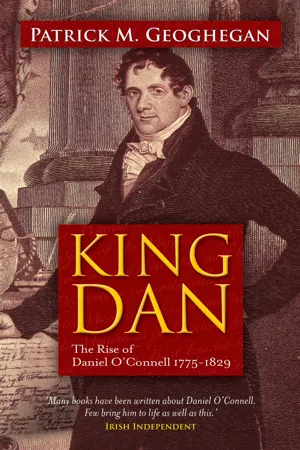
Daniel O'Connell, often referred to as The Liberator, was an Irish political leader in the first half of the 19th century. One of the most remarkable historical figures in Irish history, he campaigned for Catholic Emancipation, including the right for Catholics to sit in the Westminster Parliament, and repeal of the Act of Union which combined Great Britain and Ireland.
Famous in his day as the most feared lawyer in Ireland, O'Connell tormented judges, terrorised opposing barristers, and won a reputation for saving the lives of so many men who would otherwise have been hanged. He became 'The Counsellor', the fearless defender of the people.
He secured that reputation through his campaign for Catholic emancipation when he founded the first successful mass democratic movement in European history, and became 'The Liberator'.
‘I was born with strong feelings’.1 Daniel O’Connell was born on 6 August 1775, the eldest son of Morgan O’Connell, a farmer at Carhen, near Cahirciveen, Co. Kerry, and his wife, Catherine O’Connell (née O’Mullane). There are different accounts about where he was born, but he himself was certain he was born at the small farmhouse of his parents at Carhen.2 His parents had married in 1771 at the church of the Holy Trinity in Cork, a Protestant church because of legal requirements for inheriting property, but with a Catholic priest officiating.3 O’Connell took great pleasure in later years in pointing out that he was born at the start of what became the American War of Independence, and he liked to suggest that this coincidence ‘shadowed forth his destiny as a champion of freedom’.4 Even in his lifetime mythical stories were told of his birth. It was said that he was ‘the gift of God’, that his parents had been childless until his mother gave a generous gift to a priest, and in return was rewarded with the gift of a son.5 The first-born of a large family, he had three younger brothers, Maurice, John, and James, and five sisters. Daniel liked to boast of his ancient and noble lineage, but the reality is that by the eighteenth century the family was fairly undistinguished. It was more accurate to say, as he also sometimes did, that he was ‘the son of a country gentleman’.6 The head of the family was Maurice O’Connell, the second but eldest surviving son of Donal Mór and Máire Ní Dhuibh, and the brother of Morgan. Maurice was known as ‘Hunting Cap’, after the velvet hat he took to wearing after a tax had been placed on beaver hats, his previous headgear of choice.7 He lived in seclusion at Derrynane in Kerry, amassing a large fortune through various legal and illegal ways, including smuggling. A fourth son of Donal Mór and Máire Ní Dhuibh was called Daniel O’Connell, and he joined the French army at an early age, rising to the rank of general. Máire Ní Dhuibh was an extraordinary figure, revered and feared in equal measure for her wisdom and forthright views. Frequently consulted by the locals, she was unafraid to attack those who disagreed with her using vicious sarcasm and strong language, and it was later said that the future Liberator inherited from her ‘his muscular mind and power of invective’.8 She was also a poet of some renown and much of her work was political. In one poem in Irish she prophesised that ‘A greater chief from me shall yet be born/To triumph over ocean’s haughty lord’.9 As a baby, Daniel was sent to be nursed and fostered by the wife of his father’s herdsman, who lived in a cabin on the Iveragh mountains, and he remained there until he was four.
When O’Connell was three the American sailor Paul Jones hovered off the coast of Kerry. There was great excitement at the time, and O’Connell was brought to the shore in his nurse’s arms. He later claimed to remember the whole thing ‘perfectly’, and it certainly appears to have been one of his earliest memories.10 Two boats came ashore. On-board were men who had been sent by Paul Jones with ‘towing ropes to get his vessel out of shallow water’. They were former prisoners of war, British and Irish, who had been imprisoned in Brest until given the opportunity to serve the other side at sea. However the men took the opportunity to escape, cutting the ropes and heading for the safety of the shore. Relieved to be free, the men left their fire-arms on the boats, and went to the nearest public house to get drunk. The locals, terrified of the men, drenched the weapons with water and then called the local magistrate, who arrested the sailors. O’Connell’s memory, despite his young age, was probably accurate enough. He vividly remembered a tall man, mounted on a grey horse, who seemed to be ‘the lawyer of the party’ and who protested at the men being arrested.11 This image of the man fighting against the authorities made a lasting impression. As no charges could be sustained, the sailors were released.
‘I was born within the sound of the everlasting waves’.12 O’Connell loved the sea and as a child was spellbound by ‘the varying sounds emitted by marine shells’.13 He enjoyed greatly his visits to Derrynane, about nine miles away from Carhen, and in later years described poetically ‘the mountain waves coming in from the illimitable ocean in majestic succession, expending their gigantic force, and throwing up stupendous masses of foam, against the more gigantic mountain cliffs that fence this my native spot’. Listening to the sea, O’Connell liked to imagine the adventures of long-dead Irish heroes. As he later recounted, ‘Yes! My expanding spirit delighted in these day-dreams’, and from them he developed an enthusiasm ‘which no disappointment can embitter nor accumulating years diminish’. This enthusiasm was ‘the high resolve to leave my native land better after my death than I found her at my birth and, if possible, to make her what she ought to be’.
At the age of four he returned to his parents’ house. As a child he could be shy and silent and Hunting Cap despaired that anything would come of him; apparently he told O’Connell’s mother that ‘Daniel will be a blockhead’.14 However at other times he could be unruly, especially when it came to his schooling when he was unwilling to take instruction. A travelling hedge-school master called David O’Mahony was hired to teach him but O’Connell was uncontrollable. Struggling to make any impression, O’Mahony gently combed his tangled hair one morning and this kindness apparently won him over.15 O’Connell was now willing to learn and O’Mahony taught him the alphabet. O’Connell later boasted that he learned the alphabet in a single hour. From the beginning he was intensely competitive and this was a defining part of his character throughout his life. By his own admission, he ‘desired to excel, and could not brook the idea of being inferior to others’.16 His own family said of him that he had a burning desire to be the best at whatever he attempted, that if he ‘was only a pothole digger he’d be the first of pothole diggers’.17
The first ‘big book’ that he read was Captain James Cook’s A voyage towards the South Pole, and round the world, published in two volumes, in 1784.18 He took it everywhere with him until it was finished, reading it with ‘intense avidity’. Even when the local children came and asked him to play with them he refused, running away and taking his book to the window in the housekeeper’s room where he would sit, with his legs crossed, ‘devouring the adventures of Cook’. For a brief time, O’Connell was obsessed with exploration and traced out the maps from the book. It made him, he said, ‘a good geographer’ and he could not recall ‘a book that took a greater grasp’ of him. And so he would ignore his friends, preferring to sit with his book, ‘reading it, sometimes crying over it, while the other boys were playing’.
O’Connell was a lazy child. However ‘the fear of disgrace’ often motivated him to work hard at the last moment, and he boasted that he was ‘remarkably quick and persevering’.19 One day in school he was idling, and was caught by the teacher. Found ‘imperfect in my lesson’, he was about to receive a beating. But O’Connell, even then, was able to talk his way out of trouble. He ‘shrank from the indignity, exclaiming, “Oh, don’t beat me for one half hour! If I haven’t my lesson by that time, beat me then!”’ The teacher granted O’Connell his reprieve, and the lesson, though ‘rather a difficult one, was thoroughly learned’.20 O’Connell’s lifelong love of the theatre began as a child and it was said that at the age of ten he composed a drama about the fortunes of the house of Stuart.21
Hunting Cap often bought the Dublin Magazine, which was sold at Carhen, and the young Daniel enjoyed looking at the portraits of important people and reading the biographical sketches which accompanied them. As O’Connell later admitted, ‘I was always an ambitious fellow, and I often used to say to myself, “I wonder will my visage ever appear in the Dublin Magazine?” I knew at that time of no greater notoriety’.22 In September 1810, when O’Connell was walking through the Dublin streets after a Catholic meeting he saw the Dublin Magazine in a window bearing a portrait of ‘Counsellor O’Connell’. He remembered his childish ambition and ‘said to myself with a smile, “Here are my boyish dreams of glory realised.”’23 It is an indication of O’Connell’s vanity that he did remember and was still telling the story in his sixties. However he insisted that he ‘had long outgrown that species of ambition’ by 1810, although it had clearly been superseded, if not quite replaced, by greater ones.24
From the beginning O’Connell was precocious and had an extraordinary belief in his own destiny. Many children have fanciful ideas about their future, but O’Connell never forgot his dreams of making an impression on the world. Even at the end of his life he recollected that at the age of seven he had ‘felt a presentiment that I should write my name on the page of history’.25 This was the year 1782, when everyone was discussing the triumph of legislative independence and the victory of Henry Grattan and the Irish parliamentarians. O’Connell admired the Volunteers who had helped make legislative independence possible and, even as an adult, had a romantic attachment to them. When Lord Charlemont’s son was considering reorganising them in the 1840s, O’Connell expressed an interest in becoming colonel of the first regiment of Dublin Volunteers.26 When asked whether this contradicted his views on non-violence, he denied it saying would ‘be a pacific band; its existence would quietly achieve our rights by showing the futility of resisting them’.
One evening at his parent’s house in Carhen, sometime after the winning of legislative independence, the guests began discussing the political events of the day. Everyone had an opinion on who had made a greater contribution to Ireland, Henry Grattan or Henry Flood, and there followed a similar debate about the relative achievements of Henry Grattan and Lord Charlemont. During these debates O’Connell sat ‘lolling back’ in a large old chair, ‘musing to himself and sometimes thinking aloud, apparently unconscious of anyone’s presence’.27 He had a serious look on his face and, whenever he was asked a question, answered only with a monosyllable, before returning to his reverie and staring out the window. Finally, a female relative asked him, ‘Daniel, what are you doing? What are you thinking of?’ His response was never forgotten by the woman: ‘I am thinking that I’ll make a stir in the world yet’.28
Henry Grattan was O’Connell’s boyhood idol.29 And the winning of legislative independence in 1782 was the event that O’Connell would return to throughout his career. But despite his admiration for Grattan, he supported his great rival, Henry Flood, over the question of renunciation in 1782–3, although it is not possible to date when he developed this belief, and it might well have been an adult opinion. Flood believed that legislative independence alone would never be enough and that the British government should be forced to renounce for ever any right to legislate for Ireland. In his later years O’Connell rambled, claiming that ‘if Flood had succeeded, it is my firm conviction that the Union could never have passed’.30 But here O’Connell was confused and in error: a Renunciation Act was passed in 1783, and it had no effect whatever on the Union seventeen years later.
O’Connell loved Kerry and, in particular, Glancara, near the lake of Cahara, which had been in his family for generations. In old age he speculated that if he was ever to take a title it would be ‘earl of Glancara’.31 O’Connell had many happy memories of childhood adventures there. One story he was fond of telling involved an encounter with a bull in a field. The bull chased after him and O’Connell found his escape cut off by a ditch. So he turned round an...
Table of contents
Cover
Title
Introduction
Acknowledgments
Prologue: The Doneraile Conspiracy, 1829
1. ‘The Fortunate Youth’, 1775–1793
2. Young Dan: Life in London, 1793–1796
3. ‘In the Service of Liberty’: O’Connell in Dublin, 1797–1799
4. The Counsellor: Daniel O’Connell and the Law, 1799–1830
5. ‘The Text-Book of my Political Career’: Opposing the Act of Union, 1800
6. Confronting a Culture of Defeat, 1801–1810
7. ‘Hated by Some, Disliked by Many’: the Agitator, 1811–1814
8. ‘A Bad Business’: Affairs of Honour, 1815
9. Debts and Despair, 1816–1820
10. ‘An Unprincipled Libertine’: the Private Life of Daniel O’Connell
11. ‘A Restless Existence’: Deciding on New Strategies, 1821–1824
12. Big O and Sir Glory: a Comedy in Three Acts, 1825
13. ‘The Wand of the Enchanter’: Mobilising the Masses, 1826–1827
14. Liberation, 1828–1829
Abbreviations
References
Bibliography
Copyright
About the Author
Also by this Author
About the Publisher
Other Ebooks Available
Trusted by 375,005 students
Access to over 1.5 million titles for a fair monthly price.
Study more efficiently using our study tools.
Frequently asked questions
Yes, you can cancel anytime from the Subscription tab in your account settings on the Perlego website. Your subscription will stay active until the end of your current billing period. Learn how to cancel your subscription
No, books cannot be downloaded as external files, such as PDFs, for use outside of Perlego. However, you can download books within the Perlego app for offline reading on mobile or tablet. Learn how to download books offline
Perlego offers two plans: Essential and Complete
Essential is ideal for learners and professionals who enjoy exploring a wide range of subjects. Access the Essential Library with 800,000+ trusted titles and best-sellers across business, personal growth, and the humanities. Includes unlimited reading time and Standard Read Aloud voice.
Complete: Perfect for advanced learners and researchers needing full, unrestricted access. Unlock 1.5M+ books across hundreds of subjects, including academic and specialized titles. The Complete Plan also includes advanced features like Premium Read Aloud and Research Assistant.
Both plans are available with monthly, semester, or annual billing cycles.
We are an online textbook subscription service, where you can get access to an entire online library for less than the price of a single book per month. With over 1.5 million books across 990+ topics, we’ve got you covered! Learn about our mission
Look out for the read-aloud symbol on your next book to see if you can listen to it. The read-aloud tool reads text aloud for you, highlighting the text as it is being read. You can pause it, speed it up and slow it down. Learn more about Read Aloud
Yes! You can use the Perlego app on both iOS and Android devices to read anytime, anywhere — even offline. Perfect for commutes or when you’re on the go. Please note we cannot support devices running on iOS 13 and Android 7 or earlier. Learn more about using the app
Yes, you can access King Dan Daniel O'Connell 1775-1829 by Patrick M. Geoghegan in PDF and/or ePUB format, as well as other popular books in History & Historical Biographies. We have over 1.5 million books available in our catalogue for you to explore.