eBook - ePub
From Ordinary to Extraordinary – How to Live An Exceptional Life
Practical Tools and Techniques to Transform Your Life
- 256 pages
- English
- ePUB (mobile friendly)
- Available on iOS & Android
eBook - ePub
From Ordinary to Extraordinary – How to Live An Exceptional Life
Practical Tools and Techniques to Transform Your Life
About this book
If you feel at times that life is just passing you by, if you feel that you are being distracted from being your best, or if you know you could do it given half the chance — then this is the book for you!
Many of us think that you have to be born talented to succeed. However, recent scientific research has proven that the genes you are born with are open to influence. This book will teach you how to reprogram your mind for success. Brian Colbert will teach you the practical tools and techniques to transform your life into the special experience you deserve to have.
Utilising Neuro-Linguistic Programming (NLP), psychology, Taoism and Zen Buddhism, Brian explains how to reveal your hidden talents and how to uncover the ever elusive X-factor and make it your own.
From Ordinary to Extraordinary teaches you:
- How to revolutionize your mind, your moods and your motivations.
- How to handle opportunities, challenges and life transitions.
- How to influence, persuade and help others as you make your way to the top.
- How to stay on the path and master the rules of your true potential.
From Ordinary to Extraordinary: Table of Contents
Introduction
- The Path of the Extraordinary
- Lessons from the Extraordinary
- Tapping Into Uncommon Sense
- Creating Extraordinary Relationships
- Body Talk
- Going Mental
- Keeping Extraordinary Relationships
- Getting Past What's Stopping You
- Mind Your Language
- The Stages of Life
- The Rules of Engagement
- Modelling ExcellenceConclusion
Information
Topic
Personal DevelopmentSubtopic
Personal SuccessCHAPTER 1
The Path of the Extraordinary

All the evidence that we have indicates that it is reasonable to assume in practically every human being, certainly in almost every newborn baby, that there is an active will toward health, an impulse toward growth, or toward the actualization of human potentialities.
Abraham Maslow
Most of us are intrigued by the lives of the rich and famous. We like to get a look in, put ourselves in their shoes and wonder what it would be like if we were in their role. This interest extends itself to celebrities and successful people from all walks of life. There are articles, books and magazines filled with ‘How I made it to the top’ stories. We read, we study, we pick up tips and we might even apply a few; but we rarely seem to get as far as we would like. ‘You have to have what it takes’, ‘You need to work hard to succeed’; we have heard it all before and we will hear it again. We love rags-to-riches stories but deep down we believe them to be the exception rather than the rule. There appears to be something missing: that ever-elusive X-factor, that secret ingredient that makes all the difference. Is it belief? Is it luck? Is it genetic? Is it IQ, EQ or sucking up to HQ? Whatever it is, it seems to be out of our reach. In the end, some of us settle for fascination with the lives of others. We spend our time being bystanders, instead of making our own lives something worth envying.
If you want to be the best you can be, if you want to reach your full potential, then it makes sense to study those who have already reached theirs. Obviously, each person will have their own take on things, so what is needed is a system that covers the overall process rather than individual idiosyncrasies. In NLP (Neuro-Linguistic Programming) we call this process modelling.
First, we will look at the process that leads to living an exceptional life. As we do so, we will explore the obstacles and distractions that stand in the way of you realising your highest ambitions, the things that cause inconsistencies and the reasons why there are more ordinary than extraordinary days in your life. Think of this as the time to tilt the balance back in your favour.
Once we have done this, we can come up with a working model that combines the qualities of peak performance, genius, self-actualization and enlightenment. In working with this model, I will demonstrate how you can generate the skills required of it. This will give you the ability and the scope to add so much more sparkle to your life. And so, you can begin to live the life you were born to live!
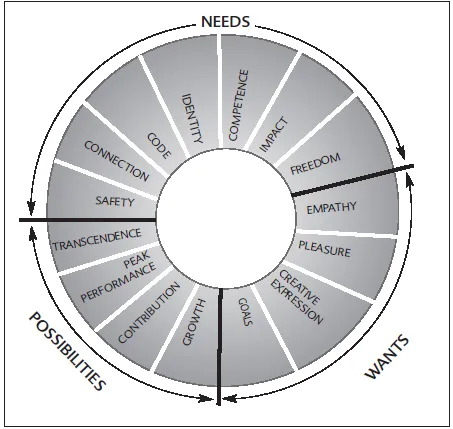
The Wheel of Human Potential
Examine the chart above. It points towards the fact that we have to satisfy our survival needs before we can meet other needs. Our most basic needs include food, shelter, warmth and reproduction. Alongside these needs there are, in my opinion, further needs that are just as important. In my first book, The Happiness Habit, I addressed these core needs as Human Fulfilment Drives. To place them in a wider context in this book, I will reframe them as Human Fulfilment Needs. These are the critical needs that we are driven to satisfy no matter what. These needs reflect the human experience at its most basic. They drive our behaviour and occupy our attention. If they are absent, we seek them. We are out of balance without them. They are the ‘must-haves’, the ‘non-negotiables’ without which we fail to function at the most basic level of normality. These needs offer the backdrop to our core values and set the tone of our fundamental perceptions of life.
In addition to the Human Fulfilment Needs are Human Fulfilment Wants. While they aren’t critical for survival, they play a vital role in our psychological and emotional health. A well-adjusted human being will satisfy their Human Fulfilment Wants.
Beyond the Human Fulfilment Wants are Human Fulfilment Possibilities. These are what make us extraordinary. We can live perfectly good lives without these possibilities, but living with them energises our life experience and takes it to a whole new level. This is the shift from ordinary to extraordinary! It is not something you have to do but it is something that is well worth doing. When you get even the slightest hint of this move towards the extraordinary, perhaps during a moment of brilliance, your life bathes in the enchanting afterglow. The Human Fulfilment Possibilities are the high hanging fruits. You may need to stretch a little to reach them but the sweetest fruits are always at the top.
Now let’s explore every element of the Wheel of Human Potential in more detail.
Human Fulfilment Needs
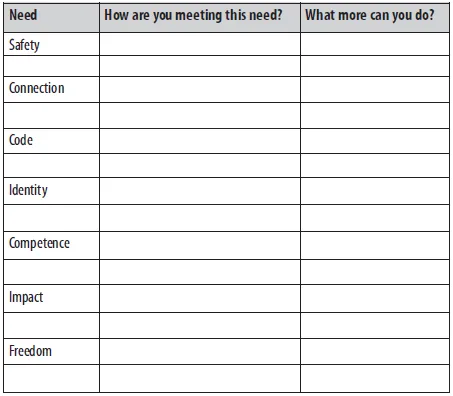
There are seven Human Fulfilment Needs: safety, connection, code, identity, competence, impact and freedom.
Safety
Each of us feels the need to be safe. Safety comes when you know there will be enough food on the table, the bills can be paid and you can put your head to the pillow without having to worry about what is going to happen next.
Connection
We all want to love and be loved. We want to be accepted, respected and validated by our chosen groups, tribes or communities.
Code
Whether we choose to break them or not, we need to know that there are rules and guidelines. This gives us a sense of certainty and balance in the world. Our codes reflect the boundaries, standards and beliefs to which we hold ourselves (and others) accountable and answerable.
Identity
As much as we need to know what the rules are, we also need to know who we are and what we stand for. A person’s identity is made up of all seven Human Fulfilment Needs.
Competence
Each of us has an inbuilt need to be good at something and to be known for this competence. This gives us a sense of recognition and validation.
Impact
The scriptwriter Leo Rosten once wrote: ‘I cannot believe that the purpose of life is to be happy … the purpose of life is … to matter, to count, to stand for something, to have made some difference that you lived at all.’ To be good at something is one thing; to be good for something is quite another. Each of us needs to know that we are important, significant and needed in some way. We need to know that who we are and what we do counts for something.
Freedom
In my opinion, being free and feeling free are horses of a different colour. Few people want total freedom because being free like that means not being attached to anything, which goes against our need for connection. However, we do need to feel free to come and go as we please within reason. Freedom is a balancing act and we are all prepared to give up certain freedoms for the sake of meeting other social needs.
Summary
Human Fulfilment Needs tend to operate progressively. When our need for safety is met, this gives rise to the need for connection, which in turn leads to a need for code, and so on. Over time, these needs work simultaneously and become interdependent. For example, if a person loses their job, they will lose a number of things at once. They may go through the following thought process:
I am being made redundant.
Safety: What am I going to do for money now?
Connection: There goes the weekends out with the lads.
Impact: I guess nobody appreciates good craftsmanship anymore.
Competence: Who is going to employ me now? This is all I know how to do.
Code: I guess there’s nothing more I can do.
Freedom: I’ll have to tighten the belt, put a load of things on hold and just sit it out until things get better.
Identity: Right now this all feels like a big blur. I don’t know what end of me is up. I mean, I don’t know whether I’m coming or going. I don’t know. I just don’t know …
The above thought process takes you through an assault on the seven Human Fulfilment Needs. When a person loses their job, their feeling of safety is affected. Their feeling of connection may also be affected. When both of these needs are hit, this may bring about a questioning of identity. The problem will be exasperated if work is the place where the individual feels they make an impact and express their competence. If that person is the sole earner in the household, you can be sure that their freedom will be severely restricted because of losing their job.
If a person fails to restore this balance, they could feel helpless, hopeless and worthless over time. This is a real challenge to their sense of humanity and it is not a healthy state of mind for anyone to occupy. Balance is needed. In this case, re-employment is certainly a solution but there are other ways of restoring balance. All effort and attention now naturally shifts to meeting these Human Fulfilment Needs. This will happen with or without conscious intent, since the person is now in survival mode. Even if the person remains unemployed, over time their life will show evidence of these needs being met elsewhere. Perhaps they will volunteer for charity work, help their neighbours or take on some DIY projects. Regardless of what goes on in our lives, at all times we are either meeting these Human Fulfilment Needs or working towards meeting them.
Exercise: Assessment of Human Fulfilment Needs
Here is an example of one person’s assessment of their need for impact.
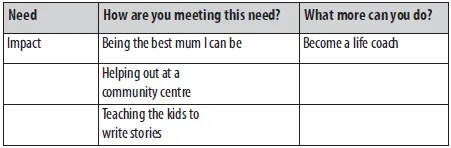
Assess how each of the Human Fulfilment Needs is being met in your life.
Human Fulfilment Wants
Once our Human Fulfilment Needs are being met, we want for other things: things that make us feel good about ourselves and about life in general. These are the Human Fulfilment Wants: things that add sparkle and give meaning to our lives.
When you can find avenues to express Human Fulfilment Wants, life is good. You are happy with your lot. You plod along and deal with the good and the bad in equal measure. You take things in your stride and, overall, you are happy. You can spend time with people who understand you and accept you for who you are. There are no apologies or modifications needed: these are your kind of people. All is well in your world... Well, that might be a bit of a stretch. Life is not always wonderful, but overall you get to do what you want. You get to go where you want. You have some plans for your life and even if things get tough at times, at least once a week you get that Friday feeling! You have the time, opportunity and resources to let your hair down and have some fun. (In my case, letting my hair down is purely metaphorical: my forehead has been elongating for quite some time now, so I don’t have that luxury )
There are four Human Fulfilment Wants: empathy, pleasure, creative expression and goals.
Empathy
It feels really good to know that you are on the same wavelength as someone else and that you can be there for them in times of need or challenge. We love to give advice; it makes us feel important. We all seek to understand and to be understood. It gives us a sense of belonging and provides us with the ability to make meaningful connections. Empathy is the skill that allows us to form healthy relationships. It is the glue that bonds us together. It gives us the ability to walk a mile in another person’s shoes. (And, as the joke says, if by that time you still don’t understand them, at least you have their shoes and you’re a mile away!)
Pleasure
Life is meant to be good. You are meant to enjoy it. You are meant to have fun. This does not have to be ‘the valley of tears’. That is just someone else’s take on it and they are well dead by now. As the saying goes: ‘We are here for a good time, not for a long time!’ I am Irish – the Roman Catholic variety. I always felt that Protestants were brought up to work hard but still enjoy life, while Roman Catholics were told to g...
Table of contents
- Cover
- Title Page
- Epigraph
- About your Mind of Genius Audio Track
- Introduction
- 1. The Path of the Extraordinary
- 2. Lessons from the Extraordinary
- 3. Tapping Into Uncommon Sense
- 4. Creating Extraordinary Relationships
- 5. Body Talk
- 6. Going Mental
- 7. Keeping Extraordinary Relationships
- 8. Getting Past What’s Stopping You
- 9. Mind Your Language
- 10. The Stages of Life
- 11. The Rules of Engagement
- 12. Modelling Excellence
- Conclusion
- Bibliography
- Irish Institute of NLP
- Dedication
- Acknowledgments
- Copyright Page
- About the Author
- About Gill & Macmillan
Trusted by 375,005 students
Access to over 1.5 million titles for a fair monthly price.
Study more efficiently using our study tools.
Frequently asked questions
Yes, you can cancel anytime from the Subscription tab in your account settings on the Perlego website. Your subscription will stay active until the end of your current billing period. Learn how to cancel your subscription
No, books cannot be downloaded as external files, such as PDFs, for use outside of Perlego. However, you can download books within the Perlego app for offline reading on mobile or tablet. Learn how to download books offline
Perlego offers two plans: Essential and Complete
- Essential is ideal for learners and professionals who enjoy exploring a wide range of subjects. Access the Essential Library with 800,000+ trusted titles and best-sellers across business, personal growth, and the humanities. Includes unlimited reading time and Standard Read Aloud voice.
- Complete: Perfect for advanced learners and researchers needing full, unrestricted access. Unlock 1.5M+ books across hundreds of subjects, including academic and specialized titles. The Complete Plan also includes advanced features like Premium Read Aloud and Research Assistant.
We are an online textbook subscription service, where you can get access to an entire online library for less than the price of a single book per month. With over 1.5 million books across 990+ topics, we’ve got you covered! Learn about our mission
Look out for the read-aloud symbol on your next book to see if you can listen to it. The read-aloud tool reads text aloud for you, highlighting the text as it is being read. You can pause it, speed it up and slow it down. Learn more about Read Aloud
Yes! You can use the Perlego app on both iOS and Android devices to read anytime, anywhere — even offline. Perfect for commutes or when you’re on the go.
Please note we cannot support devices running on iOS 13 and Android 7 or earlier. Learn more about using the app
Please note we cannot support devices running on iOS 13 and Android 7 or earlier. Learn more about using the app
Yes, you can access From Ordinary to Extraordinary – How to Live An Exceptional Life by Brian Colbert in PDF and/or ePUB format, as well as other popular books in Personal Development & Personal Success. We have over 1.5 million books available in our catalogue for you to explore.