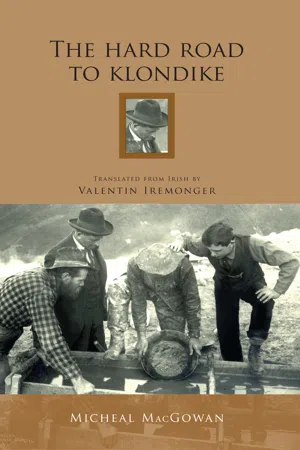
Micheal MacGowan was born in 1865 in the parish of Cloghaneely in the Donegal gaeltacht. He was the eldest of twelve children in a poverty-stricken family, living in a thatched cottage and speaking no English. He ended his days in a large slate-roofed house in the same place. First published in Irish as Rotha Mór an tSaol, this is his account of the fate dealt to him by 'the Wheel of Life'. From the age of nine he was hired out for six consecutive summers at a hiring fee of 30 shillings. After emigration to Scotland and the drudgery of farmwork, he left for America and worked his way across the USA in steelmills and mines to Montana. He then took part in the Klondike gold-rush and vividly recounts his adventures and hardships in the primitive icy wastes of the Yukon. Home on holiday in 1901, he fell in love and stayed, using the money from the gold to buy land and a house. Told with the certainty and authority of someone who has 'lived' what he describes, this book reflects the author's indomitable spirit and loyalty to his native place and culture. He died in 1948.
- English
- ePUB (mobile friendly)
- Available on iOS & Android
eBook - ePub
The Hard Road To Klondike
About this book
Information
Subtopic
Historical BiographiesIndex
Social SciencesV
Between Two Lands

RUMOURS OF GOLD
Michael MacCarthy had a wonderful story for us on the St. Patrick’s Day of that year 1897. Some man named Carmac had found a nugget of gold the previous summer in the icy region of north-west Canada. There were plenty of stories in the papers about it, MacCarthy told us. People in the big towns along the coast of America—places like Seattle and Portland—were talking of going there as quickly as they could. Those who were up in Klondike already were writing letters to their relatives about the wealth they had got and something of what they were saying was being published in local newspapers. MacCarthy told us this at Granite Mountain; we started to talk of going to Klondike ourselves and having a look at the place. We knew that the journey was very long and that it would involve a lot of wretchedness, hunger and suffering; but we didn’t mind that too much. We were wan with the wretchedness by this time. Our bit of money was getting scarce as well but that didn’t worry us either because the way it was out there was every person helping the next—the man that had nothing himself would neither want nor suffer as long as one of his comrades had a bit at all. They used to divide among themselves as if they were brothers and the man that paid back what he borrowed from time to time need have no fear at all.
At this time, we hadn’t enough money to get us all up to Klondike. Some of the men that were present weren’t too keen on the business anyhow. A couple of older men said that they had often heard stories like this before, but that none of them saw yet the gold that everyone was talking about. Maybe the story was only a newspaperman’s exaggeration, an unfounded rumour, that wouldn’t be heard of in a couple of months. These thought that they’d stay where they were until the miners came back to the coast with the gold. There were five or six of us in the company, however, that were eager to see this new country and we knew that whoever got there first would get whatever gold was to be had. Since we hadn’t enough money between us to get us all moving, it was decided that only three would go—MacCarthy and two others. We drew lots ‘long and short’, to find out who would go and it fell to Hugh McGinley and Jim Anthony out of my own parish to undertake the journey. Jim had come over from Ireland with me and had been with me in the silver mines and on the whole journey through the mountains after that. I was sorry enough that we were parting now but it was inevitable so I didn’t oppose it. I knew he’d send for us as soon as ever he found out if it was worth our while making the same journey.
As soon as the three got all the things they needed—no small amount for there’d be nothing waiting for them in Klondike—off they went, heading for the coast and beyond. The summer would be starting before they would have reached Seattle or Portland and of course there would be no boat going north until then when the thaw would have set in opening up the bays and rivers of Alaska. After they had gone, I went with an old comrade of mine, Owen Cormac, across to Butte where, at this time, they were mining for copper. There was a good price to be had for that mineral but, even so, we were worried that we wouldn’t get any work as there were a lot of men hanging around idle. But, just then, there were few of the men that were mining in Montana that I didn’t know and we were only a short time in Butte when I came across a man from the North of Ireland that recognized me. He was a foreman in the copper mine and he gave the two of us a start.
The mine was very unhealthy on account of the amount of sulphur or brimstone that was in the copper but the pay was good and we worked away as well as we were able. We kept saying to ourselves that we would be only a short time there as we were waiting impatiently every day for news from our companions who had gone to Klondike. Well, a full season went by and another one, month succeeded month and every month seemed to us to be as long as a year. In the end, we were actually over a year waiting before they sent for us.
HITCH-HIKING TO THE COAST
By the end of July in 1898, I heard from Jim Anthony that they were working in Klondike, that there was plenty of gold and that they themselves were making a good bit. They had suffered a lot of hardship on the way out, he said, because they had gone through Dyea on the coast of Alaska and, from there, through the mountain passes, through bogs and lakes and rivers until they reached Dawson City from the south. He recommended that we should go to the mouth of the Yukon and get a boat there that would take us right up the river the whole way entering Dawson from the north. This, he thought, was the best and the easiest way from every point of view.
We didn’t spend much time discussing the venture. We got ourselves together to go to them and a long journey it was that faced us. Indeed, if we had known when we were leaving Butte what lay before us, I’m telling you we’d have stayed where we were for ever. Our pockets weren’t too heavy the day we left but we wouldn’t be long in Klondike until every mother’s son of us would have them filled with gold. We got together little baskets of food—meat, bread and such—to bring with us. We knew only too well that it would be a long time until we got a bit anywhere else. About ten of us set out from the town of Butte to a place where a goods train passed that would take us a good bit of the way if we managed to jump it.
In America at that time, it wasn’t usual for workmen like ourselves to spend much money on travelling when we were able to get a free ride. There were a lot of hoboes who used go from place to place on the trains, ‘riding the brake-rods’ as we used to call it, or ‘riding the blind baggage’ (the space between two carriages) or on the roof itself. Riding like this was more than dangerous and many’s the man was killed if he loosened his grip for a second, sliding under the wheels or being hit by a water-pipe or something of that kind as he moved along the cat-walk. But we intended to get a right comfortable ride—inside a carriage—if it was at all possible. We slipped into the station in two’s and three’s, keeping ourselves in hiding as far as we could. It wasn’t long until the train came and I’d say it was a mile long if it was an inch. There were eighty coal-wagons and there was only one engine to pull the lot. It couldn’t, therefore, go very fast and it had to stop here near Butte to take on more water. The engine left the carriages standing and went around another way to get the water; and that’s when we started searching for some way in. In the end, we found a carriage that had a lot of different goods in it and we slipped inside it without any busybody seeing us. We put the lock on the door then and sat back at our ease on big wooden boxes until the train started.
We were on the train through the night until we reached Missoula. This was about a hundred and fifty or two hundred miles from the place we left—towards the north-west. By this time, it was daylight and we couldn’t go any further on this train. We said goodbye to it one after another as it was drawing in towards Missoula station. Nobody paid any attention to us throughout this operation or told us that we had no right to be where we were.
We spent the day taking it easy until another train like it would come by us in the evening. It came in good time and we made sure to get into a carriage the same as we had done the day before. Out with us then through the hills—the Bitter-Root Mountains—and on through a big wide countryside where, as far as the eye could see, there was neither house nor hut. ‘Prairie’ is what that kind of country is called and we went through a couple of hundred miles of it through Idaho and into the state of Washington. There was no beating it for a way of travelling, I thought; and then it happened!
The group that was with me in the carriage was young and lively and lighthearted and had a good share of devilment. When they found themselves away out in the hinterland, what did some of them do but open some of the boxes that they were sitting on to see what was in them. And what, of all things, was in some of them but spirits—not one bottle but a dozen or so in every crate. Three or four of us didn’t want to have anything to do with them. We felt that it would be a poor return for a free ride and, particularly as we had jumped the train, that we’d all end up in prison if it was found out. But there was no use talking. We were hungry and thirsty and the temptation was too great.
Well, it was good and it wasn’t bad until some of the boys got merry and started to sing. They weren’t English songs they sang either but the fine old Gaelic songs that our people way back home used to sing: ‘The Red-haired Man’s Wife’, ‘The Bright Autumn Stubble’, ‘The Summer Will Come’, and many more that I don’t remember now. And as I’m on the story, I don’t think anybody spoke a word of English on that long journey from Butte in Montana. Anyway, the songs were rising bravely from us and wasn’t it the worst of luck that one of the train-team came by above us—the guard. He didn’t know that there was anybody at all on his train but he heard the noise and the ructions and as quick as you like, he was in on top of us. A flood of abuse poured from him to begin with and then he demanded money from us. Some of us were well satisfied to give him a little but there were others in the company who threatened that it would go hard with anybody who gave him a red cent; what they ordered was that he should get outside as fast as his two legs would carry him. He said no more but got out with a look on his face that would ‘stop a wake’.
While we were in Missoula, we collected a good deal of information about the trains and we were told that this one should stop in a particular town where a lot of trains came together. I don’t remember the name of the town now but, anyway, we intended to jump off the train as soon as it would start to lose speed. Instead, what happened was that when we came towards this station, the driver accelerated and away with us towards Portland or some other of the towns out south. We knew that if we stayed on it, it would take us a couple of hundred miles out of our way and, as well as that, we’d be arrested as soon as it stopped. We were in a right fix but it seemed to us that it would be a poor thing that we’d give them the satisfaction of throwing us into prison after all we had been through. We resolved that we’d look to leaving the train—and that’s what started the talking! It was travelling at a spanking pace by this time but we had no choice—every man of us would have to take a death-jump. We grabbed whatever bags and baggage we had and fired them out through the window. At that, the first man that was ready leaped out after the baggage. One after another followed suit and, thanks be to God, none of us was injured. All that happened was that we were very much separated by the time the last man was out. I’m sure there were almost five miles between the first man who jumped and the last man and all the baggage was strewn along in the same way. We had to gather all that up and each man waited for the next until we all came together again. We were tired and played out by then but, if we were, we were well satisfied that we left only empty space for the man on the train.
When we were all well together, it was the middle of the night and there we were, strangers in unknown country, without the slightest knowledge about the place in which we found ourselves. We thought the best thing we could do was to walk westwards until we came to a house or a dwelling-place where we could ask the way of somebody. Off with us along by the railroad and, after a lengthy walk in the darkness, we reached a place where there was a public house and a couple of other houses. We gave a good loud knock on the door and it wasn’t long till the owner stuck his head out of the upper window. He heard us down below talking in Irish—and the first greeting he gave us was to ask, in the purest Irish, what the devil were we up to at that hour of the night. He questioned us as to where we came from and, when he was told, he came down on the spot and let us in. He was as surprised and delighted to meet Irish speakers like this as we were ourselves to meet one, in such a place. But that’s the way it was in America then. You’d never know the time or the place when you’d come across an Irishman and, when you did, you’d frequently find that he was from Donegal. This man was one of the O’Beirnes of Glencolumbkille and for a long time, he said, he had been working for the railway company in the town of Tacoma on the coast. He did so well there that he was able to give up the job and buy himself a hotel just where we were. He told us that we were only three or four score miles from Tacoma and that it wasn’t far from there to Seattle. He gave us food and drinks generously and plentifully and we spent the rest of the night very much at our ease with him.
The next morning when we’d had a bite to eat, we roamed on again and that day was as hot a one as ever blew out of the sky. I believe that the summers are usually like that on the prairies in the State of Washington that we were crossing. O’Beirne mentioned that the trains didn’t stop anywhere around this area—and the reason was because there weren’t many people living around since the ground was so burnt and sterile. We walked on, therefore, as briskly as we could, trying to shorten the road to the coast. We were all hot—too much so—and the perspiration was running down us from top to toe. We still had between two and three score miles to slog through over the mountains between us and the sea; and between the sweat and the coal-dust, our clothes were filthy. We felt miserable and could only think how a wash would give us great relief and cool us. We spent the night on the prairie and at last, when the sun was high in the sky the next day, we came by a good-sized stream. We stopped there, took off our clothes, washed them and hung them out on the trees to dry. In the evening, we put them on us clean and we were ready for the road again. Later in the night as it got nice and cool, we pushed off again and kept going throughout the night until we reached the big town of Tacoma by the break of day. We were fagged out entirely by then and we spent the whole day without moving anywhere.
LIFE IN SEATTLE
On foot, we finished the last bit of our journey from Tacoma to Seattle. We were fairly at the end of our tether by the time we got to Seattle. This is a very big town and from it sail most of the vessels that ply to Alaska. About this time—autumn 1898—it looked as if the whole world was on this route. People from the four corners of the world were on the streets of Seattle—and more coming in with each day that passed—miners and other workers like ourselves who had thrown up whatever work they had to go looking for gold in Alaska—servants from the cities, cowboys from Texas, clerks from offices, shopkeepers, outlaws, gamblers and other tricksters that never held in their hands any tool heavier than a spoon.
All the hotels were packed to the doors and there were hundreds around the harbour or in the telegraph offices sending off telegrams appealing for ‘grub-stakes’. What that meant was that where a man hadn’t enough money to get him up to Klondike, he tried to borrow as much as would keep him going, on condition that he would share whatever gold he found with the one that helped him. Everything a man could want in the Yukon could be bought in and around the harbour—fur coats, snow-shoes, sleeping-bags, mining implements of every kind, tinned food and, above anything you ever saw, special canvas baths! I often thought of that afterwards and how funny it was, when you couldn’t let water touch your skin for six months in case it would freeze on you.
People going up north to the mines were advised to take a lot of things with them—a year’s food and that, as there’d be nothing to be got on the way or in Klondike itself. We didn’t pay much attention to this advice ourselves, thinking that we’d never be at a loss when we had friends out there already—Jim Anthony and Hugh McGinley. But had we known what was in front of us, we wouldn’t have made up our minds as easily as all that.
We met plenty of people in Seattle that we had known before—people who had been working in Butte with us previously and who were heading for Klondike the same as everybody else. At the time we met them, our passages were paid on a ship leaving the next day for the mouth of the Yukon but they told us to go another way—the way Jim Anthony went—through Dyea or Skagway and on from there till we reached the head of the Yukon. There we could get a skiff or a coracle from the Indians which would take us down the river as far as Dawson City. If we went this way, our friends told us, we’d reach Klondike quicker than if we went the way we had planned, up the Yukon from the coast. It was getting late in the season now and the danger was that the river would freeze over before we reached our destination. We knew that, but we remembered the advice Jim Anthony gave us and we had heard a lot of stories in Seattle about the dangers of the Chilcoot Pass and about the ‘rapids’ on the upper part of the Yukon. As well as that, we had got our tickets and we had paid nearly twenty pounds apiece of money we had carefully saved for them. It didn’t matter about the tickets, they said, as they had plenty of money and would pay our way by the other route. But there was no use in their talking to us and we resolved to go out by the route we had paid for.
We left Seattle in a large steamer and went up by the coast for a while, turning north-west until we reached the Aleutian Islands when we sailed into the Bering Sea. The voyage was pleasant enough so far and we pitied the poor creatures straining up the Chilcoot Pass; but we were so tightly packed on the boat that it wasn’t long until we were singing a different tune. We were heading for the town of St. Michael at the mouth of the Yukon which I believe is up to three thousand miles from Seattle. Anyway, we were thirty-two days on the boat and we were pretty worn out by the time we at last got to St. Michael. By this time, it was near the middle of September.
It was night as we sailed into the port of St. Michael but the sight we saw as the dawn came was both wonderful and beautiful. A hundred ...
Table of contents
- Cover
- Dedication
- Title Page
- Contents
- Preface
- Maps
- I A Cabin in Cloghaneely
- II On the Lagan
- III In Scotland
- IV The Land of Silver
- V Between Two Lands
- VI The Land of Gold
- VII A Big House in Cloghaneely
- About the Author
- Copyright
Trusted by 375,005 students
Access to over 1.5 million titles for a fair monthly price.
Study more efficiently using our study tools.
Frequently asked questions
Yes, you can cancel anytime from the Subscription tab in your account settings on the Perlego website. Your subscription will stay active until the end of your current billing period. Learn how to cancel your subscription
No, books cannot be downloaded as external files, such as PDFs, for use outside of Perlego. However, you can download books within the Perlego app for offline reading on mobile or tablet. Learn how to download books offline
Perlego offers two plans: Essential and Complete
- Essential is ideal for learners and professionals who enjoy exploring a wide range of subjects. Access the Essential Library with 800,000+ trusted titles and best-sellers across business, personal growth, and the humanities. Includes unlimited reading time and Standard Read Aloud voice.
- Complete: Perfect for advanced learners and researchers needing full, unrestricted access. Unlock 1.5M+ books across hundreds of subjects, including academic and specialized titles. The Complete Plan also includes advanced features like Premium Read Aloud and Research Assistant.
We are an online textbook subscription service, where you can get access to an entire online library for less than the price of a single book per month. With over 1.5 million books across 990+ topics, we’ve got you covered! Learn about our mission
Look out for the read-aloud symbol on your next book to see if you can listen to it. The read-aloud tool reads text aloud for you, highlighting the text as it is being read. You can pause it, speed it up and slow it down. Learn more about Read Aloud
Yes! You can use the Perlego app on both iOS and Android devices to read anytime, anywhere — even offline. Perfect for commutes or when you’re on the go.
Please note we cannot support devices running on iOS 13 and Android 7 or earlier. Learn more about using the app
Please note we cannot support devices running on iOS 13 and Android 7 or earlier. Learn more about using the app
Yes, you can access The Hard Road To Klondike by Micheal MacGowan in PDF and/or ePUB format, as well as other popular books in Social Sciences & Historical Biographies. We have over 1.5 million books available in our catalogue for you to explore.