- 336 pages
- English
- ePUB (mobile friendly)
- Available on iOS & Android
eBook - ePub
About this book
Discover the answers to 20 burning questions about life and our amazing existence with Ireland's most exciting scientist, Professor Luke O'Neill.Taking us on an incredible journey across centuries and galaxies, accompanied by his characteristic wit, Professor Luke O'Neill explains how it all began, how it all will end and everything in between. Readers will benefit from Luke's insatiable curiosity for life when they dive into this ultimate journey through life and death.Among many fascinating facts, you'll discover the science behind how we got to be so smart, why sex with a caveman was a good idea, the science of finding love, why we follow religions, and how robots will become part of everyday life. Humanology is a humbling reminder that we're just a small speck in a big universe – so sit back and embrace the adventure.'A man who can explain 4.2 billion years of life on Earth and make me laugh at the same time – sheer genius.' Pat Kenny, Newstalk
Information
CHAPTER 1
WELCOME O LIFE! HOW LIFE GOT STARTED
FOR SOME PEOPLE it began with two hippies and a talking snake. For others a giant cosmic egg – or a rainbow serpent shaking the world into life. Some of these might be true, and certainly many millions of people still believe in some of these so-called creation myths. But if you’re scientifically inclined you are compelled to follow the motto of the world’s oldest scientific society, the Royal Society in London, founded by Isaac Newton, Robert Boyle and other scientific luminaries in 1660: ‘Nullius in Verba’, or ‘Take Nobody’s Word for it’. In other words, show me the evidence; otherwise, stop talking. At scientific gatherings, you’re only truly listened to if you have the data to back up what you’re saying. So what does science tell us about that most narcissistic and fundamental of questions – the selfie of all questions: How did life begin on Earth?
To try to answer that question we need everything that science has to throw at a problem – from chemistry to biology to geology and even astrophysics. But we also need modesty. It is a devilishly difficult question to answer. It’s a great puzzle, and science at its best is about solving puzzles. And the truth is there’s an awful lot of science still to be done about everything. We know a lot about a lot of things, but there’s an awful lot still to be found out.
As to how life began, scientists still have no definitive answer to the puzzle of how inanimate matter, effectively rocks and minerals, somehow formed a living organism. How could a lump of clay turn into a living organism? And don’t mention God; that’s for a different kind of book. But there has been great progress and we now have a reasonable understanding of how life began, and of how that life led to us.
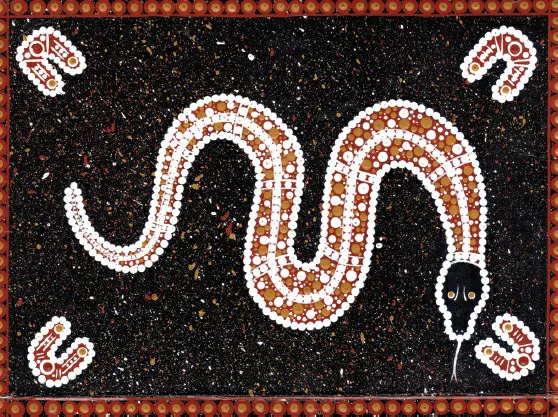
A RAINBOW SERPENT, PART OF THE CREATION STORY OF SOME ABORIGINAL PEOPLE OF AUSTRALIA.
Careful dating of rocks tells us that the Earth formed around 4.54 billion years ago1, and the evidence for the first living creature on Earth is from 4.28 billion years ago2. So a vast amount of time separates us from the first cell to arise on Earth: our most important ancestor. Imagine that amount of time for a moment. Imagine how we perceive one year passing. We can grasp 10 years passing. But how about 1,000 years? A hundred thousand years? A million years? Or 4.28 thousand million years? Such time spans are well beyond our comprehension. If humans had appeared at that time (and they didn’t) there would have been around 140,000,000 generations of us since then. This gives us an indication of how long ago it was – there have been 34 generations of humans since the year 1000 AD. This is probably why we were more comfortable with the notion that the Earth is only 6,000 or so years old.
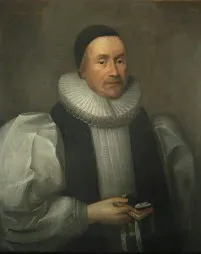
BISHOP JAMES USSHER (1581–1656), ARCHBISHOP OF ARMAGH AND PRIMATE OF ALL IRELAND. USING MAINLY THE BIBLE FOR EVIDENCE, HE ESTABLISHED THE TIME AND DATE OF CREATION AS 6 P.M. ON 22 OCTOBER 4004 BC. NOT A BAD ATTEMPT FOR THE TIME – BUT WRONG.
An Irish bishop, James Ussher, gets credit for the first systematic attempt to age the Earth. In 1650 he went to the library (in those far-off days people used to go to places called libraries to read books), and using the main book he found there, the Bible, figured out that creation began at 6pm on 22 October 4004 BC, and was completed by midnight3. Remarkably fast, and for most people scarcely enough time to eat dinner and binge watch the latest season of Game of Thrones. This date for the creation of the Earth was put into the King James Bible and held to be true until well into the 1800s, because someone clever had figured it out using a book which people believed contained by definition only truth. This seems ludicrous now, but in 1650 this was a good attempt, given what he had at his disposal, his systematic approach to the question at hand, and the fact that science hadn’t really been invented then.
When the idea was first suggested that the Earth was more than a few thousand years old, people were understandably confused and worried. In 1899, the Irish physicist John Joly, who was a pioneer in the effort to age the Earth, calculated that it was 80–100 million years old, based on how salty the oceans are, and assuming that the salt was caused by rocks being dissolved by rain at a certain rate4. Again, this was a reasonable attempt, and probably caused consternation in some circles. Finally, using a method called radiometry, the formation of the Earth was dated to 4.567 billion years ago. Radiometry involves measuring the radioactive state of elements such as lead, calcium and aluminium in minerals containing uranium. These are known to decay at a particular rate, and so how much they have decayed can be used to date rocks. So although impossible for us to grasp we can state with confidence that the Earth formed 4.567 billion years ago.
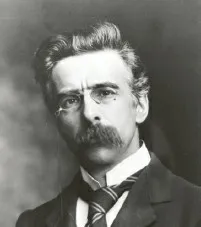
JOHN JOLY (1857–1933), PROFESSOR OF GEOLOGY AT TRINITY COLLEGE DUBLIN, CALCULATED THAT THE OCEANS WERE 80–100 MILLION YEARS OLD, SUBSTANTIALLY PUSHING BACK THE AGE OF THE EARTH FROM WHAT WAS THEN KNOWN, CAUSING CONSTERNATION IN SOME CIRCLES.
We can also tell from looking at the rocks that date from then that it was a very inhospitable place, where no life could exist. The atmosphere was full of toxic chemicals like hydrogen cyanide. We have to wait hundreds of millions of years for the first agreed evidence of a living organism to appear. No life on Earth for millions of years, just a vast bubbling cauldron, with random chemicals forming and being destroyed and reacting with other chemicals. And then, somehow, all these random chemical reactions, with energy in the form of heat, coming most probably from warm vents at the bottom of the sea, lead us to the first living creature. What has been observed is not the actual creature, however, but a series of tube-like structures that scientists believe is good evidence for living creatures. These have been observed in rocks from Quebec in Canada. It’s as if the Earth was like a giant test tube full of chemicals and gases, with a Bunsen burner in the form of heat coming from the sea floor. There was also electricity sparking in the form of lightning strikes. The lightning strikes and heat in the Earth provided the energy for the water in the ‘tube’ to boil and simmer and allowed the chemicals to hit off each other and react.
What with all the lightning, life therefore effectively began in bad weather, and we get to the first cell. Was the first cell Canadian or Australian, however? The matter isn’t fully resolved, as there is a competing claim that the oldest evidence for life on Earth is seen in rocks in Western Australia which date from the more recent 4.1 billion years ago5. This evidence is in the form of what one of the scientists involved (Mark Harrison) called ‘the gooey remains of biotic life’6. This whole area of science is very much a work in progress, and typifies the scientific process – produce evidence, evaluate and come to a conclusion. Whatever the outcome, the first cell was likely to have been not American (thankfully), but Canadian (who must love that) or Australian.
Whatever it was, it changed everything. If you had gone back in time to look at it you would need a microscope. It is in fact what we now call a bacterium, a single-celled creature. Not like us at all, as we are made up of lots of different types of cells, all of them working together. When looked at down a microscope our cells are quite different from a bacterium, which is actually pretty boring-looking. But 4 billion years ago, boring was good. The bacterium thrived, sucking up nutrients and dividing to make baby bacteria. This was the start of us. The first cell ever. There should have been some great blast of trumpets, or perhaps as Shakespeare wrote when describing the birth of the Welsh wizard Glendower, ‘The front of heaven was full of fiery shapes … The frame and huge foundation of the Earth shaked like a coward … the goats ran from the mountains’. No goats ran from the mountains when the first cell arose, because goats (and possibly mountains) hadn’t been invented.
We define a cell as the unit of life because all living things are made of cells, but another definition is a bag with chemicals inside it that can make copies of itself. So the ‘origin of life’ question then becomes, How did this first cell arise? A microscopic bag had to form, and in that bag there had to be a molecule that could copy itself to make more bags. How on Earth (literally) could this first bag have arisen?
We’re not completely sure of the answer to this question, but we know it must lie in the realm of chemistry and must obey the laws of physics. What happened was that chemistry and physics gave us biology. There must have been chemicals around that would react with each other to form more complex chemicals that in turn would go on to form the first cell, which is after all composed of sets of biochemicals all contained within a bag we call a cell. The formation of the actual bag itself was probably an early event, as that allowed the chemicals to become concentrated inside, which in turn would allow them to react with each other. The bag must have been made of molecules that were insoluble in water, just like the bags that make our cells today are made of fat molecules (also called lipids).
Chemical reactions need proximity – the chemicals that react have to hit off each other and form a product, and this happens when each constituent chemical reaches a certain concentration and is near another chemical. They then react with each other to form a new chemical, usually with the help of catalysts. In the case of the first cell this would have meant a chemical being able to make a copy of itself, which, as we will see, is what DNA can do. Once that happened the new chemical that formed would become sealed inside its own fatty bag and we now have two bags – the first bag having copied itself. And so, off we go, life begins, with each bag dividing to make a new bag. One definition of life therefore is ‘bags of chemicals that can make new bags of highly similar chemicals’. Or perhaps ‘Papa’s Got a Brand New Bag’?
To answer this question in more detail we need to know a little about the chemistry of life. What are living things made of? In the early days of biology, this was a straightforward question to answer, as biologists could break open cells and tissues from living things and, using chemical analysis, find out what they were made of. It starts out quite simply. There are four main types of chemicals that make up all living things. All are equally important for life because they work together and depend on each other, but we usually start with nucleic acids. These are the information molecules of life – DNA is the chemical recipe to make a cell. It can be copied and has the information that tells cells how to make proteins.
Proteins are the second class of life molecule. They are highly sophisticated biochemicals and are the grunts of life; they extract energy from food, catalyse the chemical reactions of life and copy the information in DNA to make another cell. It’s as if life began with a photocopier that could copy documents (the DNA), and then office workers come along in the form of proteins to help this process along.
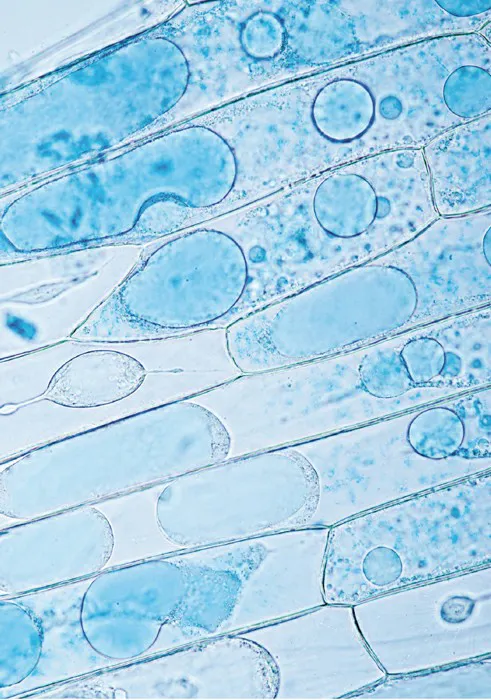
ONION CELLS. EACH IS A BAG MADE OF FAT THAT CONTAINS CHEMICALS AND HAS THE AMAZING FEATURE OF BEING ABLE TO COPY ITSELF.
The third family is called carbohydrates. Glucose is a typical carbohydrate. We burn these for energy (critical for any machine to do work), and they also go into structures like the collagen that holds our joints together. In our office analogy, the carbs are the lunch the workers eat.
Finally there are the fats – also known as lipids. These turn out to be absolutely crucial for life. They are insoluble in water, and make the membranes that form the little bags that contain everything else. Without these membranes, everything would be too dilute and nothing would happen. This is what defines the room that has the photocopier. The office workers can go there instead of wandering off in all directions – a much more efficient process. And so we get to our definition of life as being a bag full of complex chemicals that can make copies of itself. Or a room with a photocopier in it.
The photocopier for life has been running for at least 3.567 billion years, and has kept going relentlessly until it got to you and me – a very long string of DNA stretching back 3.567 billion years. The only rational purpose we can give to life therefore is the copying of DNA. Cells are the vessel in which this happens, and all of life that we see on Earth is still doing it. By this definition, then, it turns out that we humans are insignificant. We most likely contain only a tiny bit of the total DNA on Earth. And remember, all life on Earth is descended from that single Canadian (or Australian) cell that first copied its DNA. A recent study has shown that humans make up about 0.01% of all life on Earth7. Most of the rest is in plants with the next prominent group being bacteria, which are abundant and occur everywhere. So if that first cell that arose said to all subsequent cells of which it is the ancestor, ‘Go forth and multiply’, meaning ‘Keep copying your DNA’, we are making a tiny contribution. Even worse, we have caused the loss of 83% of wild animals and nearly half of all plants. We therefore shouldn’t be so full of ourselves. This is especially the case when we consider how many other organisms we carry with us in the form of abundant bacteria in our bodies.
The first problem we run into in trying to explain how the first cell arose is that all these chemicals are very fragile. They don’t like things like acid, or heat, or even oxygen. That last one will come as a surprise, as we normally think of oxygen as being essential for life. It is for us, as we use it to extract energy from food. But it’s also very toxic, and cells had to come up with a way to use it. As for heat, look what happens when you boil an egg, which is mainly made of protein. Conditions to make these chemicals therefore had to be just right – not too hot, not too cold. Life had to be like the tale of Goldilocks, except we’re not talking porridge here, we’re talking nucleic acids, proteins, carbohydrates and fats.
A mere 3.567 billion years afterwards, humans performed the first experiment to try and recreate this Goldilocks world8. In the early 1950s, two scientists (Stanley Miller and Harol...
Table of contents
- Cover
- Title Page
- Dedication
- Contents
- Introduction
- Chapter 1: Welcome O Life! How life got started
- Chapter 2: How we got to be so smart and why sex with a caveman was a good idea
- Chapter 3: I want you, I want you so bad: the science of finding love
- Chapter 4: Sperm meets egg: the science of fertility
- Chapter 5: Irish mammies got it right
- Chapter 6: I am what I am: the science of gender and sexual orientation
- Chapter 7: The God invention
- Chapter 8: Here’s a good one: why do we laugh?
- Chapter 9: I got the music in me: why do we listen to music?
- Chapter 10: Sleep and the daily rhythms of life
- Chapter 11: Our desperate relationship with food
- Chapter 12: Superhumans real and imagined
- Chapter 13: Are the robots coming to save us or enslave us?
- Chapter 14: The biggest and most expensive machines ever built
- Chapter 15: Will we stop all diseases?
- Chapter 16: Why you shouldn’t worry about getting old
- Chapter 17: Don’t fear the Reaper: death and beyond
- Chapter 18: Defying death
- Chapter 19: Will we become extinct?
- Chapter 20: Things will only get better
- Endnotes
- Acknowledgements
- Copyright
- About the Author
- About Gill Books
Trusted by 375,005 students
Access to over 1.5 million titles for a fair monthly price.
Study more efficiently using our study tools.
Frequently asked questions
Yes, you can cancel anytime from the Subscription tab in your account settings on the Perlego website. Your subscription will stay active until the end of your current billing period. Learn how to cancel your subscription
No, books cannot be downloaded as external files, such as PDFs, for use outside of Perlego. However, you can download books within the Perlego app for offline reading on mobile or tablet. Learn how to download books offline
Perlego offers two plans: Essential and Complete
- Essential is ideal for learners and professionals who enjoy exploring a wide range of subjects. Access the Essential Library with 800,000+ trusted titles and best-sellers across business, personal growth, and the humanities. Includes unlimited reading time and Standard Read Aloud voice.
- Complete: Perfect for advanced learners and researchers needing full, unrestricted access. Unlock 1.5M+ books across hundreds of subjects, including academic and specialized titles. The Complete Plan also includes advanced features like Premium Read Aloud and Research Assistant.
We are an online textbook subscription service, where you can get access to an entire online library for less than the price of a single book per month. With over 1.5 million books across 990+ topics, we’ve got you covered! Learn about our mission
Look out for the read-aloud symbol on your next book to see if you can listen to it. The read-aloud tool reads text aloud for you, highlighting the text as it is being read. You can pause it, speed it up and slow it down. Learn more about Read Aloud
Yes! You can use the Perlego app on both iOS and Android devices to read anytime, anywhere — even offline. Perfect for commutes or when you’re on the go.
Please note we cannot support devices running on iOS 13 and Android 7 or earlier. Learn more about using the app
Please note we cannot support devices running on iOS 13 and Android 7 or earlier. Learn more about using the app
Yes, you can access Humanology by Luke O'Neill in PDF and/or ePUB format, as well as other popular books in Biological Sciences & Ancient History. We have over 1.5 million books available in our catalogue for you to explore.