eBook - ePub
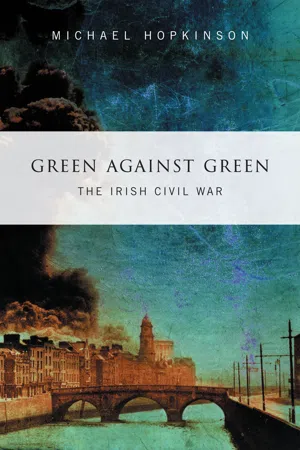
Green Against Green – The Irish Civil War
A History of the Irish Civil War, 1922–1923
- 356 pages
- English
- ePUB (mobile friendly)
- Available on iOS & Android
eBook - ePub
Green Against Green – The Irish Civil War
A History of the Irish Civil War, 1922–1923
About this book
Michael Hopkinson's Green Against Green is the definitive study of the Irish civil war, putting in perspective a bitter and passionate conflict, the legacy of which still divides Irish society today. Widely praised and frequently cited as the most authoritative work on the subject, it continues to hold its place as one of the finest works on modern Irish history.
Unlike the Easter Rising and the War of Independence, the Irish Civil War has been largely overlooked by historians, put off by the messy divisions between former War of Independence allies and its continued importance in modern Irish society: even now, the rival parties in the conflict form the basis for two of the largest political parties in Ireland.
In Green Against Green, Michael Hopkinson addresses this gap in Irish historical writing, looking closely at the reasons for the outbreak of civil war, the major figures who directed it, how it was fought and its impact across Ireland. This major achievement of historical scholarship traces the history and course of the war from 1912 to its conclusion, starting with a sketch of the background to the divisions which surfaced during the war and continuing through to the functioning of the post-civil war Irish State.
This groundbreaking work, 'a dispassionate account of the most passionate times' (Irish Times), captures the confused loyalties and localised, often personal, violence that characterised one of the most critical, and least studied, formative events in modern Irish history.
Green Against Green: Table of Contents
Preface
PART I. 1912-1921
- The Background to the Treaty Divisions, 1912-1918
- The Anglo-Irish War, January 1919-July 1921, and the Truce Period
- The Treaty Negotiations
- The Treaty Split
- The Irish Question in the United States
PART II. FROM THE TREATY TO THE ATTACK ON THE FOUR COURTS
- The Political and Constitutional Background in Early 1922
- The Military Split
- De Valera and the Military and Political Developments
- Military Developments after the Army Convention
- The North, from Treaty to Attack on the Four Courts
- Social and Governmental Problems
- The Search for Unity
- The Constitution
- The June Election and the Assassination of Sir Henry Wilson
PART III. THE OPENING OF THE WAR
- The Attack on the Four Courts
- Dublin Fighting
PART IV. THE EARLY CIVIL WAR
- The Military and Political Background to the Fighting
- The War in the Localities: July-August 1922
- The Opening of the Guerrilla Phase of the War
- The Death of Collins
- The Establishment of the Third Dáil
- Peace Initiatives
- The Formation of the Republican Government
- The First Executions
- The British Government and the Early Civil War
- The Southern Unionists and the Civil War
- The Civil War and the Railways
- The War in the Localities: September 1922-January 1923
PART V. THE WAR'S END
- The Free State—Government and Army: January-April 1923
- The Republicans and the Civil War: January-April 1923
- The War in the Localities: January-April 1923
- The North and the Civil War
- Exile Nationalism: The United States and Britain in the Civil War
- The Ceasefire
PART VI. THE POST-WAR PERIOD
- The Republicans
- The Post-War Free State Government and Army
- The Republican Hunger-Strike, October-November 1923
Conclusion
Information
Table of contents
- Cover
- Title page
- Dedication
- Contents
- Epigraph
- Preface
- PART I. 1912-1921
- Chapter 2: The Anglo-Irish War, January 1919-July 1921, and the Truce Period
- Chapter 3: The Treaty Negotiations
- Chapter 4: The Treaty Split
- Chapter 5: The Irish Question in the United States
- PART II. FROM THE TREATY TO THE ATTACK ON THE FOUR COURTS
- Chapter 7: The Military Split
- Chapter 8: De Valera and the Military and Political Developments
- Chapter 9: Military Developments after the Army Convention
- Chapter 10: The North, from Treaty to Attack on the Four Courts
- Chapter 11: Social and Governmental Problems
- Chapter 12: The Search for Unity
- Chapter 13: The Constitution
- Chapter 14: The June Election and the Assassination of Sir Henry Wilson
- PART III. THE OPENING OF THE WAR
- Chapter 16: The Dublin Fighting
- PART IV. THE EARLY CIVIL WAR
- Chapter 18: The War in the Localities: July-August 1922
- Chapter 19: The Opening of the Guerrilla Phase of the War
- Chapter 20: The Death of Collins
- Chapter 21: The Establishment of the Third Dáil
- Chapter 22: Peace Initiatives
- Chapter 23: The Formation of the Republican Government
- Chapter 24: The First Executions
- Chapter 25: The British Government and the Early Civil War
- Chapter 26: The Southern Unionists and the Civil War
- Chapter 27: The Civil War and the Railways
- Chapter 28: The War in the Localities: September 1922-January 1923
- PART V. THE WAR’S END
- Chapter 30: The Republicans and the Civil War: January-April 1923
- Chapter 31: The War in the Localities: January-April 1923
- Chapter 32: The North and the Civil War
- Chapter 33: Exile Nationalism: The United States and Britain in the Civil War
- Chapter 34: The Ceasefire
- PART VI. THE POST-WAR PERIOD
- Chapter 36: The Post-War Free State Government and Army
- Chapter 37: The Republican Hunger-Strike, October-November 1923
- Conclusion
- Notes
- Bibliography
- Copyright
- About the Author
- About Gill & Macmillan
Trusted by 375,005 students
Access to over 1.5 million titles for a fair monthly price.
Study more efficiently using our study tools.
Frequently asked questions
Yes, you can cancel anytime from the Subscription tab in your account settings on the Perlego website. Your subscription will stay active until the end of your current billing period. Learn how to cancel your subscription
No, books cannot be downloaded as external files, such as PDFs, for use outside of Perlego. However, you can download books within the Perlego app for offline reading on mobile or tablet. Learn how to download books offline
Perlego offers two plans: Essential and Complete
- Essential is ideal for learners and professionals who enjoy exploring a wide range of subjects. Access the Essential Library with 800,000+ trusted titles and best-sellers across business, personal growth, and the humanities. Includes unlimited reading time and Standard Read Aloud voice.
- Complete: Perfect for advanced learners and researchers needing full, unrestricted access. Unlock 1.5M+ books across hundreds of subjects, including academic and specialized titles. The Complete Plan also includes advanced features like Premium Read Aloud and Research Assistant.
We are an online textbook subscription service, where you can get access to an entire online library for less than the price of a single book per month. With over 1.5 million books across 990+ topics, we’ve got you covered! Learn about our mission
Look out for the read-aloud symbol on your next book to see if you can listen to it. The read-aloud tool reads text aloud for you, highlighting the text as it is being read. You can pause it, speed it up and slow it down. Learn more about Read Aloud
Yes! You can use the Perlego app on both iOS and Android devices to read anytime, anywhere — even offline. Perfect for commutes or when you’re on the go.
Please note we cannot support devices running on iOS 13 and Android 7 or earlier. Learn more about using the app
Please note we cannot support devices running on iOS 13 and Android 7 or earlier. Learn more about using the app
Yes, you can access Green Against Green – The Irish Civil War by Michael Hopkinson in PDF and/or ePUB format, as well as other popular books in History & 20th Century History. We have over 1.5 million books available in our catalogue for you to explore.