- 672 pages
- English
- ePUB (mobile friendly)
- Available on iOS & Android
eBook - ePub
About this book
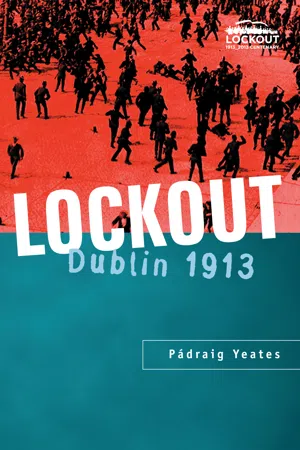
On 26 August 1913 the trams stopped running in Dublin. Striking conductors and drivers, members of the Irish Transport Workers' Union, abandoned their vehicles. They had refused a demand from their employer, William Martin Murphy of the Dublin United Transport Company, to forswear union membership or face dismissal. The company then locked them out.
Within a month, the charismatic union leader, James Larkin, had called out over 20,000 workers across the city in sympathetic action. By January 1914 the union had lost the battle, lacking the resources for a long campaign. But it won the war: 1913 meant that there was no going back to the horrors of pre-Larkin Dublin.
This outstanding survey shows why: it has already established itself as the definitive work on the Lockout.
Information
Part I
Stars in Their Courses

1
AT twenty to ten on the morning of Tuesday 26 August 1913 the trams stopped running in Dublin. Striking conductors and drivers pinned the Red Hand badge of the Irish Transport and General Workers’ Union on their lapels and abandoned their vehicles. Dublin’s transport system came to a halt.1
It had been feared for some time that the union might choose the first day of the Dublin Horse Show to take action. That very morning the Irish Times expressed concern that ‘a rumoured dislocation of the city traffic by a strike among the servants of the Dublin United Tramways Company’ might cast a ‘cloud on the horizon.’ This was most unfortunate, thought the Times, because everyone predicted that Horse Show Week would be an enormous success in 1913. It had been a glorious summer, with eight weeks of almost unbroken sunny weather, and the forecast was excellent. Improvements to the show-jumping arena in Ballsbridge promised to increase the enjoyment of participants, judges and spectators alike. Most important of all, a record number of foreign visitors was expected. Steamship companies said they were having difficulty accommodating the demand from first-class travellers, and the Times reported hotels turning away hundreds of disappointed guests. Unfortunately, the Horse Show appeared to be dogged by misfortune. In 1912 there had been an outbreak of foot and mouth disease that caused some events to be cancelled, and in 1911 attendances plummeted because of a rail strike that crippled train services throughout Ireland and Britain.
If the trams stopped this year, the fifty miles of track that linked Dublin with the middle-class suburbs of Clontarf, Rathmines, Blackrock and Kingstown (Dún Laoghaire) would be idle. In the circumstances it was reasonable for a liberal unionist newspaper like the Irish Times to warn prospective strikers that, whatever legitimate grievances they might have, they could only arouse the public’s hostility if they pursued their threatened course of action. But reasonableness was a quality that would be noticeably lacking in the industrial convulsion that was about to engulf Dublin. It was certainly not a characteristic of the two great protagonists in the coming struggle, Larkin and the rather ascetic chairman of the Dublin United Tramways Company, William Martin Murphy.
*
Murphy was the antithesis of the flamboyant Larkin. He was a private man who was instinctively repelled by the sort of public notoriety in which Larkin revelled. Time spent with his family and sailing his 25-foot yacht Eva were Murphy’s favourite forms of recreation. This did not mean he was a recluse. He had been the first captain of Milltown Golf Club and president of Rathmines and Rathgar Musical Society. He was also one of that peculiar breed of Irish businessmen who managed to combine extreme personal piety with utter ruthlessness in their commercial dealings. One admirer described him as a man ‘who blends the milk of human kindness with an unswerving rectitude of conduct.’2 A fellow Home Rule MP and long-time political ally, P. A. Chance, put it more pungently when he described Murphy as a man who carried a copy of the Companies Act in one hand and The Imitation of Christ in the other.3
Murphy was born in Bantry, County Cork, in 1847, the son of a small builder. He was educated by the Jesuits at Belvedere College in Dublin. His mother died when he was four, and at seventeen he had to abandon his studies and take over the family firm, following the sudden death of his father. He quickly showed an entrepreneurial talent rare for Ireland in that era and developed an expertise in constructing light rail and tramway systems. Ireland was full of cheap labour, and Murphy had the wit to pay well: he recognised that a well-fed labourer could work much harder than a hungry one. His marriage to Mary Julia Lombard happily furthered his career. She was the daughter of one of Cork’s leading capitalists, James Fitzgerald Lombard, who had extensive investments in property, retailing, and railways. When Dublin’s tram companies amalgamated to form the DUTC in 1880 it was under Lombard’s chairmanship. Murphy succeeded his father-in-law in 1899 and ran the company until his own death in 1919. By then he had accumulated a fortune of over £250,000, had built railways and tramway systems in Britain, South America, and West Africa, and owned or was a director of many Irish enterprises, including Clery’s department store, the Imperial Hotel and the Metropole Hotel in Dublin’s premier thoroughfare, Sackville Street (O’Connell Street). But his primary interest remained the transport industry and ancillary enterprises such as electrical engineering and power generation. Partly through his father-in-law’s influence, his role evolved from building railways to owning them. His early directorships were on light provincial lines, such as the West Clare Railway (immortalised in Percy French’s song ‘Are You Right There, Michael?’). But by 1904 Murphy had joined the board of the Great Southern and Western Railway, the principal railway company of Ireland. It represented a form of apotheosis in the Irish business world, for its chairman was Sir William Goulding, reputedly the richest businessman in the south of Ireland, after the head of the Guinness dynasty, Lord Iveagh.
Murphy reached the pinnacle of success with his election as vice-president of the Dublin Chamber of Commerce in 1911 and president the following year. His political stock in the business community rose considerably when he co-operated with Goulding in defeating an ITGWU strike at the GSWR with an early application of the lockout tactic. That was in 1911, and as a result of the year’s labour troubles he founded the Dublin Employers’ Federation. The lockout would ensure that the railway workers played a rather subdued role in the troubles of 1913.
However, the Dublin Employers’ Federation itself fell moribund, as Murphy’s attention was diverted by other issues. As president of the Dublin Chamber of Commerce he hosted meetings of the Association of Chambers of Commerce of the United Kingdom and the British Chambers in Foreign Countries during 1912. On a more practical note, he lobbied vigorously on behalf of the Chamber of Commerce against British government efforts to foist the more extravagant aspects of Lloyd George’s social and health insurance schemes on Ireland. He argued that this would impose an unfair and disproportionate burden on the Irish taxpayer. He also led opposition to a proposal to build an art gallery in Dublin to house the collection that Sir Hugh Lane was offering to the city, on the grounds that the ratepayer—that is, the business and property-owning classes—would have to foot the bill. At a national level he lobbied the British government to prevent the Cunard line dropping Dublin and Queenstown (Cóbh) from its transatlantic schedules. The loss of such a service would be a blow to Irish ports—and, of course, the railways.4
In August 1913 Murphy, at sixty-eight, was very much an elder statesman of the Irish business community. ‘Mr. Murphy enjoys the entire confidence of the citizens of the more substantial class,’ an admirer enthused. ‘Uncompromising Unionists and equally determined Nationalists sit under his presidency … in complete harmony.’5 Murphy was nearly thirty years older than his adversary, and age had taken its toll. His tall figure had developed a slight stoop, his hair had turned silver, and his bewhiskered face suggested ‘the typical family solicitor of the old school.’ But this outwardly courtly capitalist was a formidable opponent, as many distinguished members of the Irish Party who had crossed him could testify. Behind the twinkling blue eyes ‘dwelt a soul of iron.’6 It was no accident that it was the wittily vituperative Timothy Healy who was Murphy’s closest political confidant. Another vitriolic nationalist politician from County Cork, the rural radical William O’Brien, referred to them as ‘Messrs. Healy, Murphy & Co., Moral Assassins’. It was a business in which ‘Mr. Murphy bought the knives and Mr. Healy did the stabbing.’ Though they worked closely together for forty years, Healy described Murphy as a ‘cold man’. G. K. Chesterton detected the same reptilian quality, comparing Murphy to ‘some morbid prince of the fifteenth century, full of cold anger, not without a perverted piety.’7
*
Piety and parochialism were the axis of the ‘Bantry Band’, the small group of influential west Cork politicians to which both Healy and Murphy belonged on the conservative and intensely Catholic wing of the nationalist movement. Though Healy was ‘the more prominent and brilliant figure,’ a fellow nationalist MP and shrewd observer of people, T. P. O’Connor, added that ‘Murphy … must be regarded as the most potent.’8 Part of that potency rested in his control of the Irish Independent and its associated publications. They had been acquired during the bitter civil war within the Irish Party following the Parnell divorce case. If Healy was Parnell’s bitterest and most articulate opponent in the public debate, it was Murphy who used his wealth to finance the anti-Parnellites. He regarded the divorce case as ‘an interposition of divine providence’ that released the nationalist movement from bondage to a Protestant landlord and adulterer.9 It was a stance for which the predominantly Parnellite electorate of Dublin never forgave him. Though he had represented St Patrick’s division of the city since 1885, he was defeated in 1892 by a Parnellite, William Field, who still held the seat in 1913.
Murphy’s distaste for the forced camaraderie of the hustings and his poor speaking voice were no doubt contributory factors in cutting short his parliamentary career. Attempts by Healy to find his friend a safe seat in an anti-Parnellite constituency proved unsuccessful; Murphy’s personality was voter-resistant. Yet the public perception of him was not entirely fair. While he was denounced as a philistine for his opposition to the proposed Hugh Lane gallery, he had earned almost universal praise for his organising of the International Exhibition of 1907, which was the high point of the visit to Dublin that year by King Edward VII and Queen Alexandra. Some of Murphy’s enemies said that he only took on the job in the hope of winning a knighthood. Stung by the allegation, Murphy declared that in no circumstances would he accept a title, even if one were offered to him. Presumably one was, for the king proposed to knight Murphy on the spot at the exhibition grounds in Herbert Park. To everyone’s surprise and embarrassment, Murphy refused it. With the characteristic attention to the niceties that marked all his dealings with polite society, Murphy wrote a letter to the king explaining that he intended no disrespect by his refusal of a knighthood. He said that he would not wish the king to leave Ireland ‘thinking that he had left one churlish man behind him.’10
Knighthoods were tricky things for nationalists. Recruiting an existing knight like Roger Casement to the movement was a political coup; but for a nationalist to accept a knighthood was a very different matter. Murphy’s action in 1907 showed that he still cherished his reputation as a nationalist, whatever the electorate thought of him. Indeed his nationalism was more substantial than that of many members of the Irish Party and was closer in many respects to that of Sinn Féin than to the rural activists who comprised the main weight of constitutional nationalism. He saw home rule less as an opportunity to seize the levers of state power and patronage than as a chance to develop Irish industry. His increasing criticism of Redmond’s leadership of the Irish Party had less to do with the fact that Redmond had been a Parnellite than with his inability to gain greater fiscal powers from the Liberals for the proposed home rule parliament. Murphy believed that Ireland’s salvation lay as much in economic discipline and fiscal rectitude as in political action. When Redmond compounded his mistake by vacillating over partition, which would exclude the country’s industrial heartland from home rule, Murphy would be sick to his heart. In March 1914 he confided to Healy that he ‘never lost a night’s sleep during the tram strike; but was awake all night from humiliation’ at the prospect of partition.11
This, then, was the man who planned Larkin’s downfall. He did so with characteristic thoroughness, insisting all the while that he was not anti-union. As we have seen, the fact that his strategy would require locking out thousands of workers and starving a third of the city’s population into submission never cost him a night’s sleep. The courtly patriarch was by no means unsympathetic to the plight of employees, but he insisted that they ‘must help employers to compete … They must put themselves in their employers’ place, and see whether they are allowing him a margin … without which the shop must ultimately close.’12 By 26 August the tramway men’s actions had shown they were not that kind of employee; and the shop was about to close.
*
It was in July that Murphy learnt of Larkin’s efforts to organise DUTC workers. Larkin was doing it discreetly, just as he had been doing in Guinness’s brewery at St James’s Gate. The tramway workers, and the Guinness carters and boat crews, were the elite of the city’s transport employees in pay and conditions. The tramway workers were particularly important; a strike at the company could seriously disrupt the city’s business. But the DUTC and Guinness’s were not like other companies. Guinness’s paid employees well and exercised a benevolent despotism over them in return for loyalty. The company had early hired a retired DMP sergeant, Michael Walsh, to monitor the activities of Larkin and his union so that it could minimise his inroads at the brewery. Only one in six of the workers had joined the ITGWU by the summer of 1913.13
Murphy had a simpler and harsher strategy. Like many transport magnates, he ran the tramways on military lines. Not only did tramcar workers have to wear uniforms but they were completely at the mercy of their immediate superiors, the inspectors. These, in turn, answered to office-based supervisors. ‘Discipline is too severe for an industrial concern,’ a confidential informant told the Archbishop of Dublin, Dr William Walsh, in a detailed memorandum.
Promotion depends on favour and plasticity of employees’ character rather than efficiency and seniority. Tenure of men’s employment insecure owing to frequency and trivial nature of Inspectors’ reports. Hours too long and pay about 10s per week le...
Table of contents
- Cover
- Title Page
- Dedication
- Preface
- Prologue
- Part 1: Stars in Their Courses
- Part 2: Saving the Children
- Part 3: War to the Knife
- Epilogue
- Notes
- Bibliography
- Acknowledgments
- List of Abbreviations
- Copyright
- About the Author
- About Gill & Macmillan
Trusted by 375,005 students
Access to over 1.5 million titles for a fair monthly price.
Study more efficiently using our study tools.
Frequently asked questions
Yes, you can cancel anytime from the Subscription tab in your account settings on the Perlego website. Your subscription will stay active until the end of your current billing period. Learn how to cancel your subscription
No, books cannot be downloaded as external files, such as PDFs, for use outside of Perlego. However, you can download books within the Perlego app for offline reading on mobile or tablet. Learn how to download books offline
Perlego offers two plans: Essential and Complete
- Essential is ideal for learners and professionals who enjoy exploring a wide range of subjects. Access the Essential Library with 800,000+ trusted titles and best-sellers across business, personal growth, and the humanities. Includes unlimited reading time and Standard Read Aloud voice.
- Complete: Perfect for advanced learners and researchers needing full, unrestricted access. Unlock 1.5M+ books across hundreds of subjects, including academic and specialized titles. The Complete Plan also includes advanced features like Premium Read Aloud and Research Assistant.
We are an online textbook subscription service, where you can get access to an entire online library for less than the price of a single book per month. With over 1.5 million books across 990+ topics, we’ve got you covered! Learn about our mission
Look out for the read-aloud symbol on your next book to see if you can listen to it. The read-aloud tool reads text aloud for you, highlighting the text as it is being read. You can pause it, speed it up and slow it down. Learn more about Read Aloud
Yes! You can use the Perlego app on both iOS and Android devices to read anytime, anywhere — even offline. Perfect for commutes or when you’re on the go.
Please note we cannot support devices running on iOS 13 and Android 7 or earlier. Learn more about using the app
Please note we cannot support devices running on iOS 13 and Android 7 or earlier. Learn more about using the app
Yes, you can access Lockout Dublin 1913 by Padraig Yeates in PDF and/or ePUB format, as well as other popular books in History & Irish History. We have over 1.5 million books available in our catalogue for you to explore.