eBook - ePub
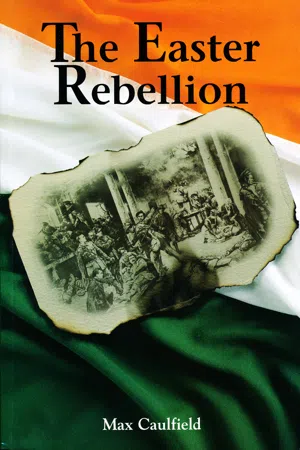
The Easter Rebellion
The outstanding narrative history of the 1916 Rising in Ireland
- 331 pages
- English
- ePUB (mobile friendly)
- Available on iOS & Android
eBook - ePub
About this book
This is a scrupulously researched and superbly written account of the events of that fateful week.
The narrative proceeds almost on an hour-by-hour basis building up a picture which, while immensely detailed, is none the less presented with the greatest clarity. First published in 1964, The Easter Rebellion quickly established itself as the outstanding narrative history of the 1916 Rising in Ireland.
It provides an objective and exciting appraisal of what was perhaps the most decisive week in the making of modern Ireland. The story unfolds as a vivid and explosive drama, building up a picture which never loses its sense of narrative urgency.
Most of all, the author was able to interview many of the surviving participants – something denied to all subsequent accounts of the Rising.
Information
1
AT FOUR MINUTES past noon on Easter Monday, April 24th, 1916, a Red Cross nurse, returning to duty at the wartime hospital in Dublin Castle, paused at the main gate and half-jokingly asked the policeman on duty, “Is it true that the Sinn Feiners are going to take the Castle?”
“Ah, no, miss,” said Constable James O’Brien of the Dublin Metropolitan Police. “I don’t think so. Aren’t the authorities making too much fuss?”
So the nurse smiled and went her way, passing out of sight through a stone archway which led into Upper Castle Yard, an archway imposingly surmounted by a large statue of Justice, which stood—significantly, said Dubliners of rebellious sympathies—with her back to the city. Upper Castle Yard itself was a two hundred and eighty by one hundred and thirty-foot quadrangle enclosed by the various Crown administrative offices and the Irish State Apartments, among them the gilded Throne Room, with its exquisitely curved ceiling, and the age-worn St. Patrick’s Hall, where for centuries the Irish Viceroys had given magnificent levees. It was in this room that new Knights of the Illustrious Order of St. Patrick were installed; here, also, that Victoria and Albert danced quadrilles on the occasion of their state visit to Dublin. Of the rather indifferent set of panels decorating the ceiling, the most significant was a painting showing the Irish chieftains paying homage to their feudal overlord, King Henry II, a measure of the time England had wielded paramount influence in Ireland. Here, then, in and around this short perimeter, lay the heart of British power in the subjugated sister island.
Less than a minute later, Mr. H. S. Doig, editor of the Dublin Mail & Express, whose windows faced the Castle Gate, heard one of his staff say, “Good God! The Citizen Army are parading in spite of MacNeill’s letter.” Doig, who was busy writing a leader on Shakespeare’s Tercentenary, rose from his chair and saw a small detachment of armed men and women just about to break ranks. He noted that they were wearing the dark green uniforms and the Boer-like slouch hats of the Irish Citizen Army. He watched O’Brien confront them with his hand up and thought he was telling them, “Now, boys, you shouldn’t be here at all.” Then, to his surprise, the Citizen Army stepped back and raised their rifles. There was the crack of a bullet and the big policeman crashed to the ground, shot through the brain. For a moment, the rebels hesitated, almost as though they were stunned themselves by this abrupt expression of violence. Then Doig heard their leader roaring, “Get in! Get in!” and saw them surge forward.
Inside the Gate, the military sentry fired once, then dived for cover as the rebels returned his fire. Quickly a number of them succeeded in reaching the archway and launching an assault on the Guardroom. Behind them, and still under the eyes of the astonished Doig, a priest who happened to be passing up Cork Hill, rushed in and began gesturing wildly in an obvious attempt to dissuade the main force from further action, but they simply ignored him and pressed on with their attack. Left standing in utter bewilderment—Irishmen, after all, rarely disobeyed Catholic clergy—the priest finally caught sight of O’Brien’s body lying beside the Gate and at once ran over and knelt down to administer the last rites. Even as he did so, the rebels opened up a general, if rather haphazard fire on the Castle in support of their advanced comrades.
Within that enormous, straggling complex of buildings, in a fusty Victorian office scarcely twenty-five yards from where O’Brien now lay dead, Sir Matthew Nathan, His Majesty’s Under-Secretary for Ireland, Major Ivor Price, the Military Intelligence Officer, and Mr. A. H. Norway, Secretary of the Post Office, had already risen to their feet in some alarm. They had been sitting discussing in detail a plan to arrest the leaders of Sinn Fein, following a decision reached at a conference held the previous night with the Lord Lieutenant, Lord Wimborne, at the Vice-Regal Lodge, Phoenix Park. This had marked the culmination of a series of incidents over the week-end, which had begun with the arrest of Sir Roger Casement after he had landed from a German submarine, and had reached an apparent climax with the cancellation of the special manoeuvres called for Easter Sunday by the Irish Volunteers—exercises which had been clearly intended, as it had now become obvious, only to cloak something much more serious. Although the conference had decided that the danger of real trouble in Ireland had almost entirely receded, still it had been considered advisable to take punitive measures if only on a kind of pour encourager les autres basis. After all, an overt attempt at rebellion had been made, and the conspirators ought to be locked away at once—as indeed, if the truth were admitted, they should have been a long time ago.
Before the arrests could be made, however, it had been constitutionally necessary to obtain the permission of the Chief Secretary, Mr. Augustine Birrell, who was in London. A cable had been dispatched to him the previous night, therefore, immediately after the conference, and his reply had just been received—or not much more than an hour before—agreeing to the arrests. Sir Matthew had waited until the arrival of Major Price at 11.45 a.m. before telephoning Mr. Norway at the newly-renovated and remodelled General Post Office in Sackville Street (which had just been reopened to the public) inviting him to join in the discussions. Mr. Norway (rather fortunately in the light of events) had left his office at approximately 11.50 a.m. and had arrived at the Castle almost precisely at noon. The three men were hardly settled down to their talks, therefore, when the sound of the shots penetrated their seclusion.
“They’ve commenced it!” shouted Price, leaping to his feet and running from the room, tugging at his revolver. In Upper Castle Yard he was in time to see half-a-dozen rebels breaking their way into the Guardroom. He emptied his revolver in their direction, then deciding that there was little he could do without assistance, rushed back to Sir Matthew’s office.
Inside the Guardroom the six soldiers on duty had been heating a saucepan of stew for their midday meal when they were rudely disturbed by the shots. Reaching for their rifles, they were about to rush outside at the double when a home-made bomb, lobbed through the window, landed right in the middle of them. It failed to explode but created such panic that when the insurgents broke in they had no difficulty in forcing a surrender. Within seconds, the six soldiers had been laid flat on the floor, trussed up with their own puttees, and the rebel party, under the command of Citizen Army Sergeant Tom Kain, were crouching under the windows, quietly planning their next move.
Among the several mistakes made by the insurgents during the course of the subsequent week, their decision not to press forward with their attack on Dublin Castle still ranks as one of the most difficult to understand. Possibly, as has been argued, their orders were not to capture the Castle, because of difficulty in defending it against counter-attack. Possibly they were simply overawed at the idea of taking a fortress which had defied the Irish for almost seven hundred years. But, more probably, they were afraid of blundering into the considerable military forces with which the Castle was normally garrisoned. Clearly they never guessed that the place lay almost entirely at their mercy; that fewer than twenty-five soldiers—and these were idling away their time in Ship Street barracks round the corner—were all that stood between them and an epic moment in Irish history. Yet they were aware that there was an excellent holiday card at Fairyhouse races (including the Irish Grand National) and might be presumed to have known that the garrison would be below strength. In fact, there were only two officers on duty in Dublin Castle that morning.
There were sixty-seven war-wounded soldiers in the Red Cross hospital but none of these, of course, could have fought. The Castle, to all intents and purposes, indeed, lay entirely in the hands of its civil servants, most of whom had spent their morning idly gazing out at a blue sky and at wisps of trailing cloud, envying holiday-makers who were even then enjoying themselves on the beaches at Dalkey and Malahide.
But instead of reinforcing Kain and ordering him to take the Castle—and if necessary burn it down—John Connolly (no relation of James Connolly), leader of the rebel detachment, decided to split his forces—acting on his original orders. He sent one party to occupy the premises of Henry & James, outfitters, on the corner of Cork Hill and Parliament Street, which directly faced the Castle Gate; another to charge up the stairs of the Mail & Express offices on the other corner and eject the startled Doig and his staff at bayonet point, while the main body, under his own command, turned aside to break into the City Hall, using a specially-impressed key to open the main door.
Meanwhile, in Sir Matthew’s office, Major Price had set about the hasty task of organizing the Castle’s defences. His first job, even while he waited for the rebels to break down the door and slaughter them all without mercy, was to summon every available soldier from Ship Street barracks. Sir Matthew himself took a revolver from his desk and prepared to assist in selling their lives dearly—fortunately, it proved to be quite an unnecessary gesture, for the rebels inexplicably failed to put in an appearance. In their stead, the military party from Ship Street turned up at the double, although Price was somewhat taken aback to count only twenty-five men where he had expected to see two hundred, the normal garrison strength. He at once reached for Sir Matthew’s private telephone which gave a direct line to Irish Command H.Q. at Parkgate, conscious that someone had blundered badly in not doubling the garrison that morning. In his excitement he had difficulty at first in disentangling the wires, but finally he managed to sort them out. For perhaps three full seconds he held the receiver to his ear, waiting. Then a wild look suddenly crossed his face and, turning to Sir Matthew, he exclaimed in desperation, “My God! They’ve cut the wires!”
Bugler William Oman of the Irish Citizen Army had sounded the “fall-in” for the main rebel army at exactly 11.30 that morning. The notes had risen stickily into the calm air of Beresford Place, which abuts the River Liffey, and had sounded hoarsely along the dingy corridors of Liberty Hall, headquarters of the Irish Transport and General Workers’ Union, and its militant offshoot, the Citizen Army. Sergeant Frank Robbins, who was trying on a new pair of trousers at the time, had them only half on when he heard the call. There was a sudden rush of feet along the rough boards outside the door and, heart in mouth, Robbins, who was only twenty, slung his bandolier over his shoulder, took up his rifle, and went racing down the stairs, still buttoning his trousers. He found the place in an uproar. There were bicycles parked everywhere, in some cases a dozen deep; girls were rushing about, carrying haversacks stuffed with food and medical supplies; wives and sweethearts were thrusting cigarettes or chocolates upon their men as they said farewell.
Outside in the big square in front of Liberty Hall, two hundred and fifty men and boys at the most were feverishly shuffling themselves into an orderly double column. One of them, Tommy Keenan, was only twelve years old. Behind them, bisected by the ugly Loop Line railway bridge which links termini at Amiens Street and Westland Row, rose Gandon’s graceful Custom House, in the sunlight a dazzlingly white-and-shadowed affair of slender dome and sweeping perpendiculars. Over the Liffey, mirrored as a lake now, swung the lazy, drifting gulls, like flowing polka dots.
Despite the enhancing effect of a glorious morning, the rebel army hardly looked an inspiring one. Fewer than a fourth of its members wore the dark green uniform of the Citizen Army or the heather green of the Irish Volunteers. One or two had tried to give themselves a military appearance by covering their legs with puttees or leggings; some had put on riding breeches; but all that most of them had been able to do was to sling a bandolier over their right shoulder or tie a yellow brassard around their left arm. Their armaments, too, looked appallingly primitive. In the bright sunlight, the high gleam of pikes caught the eye a great deal more readily than the dull glint of rifles; when there was a stir among the Kimmage men, for instance, the pikes were seen to jink in the air like the halberds of a Tudor army. For that matter, the rifles themselves seemed only a trifle less antique. There were a few modern short Lee-Enfields (filched or bought clandestinely from the military when no officer was looking); some Italian Martinis (smuggled in from the Continent among the blocks of Carrara marble) and the odd Lee-Metford (come from God knows where!). There were plenty of single-barrelled shotguns; but the predominant weapon was the brute-like Howth Mauser—so called because it had formed part of a cargo of German rifles landed at Howth in July 1914, from Erskine Childers’ yacht Asgard. This rifle, manufactured for the Prussian forces of 1870, was a single-loader, firing a soft-nosed lead bullet which struck with all the effect of a dum-dum. In action, it would be discovered that it drilled a neat hole in a man as it entered but tore out the other side like a plate, and its use would anger the British Army and lead to an accusation against the rebels of firing outlawed bullets. In short, these men, like almost any army of rebels anywhere, looked a forlorn and rather desperate lot.
No one, certainly, realized this better than James Connolly, commander of all the rebel forces in Dublin city. As he clattered down the broad sweeping staircase of Liberty Hall, a stocky little man in the full uniform of a Commandant-General, his bandy legs encased in highly-polished leggings, ready to lay down his life for the principles in which he so passionately believed, he stopped for a moment to say good-bye to his friend William O’Brien. In a half-whisper, so that the men nearby would not overhear him, he added, “Bill, we’re going out to be slaughtered.”
“Is there no hope at all?” asked O’Brien, who knew the question was superfluous.
“None whatever,” Connolly answered cheerfully and, slapping O’Brien’s shoulder, strode on.
At 11.50 precisely, the first body of rebels to move off turned smartly in obedience to Connolly’s sharp order, “Left turn! Quick march!” Twenty-eight men and eight boys, comprising a detachment under Citizen Army Captain Richard MacCormack, marched towards Butt Bridge. They had gone only a short distance when Connolly ran after them, shouting, “No, not that way, Mac!—you’ll get slaughtered! Fighting might have broken out in some places already. You’d better take a short cut and be as quick as you can!” MacCormack at once wheeled his column and led them up Eden Quay. With Robbins in the column was James Fox, aged nineteen. A few minutes before they moved off, an old man had pushed his way forward, leading a young man by the hand. “Frank Robbins,” Patrick Fox had said, “here’s my lad—will you take him with you? I’m too old for the job myself.”
It was 11.55 a.m. before Pearse himself finally made an appearance, followed by the pale-faced figure of his younger brother Willie. Preceding them was the bizarre and dying figure of Joseph Plunkett, his throat still swathed in bandages as a result of an operation for glandular tuberculosis three weeks earlier, who had to be helped down the steps by his A.D.C. Michael Collins. A filigree bangle glittered on Plunkett’s wrist and two enormous antique rings clustered upon his fingers. By this time MacCormack’s column had crossed O’Connell Bridge, marching at the double; the Castle detachment under John Connolly had followed; then John Heuston, aged nineteen, leading a party of twelve young men, all of about his own age, had tramped off to occupy the Mendicity Institution, up-river on the south bank. Until that moment there had been no perceptible thinning of the main body, but as forty men under Commandant Michael Mallin moved off to occupy St. Stephen’s Green—his second-in-command, Lieutenant Countess Markievicz flamboyantly following with her own troop of women and Boy Scouts—its numbers suddenly depreciated alarmingly. Hardly one hundred and fifty men, in fact, were left to shuffle their feet in Beresford Place—the total of the grand army with which Patrick Pearse intended to establish the headquarters of an Irish Republic in the General Post Office in Sackville Street.
From the steps of Liberty Hall Patrick Henry Pearse, thirty-six-year-old Commander-in-Chief and President of the Provisional Government, gazed out over the shabbily-thin ranks and, beyond them, two drays laden with an astonishing assortment of weapons and work-implements, including pickaxes, sledges and crow-bars and some brand-new wicker-hampers, to where a closed cab hung funereally about on the outskirts, stuffed to the roof with similar junk. For a moment he studied the men’s faces intently. Not content with a soldier’s normal equipment, many of them were carrying two rifles, one over each shoulder, or a rifle and a pickaxe, or a shotgun and a pike. Captain Brennan Whitmore, a member of Plunkett’s staff, wondered how they hoped to defend themselves if they were called upon suddenly to do battle but, before he could raise the issue, a dusty touring car swung round into Beresford Place and halted amid cheers. Down from the running-board stepped The O’Rahilly, Treasurer of the Irish Volunteers. No one there knew it, but The O’Rahilly had, in fact, spent the previous twenty-four hours doing his best, in the light of what had happened during the week-end, to prevent a Rising—his efforts taking him in a wild night drive to the provincial Commandants in Cork, Kerry, Limerick and Tipperary with orders from Professor Eoin MacNeill, President of the Volunteers, not to obey Pearse’s instructions. Now, however, he leaped eagerly up the steps of Liberty Hall to shake hands with Pearse and Plunkett, gasping out the explanation, “Well, I’ve helped to wind up the clock—I might as well hear it strike!” Delighted Volunteers and Citizen Army men began to load weapons, implements and home-made bombs into his car.
The time was just two minutes to twelve. Pearse, his thoughts fixed intently upon sombrely magnificent ambitions whose realization now seemed imminent, took his place at the head of the column. He was followed by Plunkett, his Chief-of-Staff and the mercurial brain behind the military planning and strategy of the Rebellion, who dramatically unsheathed a sabre as he took up his position. Then Connolly, having satisfied himself that all was in readiness, placed himself between Pearse and Plunkett, and behind the three Commandant-Generals (as they had ranked themselves) came the rest of the column in orthodox fours. Captain Brennan Whitmore took the extrem...
Table of contents
- Cover
- Title page
- Contents
- Chapter 1
- Chapter 2
- Chapter 3
- Chapter 4
- Chapter 5
- Chapter 6
- Chapter 7
- Chapter 8
- Chapter 9
- Chapter 10
- Chapter 11
- Chapter 12
- Chapter 13
- Chapter 14
- Chapter 15
- Chapter 16
- Chapter 17
- Chapter 18
- Chapter 19
- Chapter 20
- Chapter 21
- Chapter 22
- Chapter 23
- Chapter 24
- Chapter 25
- Chapter 26
- Chapter 27
- Chapter 28
- Chapter 29
- Epilogue
- Bibliography
- Maps
- Preface to the 1995 edition
- Acknowledgments
- Copyright
- About the Author
- About Gill & Macmillan
Trusted by 375,005 students
Access to over 1.5 million titles for a fair monthly price.
Study more efficiently using our study tools.
Frequently asked questions
Yes, you can cancel anytime from the Subscription tab in your account settings on the Perlego website. Your subscription will stay active until the end of your current billing period. Learn how to cancel your subscription
No, books cannot be downloaded as external files, such as PDFs, for use outside of Perlego. However, you can download books within the Perlego app for offline reading on mobile or tablet. Learn how to download books offline
Perlego offers two plans: Essential and Complete
- Essential is ideal for learners and professionals who enjoy exploring a wide range of subjects. Access the Essential Library with 800,000+ trusted titles and best-sellers across business, personal growth, and the humanities. Includes unlimited reading time and Standard Read Aloud voice.
- Complete: Perfect for advanced learners and researchers needing full, unrestricted access. Unlock 1.5M+ books across hundreds of subjects, including academic and specialized titles. The Complete Plan also includes advanced features like Premium Read Aloud and Research Assistant.
We are an online textbook subscription service, where you can get access to an entire online library for less than the price of a single book per month. With over 1.5 million books across 990+ topics, we’ve got you covered! Learn about our mission
Look out for the read-aloud symbol on your next book to see if you can listen to it. The read-aloud tool reads text aloud for you, highlighting the text as it is being read. You can pause it, speed it up and slow it down. Learn more about Read Aloud
Yes! You can use the Perlego app on both iOS and Android devices to read anytime, anywhere — even offline. Perfect for commutes or when you’re on the go.
Please note we cannot support devices running on iOS 13 and Android 7 or earlier. Learn more about using the app
Please note we cannot support devices running on iOS 13 and Android 7 or earlier. Learn more about using the app
Yes, you can access The Easter Rebellion by Max Caulfield in PDF and/or ePUB format, as well as other popular books in History & 20th Century History. We have over 1.5 million books available in our catalogue for you to explore.