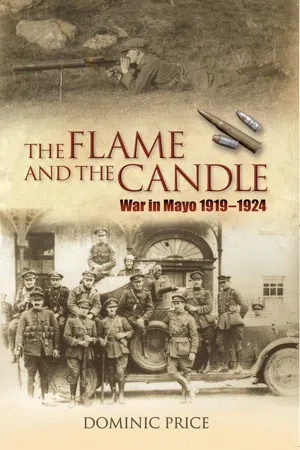
This is the story of Mayo men and women active during the War of Independence and the Civil War, a story largely untold or forgotten. Throughout, there is an attempt at real insight into the lives of participants. The establishment and acceptance of the Garda Síochána and how Mayo adapted to peace while hundreds of Mayo men and women were still imprisoned is explored. The myth that little or nothing happened in Mayo during these troubled times is dispelled forever. • First factual account of War of Independence and Civil War in Mayo • This book is explosive (Taoiseach Enda Kenny, at the launch of the book) •
- English
- ePUB (mobile friendly)
- Available on iOS & Android
eBook - ePub
The Flame and the Candle
About this book
Information
Subtopic
Irish HistoryIndex
History1
‘I Beg to Report’: The Mayo RIC
Owen Spellman walked into his office and sat down. At 6 foot 2 inches and dressed in the dark green of a RIC District Inspector, the Roscommon man cut an imposing figure. He removed his peaked cap and gazed upon the black harp and crown. It looked very distinguished on the red background. Head Constable Maunsell brought him a cup of tea. As Spellman sipped his brew he felt very satisfied with himself. Claremorris was his first command as a District Inspector (DI). The town was a good posting for a man who had worked his way up through the ranks. Having joined the force in 1892, Spellman was promoted to Acting Sergeant in 1898 while stationed in Kilkenny. In 1917 he married Mary McDonnell from Stoneyford, County Kilkenny. Transferred upon marriage in accordance with the usual RIC practice, Spellman found himself appointed to Galway West Riding as a Head Constable. Just two years later the couple were in Claremorris, a growing town in south Mayo served by two rail links, one to Dublin and the other to Galway. The town was also the hub through which British forces and the RIC were distributed throughout the county of Mayo to the larger towns and villages.
The RIC county headquarters were further north in Castlebar, the administrative centre of Mayo. The RIC divided the county into districts based on the major towns of Ballina, Claremorris, Newport and Westport. A district barracks had a garrison of between ten and twenty constables. Garrisons like Westport were to rise to thirty or more constables during the War of Independence. Each district was in turn divided into sub-districts with minor barracks in towns and villages and additional RIC huts situated in rural townlands. The sub-district barracks had a complement of five to ten men. They were able to draw down reinforcements from the main district and county headquarters during times of crisis. The huts, manned by around four constables, were placed in areas noted for agrarian unrest. Mayo, with an area of 2,159 square miles and a population (according to the 1911 Census) of 192,177, was one of Ireland’s largest counties.1 It was thus a considerable challenge for the RIC to police effectively, requiring one of the highest numbers of sergeants and constables – over 400 – in the country.2

RIC Insignia. (Reproduced with kind permission of Raymond and Jean Shearer.
Photograph courtesy Neil Harrison Photography)
Photograph courtesy Neil Harrison Photography)

Constable James Hopkins from Mayo pictured here on joining the RIC in April 1907. Hopkins joined the RIC from Ballina where he was recommended by District Inspector Shier. Hopkins was stationed in Galway West Riding and then in Limerick during the War of Independence. He was promoted to Sergeant in June 1921. His nephew, Constable Thomas Hopkins, was murdered by the IRA while home on leave at Leface, Ballindine in May 1921. (Reproduced with kind permission of Bridie Hopkins and family)
DI Spellman was a dedicated police officer who had trained at the RIC Depot in the Phoenix Park, Dublin. The instruction provided was exemplary, and a benchmark for police forces throughout the British Empire. One of Spellman’s first ceremonies as a young recruit had been to take the following oath:
I do swear that I will well and truly serve Our Sovereign, the Queen, in the office of Constable without favour or affection, malice or ill-will; that I will see and cause Her Majesty’s peace to be kept and preserved and that I will prevent to the best of my power, all offences against the same; and that while I shall continue to hold the said office, I will, to the best of my skill and knowledge, discharge all the duties thereof, in the execution of warrants and otherwise, faithfully according to the law; and that I do not now belong, and that I will not, while I shall hold the said office, join, subscribe, or belong to any political society whatsoever, except the Society of Freemasons. So help me God.3

Claremorris RIC Barracks. (Author’s photograph)
Spellman looked at the large stack of files in front of him. The first assignment he had given himself was to review the actions of the Mayo RIC over the past few years. It would be the best way of familiarising himself with the major issues of his new command. He thought the Crown and Peace Papers4 would be a good starting point as he finished off his tea and settled down to work.
At first glance, the Crown and Peace Papers revealed that the Mayo RIC’s work was similar to that of other districts throughout Ireland. Some of the crimes included theft of bicycles, dealing with cattle, sheep and pigs on the loose, hurley fights, trespass of geese on crops, fist fights, assaults, disputes over bog rights, no lights on carts or bicycles, use of abusive language and no number plates on motors. But there were also more menacing crimes. Land agitation had been a focus of law and order concerns in Mayo since the RIC was established in 1822. In April 1916, Edward Walsh, a landlord at Castlehill, had discovered a coffin placed outside his home with a note attached stating he would lie in it within the month.5 Spellman was glad to see the dispute had been settled peacefully. He read on through the files. Some stories told of the more human and tragic stories that Mayo constables faced. One report ran as follows:
On 17th May 1916, John Reilly, a tramp, observed a bundle under a dry gullet in the village of Belderrigmore, Glencalry Sub Dist [north Mayo]. It was found to contain the dead body of a newly born male child wrapped up in two old womens’ coats. The whole tied in a piece of canvass. Inquest held on 18:5:16 and following verdict returned viz that death was caused by exposure and want of attention at birth. No person made amenable as yet but police inquiries are still being pursued.6
There were also a number of cases relating to members of the Irish Volunteers and Sinn Féin. The most serious concerned the arrest of Colum O’Geary, a teacher, on 30 April 1916. The incident began with a raid by the RIC:
Sergeant D. Fitzgerald 55670 who with an armed party of police went to Ryan’s Hotel, Cong, for the purpose of questioning Colum O’Geary a Gaelic Teacher, a reputed Sinn Feiner. O’Geary answered unsatisfactorily whereupon the Sergeant asked him had he any arms and immediately O’Geary threw himself on a bed put his hand in his hip pocket and drew a colt revolver (magazine charged with nine cartridges) and presented it at the Sergeant. Const O’Donnell who was with the Sergeant threw himself upon O’Geary and wrenched the revolver from him. When searched O’Geary was found to have in his possession 159 other cartridges for revolver and £81 6[s] 6[d] in money.

RIC Baton of District Inspector J. C. Milling. (Reproduced with kind permission of Raymond and Jean Shearer. Photograph courtesy Neil Harrison Photography)
A postscript in red ink followed the initial statement: ‘Dealt with by court martial and sentenced to 15 years penal servitude – 5 years remitted.’7
Spellman was intent on burning the midnight oil. Putting away the Crown and Peace Papers he called for more tea and turned his attention to the County Inspector’s monthly reports. The County Inspector was the senior ranking RIC officer in each Irish county. David Adie Steadman, a 54-year-old Presbyterian from Fifeshire, Scotland, had served as a District Inspector in Moate, County Westmeath, before his promotion to County Inspector of Mayo in 1911. The County Inspector was rather harsh in his attitude towards local people, as this statement reveals: ‘The Out of Work donation scheme has not helped matters following as it does the idea of getting something substantial for doing nothing and there are no lack of claimants in these parts whose wily cunning and mendicancy are more predominant attributes than self-respect and independence.’8
On the last day of each month, the County Inspector submitted a report to Dublin Castle, the headquarters of the British administration in Ireland. Steadman’s reports were always handwritten and not easy to read. Spellman was in for a long night. Each County Inspector’s report fell into two sections. Part I dealt with the prevailing situation in the county during the past month. Steadman always began with the words ‘I beg to report …’ This was usually followed up with ‘comparative calm prevails throughout this County at the moment’, no matter what the circumstances. Steadman usually related any developments regarding the Irish Transport and General Workers Union, the trade union that had led the General Strike in Dublin in 1913, which was always ‘busy fermenting unrest’.9 Of more serious concern for Steadman was the Congested Districts Board’s inaction with regard to the issue of land purchase. He was worried that the lack of available land would lead to unrest and violence. Land agitation was to become a major challenge for the Mayo RIC.
The price and availability of food was another problem. Due to demand for produce during the First World War, farmers had done well but the poor ‘felt the pinch of things’.10 Steadman often reported on the prospective turf yield and potato crop during the summer months. Shortages of turf and potatoes meant hardship for many Mayo people. It also raised the possibility of increased unrest due to high prices. Mayo had relatively few local industries but Steadman always referred to developments that offered hope of employment. Some examples were a small knitting industry in Keel on Achill Island, a woollen factory at Foxford and a bacon factory at Castlebar. Steadman also listed indictable offences reported during the month. This was a good indicator of the level of crime the RIC was facing. The crime of ‘inflicting malicious injury while driving cattle’ was to become very frequent. Steadman usually concluded Part I of his reports with a reference to the general level of drunkenness in the county. In July 1919 drunkenness was reported to be on the decrease due to high prices and scarcity of poitín.
Part II of the County Inspector’s monthly reports dealt with political activity on the part of Sinn Féin, the Gaelic League and the Irish Volunteers. The RIC kept Sinn Féin activists under constant surveillance. After Sinn Féin’s stunning election victory in December 1918, Steadman reported political activity to be decreasing or inactive. This was a cause for concern among committed Sinn Féin members in the county. They feared an opportunity was being lost. Mayo had elected four Sinn Féin TDs (Teachtaí Dála/Members of Parliament)in 1918. However, Dr John Crowley for Mayo North was the only Mayo representative present when the Ceann Comhairle (Speaker) Cathal Brugha called the roll of TDs for the first time. Éamon de Valera, Mayo East, Joseph MacBride, Mayo West, and William Sears, Mayo South, were all recorded as ‘fé ghlas ag Gallaibh’ (under lock and key of the British).

RIC officer’s belt buckle of J. C. Milling. (Reproduced with kind permission of Raymond and Jean Shearer. Photograph courtesy Neil Harrison Photography.
On the day the first Dáil met in Dublin, eight Irish Volunteers of the South Tipperary Brigade under the command of Seán Treacy and Dan Breen ambushed a cartload of gelignite escorted by two RIC constables at Soloheadbeg. Both men were shot dead. One of them was Mayo man James McDonnell, a 54-year-old widower with seven children. McDonnell, originally from Belmullet, was the first of twenty-three Mayo men in the RIC to be killed over the next four years.11 Events at Soloheadbeg marked the beginning of the Irish Volunteers’ military campaign against the RIC and the British military that was to be called the War of Independence or the Anglo-Irish War.
The RIC witnessed little Irish Volunteer activity in Mayo beyond training and collecting arms. The County Inspector’s reports detailed that in the first half of 1919 there were Sinn Féin meetings at Ballyhaunis, Crossmolina, Westport, Foxford and Keelogues to demand the release of interned prisoners. The Ballina Herald was allowed to reopen on 6 January following the seizure of its plant for printing ‘seditious election literature’. There were also court appearances for eight men in connection with rioting in Louisburgh and Ballycastle at the end of December. Among Sinn Féin activists in the county who received special mention were William Sears, TD for Mayo South, Conor Maguire, a solicitor from Claremorris, J. J. Collins, editor of the Mayoman from Castlebar, Paddy Hegarty, an Irish Volunt...
Table of contents
- The Flame and the Candle
- Title Page
- Dedication
- Contents
- Acknowledgements
- Abbreviations
- Author’s Note
- Map of County Mayo
- Introduction
- 1 ‘I Beg to Report’: The Mayo RIC
- 2 ‘An Apprenticeship of over 700 Years’: Sinn Féin and the Mayo Volunteers, 1920
- 3 ‘For the Sake of the Republic’: Chaos, Murder and the Republican Victory of 1920
- 4 ‘Demons’: Tans, Auxiliaries and the Counter-Terror Strategy
- 5 ‘Desire for Revenge’: Ambush – The Road to Victory
- 6 ‘The Year of Destiny’: Truce, Treaty and Descent to Civil War
- 7 ‘To the Bitter End’: Civil War
- Appendix I
- Appendix II
- Appendix III
- Appendix IV
- Appendix V
- Appendix VI
- Appendix VII
- Appendix VIII
- Appendix IX
- Appendix X
- Appendix XI
- Appendix XII
- Appendix XIII
- Appendix XIV
- References
- Bibliography
- About the Author
- Copyright Page
Trusted by 375,005 students
Access to over 1.5 million titles for a fair monthly price.
Study more efficiently using our study tools.
Frequently asked questions
Yes, you can cancel anytime from the Subscription tab in your account settings on the Perlego website. Your subscription will stay active until the end of your current billing period. Learn how to cancel your subscription
No, books cannot be downloaded as external files, such as PDFs, for use outside of Perlego. However, you can download books within the Perlego app for offline reading on mobile or tablet. Learn how to download books offline
Perlego offers two plans: Essential and Complete
- Essential is ideal for learners and professionals who enjoy exploring a wide range of subjects. Access the Essential Library with 800,000+ trusted titles and best-sellers across business, personal growth, and the humanities. Includes unlimited reading time and Standard Read Aloud voice.
- Complete: Perfect for advanced learners and researchers needing full, unrestricted access. Unlock 1.5M+ books across hundreds of subjects, including academic and specialized titles. The Complete Plan also includes advanced features like Premium Read Aloud and Research Assistant.
We are an online textbook subscription service, where you can get access to an entire online library for less than the price of a single book per month. With over 1.5 million books across 990+ topics, we’ve got you covered! Learn about our mission
Look out for the read-aloud symbol on your next book to see if you can listen to it. The read-aloud tool reads text aloud for you, highlighting the text as it is being read. You can pause it, speed it up and slow it down. Learn more about Read Aloud
Yes! You can use the Perlego app on both iOS and Android devices to read anytime, anywhere — even offline. Perfect for commutes or when you’re on the go.
Please note we cannot support devices running on iOS 13 and Android 7 or earlier. Learn more about using the app
Please note we cannot support devices running on iOS 13 and Android 7 or earlier. Learn more about using the app
Yes, you can access The Flame and the Candle by Dominic Price in PDF and/or ePUB format, as well as other popular books in History & Irish History. We have over 1.5 million books available in our catalogue for you to explore.