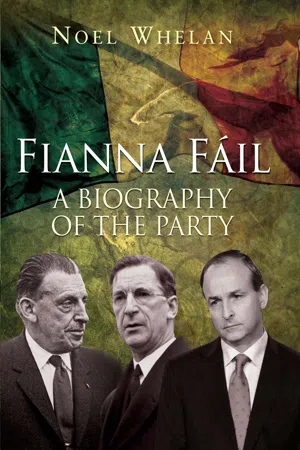
The Fianna Fáil Party was founded in 1926 and first came to Government in 1932. From that date until 2010, it has completely dominated the political life of the Republic of Ireland. For all but 13 of those 78 years, it has formed the Government of Ireland, either on its own or as the dominant party in a coalition.
Fianna Fáil has always seen itself as more than a party. Its self-image has been that of a national movement, one that represented the nation in microcosm and superseded partisan and regional prejudices. While holding this view of itself, it also managed to be the most ruthlessly, successful and professional party machine in Europe.
Noel Whelan, the distinguished political commentator and columnist, is steeped in the Fianna Fáil tradition. In this book, he traces the party's fortunes from its foundation by Eamon deValera and Seén Lemass in the 1920s through the economic war of the 1930, war time neutrality and stagnation of the 1950s.
Lemass's Governments of the 1960s, generally regarded as the best in the history of the State, restored the Country's fortunes, but the 70s and 80s were locust years dominated by the divisive and charismatic figure of Charles J. Haughey.
Under the later leadership of Bertie Ahern, party divisions were healed, and it seemed that national divisions were healed with them. An economic boom was allowed recklessly to run out of control with the result that the party, having brought Irish prosperity to a new peak, was then blamed for the sudden violence of the crash. The general election of 2011 reduced Fianna Fáil to its lowest ebb since it was founded. It may not have marked the end of the party, but it clearly marked the end of an era that began in 1932.
One afternoon in March 1926 two men strolled out of Rathmines Town Hall. The taller of them had just formally resigned as president of Sinn Féin. As he later told it, he turned to his companion and said, “Now, Seán, I have done my best, but I have been beaten. Now is the end for me. I am leaving public life.”
The speaker was Éamon de Valera; the man to whom he declared his intention to retire from politics was Seán Lemass. In later accounts de Valera reported that Lemass was shocked to hear what he said and replied, “But you are not going to leave us now, Dev, at this stage. You cannot leave us like that. We have to go on now. We must form a new organisation along the policy lines you suggested at the ard-fheis. It is the only way forward.”1
De Valera’s version of this exchange overstates his reluctance to become involved in establishing a new political party, but it accurately reflects Lemass’s enthusiasm for the project. The journey both men had taken to that moment was mirrored by many within Sinn Féin and the anti-treaty IRA who would decide to break away with them. Their relationship was to be if not the rock at least one of the foundation stones on which Fianna Fáil would be built. Together and in turn they would lead the new party for more than four decades.
De Valera’s pronouncement that he was leaving public life, if it had been accepted by Lemass, would indeed have been a startling one. When he spoke these words Éamon de Valera was forty-three, but he had been the most prominent face and perhaps the most important personality in Irish nationalist politics for the preceding decade. Ten years earlier he had been the commander of the rebel garrison in Boland’s Mill in Dublin during the rising of April 1916 and had avoided execution with the other leaders only because of his American birth. He had been imprisoned in England during the maelstrom that engulfed Ireland in the aftermath of the rising and executions, but when he was released, in June 1917, he emerged as a central figure in the new national independence movement that quickly gathered and grew under the umbrella name of Sinn Féin (“ourselves”). The name was that of a small political group established by Arthur Griffith that had long argued for an emphasis on the need for economic as well as political self-reliance and that had been initially blamed for the 1916 Rising by the British authorities.
As disenchantment with the Irish Party in the British Parliament and antagonism towards Britain increased, further fuelled by attempts to impose wartime conscription in Ireland, de Valera’s standing within the movement also grew. The transformation of Griffith’s small party into a broad popular front and national independence movement was reflected in de Valera’s assumption of the presidency of Sinn Féin at the party’s ard-fheis in 1917.
In the 1918 general election Sinn Féin had a landslide victory in Ireland on a policy of abstention from the British Parliament. De Valera had been re-arrested in May 1918 as part of the so-called German Plot and was in jail again in England when the Sinn Féin deputies met in the Round Room of the Mansion House, Dublin, on 21 January 1919 and constituted themselves as Dáil Éireann. Cathal Brugha was elected temporary president in de Valera’s absence. Following his escape in February from Lincoln Jail, masterminded by Michael Collins and Harry Boland, de Valera was elected Príomh-Aire (first minister) and president of Dáil Éireann in April 1919. As such he was not only the figurehead of the republic that had been proclaimed in 1916 but was also chairman of the executive council of ministers running the alternative government structure that Sinn Féin now developed throughout the country, and political head of the independence movement. The latter was engaged in a brutal but effective guerrilla campaign, which fought the British forces in Ireland to a standstill, forcing them to enter negotiations in the late summer of 1921.
Although head of the government of the self-declared Irish Republic, de Valera himself did not travel to London as a member of the negotiation team. It was instead led by Arthur Griffith, who was effectually deputy head of the Dáil government, and Michael Collins, who was Minister for Finance as well as commander of the independence movement’s guerrilla forces. De Valera was unhappy with the treaty that was eventually agreed between the Irish and British delegations and signed on 6 December 1921. Along with fellow-ministers, including Cathal Brugha and Austin Stack, he angrily rejected the contention that the Angl0-Irish Treaty gave effective independence to the 26 Counties. They railed against it because it provided for the partition of Ireland, and more vociferously because it included a requirement that, although the Dáil would be recognised as an Irish parliament, its members would have to swear an oath of allegiance to the British King. De Valera and the other opponents of the treaty contended that Griffith and Collins and their fellow-plenipotentiaries had signed the treaty without approval from the cabinet in Dublin and that at the time the signatories had been intimidated by a British threat of return to “immediate and terrible war”.
As the Dáil, Sinn Féin, the Irish Republican Army and the country followed the cabinet in bitter division over the provisions of the treaty, de Valera led the opposing side. On 7 January 1922 he and his followers narrowly lost the Dáil vote on the treaty and walked out of the assembly, claiming to be the true custodians of the Irish Republic as proclaimed in 1916 and ratified by the first Dáil. They lost the subsequent elections in 1922 and 1923 and were even more decisively beaten in the short but brutal and bitter Civil War, which raged particularly in the east and south from June 1922 to May 1923.
Sidelined by more militant and military leaders during the conduct of the Civil War, and imprisoned for eleven months in its immediate aftermath, de Valera was released in July 1924 and sought to pick up the reins of the depleted and defeated republican anti-treaty political organisation that, though it retained the name Sinn Féin, had lost many of its leading politicians to the pro-treaty side or to death. In the wake of its electoral and military defeat Sinn Féin was a dishevelled organisation, lacking money and manpower; more significantly, by failing to recognise the newly established Irish Free State it was lacking a sustainable political strategy.
From then until he spoke those words to Lemass on the steps of Rathmines Town Hall, de Valera and the other revisionists within the third Sinn Féin who had appreciated the reality of their defeat on the treaty issue and come to recognise the futility of abstention from the institutions established under the treaty sought to move Sinn Féin from a course they knew would only leave it in the political wilderness. His remarks to Lemass were his acceptance that they had failed.
Seán Lemass was considerably younger than de Valera, being only twenty-six in March 1926, but he too had led a dramatic and dangerous life over the previous decade. The son of a hatter in Capel Street, Dublin, the young Lemass had to lie about his age when in 1915 he gained admittance to A Company, 3rd Battalion of the Dublin City Regiment of the Irish Volunteers. Shortly thereafter Éamon de Valera became adjutant of this battalion, and Lemass later recalled his first impression of de Valera’s personal magnetism and his “capacity to hold a crowd of volunteers there while he addressed them in inordinate length, as he always did.” Notwithstanding his “queer looking appearance”, the “long thin fellow” impressed the young Lemass enormously.2
Lemass, as a young recruit, would not have been aware that the poet and educationalist Patrick Pearse and the Labour leader James Connolly and others had planned a rising for Easter Sunday, 23 April 1916. All the young Lemass did know was that a parade in O’Connell Street scheduled for that day had been cancelled the night before on the instruction of Professor Eoin MacNeill, titular head of the Irish Volunteers. The following day Lemass and his older brother, Noel, who was also a member of the Volunteers, headed off instead on a bank holiday hike up the Dublin Mountains. A chance meeting en route with Professor MacNeill and his two sons was to prove a turning-point in the lives of both Lemass brothers. The MacNeill boys bore news that, notwithstanding their father’s countermanding order, some of the Volunteers had proceeded with the plan for a rising on the Monday and had set about taking control of strategic sites around Dublin. A clearly agitated MacNeill, who had strongly opposed the plan for the rising when he became aware of it, told them that armed unrest had already broken out in the city centre.
Determined to get into the action, the two Lemass brothers hurried back to town, making their way first to Jacob’s biscuit factory in Bishop Street, where, because nobody knew them, they were refused admission. The following morning they wandered the various sites where they understood the Volunteers had taken up position until, when they were passing the GPO in O’Connell Street, a friend on sentry duty recognised them and brought them inside, where they were “absorbed into the garrison and given arms.” In a personal account published at the time of the fiftieth anniversary of the rising in 1966 Lemass recalled that he was given a shotgun and positioned on the roof of the GPO, where he stayed until the building came under heavy British shelling on the Thursday.
The rising having collapsed by Friday, Lemass was part of the retreat to Moore Street, during which, like almost everyone else involved in the evacuation, he briefly assisted in carrying the stretchered James Connolly, who had been injured during the fighting. After the eventual surrender Lemass was arrested but was detained for only two weeks before being released because of his age. The young Lemass now returned briefly to the family business and to his studies, in apparent compliance with his father’s wish that he would become a barrister.
Despite writing about his involvement in the rising, Lemass left no formal account and seldom spoke of his subsequent activities in the War of Independence between 1920 and 1922 or of his involvement in the Civil War. We know, however, that he maintained his membership of the Irish Volunteers and that in late 1917 he became a lieutenant in the 2nd Battalion of the reconstituted Dublin Brigade—no mean achievement for someone of his youth. Lemass is said by some historians to have been one of the “Apostles” or “Squad”—a very effective assassination crew of “tough steel-willed men from the Dublin Volunteers,” hand-picked and directed by Michael Collins. He was certainly one of those responsible for killing British agents on “Bloody Sunday”, 21 November 1920. Lemass and his company were also involved in a number of shooting incidents in 1920, including a number of arms raids.
We know too that during a short visit home in December 1920 Lemass was arrested and interned at Ballykinler, Co. Down. Always a man to use his time well, he was an avid reader during his imprisonment and at this time began his self-directed study of economics. He was released on the signing of the Anglo-Irish Treaty in December 1921 and was appointed a training officer in the new Free State police force. However, having reflected on the treaty’s contents, and having realised that his first pay cheque was drawn on the Provisional Government of the Irish Free State and not on Dáil Éireann, as he had assumed, he resigned and joined up with other anti-treaty training officers who had based themselves at the former British army barracks at Beggars’ Bush, Dublin.
Lemass was part of the anti-treaty IRA group that seized the Four Courts in Dublin on 14 April 1922, and such was the regard for him that he was appointed adjutant to the garrison’s commander, Rory O’Connor. The Provisional Government, headed by Michael Collins, began shelling the building on 28 June, and after two days O’Connor and the garrison surrendered. Although Lemass escaped, he was later recaptured and imprisoned, this time in the Deerpark Camp in the Curragh.
In July 1923 Noel Lemass, also an anti-treaty IRA officer, was abducted in Dublin, it is believed by men connected to the new Free State Special Branch. His mutilated body was discovered the following October dumped on the side of Killakee Mountain in Co. Dublin. Released from imprisonment on compassionate grounds, Seán Lemass returned to work in his father’s business but also resumed his active career in the republican movement, although from this point onwards the direction of his involvement “was increasingly political.”3
Lemass had not previously been a member of Sinn Féin, but now, though still an IRA man, he became increasingly important in the political wing. The ard-fheis of November 1923 was suspended for a period to allow delegates to attend the funeral of Noel Lemass, and when it reconvened Seán Lemass, in his absence and unknown to him, was elected to the party’s standing committee. He now advanced rapidly through the party ranks. On 18 November 1924 he was elected to Dáil Éireann on his second attempt in a by-election in the Dublin County constituency.
It was at this stage that his working relationship with de Valera intensified. Within weeks of Lemass’s election to Dáil Éireann, de Valera named him Minister for Defence in the notional Republican government that the anti-treaty Sinn Féin maintained. He succeeded Frank Aiken in this political post, but Aiken remained chief of staff of the IRA. Lemass had even less enthusiasm than Aiken for the prospect of another offensive military campaign against the Free State forces. He argued instead for an emphasis on the need to mobilise public opinion, and he set about attempting to reorganise the party in Dublin.
At this time de Valera also appointed Lemass to the organisational and economic sub-committees of the Sinn Féin Ard-Chomhairle. At its meetings Lemass became one of the most ardent advocates for Sinn Féin taking a more pragmatic political approach. More practically, he set about applying his already obvious administrative skills to that end and in particular to revitalising the party’s Dublin organisation. In a series of six articles in the party’s weekly newspaper, An Phoblacht, between September 1925 and January 1926 Lemass offered an increasingly depressing analysis of the state of the Sinn Féin organisation, finances and membership. He also made increasingly strident calls for a change of direction and for an emphasis on “immediately recognisable political objectives.” The Lemass articles were all the more significant because they could not have appeared without the agreement of P. J. Ruttledge, the publication’s editor, and because Lemass was widely regarded as a protégé of de Valera.
Lemass became increasingly impatient with political progress, and indeed with de Valera’s cautiousness. In one of his articles in An Phoblacht in early January 1926 Lemass wrote: “There are some who would have us sit at the roadside and debate the true points about a de jure this and a de facto that but the reality we want is away in the distance and we cannot get there unless we move.” It is an observation that some historians have argued was directed as much at the party president as at the membership generally.
The question whether or not those elected as Sinn Féin deputies would take the oath and therefore their Dáil seats was given new impetus by the fiasco over the report of the Boundary Commission. The three-member commission had been established under the terms of the Anglo-Irish Treaty to decide on the precise delineation of the boundary between the Irish Free State and Northern Ireland. Both sides in the treaty debate had expected that substantial areas of Northern Ireland along the provisional border would be transferred to the Free State. However, an authoritative article on what was said to be a draft of the commission’s report was published in a conservative English newspaper, the Morning Post. This suggested that extensive adjustments to the existing border were to be recommended, which caused consternation among both nationalists and unionists.
Such was the intensity of the public reaction in the South that the Irish member of the commission, Eoin MacNeill, now a minister in the Free State government, resigned from the commission and then from his government position. Fearing further disputes, the Free State, Northern Ireland and British governments agreed to suppress the full report, and in a wider agreement, ratified on 3 December 1925, the head of the Free State government, W. T. Cosgrave, agreed with his British and Northern counterparts that the existing border would be retained.
The case against the anti-treaty deputies’ continued abstention from the Free State Dáil was further undermined by this controversy. It did not escape de Valera’s notice, or that of the public in general, that if the forty-eight Sinn Féin deputies had taken the seats to which they had been elected the Cosgrave government’s proposal on the boundary would have been defeated. Indeed on 8 December 1925 de Valera had led thirty-eight republican deputies in a meeting with the Labour Party deputies and others at which the Labour Party leader beseeched de Valera and his colleagues to take their seats so as to defeat the boundary proposal. However, as Sinn Féin had been elected on a mandate of principled opposition not only to the oath but to participation in the Free State institutions, and facing substantial oppo...
Table of contents
Cover
Title
Introduction: Talking to the Lemass Group in the Cowen Era
Chapter 1: From the Steps of Rathmines Town Hall, 1926
Chapter 2: Laying the Foundations, 1926–7
Chapter 3: Over the Oath and Then Into Power, 1927–32
Chapter 4: First Terms in Government, 1932–9
Chapter 5: Government in Wartime, 1939–48
Chapter 6: Pushed Into Opposition by a Pretender, 1948–54
Chapter 7: Renewal, 1954–9
Chapter 8: A Breath of Fresh Air, 1959–66
Chapter 9: A Weak Start, 1966–9
Chapter 10: Arms and Intrigue, 1969–70
Chapter 11: Backing Jack, 1970–77
Chapter 12: The Turbulent Transition, 1977–81
Chapter 13: “Rise and Follow Charlie,” 1981–7
Chapter 14: Crossing the Coalition Rubicon, 1987–9
Chapter 15: Nine Lives, 1989–92
Chapter 16: Back From the Brink, 1989–92
Chapter 17: A Rollercoaster Ride, 1992–4
Chapter 18: The Bertie Bounce, 1995–7
Chapter 19: Peacemaker and Politician, 1997–2002
Chapter 20: Bertie: From Boom to Bust, 2002–8
Epilogue
Notes
Bibliography
Images
Copyright
About the Author
Dedication
Acknowledgments
About the Publisher
Trusted by 375,005 students
Access to over 1.5 million titles for a fair monthly price.
Study more efficiently using our study tools.
Frequently asked questions
Yes, you can cancel anytime from the Subscription tab in your account settings on the Perlego website. Your subscription will stay active until the end of your current billing period. Learn how to cancel your subscription
No, books cannot be downloaded as external files, such as PDFs, for use outside of Perlego. However, you can download books within the Perlego app for offline reading on mobile or tablet. Learn how to download books offline
Perlego offers two plans: Essential and Complete
Essential is ideal for learners and professionals who enjoy exploring a wide range of subjects. Access the Essential Library with 800,000+ trusted titles and best-sellers across business, personal growth, and the humanities. Includes unlimited reading time and Standard Read Aloud voice.
Complete: Perfect for advanced learners and researchers needing full, unrestricted access. Unlock 1.5M+ books across hundreds of subjects, including academic and specialized titles. The Complete Plan also includes advanced features like Premium Read Aloud and Research Assistant.
Both plans are available with monthly, semester, or annual billing cycles.
We are an online textbook subscription service, where you can get access to an entire online library for less than the price of a single book per month. With over 1.5 million books across 990+ topics, we’ve got you covered! Learn about our mission
Look out for the read-aloud symbol on your next book to see if you can listen to it. The read-aloud tool reads text aloud for you, highlighting the text as it is being read. You can pause it, speed it up and slow it down. Learn more about Read Aloud
Yes! You can use the Perlego app on both iOS and Android devices to read anytime, anywhere — even offline. Perfect for commutes or when you’re on the go. Please note we cannot support devices running on iOS 13 and Android 7 or earlier. Learn more about using the app
Yes, you can access A History of Fianna Fáil by Noel Whelan in PDF and/or ePUB format, as well as other popular books in Politics & International Relations & Historical Biographies. We have over 1.5 million books available in our catalogue for you to explore.