- 208 pages
- English
- ePUB (mobile friendly)
- Available on iOS & Android
eBook - ePub
About this book
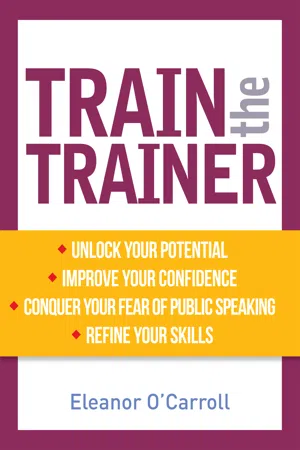
Essential guide for those who wish to unlock their potential as a professional trainer. Learn how to develop your confidence, conquer your fear of public speaking and refine your skills.
Train the Trainer gives guidance on each stage of the Training Cycle, i.e. identifying training needs, designing training, delivering training and evaluating training; presents good training practice; explains the importance and relevance of different kinds of learning, including experiential and task-based learning; encourages reflective practice and continuous professional development; describes how to identify training needs, devise learning objectives and prepare and plan appropriate training methods to achieve those objectives; outlines how to plan, prepare and deliver a dynamic and thought-provoking presentation using a variety of resources.
The book contains a completed sample training needs analysis (TNA) document and provides instruction on how to develop and implement appropriate assessment and evaluation methods.
The appendices include a quick Inventory of Activities that is useful for Group Training Scenarios and ideas for Activities for Train the Trainer Course Tutors to use on courses.
Ideal for all those involved in professional training and for students on Train the Trainer courses.
Information
C H A P T E R 1
Introduction to Training
In this unit we will look at:
 | What is training? |
| How do I become a trainer? |
| How do I become an effective trainer? |
| Why is training important? |
| The difference between training and learning |
| The changing environment of training |
| Responding to change |
| The benefits of training |
| Motivations for training |
| The role of the trainer |
| What is a train the trainer qualification? |
So you want to be a trainer?
Training is often defined as a means of transmitting new skills and knowledge to different target audiences and recipients. There are many kinds of training programmes available for providers and users. Candidates on training programmes can include employers, employees, managers, enthusiasts, students, volunteers, jobseekers and entrepreneurs. If you have an aptitude for tutoring, demonstrating, instructing or coaching others, you may already have taken the first step in becoming a trainer, but you may not have reached your optimum potential for becoming an effective trainer. Perhaps you have recognised that there is a demand for your skills or a gap in the market for a service you can provide or maybe you have inadvertently stepped into a training role within your department at work. If this is the case, a Train the Trainer course could well be the next step for you in becoming a successful and effective trainer.
As well as providing you with a variety of tips and confidence-building training tasks, the objective of this book is to provide you with all the necessary information to prepare you for any role where you will be providing training to others. In this book, you will learn all the skills required to become an effective trainer in any discipline. While it is chiefly aimed at FETAC Level 6 students pursuing the Train the Trainer module certificate, it is also useful to many other professionals in the training world to enable them to further develop their training skills and fully unlock their training potential. It provides useful advice, guidelines and information for Train the Trainer course participants, trainer-tutors, aspiring and existing trainers and trainees in all disciplines.
What is training?
For the purpose of this book we can assume that the term ‘training’ refers to the provision of instruction and guidance designed to impart proficiency. In this sense, training can relate to the pursuit of any number of activities particular to work, lifestyle, personal interest, education or professional development. It can also relate to developmental, rehabilitative, disciplinary or corrective behaviour, for example dog training, weight training, military training or even potty training!
Training is defined by challenges. In order for a training programme to have a justification, a deficit must be identified and a training need established. This is the beginning of what is often an exciting and challenging process. This involves defining a training objective (or objectives), selecting appropriate training methods and setting a target level of proficiency that is to be achieved by the end of the training programme. Through training, we find a way of facilitating changes in people and motivate them to challenge behaviours, experiment, explore and view the world in a different way.
How do I become a trainer?
Many people did not intentionally set out to be trainers. In the work environment, it is common to hear stories of people who stepped into a training role accidentally. For example, in many instances, a long-serving employee might be asked to train in the new recruit and show them the ropes. This could entail a quick demonstration or a more lengthy period of shadowing, where the new employee observes the more experienced person carrying out work-related procedures. This turns out to be a successful process and before long, it is repeated with another new member of staff. After that, management realise that this person has the aptitude and skills to head up a training department or to be officially appointed in a training role for the department. However, this is not always the ideal scenario. In some cases, informal training is not consistent and lacks structure or clear objectives. It can also create problems regarding clarity about seniority of roles. Nowadays, more companies acknowledge that training should be a formalised set of procedures carried out by a designated trainer who works specifically in a training role.
In other situations, people have stepped into a training role later on in life, passing on their professional skills and knowledge as a secondary career. Some professions, such as athletes and performers, have a shelf life, and therefore becoming a trainer implies assuming a role in an advisory capacity to the next generation of aspiring professionals. Other people specifically set out to learn a set of skills with the sole intention of using them in a training capacity at a later date, for example becoming a business trainer or a teacher-trainer after gaining many years of professional experience in the field. Regardless of how you have got to this point in your career or whether you are a part-time, full-time or occasional trainer, a professional Train the Trainer qualification is the foundation for your continued progress and development in the training field.
How do I become an effective trainer?
Training is a skill that you can develop and improve over time. If you have been involved in training for a number of years, either in a dedicated training role within a company or as an occasional trainer, you will have developed many skills which have helped you to evolve your style. If you cast your mind back to your experience of being a novice trainer, you were probably very nervous. New trainers often over-compensate by talking too much or bluffing answers and in some cases they can even be over-prepared, which causes inflexibility in modifying the programme and can lead to the trainer being unable to respond to the real needs of the group. It is important that you do not allow complacency to set in regarding your methods of delivery and your approach to training. Some training methods can work like a dream with one group and fail miserably with another. A good trainer will always seek new methods, evaluate previous training experiences and endeavour to make each course better than the last. If you are new to a training role, it may be difficult at first, but you will soon realise that the challenge and the satisfaction of being a trainer lies in serving as a vehicle for the motivation and empowerment of others. It is also important to remember that training is a two-way process – both the trainee and the trainer serve as a resource to each other and there should be a mutual respect.
What is the difference between training and learning?
Training is different from education in various ways and it therefore presents us with different challenges. This is mainly due to the fact that the person or people being trained actively participate in the training activity rather than simply receiving instruction in a passive way. As training usually involves hands-on participation, the trainee has an active role in the training process. At the basis of any training programme is the belief that it must be directed towards achieving specific standards or objectives, sometimes referred to as learning outcomes. Training is largely concerned with communicating information and facilitating learning and it often takes place in an appropriate environment, such as a community environment or actual workplace where the knowledge and skills being communicated are to be used in the future. Training typically involves participation, whereby the trainer is actively involved in guiding and facilitating the recipients through the training process, providing the necessary support mechanisms that in turn enable the trainees to successfully complete tasks or procedures.
Training is defined by a process of identifying key learning outcomes or objectives for these tasks or procedures. Through a variety of assessment methods, the ultimate goal of the trainer is to determine if these learning outco...
Table of contents
- Cover
- Title Page
- Contents
- Chapter 1 Introduction to Training
- Chapter 2 Training Assignments
- Chapter 3 Presentation Skills
- Chapter 4 Preparing for Training Delivery
- Chapter 5 Trainer Skills
- Chapter 6 Theory of Training and Adult Learning
- Chapter 7 The Training Cycle
- Chapter 8 Training and Instructional Methods
- Chapter 9 What Is Assessment?
- Chapter 10 Evaluation
- Chapter 11 Bridging the Gap to Successful Training with a TNA
- Chapter 12 The ‘How To’ of Training Needs Analysis
- Chapter 13 Reflective Practice and Continuous Professional Development
- Appendix 1: Activities That Are Useful for Group Training Scenarios
- Bibliography
- Acknowledgments
- Copyright
- About the Author
- About Gill & Macmillan
Trusted by 375,005 students
Access to over 1.5 million titles for a fair monthly price.
Study more efficiently using our study tools.
Frequently asked questions
Yes, you can cancel anytime from the Subscription tab in your account settings on the Perlego website. Your subscription will stay active until the end of your current billing period. Learn how to cancel your subscription
No, books cannot be downloaded as external files, such as PDFs, for use outside of Perlego. However, you can download books within the Perlego app for offline reading on mobile or tablet. Learn how to download books offline
Perlego offers two plans: Essential and Complete
- Essential is ideal for learners and professionals who enjoy exploring a wide range of subjects. Access the Essential Library with 800,000+ trusted titles and best-sellers across business, personal growth, and the humanities. Includes unlimited reading time and Standard Read Aloud voice.
- Complete: Perfect for advanced learners and researchers needing full, unrestricted access. Unlock 1.5M+ books across hundreds of subjects, including academic and specialized titles. The Complete Plan also includes advanced features like Premium Read Aloud and Research Assistant.
We are an online textbook subscription service, where you can get access to an entire online library for less than the price of a single book per month. With over 1.5 million books across 990+ topics, we’ve got you covered! Learn about our mission
Look out for the read-aloud symbol on your next book to see if you can listen to it. The read-aloud tool reads text aloud for you, highlighting the text as it is being read. You can pause it, speed it up and slow it down. Learn more about Read Aloud
Yes! You can use the Perlego app on both iOS and Android devices to read anytime, anywhere — even offline. Perfect for commutes or when you’re on the go.
Please note we cannot support devices running on iOS 13 and Android 7 or earlier. Learn more about using the app
Please note we cannot support devices running on iOS 13 and Android 7 or earlier. Learn more about using the app
Yes, you can access Train the Trainer by Eleanor O'Carroll in PDF and/or ePUB format, as well as other popular books in Business & Human Resource Management. We have over 1.5 million books available in our catalogue for you to explore.