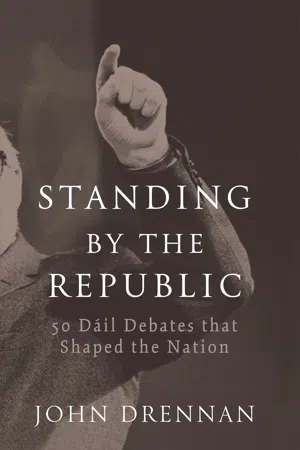
From the debates of the 1950s that were strikingly similar to what we face today – struggles against bankruptcy, emigration and abuse of power by the State – through the wars in the 70s and 80s over divorce and abortion, to the Jacobean dramas surrounding the fall of Haughey in the 1990s, this essential book finally traces the fall of the first Republic via the tragic-comic dénouement of the Cowen era and the first breaths of hope provided by a new administration.
John Drennan's Standing by the Republic captures the fascinating story of Ireland's evolution in the seven decades since the end of the war and encapsulates the culture that shaped these moments of national drama.
Chapter 1: ‘Doomed be damned’: Dev loses power and the sky doesn’t fall in
Chapter 2: Keeping the past for pride as Mr Costello declares the Republic
Chapter 3: Protecting mothers and children? Not in our Republic, thank you
Chapter 4: The Duke of Plaza Toro returns, leading from behind
Chapter 5: Suffer the little children … in blind indifference
Chapter 6: Dev steps out, Costello steps in again
Chapter 7: ‘National progress has halted’: Lemass addresses the state of the nation
Chapter 8: Hoping for an ‘upsurge of patriotism’: Mr Lemass is chosen
Section 2: After the lost decade new hope blossoms … but old problems scowl
Chapter 9: A turn to the left: Lemass leads on
Chapter 10: In the ‘affluent society’ even the undeserving poor deserve justice
Chapter 11: The reluctant Taoiseach takes to the pitch
Chapter 12: ‘So charming as to be dangerous’
Chapter 13: The Revenue are not the enemy: Mr Haughey’s first budget
Chapter 14: Hot Dames on Cold Slabs: The beginning of the end of the age of censorship
Chapter 15: Oliver J. Flanagan’s fishy tale
Section 3: Enter Haughey after Jack secures too much of the love of the people
Chapter 16: The Arms Crisis: A state and a party confront the enemy within
Chapter 17: Jack’s ‘exercise in persuasion’
Chapter 18: The original Quiet Man comes to power
Chapter 19: Honest Jack gobbles the lot as John Kelly plays Nostradamus
Chapter 20: ’Tis an Irish solution to an Irish problem’
Chapter 21: Mr Haughey ‘comes with a flawed pedigree’
Section 4: The horrid eighties and the great age of GUBU
Chapter 22: ‘I found my foot in some strange doors last week’
Chapter 23: Ephemeral creations bring down the best Government we never had
Chapter 24: A duo of despair
Chapter 25: Dessie O’Malley stands by the Republic
Chapter 26: Frankenstein’s monster and Pee Flynn stalk the land
Chapter 27: Mac the Knife confronts Ireland’s economic crisis
Chapter 28: ‘A further significant development in the political degeneration of Fianna Fáil’
Section 5: An evil spirit leaves and a ward boss comes
Chapter 29: An evil spirit governs the Republic
Chapter 30: ‘I have done the state some service’
Chapter 31: Hollow, nervous laughter as they pass the graveyard
Chapter 32: A bit of a shock as Bruton ‘rises as a phoenix’
Chapter 33: We are in surplus: Labour’s last budget
Chapter 34: A rat in an anorak or a humble nort’side Dub?
Chapter 35: Ray Burke draws a line in the sand
Chapter 36: Bertie sees the Ghost of Tribunals Future
Chapter 37: Drinking champagne as Charlie McCreevy becomes midwife to the Celtic Tiger
Chapter 38: Hope and history walk hand in hand
Chapter 39: The apotheosis of the dragon’s teeth of terrorism
Section 6: Death of the Republic
Chapter 40: A man in full: Bertie leaps the second hurdle
Chapter 41: McCreevy’s last hurrah turns into a handful of dust
Chapter 42: Appeasement challenged: Enda comes of age
Chapter 43: Three-in-a-row secured as death by tribunal waits
Chapter 44: ‘This is a wonderful country, and we are a fortunate people’: Seeing through a glass darkly as Brian Cowen becomes Taoiseach
Chapter 45: Handing over the deeds of the country to bail out the banks
Chapter 46: Ireland has ‘turned the corner’
Chapter 47: Darkness falls
Chapter 48: ‘Where do we leave our CVs for all these jobs?’
Chapter 49: Mr Cowen sips from the bitter cup for a final time
Epilogue
Chapter 50: Hanging out our brightest colours for Enda
Bibliography
Acknowledgements
Copyright
About the Author
About Gill & Macmillan
INTRODUCTION
In 1986 John Kelly TD claimed that the Irish politician is
a hissing and a byword to many people. Wrongly so, no doubt. Perhaps the public do not understand the motives which drive people into it, the bug which gets into them or the psychological deficiencies which force them to try and make up in this arena what they lack in others. They may not have enough sympathy. All they see are a lot of fat cats or people who ride along enjoying a high profile and getting a lot of coverage and publicity on what they think is a lot of unearned money.
Almost thirty years later little has changed, but is such an analysis too reductive? For politics is also an art that, to some degree at least, shapes the destiny of the nation.
Despite—or perhaps because of—our national capacity for talk, one of the unchanging features of Irish politics is the public’s distrust of the art of political rhetoric. This opinion is epitomised by the outwardly wise old saw that a new TD, having talked themselves into the Dáil, should keep quiet lest they talk themselves out of it.
However, as John Bruton once noted in an eloquent critique of Sinn Féin, words are the only weapons politicians possess: they are for them the tools that shape the future of the society they represent. And the Dáil is still the great arena in which the battle to reinvent, protect and sometimes even define the nature of the republic we inhabit takes place.
Though eloquence in politics is associated with sophistry, voters still retain a core belief in the status of the Dáil as the national theatre of the people. It may be a dusty old palladium now, but in the public imagination it is still where the future of the state is settled. This status means that the present lacuna, in which there is no collection of the most dramatic debates that have occurred within the Dáil, is all the more curious.
My objective in this book has been to write the story of the evolution of a state as seen through the great clashes that occurred in the political theatre of the people.
In looking at the great cast of kings, pretenders, princes, regicides, turbulent priests and some clowns, we begin, just to vary the atmosphere, in 1948, with the transfer of power from Éamon de Valera to J. A. Costello and the birth of the Republic. This date is chosen because in many respects it marks the natural end of the old Civil War era and the beginning of the process that would shape the development of the modern Republic. It is also relevant for darker reasons, as the final debates in this book tragically chronicle what is essentially the death of that first Republic.
The subsequent debates reveal that for much of the 1950s the new Republic’s legs were, in a hostile world, at best unsteady. There were great characters and dramatic moments, but the dominant mood of the age was one of public stagnation, as, aided by the strength of some ghouls from the past, the old dispensation clung on grimly to power. Several of the debates from what should seem to us an entirely different time in fact resemble a prologue to our present fire-song.
The mood picks up dramatically in the 1960s through seminal events such as the arrival of Seán Lemass, the introduction of free education by Donogh O’Malley and the reform of the censorship laws. The wars in the 70s and 80s about divorce, abortion and the Arms Trial, in contrast, are indicative of the arrival of a darker era of uncertainty, one accentuated by the sulphurous elevation of Charles Haughey to office and by the subsequent great corruption wars.
This book will focus on the more dramatic and colourful figures of our parliamentary history—our various Taoisigh, John Kelly, Ray Burke, Dessie O’Malley, the two Brian Lenihans (father and son), Michael Noonan—as well as on some semi-forgotten blossoms such as Oliver J. Flanagan.
I have tried to avoid the temptation to editorialise, and to let, within their context, the politicians of the various ages speak in their own voices.
In selecting the debates I was mostly guided by the historical importance of the events—for instance the election of a Taoiseach or the state of knowledge in the 1950s of the abuse of children—rather than by soaring flights of rhetoric. This means that in some debates, such as that regarding our accession to the European Union, there is little hand-to-hand political combat. In that instance, for example, it was the significance of the occasion—together with its eerily prescient critique by Justin Keating (one of the lost public intellectuals of the era) of the dangers of EU membership—that merited its inclusion.
As well as focusing on how incoming Governments saw the country—on their plans and hopes and how accurate those were—this book also covers a number of critical budgets from the Haughey era to the present.
Mention of Haughey brings us to one of the text’s central themes. Over four decades, no politician, outside perhaps of de Valera, possessed such sway over the imagination, and the nightmares, of the country.
Another feature I have noted is that drama and conflict in Irish politics often appear in clusters. The strongest evidence for this is the stark contrast between the Augustan age of Bertie, in which nothing occurred (on the surface, at least) for a decade, and the cataclysmic Cowen era, in which one could be dealing with five national crises a week.
In this regard, readers will also have to excuse me for the high concentration of debates from the last four years; but we must realise that this has been the most traumatic era for politics and the state since the Civil War.
Study of these debates may even become all the more necessary, for when it comes to our recent series of political catastrophes, the flux of events means that we quickly lose touch with the public record of who said what during the banking guarantee or the debates on the EU-IMF bail-out.
Though this book deals with debates that often range over days and weeks, a single speech is sometimes so compelling that it dominates the entire affair. Examples of this are Garret FitzGerald’s ‘flawed pedigree’ oration about the accession of Haughey to the Taoiseach’s office, and Dick Spring’s coruscating ‘evil spirit’ critique of the same politician more than a decade later.
I hope to show that, in spite of itself and the voters, the Dáil, often driven by outside events, has provided us with no shortage of dramatic moments, and sometimes of merely farcical rows.
Happily, not all the events described herein are dark and bitter. There are also those days of joy, generally during the accession of Taoisigh or in the wake of the Belfast Agreement, on which Leinster House, all too briefly, hangs out its brightest colours. Some may even recall that the mood was more than jovial during a couple of Charlie McCreevy’s budgets. But, like many other things, all that has gone quite out of fashion now.
HOPEFUL FORTIES, HUNGRY FIFTIES
Chapter 1
‘DOOMED BE DAMNED’: DEV LOSES POWER AND THE SKY DOESN’T FALL IN
18 February 1948
The late 1940s were a time of conflicting national impulses. In public life—understandably so, given our economic performance—the language of pastoral decline was endemic. But radical strands of thought, which would fully blossom only in the sixties, were also emerging. In looking at the ‘desolate’ forties and fifties, the modern eye also sometimes fails to see that the new Free State had come through significant traumas and secured major achievements.
The bloodied entrails of the War of Independence and the Civil War meant that even securing a relatively apolitical police force and a democratic transition of power from the victorious to the defeated side of the Civil War was, in the context of the time, a worthy success. Under Éamon de Valera, Ireland had also gone through a radical era in which the final apron strings of empire were severed just in time to avoid embroilment in the Second World War.
Thanks to the senseless economic war with Britain a new economic regime based on tariffs and self-sufficiency had been developed, and the primacy of the state had been established over the nascent but pleasantly incompetent—well, by fascist standards—Blueshirts as well as over the somewhat less pleasant remnants of the IRA, which had been proscribed in 1936.
Throughout all these changes a Taoiseach formed by the age of political giants such as Charles Stewart Parnell and W. E. Gladstone retained an aristocratic hold on the loyalties of his people. There was, however, an Achilles heel in the political make-up of the man known as ‘the Chief’, for the closest de Valera had come to an economic policy was his belief that sovereignty on its own could play a key role in socio-economic development. Amidst the bloodshed and terror of the 1940s a policy of elegant pessimism, in which Ireland aspired to be little more than a quaint backwater, had its attractions. And few in Fine Gael would have disagreed fundamentally with de Valera’s Arcadian dreams of a land of ‘frugal comfort’.
But the mood of the citizens began to shift when the ending of the war appeared to signal an actual deterioration in economic conditions. That old fox de Valera had sensed trouble in 1947 when Clann na Poblachta had won two by-elections. The farcical Locke’s Distillery furore saw the ascetic de Valera shrouded with accusations about the sale of the rights to mature whiskey in return for a gold watch. In fact Dev was up to different types of mischief with the Irish Press, and his political health had been far more damaged by a teachers’ strike and an emergency budget in 1947, which had imposed new taxes on beer, cigarettes and even cinema tickets.
In spite of all these factors, after the results of the snap election came in it looked for a time that de Valera would return to office. Fine Gael, with 19 per cent, won its lowest share of the vote in the history of the state. The eternally unhealthy Labour Party was split into two parties, while the nascent radicalism among the electorate was epitomised by the election of two former chiefs of staff of the IRA—one of those of very recent vintage. Clann na Poblachta was described by one observer as consisting of ‘incorrigible Celts, disgruntled IRA and political adventurers’, and Clann na Talmhan, which was...
Table of contents
Cover
Title page
Contents
Bibliography
Acknowledgements
Copyright
About the Author
About Gill & Macmillan
Trusted by 375,005 students
Access to over 1.5 million titles for a fair monthly price.
Study more efficiently using our study tools.
Frequently asked questions
Yes, you can cancel anytime from the Subscription tab in your account settings on the Perlego website. Your subscription will stay active until the end of your current billing period. Learn how to cancel your subscription
No, books cannot be downloaded as external files, such as PDFs, for use outside of Perlego. However, you can download books within the Perlego app for offline reading on mobile or tablet. Learn how to download books offline
Perlego offers two plans: Essential and Complete
Essential is ideal for learners and professionals who enjoy exploring a wide range of subjects. Access the Essential Library with 800,000+ trusted titles and best-sellers across business, personal growth, and the humanities. Includes unlimited reading time and Standard Read Aloud voice.
Complete: Perfect for advanced learners and researchers needing full, unrestricted access. Unlock 1.5M+ books across hundreds of subjects, including academic and specialized titles. The Complete Plan also includes advanced features like Premium Read Aloud and Research Assistant.
Both plans are available with monthly, semester, or annual billing cycles.
We are an online textbook subscription service, where you can get access to an entire online library for less than the price of a single book per month. With over 1.5 million books across 990+ topics, we’ve got you covered! Learn about our mission
Look out for the read-aloud symbol on your next book to see if you can listen to it. The read-aloud tool reads text aloud for you, highlighting the text as it is being read. You can pause it, speed it up and slow it down. Learn more about Read Aloud
Yes! You can use the Perlego app on both iOS and Android devices to read anytime, anywhere — even offline. Perfect for commutes or when you’re on the go. Please note we cannot support devices running on iOS 13 and Android 7 or earlier. Learn more about using the app
Yes, you can access 50 Dáil Debates that Shaped the Nation by John Drennan in PDF and/or ePUB format, as well as other popular books in History & British History. We have over 1.5 million books available in our catalogue for you to explore.