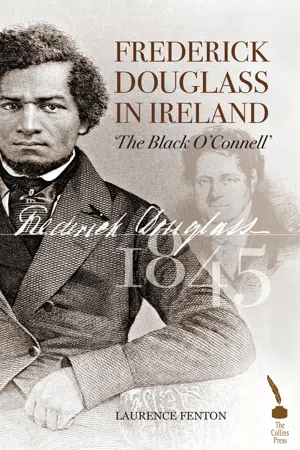
'When we strove to blot out the stain of slavery and advance the rights of man,' President Obama declared in Dublin in 2011, 'we found common cause with your struggle against oppression. Frederick Douglass, an escaped slave and our great abolitionist, forged an unlikely friendship right here in Dublin with your great liberator, Daniel O'Connell.' Frederick Douglass arrived in Ireland in the summer of 1845, the start of a two-year lecture tour of Britain and Ireland to champion freedom from slavery. He had been advised to leave America after the publication of his incendiary attack on slavery, Narrative of the Life of Frederick Douglass, An American Slave. Douglass spent four transformative months in Ireland, filling halls with eloquent denunciations of slavery and causing controversy with graphic descriptions of slaves being tortured. He also shared a stage with Daniel O'Connell and took the pledge from the 'apostle of temperance' Fr Mathew. Douglass delighted in the openness with which he was received, but was shocked at the poverty he encountered. This compelling account of the celebrated escaped slave's tour of Ireland combines a unique insight into the formative years of one of the great figures of nineteenth-century America with a vivid portrait of a country on the brink of famine.
- English
- ePUB (mobile friendly)
- Available on iOS & Android
eBook - ePub
Frederick Douglass in Ireland
About this book
Information
Subtopic
Historical BiographiesIndex
History1
Masters and Slaves
FREDERICK DOUGLASS WAS never sure of his age. A majority of masters kept such precious, deeply personal information away from their slaves. It was a sign of power, one manifestation of the many iniquities of slavery. Frederick’s best guess was February 1817. He was out by a year – the real date fell somewhere in February 1818. The uncertainty hurt even as a child: ‘The white children could tell their ages. I could not tell why I ought to be deprived of the same privilege.’ Frederick’s sense of place was far more secure: born in Talbot County, Maryland, the latest in a long-established line of Talbot County slaves, one that stretched back to the early years of the colony.1
Frederick’s first years were spent in a cabin by a creek on the rural Eastern Shore of Chesapeake Bay. He lived with his grandparents, Isaac and Betsey Bailey, and an ever-changing collection of siblings and cousins. It was a cramped and basic shelter, with windowless log walls and some planks thrown over the rafters to act as beds. Frederick’s clothes were few and the food, despite his grandmother’s best efforts, was often of the ‘coarsest kind’, cornmeal mush picked off a wooden tray with an oyster shell. And yet Frederick’s memories of this time were positively bucolic, the many hardships leavened by the thrill of being a child in the warm countryside, running wild through the trees, rolling in the dust and plunging head-first into the muddy waters of the Tuckahoe Creek.2
Frederick’s father was a white man, quite possibly his owner Aaron Anthony, a farmer in his fifties who was also estate manager at the nearby plantation, Wye House. His skin colour, certainly, was of a far lighter hue than the rest of his family. Frederick’s mother, Harriet Bailey, lived and worked on one of Anthony’s farms a few miles away (Anthony owned about thirty slaves, spread over a couple of farms). He saw her rarely, for although the distance between them was not great, it was almost impossible for field-hands to leave their place of work. ‘The slave-mother’, Frederick wrote angrily in later years, ‘can be spared long enough from the field to endure all the bitterness of a mother’s anguish, when it adds another name to a master’s ledger, but not long enough to receive the joyous reward afforded by the intelligent smiles of her child.’3 Harriet died quite young, when Frederick was six or seven years old, and the pain of never really knowing her was a source of lifelong grief.
Cut off from his mother, the greatest influence on Frederick’s early years was his grandmother Betsey. It appears that Betsey, about forty-four years old when Frederick was born, was left to look after the children so that the mothers – her daughters – could be put back to work in the fields as soon as possible after giving birth. She was illiterate, like the majority of slaves, but quite skilled at providing food for her extended family. A ‘capital hand’ at making large seine nets for catching shad and herring, the striking image of her wading waist-deep in the water for hours during their annual spring runs to spawn in the upper reaches of the Tuckahoe never strayed far from Frederick’s mind.4
Frederick’s time in Betsey’s care came to an end in the late summer of 1824. He was six years old and ready to begin work as a domestic servant. Betsey did not tell him this as they set off on the long, hot 12-mile trek to Aaron Anthony’s cottage on the grounds of Wye House. They walked west, towards the bay, winding their way down dusty roads, across great fields and through heavy woods, the now fifty-year-old Betsey carrying Frederick on her shoulders for long stretches. They arrived in the sweltering heat of mid-afternoon, and after gulping down some much-needed water, Frederick was sent out to play with his older brother and sisters, Perry, Sarah and Eliza, siblings he hardly knew, siblings who had made the same journey some years before him. Betsey slipped away without saying goodbye, thinking it easiest for the child. ‘Fed, Fed! grandmammy gone! grandmammy gone!’ called one of the children after a while.5 Frederick ran into the kitchen, saw it was true, and fell immediately to his knees in despair.
That night, the slave boy who in later years would advise Abraham Lincoln in the White House cried himself to sleep on a cold, stone floor.
‘The Bloody Transaction’
Wye House was the vast, luxurious home of Colonel Edward Lloyd V, the tall and handsome scion of one of the oldest and wealthiest families in the state of Maryland. It was the centre of a 10,000-acre kingdom, almost a small city in itself, with beautiful gardens, a magnificent orangery full of fruits, blacksmiths, carpenters, shoemakers, wheelwrights and even its own dock. There was also a large windmill where grist was ground, wheat having replaced tobacco as the crop on which the Lloyd fortune was based.6 Colonel Lloyd was one of the most important public figures of the time, a former congressman, senator and state governor. He was also well known as one of the country’s most lavish entertainers, ferrying guests from the state capital, Annapolis, to Wye House on board his private sloop the Sally Lloyd.
The newly arrived young slave was able to sneak a tempting peek at the magnificent array of food awaiting dinner guests as he ran errands or swept out the yard. The ‘glittering table’ of the main house, he recalled, groaned under the profusion of beef, veal, mutton, partridges, quails, pheasants and ‘teeming riches of the Chesapeake Bay’. A large garden provided ‘tender asparagus’, ‘succulent celery’, ‘delicate cauliflower’ and other vegetables he had never seen before. The dairy, too, poured forth ‘its rich donations of fragrant cheese, golden butter and delicious cream to heighten the attraction of the gorgeous, unending round of feasting’. There were also figs, raisins, almonds and juicy grapes from Spain, wines and brandies from France, teas from China and coffee from Java.7
On his death in 1834, a local paper, the Baltimore Republican, described how Lloyd was ‘as remarkable for the munificence of his private hospitality as for his public spirit’.8 The paper failed to mention that it was a ‘munificence’ built on the back of slave labour. Slaves had worked the Lloyd land for more than a century, the family acquiring a reputation as one of the harshest masters in Maryland. The Colonel Lloyd whom Frederick knew owned more than 500 slaves. They were poorly clothed, poorly fed and kept out of sight of the main house. ‘The sleeping apartments – if they may be called such – have little regard to comfort or decency,’ Frederick wrote of the sheds in which the slaves lived. ‘Old and young, male and female, married and single, drop down upon the common clay floor, each covering up with his or her blanket – the only protection they have from cold or exposure.’9
Frederick was at something of a remove from the majority of slaves at Wye House, living in the Anthony cottage instead of the desperate slave quarters. He was, however, just as cold and hungry as the other slaves, scrabbling for food and sleeping on the floor of a small closet in the kitchen. He was quite lonely too, for although surrounded by relatives, he never forged a bond to match that which he had shared with his grandmother. The love and tenderness that had alleviated earlier hardships had disappeared.
It was not long before Frederick got his first real taste of slavery, waking up one morning to the sight of Aaron Anthony pulling the clothes off his fifteen-year-old Aunt Hester’s back. Having earlier refused her owner’s predatory advances, she had been caught out at night with one of the Lloyd slaves, a boy her own age named Ned Roberts. An enraged Anthony tied her hands to a hook in the kitchen ceiling, rolled up his sleeves and whipped her naked back until blood dripped down to the floor. ‘No words, no tears, no prayers from his gory victim seemed to move his iron heart from its bloody purpose. The louder she screamed, the harder he whipped; and where the blood ran fastest, there he whipped longest. He would whip her to make her scream, and whip her to make her hush; and not until overcome by fatigue would he cease to swing the blood-clotted cowskin.’10 Young Frederick turned away in horror, hiding until ‘the bloody transaction’ was over. It was the first such scene he had ever witnessed; it would not be the last: his memoirs are replete with the beatings of slaves by the cruel and callous overseers at Wye House.
A more positive experience at Wye House was the friendship Frederick forged with Aaron Anthony’s married daughter, Lucretia Auld, who was about twenty years old. ‘Miss Lucretia’, as Frederick always called her, lived in the simple stone cottage with her father and new husband, Thomas Auld, the captain of the Sally Lloyd. Her two elder brothers, Andrew and Richard, also stayed occasionally. ‘In a family where there was so much that was harsh, cold and indifferent, the slightest word or look of kindness passed, with me, for its full value,’ Frederick wrote. ‘Miss Lucretia … bestowed upon me such words and looks.’ Just as important were the pieces of bread she sometimes sneaked to him when no one was looking. She also washed the blood from his face when he got into a fight with another boy, wetting a ‘nice piece of white linen’ with her own balsam. For Frederick, these acts were ‘sunbeams of humane treatment’, finding their way into his soul through the ‘iron grating of my house of bondage’.11
We can never know what sign of precocity, what quirk, the young lady saw in Frederick. He was certainly a bright boy, by all accounts a clever mimic and good singer. Perhaps she was just starved of company, with the great house out of bounds, a father who was cold, stern and uncommunicative, a husband often away on Colonel Lloyd’s business, and brothers – Andrew especially – who were heavy drinkers. She may also have heard the whispers concerning Frederick’s birth – that he was her half-brother. Whatever the cause, it was a connection that would soon shape Frederick’s life indelibly.
In 1826 the ageing and increasingly unhealthy Aaron Anthony was moved on from his position at Wye House. He took his family and slaves to one of his Tuckahoe farms. Frederick, eight years old, was ready to be put to work in the fields, the most typical of all slave experiences. This would have been his fate but for the extraordinary, generous and genuinely altruistic intervention of Lucretia Auld, who arranged for him to be sent to Baltimore, the great shipbuilding city across the Chesapeake Bay, where Thomas’s brother, Hugh Auld, and his wife, Sophia, wanted a black boy to serve as a companion to their young son, as was common practice at the time. Frederick was delighted, describing the time before his departure as one of the ‘happiest’ of his childhood. He spent the best part of three days washing the ‘plantation scurf’ off his body, ‘Miss Lucretia’ having promised him a pair of trousers if he got clean. This ‘was almost a sufficient motive, not only to induce me to scrub off the mange (as pig drovers would call it), but the skin as well’.12
Frederick, clearly, did not feel much sense of loss at the prospect of leaving his family and the Eastern Shore.
‘This Mystery of Reading’
‘Instead of the cold, damp floor of my old master’s kitchen, I found myself on carpets; for the corn bag in winter, I now had a good straw bed, well furnished with covers; for the coarse cornmeal in the morning, I now had good bread, and mush occasionally; for my poor tow-linen shirt, reaching to my knees, I had good clean clothes.’ Frederick’s world had changed – and for the better. He was still a slave, the property of Aaron Anthony, but not treated as one. His new master, Hugh Auld, a carpenter trying to set up his own shipbuilding business, was too busy to pay much heed to the new arrival. Frederick’s new mistress, however, ‘Miss Sopha’, was exceptionally kind, welcoming him into the house with a warm smile. Coming from a simple country family that had never owned slaves, she treated Frederick as well as her own son, and he soon came to regard her as ‘something more akin to a mother, than a slaveholding mistress’. He also grew close to the little boy, Tommy.13
Frederick’s new home in the busy shipbuilding district of Fells Point was a world away from Wye House, and he was at first disorientated by the sheer scale and noise of the place, wagons and carriages clattering loudly through the narrow cobblestone streets at all hours. He started to run errands, however, such as fetching pails of water from the town pump, and soon learned his way around the maze of streets that all seemed to end in busy dockyards, noting with amazement how everyone, even the black men and women he saw, seemed to wear shoes.14
Back at home, Sophia, a pious Methodist, often read the Bible aloud, awakening Frederick’s curious mind ‘to this mystery of reading’. The young, curly-headed slave asked her to teach him, which she did, unquestioningly. They read passages from the Bible together, slowly and carefully. Frederick quickly mastered the alphabet and learned to spell words three or four letters long. The lessons were ended by Hugh Auld who, although not a slaveholder, still held the prejudices of the age. ‘Learning would spoil the best nigger in the world,’ he declared coldly, warning his wife off any further lessons.15 Nevertheless, a door had been opened in Frederick’s mind, never to be closed. He read in secret from the Bible, a spare Methodist hymn book and later young Tommy’s discarded school books. He also asked his young white playmates on the streets to act as teachers – skin colour no impediment to the forging of friendships at that young age. He paid his ‘tuition fee’ to these boys with bread or biscuits taken from home.16 Later, Frederick would teach himself to write, drawing inspiration from the way shipbuilders made marks on the different pieces of timber – ‘S.’ for starboard, ‘L.’ for larboard (or port), ‘L.A.’ for larboard aft and so on. He would copy these marks onto the pavement with chalk, again asking his young white friends for help.17
Before that, however, came a trepidatious return to the Eastern Shore.
‘Cash! Cash! Cash! For Negroes’
In October 1827, Frederick was called back to the Tuckahoe Creek. Aaron Anthony had died the previous November and his property, including about thirty slaves – essentially the extended Bailey clan – was to be divided up between his two sons and Thomas Auld. Frederick was reunited – briefly – with his beloved grandmother, as the slaves were lined up on one of Anthony’s farms to be assessed and examined by two lawyers. The value reached was $2,800 (about $210,000 in today’s money).18
‘What an assemblage!’ Frederick wrote of the humiliating experience. ‘Men and women, young and old, married and single; moral and intellectual beings, in open contempt of their humanity, levelled at a blow with horses, sheep, horned cattle, and swine … and all subjected to the same narrow inspection, to ascertain their value in gold and silver – the only standard of worth applied by slaveholders to slaves! How vividly at that moment did the brutalizing power of slavery flash before me! Personality swallowed up in the sordid idea of property! Manhood lost in chattelhood!’19
Frederick’s fears were heightened by the fact that his protector, Lucretia Auld, had also died by this time, in the summer of 1827, perhaps after giving birth to a daughter, Amanda...
Table of contents
- Cover
- Title Page
- About the author
- Dedication
- Frontispiece
- Contents
- Prologue
- 1 Masters and Slaves
- 2 Abolitionists
- 3 ‘Safe in Old Ireland’
- 4 ‘A Total Absence of Prejudice’
- 5 ‘There Goes Dan, There Goes Dan’
- 6 ‘The Apostle of Temperance’
- 7 ‘The Sufferings and Cruelties around Us’
- 8 ‘The Good City of Cork’
- 9 ‘This Persecuted Son of Africa’
- 10 ‘The Chattel Becomes a Man’
- Epilogue: Queenstown – 1886
- Acknowledgements
- Notes
- Bibliography
- Imprint page
- If you have enjoyed this book, you might also enjoy the following eBooks
Trusted by 375,005 students
Access to over 1.5 million titles for a fair monthly price.
Study more efficiently using our study tools.
Frequently asked questions
Yes, you can cancel anytime from the Subscription tab in your account settings on the Perlego website. Your subscription will stay active until the end of your current billing period. Learn how to cancel your subscription
No, books cannot be downloaded as external files, such as PDFs, for use outside of Perlego. However, you can download books within the Perlego app for offline reading on mobile or tablet. Learn how to download books offline
Perlego offers two plans: Essential and Complete
- Essential is ideal for learners and professionals who enjoy exploring a wide range of subjects. Access the Essential Library with 800,000+ trusted titles and best-sellers across business, personal growth, and the humanities. Includes unlimited reading time and Standard Read Aloud voice.
- Complete: Perfect for advanced learners and researchers needing full, unrestricted access. Unlock 1.5M+ books across hundreds of subjects, including academic and specialized titles. The Complete Plan also includes advanced features like Premium Read Aloud and Research Assistant.
We are an online textbook subscription service, where you can get access to an entire online library for less than the price of a single book per month. With over 1.5 million books across 990+ topics, we’ve got you covered! Learn about our mission
Look out for the read-aloud symbol on your next book to see if you can listen to it. The read-aloud tool reads text aloud for you, highlighting the text as it is being read. You can pause it, speed it up and slow it down. Learn more about Read Aloud
Yes! You can use the Perlego app on both iOS and Android devices to read anytime, anywhere — even offline. Perfect for commutes or when you’re on the go.
Please note we cannot support devices running on iOS 13 and Android 7 or earlier. Learn more about using the app
Please note we cannot support devices running on iOS 13 and Android 7 or earlier. Learn more about using the app
Yes, you can access Frederick Douglass in Ireland by Laurence Fenton in PDF and/or ePUB format, as well as other popular books in History & Historical Biographies. We have over 1.5 million books available in our catalogue for you to explore.