- 384 pages
- English
- ePUB (mobile friendly)
- Available on iOS & Android
eBook - ePub
About this book
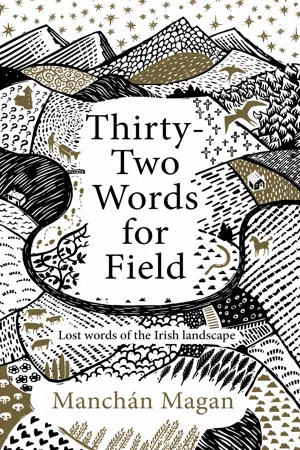
The Irish language has thirty-two words for field. Among them are:
Geamhar – a field of corn-grass
Tuar – a field for cattle at night
Réidhleán – a field for games or dancing
Cathairín – a field with a fairy-dwelling in it
The richness of a language closely tied to the natural landscape offered our ancestors a more magical way of seeing the world. Before we cast old words aside, let us consider the sublime beauty and profound oddness of the ancient tongue that has been spoken on this island for almost 3,000 years.
In Thirty-Two Words for Field, Manchán Magan meditates on these words – and the nuances of a way of life that is disappearing with them.
Information
KALEIDOSCOPE
It was my grandmother, Sighle Humphreys, who taught me Irish and when I asked her one day what the word for a hole was, she replied, ‘Do you mean one dug into the ground by an animal? That’s an uachas. Or one made by fish in a sandy riverbed for spawning? That’s a saothar. Or if it’s been hollowed out by the hoofs of beasts and then filled with rain it’s a plobán. Or if a lobster is hiding in one it’s a fach. Or if it’s been created as a hideaway by a wild beast it’s a puathais.’
That was the moment I realised that the two languages I spoke, Irish and English, required not just different forms of grammar and syntax but different ways of seeing the world. I had already noticed that, when giving directions, I had to orient myself very differently, depending on the language. In Irish I had to take account of the position of the sun. I couldn’t say I was heading ‘up the road’ or ‘back to someone’s house’ or ‘into town’. Instead I would first situate myself in relation to the planet. I would be heading siar ó dheas (‘south-west’) along the road or aduaidh (‘to the north’) or soir abhaile (‘eastwards home’). Even when someone or something was just a little way off, such as a cow in the next field, I would say, Tá an bhó thoir sa pháirc (‘The cow is in the field to the east’).
Later on I learnt that there were many other words for holes, such as one dug into a bog, a criathar, and one made by an auger, a tarathar, and a cup-like hole in a rock, a ballán. Log is a water-filled hole in the landscape, cró a hole in the eye of a needle and spail a hole at the stern of a boat. Breifne, a tiny hole made by an insect or a needle, has its direct opposite in duibheachán, a hole so big that it can be classed as an abyss. Pluais, séib, sloc, cluais and logán are all other possibilities, some more specific than others.
Each can be translated into the English word ‘hole’, and perhaps it’s efficient to do so, but I have always wondered what subtlety and nuance is lost and whether the richness of the reality the Irish words describe would wane.
Our landscape now looks like an increasingly anonymous expanse of indistinguishable fields, yet seen through the Irish language each field has its own word, depending on its characteristics and function: geamhar, bánóg, biorach, machaire, buaile, ingealtas, domasach, póicín, fásach, mainnear, cathairín, réidh, cuibhreann, réidhleán, cluain, mín, tamhnach, buadán, tuar, branar, plás, raon, lóiste, cúilín, réalóg, cabhán, achadh, mothar, plásóg, loscán, páirc, magh. To a city-dweller this land may all look the same, and in English each would probably be just referred to as a field, yet to someone whose ancestors have been cultivating the land, growing grain and tending cattle for over four thousand years, and who has built up the soil over centuries by hauling seaweed from the shore and burning limestone to add alkalinity, they look very different.
Geamhar is a field of corn grass, biorach is a marshy field, branar is a fallow field. Cuibhreann is a tilled field worked in partnership with a neighbour, tuar a night field for cattle. Cluain is a meadow field between two woods, tamhnach an arable field in an arid area. Réidhleán is a field for games or dancing, plás a level field for spreading flax or hay, plásóg a sheltered field in which a mare would foal, raon an upland field, machaire a low-lying open field. Buaile is a field for keeping cattle before milking. Mainnear is an enclosed field, réidh a level field, mín a smooth fine field and réalóg an unenclosed patch of good land in the middle of a créig (a stonier area of limestone). Cathairín is a field with a fairy-dwelling in it. Losaid, a neat, well-arranged field, is similar to cúilín, which is also neat but smaller.
Each of these words summons particular swathes of our landscape and the activities that happen on them. Some words even refer to fields in which something occasionally happened but no longer does, such as bánóg, a patch of ground levelled out by years of dancing, among other things, or buadán, a hillside that once had gorse growing on it but has since been cut with a scythe or hook, leaving only stumps. A hillside on which the gorse has been removed not by cutting but by burning is a loscán.
Having lived here for so long, we have perhaps inevitably become rooted to every aspect of this land, becoming entangled in its complex network of clay, sand, stone, weeds, worms, mycobacteria, flora, pollinators and mycelium. But I hadn’t realised how far back this connection stretched until my grandmother taught me a seanfhocal (a proverb, literally ‘old word’) that shook my sense of time and space so much that I am contending with it to this day.
Saol trí mhíol mhór saol iomaire amháin, saol trí iomaire saol an domhain.
These words – meaning ‘Three times the life of a whale is the lifespan of a ridge, and three times the life of a ridge is the lifespan of the world’ – encapsulate just how far back the knowledge contained within the language stretches on this island. A whale was thought to live for one thousand years (although they live for about a century), so it was known that the cultivation ridges that we see in the fields around us could be up to three thousand years old. Archaeologists agree that there are indeed ridges of that age still visible in such places as the Céide Fields in Co. Mayo and Slievemore on Achill Island. The span of three cultivation ridges would amount to nine thousand years, which takes us back to the time when archaeologists believe significant numbers of humans first settled here – the beginning of our world. That our people appear to have kept a count of how long we have been here – and that they encoded it in our language – is precious.
My grandmother often pointed out the still-visible cultivation ridges left by her great-grandparents’ generation during the Famine in the 1840s. Some were more visible than others, as they had been left undug; my ancestors either were too weak to dig them or, having noticed the blight-rotted potato stems, had realised that there would be nothing but a slimy mush beneath the soil. I had been struck by the longevity of such memories, but it wasn’t until I heard the proverb that I realised quite how far back these folk memories stretch.
It appears, at least, as though we managed to keep some wispy thread of memory intact from our Neolithic forebears, who planted, weeded and harvested along such ridges thousands of years ago. The knowledge is contained within the land, and over the years I’ve realised that the best way to access it is through the language.
FIRST UTTERANCE
Aduantas is that feeling one gets in unfamiliar places – a light fear with a tinge of sadness. It captures well the sense of, say, starting out on a book on something as potent and amorphous as the Irish language. This feeling is mixed with a sense of sclimpíní, which conveys the effect of lights dancing before one’s eyes – either real light or supernatural light, those glimpses one gets through the veil of what lies beyond.
When the forebears of those Neolithic farmers first arrived on this island ten thousand years ago, they didn’t yet speak Irish, but that doesn’t mean we don’t know what was first said. The unfathomable process known as the oral tradition has left us a record, passed down through the generations in the minds of druids and poets until the arrival of that poisoned chalice – writing – in the fifth century with the first missionaries, who used it as a spell to entrance us and as a tool to control us.
It was they who helped jot down and then transcribe our first memories, insights and acts onto parchment, and from there these have made their way to us in the form of a shabby set of ancient tweets, known as annals and chronicles, that list the history of our people from the time of Noah’s flood to our arrival on this green island and right up to the 17th century.
The annals were like newspaper headlines, noting the most significant events, such as that ‘a huge dragon was seen, with great thunder after it, at the end of autumn’ in AD 736 and that ‘ships with their crews were seen in the air above Cluain Moccu Nóis’ in AD 749. We also know that in AD 1116 there was a ‘great famine in the spring, so that a man would sell his son and his daughter for food and men would even eat one another, and dogs.’
It is these written records that claim that we first set foot here on 1 April in 700 BC, having sailed from Spain. Many archaeologists agree with this account but suggest that the date is closer to 8000 BC … Both versions may be right in different ways.
The old lore also preserves the first words spoken here. They were an invocation by our chief poet and druid, Amergin, who, it is said, managed to reach the coast of Co. Kerry because of a magical wave that plucked him from the Atlantic Ocean and dropped him on the shore during a tempest. His wife and his siblings were all drowned in this storm that was created by a supernatural tribe of earth-bound gods, Tuatha Dé Danann, who were living here before us. They had made a promise that if we managed to reach Ireland from a distance of nine waves from the shore they would gladly surrender. When Amergin did make it to dry land in spite of the storm they had sent, they fulfilled their promise and slunk away under the surface of the earth into the Otherworld, where they continued to live.
Amergin became leader of the island and his first act was to begin uttering an incantation, summoning up the world that we intended to create here and clarifying the interrelation between it and all other planes of existence, physical and spiritual.
This could be seen as a rather obtuse thing to do, but the Irish people always had a flair for the dramatic. Proclamations, blessings and invocations are second nature to us; often, we favour them over actions. And yet Amergin’s words were somewhat different; they were our declaration of the unity of all thing...
Table of contents
- Cover
- Title Page
- Contents
- 1. Kaleidoscope
- 2. First utterance
- 3. Isn’t it yourself?
- 4. Stones and loss
- 5. Who are you of?
- 6. Netherworld
- 7. Contortions and comets
- 8. Losing a word
- 9. Island sanctuary
- 10. Dancing words
- 11. The wave
- 12. Wave as goddess
- 13. Blarney
- 14. Fairy words
- 15. Taboo
- 16. Fairy psychology
- 17. Land
- 18. Field names
- 19. Place names
- 20. Deciphering place
- 21. Thresholds
- 22. Irish songlines
- 23. Witches’ Hill
- 24. Circles
- 25. Resonance
- 26. Sound
- 27. Arabic
- 28. India
- 29. The cure of words
- 30. Women and witches
- 31. Finding witches
- 32. How to recognise the cailleach
- 33. Sex in Irish
- 34. Seaweed
- 35. Divine inspiration
- 36. Lights in the sky
- 37. The illumination of language
- 38. Specificity
- 39. Quantum Irish
- 40. Winds
- 41. The ecology of Irish
- 42. Cows and copper
- 43. Curses
- 44. Illusion
- 45. A collection of fish
- References
- Copyright
Trusted by 375,005 students
Access to over 1.5 million titles for a fair monthly price.
Study more efficiently using our study tools.
Frequently asked questions
Yes, you can cancel anytime from the Subscription tab in your account settings on the Perlego website. Your subscription will stay active until the end of your current billing period. Learn how to cancel your subscription
No, books cannot be downloaded as external files, such as PDFs, for use outside of Perlego. However, you can download books within the Perlego app for offline reading on mobile or tablet. Learn how to download books offline
Perlego offers two plans: Essential and Complete
- Essential is ideal for learners and professionals who enjoy exploring a wide range of subjects. Access the Essential Library with 800,000+ trusted titles and best-sellers across business, personal growth, and the humanities. Includes unlimited reading time and Standard Read Aloud voice.
- Complete: Perfect for advanced learners and researchers needing full, unrestricted access. Unlock 1.5M+ books across hundreds of subjects, including academic and specialized titles. The Complete Plan also includes advanced features like Premium Read Aloud and Research Assistant.
We are an online textbook subscription service, where you can get access to an entire online library for less than the price of a single book per month. With over 1.5 million books across 990+ topics, we’ve got you covered! Learn about our mission
Look out for the read-aloud symbol on your next book to see if you can listen to it. The read-aloud tool reads text aloud for you, highlighting the text as it is being read. You can pause it, speed it up and slow it down. Learn more about Read Aloud
Yes! You can use the Perlego app on both iOS and Android devices to read anytime, anywhere — even offline. Perfect for commutes or when you’re on the go.
Please note we cannot support devices running on iOS 13 and Android 7 or earlier. Learn more about using the app
Please note we cannot support devices running on iOS 13 and Android 7 or earlier. Learn more about using the app
Yes, you can access Thirty-Two Words for Field by Manchán Magan in PDF and/or ePUB format, as well as other popular books in Social Sciences & British History. We have over 1.5 million books available in our catalogue for you to explore.