eBook - ePub
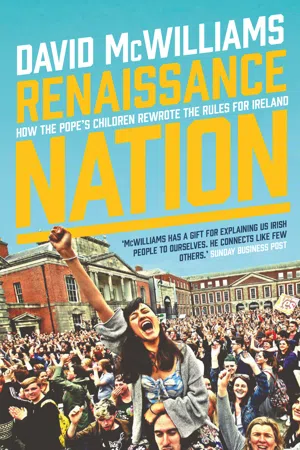
Renaissance Nation
How The Pope's Children Rewrote the Rules for Ireland
- 320 pages
- English
- ePUB (mobile friendly)
- Available on iOS & Android
eBook - ePub
About this book
Renaissance Nation is the story of how the Pope's Children rewrote the rules for Ireland.In four decades, bookended by the visits of the pope in September 1979 and August 2018, Ireland has managed to become one of the wealthiest and most progressive nations in the world.Here David McWilliams presents the story of modern Ireland and how, once we threw off the shackles and replaced the torpor of collective dogma with the vibrancy of individual freedom, the economy too started to motor.Meet the everyman revolutionaries who made it all happen, heroes like Sliotar Mom and Flat White Man. Feel the pulse of the Radical Centre and celebrate the optimism of a tolerant, accepting, 'live and let live' nation.In a world where other nations are divided, their economies stalled, lurching to the extremes, convulsed by existential fights pitting one part of the population against the other, Renaissance Nation shows how a well off, relatively chilled Ireland, with a growing economy and surfing a wave of liberal optimism, may not be perfect, but it isn't a bad place to be.A triumph of popular economics and social history, this is the story of how, almost without anyone noticing, an insurgent middle class carried off something extraordinary – a quiet revolution – and with it, reshaped our national destiny.
Information
PART 1
CULTURE WARS
CHAPTER 1
FROM MOVING STATUES TO BOUNCY CASTLES
9 A.M. DOMINICAN CONVENT, DÚN LAOGHAIRE
A patient column of people runs all the way down the street as far as the New Paddy phone repair shop. The only other shop doing business so early on a Friday morning is May’s Occasions, which is busy selling communion dresses, tiaras and parasols to cater for the last-minute panic ahead of the big celebratory weekend. Irish citizens might have been about to repeal the constitutional amendment on abortion, but no one would lay a finger on our divine right to host a full-on, over-the-top communion, replete with bouncy castles, gazebos and Instagram poses.
Down here on the coast south of Dublin you can taste the salt in the air. The impressive harbour is the last man-made sight that thousands of pregnant Irish women would have seen from the ferry to England. The polling station at the convent is jammed; the returning officer has never seen anything like it in her 20 years of supervising. By four in the afternoon, turnout has already hit a massive 43.7%. In other votes, it would typically have been half that. Something is afoot.
This is Dún Laoghaire: traditionally, Ireland’s most liberal constituency and, for years, the antithesis of ‘Middle Ireland’. Here the locals have been baptising and confirming their children for years, without believing a word of it. Being a pro-communion Repealer sits easy here. It’s an ambivalent place. But so too is Ireland.
Since the last abortion referendum in 1983, Ireland has moved seamlessly from austere Moving Statue Catholicism to squidgy Bouncy Castle Catholicism and no one really batted an eye. We might change our constitution but we’re holding onto our rituals. Welcome to the home of à-la-carte Catholicism for the Tinder age. Why pray when you can swipe?
After a winter of heavy snowfall, the town feels almost tropical in the early summer sunshine. But sunny weekends bring their own maritime challenges. The hotter the day, the busier the cops. Down at the Forty Foot, the toxic combination of Magaluf temperatures, fellas necking cans of discount Dutch Gold at noon and the arrival by jet ski of Conor McGregor isn’t going to end well. Such alien incursions upset the local Forty Footers. Like all orthodoxies, the daily swimmers follow a creed, bonded together by feats of demented endurance in icy waters. Hypothermia is their communion. Outsiders are not welcome and fair-weather, heatwave dippers are heretics. Sandycove is their tabernacle and Sandycove has strict rules; Crumlin on jet skis breaks all of them.
This morning sees even these seal-people of the Forty Foot migrate from their rocky habitat to cast their vote.
Campaigners in Repeal sweatshirts are nervous. Some long-war warriors have been at it since 1983; others are first-timers, galvanised by indignation, social media and the desire to do right not just by themselves, their friends and their daughters, but by their grannies and mothers too. They’ve had enough.
Ahead of the referendum, both sides thought the result would be tight. Liberal Ireland and Traditional Ireland were thought to be neck-and-neck. The received wisdom was that we were still a deeply divided nation and that in the ‘long grass’ of Middle Ireland lurked a Silent No. In the final days, the strict guidelines for media ‘balance’, particularly on radio and TV, bolstered the impression of a country split down the middle.
In the end, we weren’t split at all. The long grass was not just liberal, but unflinchingly so. The overwhelming majority, albeit a private and non-vocal majority, were liberal, not conservative. In one generation, to use V.S. Naipaul’s phrase about India, ‘millions of little mutinies’ had kicked off inside Irish heads. The result? The values that Dún Laoghaire held at the time of Pope John Paul II’s visit had become Ireland’s values by the time Pope Francis addressed a much-diminished crowd in a gale at Phoenix Park almost 40 years later.
This dramatic shift in Ireland’s value system poses a few critical questions. How did Dún Laoghaire’s liberal attitude, once regarded as an outlier, become mainstream? How did we move from Moving Statue Catholicism, cowed by rules, vindictiveness, superstition and fear, to Bouncy Castle Catholicism – still culturally Catholic, loving the big day out, but morally pragmatic, embracing all comers and energised by ambiguity, acceptance, facts and hope? And how did this cultural transformation affect the economy?
DÚN LAOGHAIRE-ISATION
The last time we voted on abortion, in 1983, Dún Laoghaire was a liberal enclave in a deeply conservative country. We were an extreme outlier, with opinions and norms way out of step with the rest of the country. It was more middle class, more cosmopolitan and more liberal, with higher levels of education. The fact that it also had a higher concentration of the very small Protestant population contributed to the sense that it was that little bit beyond the reach of the crozier. Today, Dún Laoghaire’s values, once seen as radical, are mainstream. We have witnessed the Dún Laoghaire-isation of Ireland.
Back in 1983, as a teenager just too young to vote, I remember feeling proud that almost six out of every 10 people in my neck of the woods had rejected the Church and its doctrine. The Church had never played a huge role in our lives. Ours was a suburban semi-D estate of panel-beaten, faded brown Datsuns where people’s primary concern was surviving the various and frequent recessions. Sure, there were Holy Joes who lived in a permanent state of moral alert, but they were not the majority. In contrast to the Church’s iron certainty, the economy, and thus people’s livelihoods, seemed precarious, fragile and much more important.
My own friends were pretty representative. After getting knocked out of an altar boys’ five-a-side soccer competition somewhere in Tallaght − then a massive building site – we never went to Mass again. Mass was an hour for mitching, chatting up girls, smoking Carrolls, hanging out with the few Protestants on the road and finding out what the priest said, just in case your mother bothered to ask you, which was rare enough. Like so many others, she was only going through the motions. My Sunday afternoon anxiety had nothing to do with missing the creed or gospel and everything to do with not having the weekend’s ‘eccer’ done.
As we hung around Dún Laoghaire pier, drinking flagons and looking towards England, spiritual home of The Clash, The Specials and Liverpool FC, we were aware that our reasonably ‘live and let live’ Dún Laoghaire existence wasn’t the Irish norm. Our place felt surrounded by another Dublin, defined by the enormous post-modern Le Corbusier-inspired churches built in the 1970s, designed to house the burgeoning faithful for generations to come. These things were the Calatrava bridges of the 1970s suburbs. We may not have built rail links, schools or hospitals in the new suburbs but, by Jaysus, did we build churches! They were built to show off, lest the last few Proddies be under any illusion who was boss. The Church that built these temples was a confident one, assured that the future was vibrantly Catholic.
Past these suburban triumphal arches, somewhere beyond Terenure, the extreme edge of our known world, another Ireland existed. In that other, much bigger Ireland, people saw moving statues and − even more distressing – bleeding statues. Some of our cousins came from out there; we’d heard the stories and had no reason to disbelieve them.
RTÉ beamed that strange country into our homes. It was a world of swaggering priests in soft Dubarry shoes, mad-looking politicians with combovers and something called The Sunday Game. During the frequent elections, there were fellas, always in Farah slacks, up on the bonnets of rusty Fiats, roaring gibberish into megaphones. The country was permanently a few short weeks away from bankruptcy. Dads on the road talked about something called the National Debt, which we understood to be big, bad and about to explode. Up North all hell was breaking loose and UTV implored a strange tribe of people called ‘key holders’ in places called Lisburn and Newtownards to witness their family businesses going up in smoke. Is it any wonder we couldn’t wait to get to the exoticism of Finsbury Park?
For a Dún Laoghaire teenager, Ireland was a perplexing place. That other Ireland threatened us. It was close by, closer than we thought. Three things seemed intertwined in that other Ireland − the Church, the ’Ra and the National Debt.
For our precariously upwardly mobile tribe, just clinging on, even in the anti-English climate of the time, Home Counties-sounding names for roads and estates were de rigeur. The estate beside us was called Richmond Park but my own estate went one better, bringing Irish Anglophilia to new heights by calling itself Windsor Park. What could be more Home Counties?
It was clearly appreciated, but never publicly admitted, that any road in Dublin named after a priest, pope or a patriot risked being mistaken for a council estate. Such a class faux pas would never do for those who’d paid for their houses. We all knew you’d never get into a nightclub with an address that sounded like Blessed Oliver Plunkett anything. Such class sensitivities are always more alive and well when a society claims to be classless. So the St Brendan’s Terraces, Rory O’Connor Crescents and St Fintan’s Parks were not for us. The penny always looks down on the halfpenny. My dad described our street as a place where Protestants on the way down met Catholics on the way up.
My middle-of-the-road, trying-to-get-on neighbours were never virulently anti-clerical by any means, but they did vote against the notion of inserting the eighth amendment into the Irish constitution, a quiet act of rebellion. We in Dún Laoghaire stood defiant, waving our two liberal fingers up at the bishops. Identity for us was confusing, particularly when we were shipped off to the Gaeltacht, protesting in vain to quizzical people from Connemara that we weren’t English, by trying to sound all Dub, like Ronnie Drew after 10 pints in Toners.
In fairness, Dún Laoghaire, then and now, comes in all shapes, sizes and sounds. But in the 1980s that didn’t matter, and our total ignorance about hurling only confirmed the Gaeltacht lads’ ethnic suspicions. We were Jackeens, little Johns – a reference to John Bull or England immortalised in the work of Dalkey resident George Bernard Shaw. We were also too lukewarm on the North at a time when lukewarm meant Orange. We were oddities.
We even had a dope-smoking candidate running on the ‘legalise weed’ ticket in the 1981 election, while a typically mouthy Dún Laoghaire burgher, Bob Geldof, railed against the Church on the Late Late Show. The election numbers didn’t lie; we were out of tune. We had different values. Dún Laoghaire was an outlier, an allegedly foreign-contaminated enclave in an insular country that felt like it was going backwards. All that has changed, but it wasn’t a victory for old Dún Laoghaire over rural Ireland. Rather it was a fusion of the two, made possible by an economy surging relentlessly forwards.
CULCHIFICATION
In the early 1980s south county Dublin, future home of Ross O’Carroll-Kelly, was seen as the bastion of West Brits: removed and somewhat diffident, looking down our noses at our country cousins. And Dún Laoghaire was the deep south, the Alabama of the southside.
Both the south Dublin tribe and the country tribe were regularly painted as being polar opposites of Irishness. South Dubliners were thought to be cosmopolitan, open, pompous and were not to be trusted. In contrast, country people were inward-looking protectors of deep Irish culture, a culture southsiders knew nothing about.
If there was an Irish bell curve, south Dublin and the Aran Islands would be the extreme outliers, the tails of the curve. So when J.M. Synge headed out from Dún Laoghaire, then known as Kingstown, home to the ranks of the British forces, to Inis Meáin over one hundred years ago as part of the fledgling Gaelic League, he headed to the place he believed was the extreme opposite of his home town.
In Inis Meáin, Synge got his idea for The Playboy of the Western World, the play that rocked the country, leading to riots in 1907 because dewy-eyed and frankly misogynistic nationalists thought his depiction of women was scandalous. If Ireland needed more evidence of how out of step the likes of Dún Laoghaire was, it was there in the history of the State’s cradle of culture, the Abbey Theatre.
Even the greats of Irish literature attested to the fact that there was a chasm between south Dublin and the rest of the country. Sure wasn’t Joyce’s Ulysses scorned for undermining Irish values and morals? Where did it start but in an English-built Martello Tower and where else but down the road from Dún Laoghaire, in Sandycove.
The Aran Islands, in contrast, were the crib of real Irishness. If there was a stable and a baby Jesus of the true Gael it would be on Inis Meáin, home of the language, sean nós, traditional music and, of course, a GAA stronghold.
Yet in the past few years, a great blurring has taken hold, where these old distinctions have melded into something else. Dalkey, formerly home of retired majors and colonels of the British armed forces, stomping ground of Protestant chroniclers of the relationship between Ireland and England, Shaw and Synge, has become the cradle of Irish hurling. All the while, Inis Meáin, once the holdout of the impoverished Gael, living on potatoes, dependent on turf and emigrant remittances, is today home to one of the most cosmopolitan, high-end fashion products exported from this country, employing Polish immigrants, and has the finest and possibly most upmarket restaurant and boutique hotel in the country booked out a year in advance.
How did that happen?
Let’s head to Dalkey to see how hurling, a game relatively unknown in those parts when the Pope came to Ireland in 1979, is flourishing in this former rugby stronghold. Dalkey is now home to the All-Ireland hurling club champions, Cuala, for two years running. On St Patrick’s Day 2017 and 2018, legions of locals left deepest south Dublin, decked out in the red and white of Cuala, heading to Croke Park to cheer on a hurling team sponsored by that pillar of south Dublin financial capitalism, Davy Stockbrokers. Yes, you are reading right.
At the beginning of our transformation, in 1979, it was so different. There was always a big local sporting final on St Patrick’s Day, but it was the schools rugby final and the sheepskin and hip-flask pilgrimage was to Lansdowne Road, to watch the sons of the local merchant class show their true skill and, more importantly, character on the playing field...
Table of contents
- Cover
- Title Page
- Contents
- PART 1: CULTURE WARS
- PART 2: THE CENTRE GROUND
- PART 3: BANANA REPUBLIC
- PART 4: THE NEW REPUBLIC
- Bibliography
- Notes
- Copyright
- About the Author
- About Gill Books
Trusted by 375,005 students
Access to over 1.5 million titles for a fair monthly price.
Study more efficiently using our study tools.
Frequently asked questions
Yes, you can cancel anytime from the Subscription tab in your account settings on the Perlego website. Your subscription will stay active until the end of your current billing period. Learn how to cancel your subscription
No, books cannot be downloaded as external files, such as PDFs, for use outside of Perlego. However, you can download books within the Perlego app for offline reading on mobile or tablet. Learn how to download books offline
Perlego offers two plans: Essential and Complete
- Essential is ideal for learners and professionals who enjoy exploring a wide range of subjects. Access the Essential Library with 800,000+ trusted titles and best-sellers across business, personal growth, and the humanities. Includes unlimited reading time and Standard Read Aloud voice.
- Complete: Perfect for advanced learners and researchers needing full, unrestricted access. Unlock 1.5M+ books across hundreds of subjects, including academic and specialized titles. The Complete Plan also includes advanced features like Premium Read Aloud and Research Assistant.
We are an online textbook subscription service, where you can get access to an entire online library for less than the price of a single book per month. With over 1.5 million books across 990+ topics, we’ve got you covered! Learn about our mission
Look out for the read-aloud symbol on your next book to see if you can listen to it. The read-aloud tool reads text aloud for you, highlighting the text as it is being read. You can pause it, speed it up and slow it down. Learn more about Read Aloud
Yes! You can use the Perlego app on both iOS and Android devices to read anytime, anywhere — even offline. Perfect for commutes or when you’re on the go.
Please note we cannot support devices running on iOS 13 and Android 7 or earlier. Learn more about using the app
Please note we cannot support devices running on iOS 13 and Android 7 or earlier. Learn more about using the app
Yes, you can access Renaissance Nation by David McWilliams in PDF and/or ePUB format, as well as other popular books in Economics & Development Economics. We have over 1.5 million books available in our catalogue for you to explore.