eBook - ePub
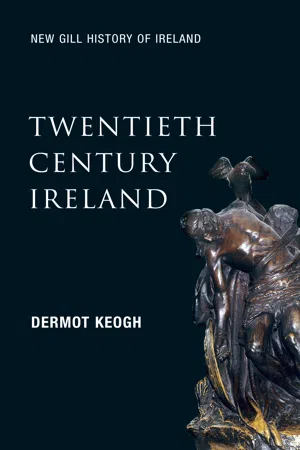
Twentieth-Century Ireland (New Gill History of Ireland 6)
Revolution and State-Building – The Partition of Ireland, the Troubles and the Celtic Tiger
- 624 pages
- English
- ePUB (mobile friendly)
- Available on iOS & Android
eBook - ePub
Twentieth-Century Ireland (New Gill History of Ireland 6)
Revolution and State-Building – The Partition of Ireland, the Troubles and the Celtic Tiger
About this book
Professor Dermot Keogh's Twentieth-Century Ireland, the sixth and final book in the New Gill History of Ireland series, is a wide-ranging, informative and hugely engaging study of the long twentieth century, surveying politics, administrative history, social and religious history, culture and censorship, politics, literature and art.
It focuses on the consolidation of the new Irish state over the course of the twentieth century. Professor Keogh highlights the long tragedy of emigration, its effect on the Irish psyche and on the under-performance of the Irish economy. He emphasises the lost opportunities for reform of the 1960s and early 70s. Membership of the EU had a diminished impact due to short-term and sectionally motivated political thinking and an antiquated government structure. Professor Keogh looks at how the despair of the 1950s revisited the country in the 1980s as almost an entire generation felt compelled to emigrate, very often as undocumented workers in the United States.
Professor Keogh also argues that the violence in Northern Ireland from the late 1960s was an Anglo-Irish failure which was turned around only when Britain acknowledged the role of the Irish government in its resolution.
He extends his analysis of the twentieth-century to include a wide-ranging survey of the most contentious events—financial corruption, child sexual abuse, scandals in the Catholic Church—between 1994 and 2005.
Twentieth-Century Ireland: Table of Contents
- A War without Victors: Cumann na nGaedheal and the Conservative Revolution
- De Valera and Fianna Fáil in Power, 1932–1939
- In the Time of War: Neutral Ireland, 1939–1945
- Seán MacBride and the Rise of Clann na Poblachta
- The Inter-Party Government, 1948–1951
- The Politics of Drift, 1951&1959
- Seán Lemass and the 'Rising Tide' of the 1960s
- The Shifting Balance of Power: Jack Lynch and Liam Cosgrave, 1966–1977
- Charles Haughey and the Poverty of Populism
- Ireland in the New Century
Information
1
A War without Victors: Cumann na nGaedheal and the Conservative Revolution
A War without Victors: Cumann na nGaedheal and the Conservative Revolution
Civil war overshadowed the birth of Saorstát Éireann (Irish Free State). In Northern Ireland the minority Roman Catholic community had to learn to live with institutionalised sectarianism. Both states came into existence as a result of enforced compromise. The new political elites in Belfast and Dublin did not regard this outcome as ideal, but pragmatism determined that imperfect solutions had to be made to work. There was unfinished business on both sides of a disputed border.
The passage of the Government of Ireland Act on 23 December 1920 provided the legal basis for the setting up of Northern Ireland. Comprising the six north-eastern counties, it was 5,452 square miles in area and constituted 17 per cent of the land area of the whole island.1 Belfast was its capital and the seat of the new Northern Ireland parliament. Northern Ireland also had thirteen seats at Westminster and twelve after 1948 when the university seat was abolished. (The figure is now 18.) Events between the summer of 1920 and mid-1922 did not augur well for Northern Ireland’s Catholic minority. During this time, over 450 people died in violence, termed ‘pogroms’ by nationalists. About two-thirds of those killed were Catholics. Thousands more were expelled from their jobs and many were driven from their homes. Nationalist fears of sectarianism had been further increased by the plan to establish a local police force. The Bishop of Down and Connor, Joseph MacRory, wrote to the Bishop of Southwark, Peter Amigo, in September 1920: ‘Just now we are threatened in Belfast with Carsonite police, most of whom would be taken from the very men whose awful bigotry has victimised our poor Catholic workers for the past ten weeks.’2
But the establishment of the state proceeded despite widespread nationalist opposition north and south of the border. There was an 89 per cent turnout in the Northern Ireland elections of 24 May 1921, where intimidation and violence were widespread.3 The Unionists got forty seats, with six each going to the abstentionist Sinn Féin and the Nationalists. King George V opened parliament on 22 June 1921 with a plea to all Irishmen ‘to pause, to stretch out the hand of forbearance and conciliation, to forgive and to forget, and to join in making for the land which they love a new era of peace, contentment, and goodwill.’4 Sir James Craig became prime minister. Cardinal Michael Logue of Armagh predicted: ‘If we are to judge by the public utterances of those into whose hands power is fallen in this quarter of Ireland, we have times of persecution before us.’5
Violence also marked the birth of Saorstát Éireann. For the President of Dáil Éireann, Éamon de Valera, the Treaty signed on 6 December 1921 fell far short of what the country could have got. He told a private session of Dáil Éireann on 14 December: ‘I was captaining a team and I felt that the team should have played with me to the last and that I should have got the last chance which I felt would have put us over and we might have crossed the bar in my opinion at high tide.’6 For de Valera the Treaty meant an acceptance of colonial status with all the trappings of imperialism—an oath of allegiance, a governor general, British bases, and partition. As the debate progressed, he said despairingly on 6 January 1922: ‘There is no use in discussing it. The whole of Ireland will not get me to be a national apostate and I am not going to connive at setting up in Ireland another government for England.’7
For Michael Collins, the architect of the Sinn Féin military campaign against the British between 1919 and 1921, the Treaty was ‘a stepping stone’ and ‘freedom to achieve freedom.’ Aware of the terrible alternative of renewed war with Britain, throughout the debates Collins expressed impatience with suggestions to renegotiate: ‘I have done my best to secure absolute separation from England. . . . I am standing not for shadows but for substances and that is why I am not a compromiser.’8 Collins justifiably felt that Dublin had got a good deal. But it was a compromise ‘without the supportive symbolic system’9 of the Republic, which the purists like de Valera claimed as their own.
On 7 January 1922 the Treaty was carried in the Dáil by 64 votes to 57. De Valera resigned as President and was replaced on 10 January by Arthur Griffith. The former wrote to his close friend, the rector of the Irish College in Rome, Monsignor John Hagan, on 13 January 1922:
A party set out to cross the desert, to reach a certain fertile country beyond—where they intended to settle down. As they were coming to the end of their journey and about to emerge from the desert, they came upon a broad oasis. Those who were weary said: ‘Why go further—let us settle down here and rest, and be content.’ But the hardier spirits would not, and decided to face the further hardships and travel on. Thus they divided—sorrowfully, but without recriminations.10
With sentiments of that kind in mind, the historian T. Desmond Williams wrote of the civil war many years later:
All wars are the product of indecision, chance, misunderstanding, and personal will. They come from the environment in which people work and the conviction of those in power. . . . Perhaps the extremists on both sides alone knew their own minds and the contingent situation better than those of more moderate opinions.11
Ideology, conviction, accident, personality and geography all helped divide much of the country into Treatyites and anti-Treatyites, and into different camps within the blocs. The Irish political world in 1922 remained a kaleidoscope of shifting emotions and ambivalences. It took the violence of civil war to force many finally to take sides.
The vote in the Dáil on 7 January was not the formal act of ratification required under Article 18 of the Treaty. Nicholas Mansergh writes that members elected to the House of Commons of Southern Ireland, as established by the Government of Ireland Act, were the designated body. The assembly was summoned to ratify the Treaty on 14 January in Dublin’s Mansion House. It did so unanimously and then set about selecting a Provisional Government. This was not to supplant the Dáil ministry, under the presidency of Arthur Griffith. The two existed in parallel, with overlapping membership: Griffith was not in the Provisional Government, but Collins, W.T. Cosgrave and Kevin O’Higgins were in both. The Irish Free State (Agreement) Bill was not enacted until 31 March 1922.12
In the months between the establishment of the Provisional Government and the outbreak of civil war, there were three tiers of power in the country. Firstly, there was the cabinet of the Second Dáil, presided over by Arthur Griffith. Secondly, there was the cabinet of the Provisional Government, of which Michael Collins was chairman and Minister for Finance. Thirdly, there was Michael Collins the burgeoning politician, who grew in stature and influence as the months progressed.
The first task confronting the Provisional Government was to secure military control of the country. Michael Collins set about achieving that objective, in which he was helped in particular by two members of his general headquarters staff, Gearóid Ó Súilleabháin and Seán MacMahon. Collins’s charismatic personality helped win converts to the side of the Provisional Government, and his radical attitude towards the Northern Ireland state revealed that he had not abjured the revolutionary goal of unity.
The Irish Republican Army (IRA) had split over the Treaty: nine members of general headquarters staff were in favour and four were against. That split was also evident in the rank and file, where the decision of a local leader often determined the direction loyalties took. On 18 January 1922 the Provisional Government agreed—unwisely as it turned out—to allow the holding of a special IRA convention on 26 March, but permission was revoked as the general situation in the country deteriorated. Dissident IRA members regarded Michael Collins and General Richard Mulcahy as traitors. Rory O’Connor and Liam Mellowes emerged among the leading militarists on the anti-Treaty side. Mellowes, for example, had said during the Treaty debate on 17 December 1921: ‘I stand now where I always stood, for the Irish republic. . . . The Treaty is a denial of the Republic. . . . We are defending it.’13
In early 1922, as the situation looked like developing into a shooting war, the British evacuation was slowed down. In March Limerick became the centre of conflict, and a brokered peace narrowly averted civil war. An armoured car, sent to help secure the defence of Templemore, Co. Tipperary, was seized on 20 March by anti-Treatyites. Despite the cancellation on 15 March of government permission to hold the army convention, the IRA went ahead, in defiance of that order. Over two hundred delegates were in attendance. Rory O’Connor hinted at a press conference on 30 March that any attempt to hold a general election would be stopped by force. Asked if that meant the establishment of a military dictatorship, he replied: ‘You can take it that way if you like.’14
The pro-Treaty Freeman’s Journal, a newspaper which had courageously reported the excesses of British rule in Ireland during the War of Independence, published an account of the convention’s proceedings and had its offices and printing presses attacked with sledgehammers. The Clonmel Nationalist earlier had seen the IRA smash the press, melt down the type and threaten the editor. The Cork Examiner was also threatened. These acts of intimidation and vandalism prefigured what was to happen in fascist Italy and Nazi Germany during the 1920s and 1930s. There was more than just a passing resemblance between the IRA and the proto-fascist movements in Europe at that time. The radical authoritarianism of the IRA was evident when a proposal to set up a dictatorship was discussed at the convention. Todd Andrews, a young anti-Treatyite, wrote in his memoirs: ‘I did not see anything wrong with an IRA military dictatorship but I resented the breakdown in discipline.’ Andrews believed that the indecision at the convention meant that ‘from that moment we Republicans were beaten.’15
The proposal to set up a dictatorship was defeated, but the army convention moved to the right. A new executive with the Limerickman, Liam Lynch, as chief of staff was appointed, and Éamon de Valera and other Sinn Féin political leaders were marginalised. An anti-Treatyite party, Cumann na Poblachta, had been founded, but de Valera proved more incapable than unwilling to exercise control over doctrinaire and intransigent anti-Treatyites. The ‘chief’, as he was still known to his followers, toured Munster in March. He was under great personal strain and may have suffered what would be known today as a nervous breakdown. That may help explain the content of some of his speeches, which one cannot excuse on the grounds of bad reporting. At Thurles he was reported as having said that if the volunteers of the future tried to complete the work the volunteers of the previous four years had been attempting, they ‘would have to wade through Irish blood, through the blood of the soldiers of the Irish Government, and through, perhaps, the blood of some of the members of the Government in order to get Irish freedom.’16 In Cork, Collins called the various speeches the ‘language of madness’ and may have been unwittingly correct in the literal sense. A subsequent attempt by de Valera to refute the editorial interpretation of his words was not very convincing, and he never denied in a plausible way that he had used those words.17
Meanwhile there were widespread seizures of arms and explosives throughout the country by the anti-Treatyite IRA. Raids were conducted on public houses and shops to acquire provisions. For example, money was seized from 323 post offices in the three weeks from 29 March to 19 April. Rory O’Connor and his followers captured the Four Courts on 14 April and the anti-Treatyites began to fortify the building. They also took the Masonic Hall in Molesworth Steet, and later published a list of members of the lodge found in the building. To the surprise of many, a number of Catholics were masons and one, a Catholic baker in Rathfarnham, almost went out of business. Kilmainham Jail, the Kildare Street Club and the Ballast Office were also taken over in Dublin. The ‘irregulars’, as government sources termed the opposition, were engaged in armed attacks in the capital and in other parts of the country. On 25 April Brigadier General Adamson was shot dead in Athlone in a skirmish with republicans who had taken over a hotel in the centre of the town. On 27 April there was fighting in Mullingar.18
The Labour Party and the trade union movement, having decided to contest the forthcoming June general election, held a fifteen-hour general strike ‘against militarism’ on 24 April. Meetings and pro-parliamentary demonstrations were held in eleven large towns and cities.19 Labour, having rejected social radicalism for social democracy, went ‘the whole hog and accepted all the trappings of An Saorstát.’20 It was fortunate for the new state that Tom Johnson, the Labour leader, remained such a strong parliamentarian.21 The growing violence and the stridency of the language on the opposing sides surprisingly did not prevent a political accommodation between Collins and de Valera in the June election. They agreed in May on a pact whereby the two sections of Sinn Féin would be represented on a national panel in proportion to their existing Dáil strength; there was further agreement on the division of ministries afterwards. This was a last desperate effort by Collins to enable de Valera and the moderates to break with Liam Lynch and Rory O’Connor.22 The strategy di...
Table of contents
- Cover
- Title page
- Dedication
- Contents
- Preface
- Introduction to the first edition
- Introduction to the second edition
- Chapter 1: A War without Victors: Cumann na nGaedheal and the Conservative Revolution
- Chapter 2: De Valera and Fianna Fáil in Power, 1932–1939
- Chapter 3: In Time of War: Neutral Ireland, 1939–1945
- Chapter 4: Seán MacBride and the Rise of Clann na Poblachta
- Chapter 5: The Inter-party Government, 1948–1951
- Chapter 6: The Politics of Drift, 1951–1959
- Chapter 7: Seán Lemass and the ‘Rising Tide’ of the 1960s
- Chapter 8: The Shifting Balance of Power: Jack Lynch and Liam Cosgrave, 1966–1977
- Chapter 9: Charles Haughey and the Poverty of Populism
- Chapter 10: Ireland in the New Century
- Notes
- Bibliography to the First Edition
- Bibliography to the Second Edition
- Note on the use of terms in Irish
- Map. Ireland: political and administrative divisions
- Copyright
- About the Author
- About Gill & Macmillan
Trusted by 375,005 students
Access to over 1.5 million titles for a fair monthly price.
Study more efficiently using our study tools.
Frequently asked questions
Yes, you can cancel anytime from the Subscription tab in your account settings on the Perlego website. Your subscription will stay active until the end of your current billing period. Learn how to cancel your subscription
No, books cannot be downloaded as external files, such as PDFs, for use outside of Perlego. However, you can download books within the Perlego app for offline reading on mobile or tablet. Learn how to download books offline
Perlego offers two plans: Essential and Complete
- Essential is ideal for learners and professionals who enjoy exploring a wide range of subjects. Access the Essential Library with 800,000+ trusted titles and best-sellers across business, personal growth, and the humanities. Includes unlimited reading time and Standard Read Aloud voice.
- Complete: Perfect for advanced learners and researchers needing full, unrestricted access. Unlock 1.5M+ books across hundreds of subjects, including academic and specialized titles. The Complete Plan also includes advanced features like Premium Read Aloud and Research Assistant.
We are an online textbook subscription service, where you can get access to an entire online library for less than the price of a single book per month. With over 1.5 million books across 990+ topics, we’ve got you covered! Learn about our mission
Look out for the read-aloud symbol on your next book to see if you can listen to it. The read-aloud tool reads text aloud for you, highlighting the text as it is being read. You can pause it, speed it up and slow it down. Learn more about Read Aloud
Yes! You can use the Perlego app on both iOS and Android devices to read anytime, anywhere — even offline. Perfect for commutes or when you’re on the go.
Please note we cannot support devices running on iOS 13 and Android 7 or earlier. Learn more about using the app
Please note we cannot support devices running on iOS 13 and Android 7 or earlier. Learn more about using the app
Yes, you can access Twentieth-Century Ireland (New Gill History of Ireland 6) by Dermot Keogh in PDF and/or ePUB format, as well as other popular books in History & 20th Century History. We have over 1.5 million books available in our catalogue for you to explore.