- 544 pages
- English
- ePUB (mobile friendly)
- Available on iOS & Android
eBook - ePub
About this book
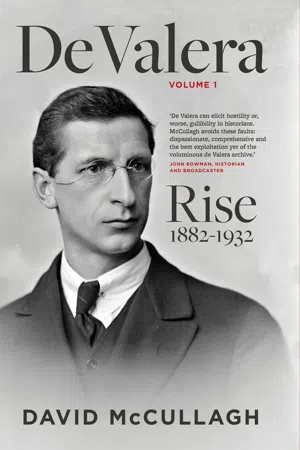
Éamon de Valera was the single most consequential Irish figure of the twentieth century. He was a leader in the Easter Rising, the figurehead of the anti-Treaty rebels during the dark days of the Civil War and, later, as the founder of Fianna Fáil and president of Ireland, the pivotal figure in the birth of the Republic.
In this, the first volume of a magisterial new biography, acclaimed historian and broadcaster David McCullagh charts De Valera's vertiginous rise from humble beginnings to electoral victory with Fianna Fáil in 1932. Riveting, nuanced, provocative and humorous, it draws on a wealth of new and neglected sources to present a truly ground-breaking portrait of de Valera the man, his times and his complex, ever-shifting legacy.
'David McCullagh combines the investigative skills of an experienced journalist with the detachment of an accomplished historian. In this vividly readable and at times gripping biography he tackles head-on all of the perennial de Valera controversies, including his parentage, his role in the 1916 Rising, his relationship with Michael Collins, his responsibility for the Civil War and his subsequent rise to power, and does so with acuity and objectivity. McCullagh's range and command of the source material is masterly … a comprehensive, mature biography, both enlightening and entertaining.' MAURICE MANNING
Information
Topic
HistoireSubtopic
Biographies historiquesCHAPTER 01
SLÁN LEAT, DEV
As the great white gates of Áras an Uachtaráin swung open, the waiting crowd surged forward, impatient for a glimpse of the man in the back of the presidential Rolls-Royce. Some had been waiting for hours, and the 85 stewards were having difficulty keeping the roadway clear as enthusiasm mounted.1
It was June 1973 and Éamon de Valera was finally leaving public life, which he had dominated for more than half a century. The last surviving commandant of Easter Week, the undisputed leader of Irish nationalism during the War of Independence, commander of the ‘legion of the rearguard’ during and after the Civil War, head of government for 21 years, President for two terms, de Valera had an unrivalled position in Irish public life – though a deeply controversial one.
Estimates of the size of the crowd varied: 6,000 according to the Irish Times; double that, said the Irish Independent; 50,000 in de Valera’s own Irish Press. Whatever its size, there was no doubting the crowd’s enthusiasm. There were spectators on car roofs, sitting in trees, and clinging to the Phoenix Monument, and others crowded six-deep along the road. There were also – according to the Irish Press – ‘many elderly women . . . weeping and waving white handkerchiefs’.
The emotion was real, though it was far from the ‘spontaneous tribute’ suggested by the Fianna Fáil leader, Jack Lynch. In fact, the party had carefully prepared the ceremony. Banners were made for each of the 26 counties, with the county name and party logo prominently displayed. The National Executive had also organised special trains and buses to bring members from around the country to Dublin.2
Lynch was determined to make the most of whatever glory reflected on him from the founder of Fianna Fáil. As the navy-blue Rolls-Royce nosed out of the gates, Lynch stepped forward and opened the door, shaking hands with the President for the benefit of the cameras and welcoming him ‘back among us’ again, after his 14 years above politics.
When the cluster of photographers and camera crews blocking the road finally parted, the car moved off. The honour guard of Old IRA veterans saluted, and the crowd broke into patriotic song: ‘A Nation Once Again’, then ‘Wrap the Green Flag Round Me, Boys’. The President’s senior aide-de-camp, Colonel Seán Brennan, sat beside the driver, while Frank Aiken, dapper as always, with a crisply ironed handkerchief in the breast pocket of his suit, sat in the back beside his Chief.
Cheering crowds lined the route out of the Phoenix Park, along the south quays and through the city centre to the venue for de Valera’s final public speech. The choice of location was instructive. There were many potential backdrops: the Department of the Taoiseach, where he had presided for so long; the Dáil, which he had dominated for decades; the head office in Burgh Quay of the Irish Press Group, which he had established; or even, of course, the gates of the Áras itself.
Instead, de Valera returned to the scene of his first appearance on the national stage, where his enduring myth began: Boland’s Bakery, an otherwise obscure building by the Grand Canal, where he commanded the garrison during the Easter Rising.3 This choice underlined the fact that, without 1916, de Valera – born in New York with question marks over his paternity, sent across the ocean by his mother to grow up in a humble home in Bruree, in rural Co. Limerick – would hardly be ending his days as perhaps the most famous man in Ireland.
The five thousand people waiting at Boland’s gave him an enthusiastic reception. Helped out of his car by Aiken, de Valera, somewhat hampered by the furled black umbrella he was holding, raised his trademark black homburg hat to acknowledge the crowd. Guided by Aiken and Brennan, he slowly made his way to the platform. Many of the signs held by the crowd were in Irish, including one simply saying, Slán leat, Dev.
After the national anthem, Lynch made a lengthy speech, paying tribute to his former leader, ‘the greatest Irishman of this century’, for his years of service, beginning with the Easter Rising. He was followed by speakers representing the four provinces: Máire Geoghegan, a 22-year-old teacher from Co. Galway, later a TD, minister and European Commissioner; Seán Ó Ceallaigh, a former Clare TD; Cathal Brugha, grandson and namesake of one of de Valera’s greatest friends; and Seán MacEntee, a former minister whose sometimes turbulent relationship with de Valera had dimmed none of his admiration for the man he now referred to as ‘Ireland’s George Washington’.
Then it was time for the outgoing President to make his final speech, which he delivered in a firm voice, speaking throughout in Irish. He told the crowd that, while he had once thought he wouldn’t see Ireland free and united in his lifetime, he now believed he would – a somewhat rash prediction for a man in his tenth decade. He urged the crowd to have faith in the country, and in the language, and thanked them for their loyalty over the years. Then he left the platform, pausing as an afterthought to pay tribute to Erskine Childers, who was to be sworn in as President the following day. De Valera was then driven to the nursing home in Blackrock where he and his wife, Sinéad, would spend their final days.
Comment on his departure was mixed: all agreed he was the dominant political figure of the previous half-century, though it was recognised that his record was not unblemished. There were, of course, many achievements: his welding together of the disparate elements of advanced nationalism in 1917; his grit and determination in coming back from the devastating defeat of the Civil War; his skill in drafting a new constitution, introduced in 1937, to solidify independence; and his leadership in asserting that independence during the Second World War. He had founded the most successful political party in the country – out of office now, but sure to be back in government soon – as well as a hugely successful newspaper group.
But even in 1973 there were plenty of people prepared to say that de Valera’s record was a dismal one. He was blamed by some for instilling in the country a narrow cultural nationalism that made Ireland a grey place; to others he was at fault for the economic failure that almost submerged the state in its third decade; to many more, he was responsible for the Civil War.
In the decades since his death, in 1975, the negative parts of de Valera’s legacy have been stressed. His reputation has taken a battering, his stature diminished in comparison with others who have risen in public estimation – principally his greatest rival, Michael Collins, and his closest lieutenant, Seán Lemass.
But even his harshest critics have to acknowledge his dominance. For good or ill, it was his vision that set the tone of Irish society, his leadership that set the pace and direction of the march towards independence, albeit for only 26 of the 32 counties. This dominance is all the more remarkable given the barriers to his rise to power: his unusual background, his upbringing in rural poverty, his obscure career as a teacher of mathematics. And yet he became the leader of nationalist Ireland, obeyed without question at home and revered abroad. And then, just as rapidly, it was all snatched away after the signing of the Treaty. He became a pariah, hated, harried and imprisoned by his political opponents. But from the nadir of 1923 he managed to claw his way back to prominence, shattering one political movement and founding another, launching a hugely successful newspaper, and winning the trust of the Irish people.
It was an extraordinary rise – and it is this rise that explains the person he had become by 1932, when the time came for him to rule. It was this rise that forged his character, formed his views and fostered his self-belief. The story of his rise begins with the most fundamental of questions: who was he, and where did he really come from?
CHAPTER 02
THE QUESTION OF FAMILY HISTORY
In International Law am I a Spaniard or an American?
Éamon de Valera, 19161
As I was less than two years of age when my father died I do not remember him, and have only such slight information as my mother had.
Éamon de Valera, 19502
. . . the question became of importance some forty odd years ago, and I would like to have it answered.
Éamon de Valera, 19623
A missing piece of paper troubled Éamon de Valera throughout his long life: his parents’ marriage certificate. He was bothered enough by its absence to seek it – or any other evidence of their wedding – over many years, using many different agents: his half-brother, his cousin, ecclesiastical authorities in America and Spain, even the Irish minister in Madrid during the Spanish Civil War. Proof of the marriage would silence persistent whispers about his legitimacy, as well as proving to the world – and to himself – that his mother had been telling the truth about his parentage.
But no proof would be found, despite the efforts of de Valera and his legion of helpers, and of future biographers and genealogists. Neither would any proof be found of the supposed death of his father, Vivion de Valera, in Denver, or perhaps New Mexico, unless it was in Minnesota. Indeed, there is little evidence that Vivion ever existed.
Of course, an individual’s paternity should not affect our opinion of them. But the point is that the questions about his father and about his parents’ marriage affected Éamon de Valera. Did his own doubts about his ancestry lead him to take a more extreme approach in politics, to try to become, in effect, ‘more Irish than the Irish themselves’? And what was the effect of the repeated slurs de Valera had to suffer as he climbed to prominence? He was sometimes referred to as ‘that Spanish-American bastard’ or as an ‘illegitimate Dago’.4 In fact, there is very little evidence of any Spanish connection.
The official story is easily told. Catherine (Kate) Coll emigrated to the United States in 1879. There she met a young Spanish man, Vivion de Valera, a former sculptor who had become a music teacher after his eye was damaged by a chip of marble. They were married in 1881, and the following year their son, Edward, was born. Vivion, because of ill-health, travelled west, where he died, in Denver, Colorado. Kate, forced to work full time, then arranged for her son to return to her home place to be cared for by his grandmother.
To believe Kate Coll’s story is to believe that no record survives of her marriage; that all written evidence of her husband’s existence was lost; and that no credible Spanish connection would emerge after her son became world famous. Any one of these things is believable; to believe all of them requires a leap of faith. On the other hand, there is a birth certificate and baptismal certificate which bear his father’s (misspelled) name. And when Catherine Coll de Valera remarried, the officiating priest accepted both that she had been married before and that her first husband was dead.
The only evidence for the first marriage is Kate Coll’s word, and she was a notably unreliable witness. She appeared to be confused – or evasive – about many details: where she met her husband, where they were married, where he died. As she put it herself in a letter to her son, in relation to her accounts of his father, ‘Please excuse me if . . . I contradict anything I have told you. It is because I forget or was not really sure of it.’5 Even a dutiful son with a pressing need to believe her story must have found this less than convincing.
Kate Coll arrived in New York on 2 October 1879, aboard the Nevada from Queenstown (Cobh).6 New York had a population of 1.2 million,7 and the sheer scale of the place must have been a shock to a young woman from rural Ireland, although she had the benefit of an aunt in Brooklyn with whom she could stay until she found a job.8
When the 1880 census was taken in the following June, Kate was living as a servant at 98 Lawrence Street, Brooklyn. The household was made up of Frank Giraud; his wife, Martha; their children, 17-year-old Edgar and 4-year-old Ella; Frank’s sister Lillie, who was 24; and the 22-year-old Irish servant girl, Catherine Coll (she was actually 23). Giraud was described on the census form as an ‘artist’ – in fact, he was a vaudeville performer. Born in 1840, he trained as a blacksmith before becoming a minstrel and cannonball juggler in a circus. He served in the Union Navy during the Civil War, before returning to show business. In 1866, while on his way to New Orleans, he was one of a handful of survivors when the Evening Star sank off the coast of Georgia.9 Rescued after five days in the water, his injured leg was nearly amputated, until a surgeon saved it after recognising a Masonic signal he gave.10 In later life he gave up the stage for a career in real estate. He died in 1900.11 Giraud was moderately successful on the stage – but the family were hardly ‘members of New York high society of that period’, as one biography of de Valera later claimed.12
And it was here, in Lawrence Street, that Juan Vivion de Valera enters the story – probably. For on the question of when she first met the father of her eldest ...
Table of contents
- Cover
- Title Page
- Contents
- Chapter 1: Slán leat, Dev
- Chapter 2: The question of family history
- Chapter 3: More or less an orphan
- Chapter 4: I hope to do something
- Chapter 5: A hard battle to fight
- Chapter 6: I need a kiss, urgently
- Chapter 7: Those who side with Ireland
- Chapter 8: Irishmen who would dare
- Chapter 9: Q95
- Chapter 10: The coming Parnell of Ireland
- Chapter 11: The most effective means at our disposal
- Chapter 12: Reaching for the stars
- Chapter 13: Feelers are being thrown out in all directions
- Chapter 14: I begged them to risk it
- Chapter 15: I am sick to the heart
- Chapter 16: The most hateful of conflicts
- Chapter 17: Master of my own soul
- Chapter 18: Empty formula
- Chapter 19: A practical rule
- Chapter 20: The disarming friendliness of his eyes
- Endnotes
- Bibliography
- Acknowledgements
- Copyright
- About the Author
- About Gill Books
- Photo Section
Trusted by 375,005 students
Access to over 1.5 million titles for a fair monthly price.
Study more efficiently using our study tools.
Frequently asked questions
Yes, you can cancel anytime from the Subscription tab in your account settings on the Perlego website. Your subscription will stay active until the end of your current billing period. Learn how to cancel your subscription
No, books cannot be downloaded as external files, such as PDFs, for use outside of Perlego. However, you can download books within the Perlego app for offline reading on mobile or tablet. Learn how to download books offline
Perlego offers two plans: Essential and Complete
- Essential is ideal for learners and professionals who enjoy exploring a wide range of subjects. Access the Essential Library with 800,000+ trusted titles and best-sellers across business, personal growth, and the humanities. Includes unlimited reading time and Standard Read Aloud voice.
- Complete: Perfect for advanced learners and researchers needing full, unrestricted access. Unlock 1.5M+ books across hundreds of subjects, including academic and specialized titles. The Complete Plan also includes advanced features like Premium Read Aloud and Research Assistant.
We are an online textbook subscription service, where you can get access to an entire online library for less than the price of a single book per month. With over 1.5 million books across 990+ topics, we’ve got you covered! Learn about our mission
Look out for the read-aloud symbol on your next book to see if you can listen to it. The read-aloud tool reads text aloud for you, highlighting the text as it is being read. You can pause it, speed it up and slow it down. Learn more about Read Aloud
Yes! You can use the Perlego app on both iOS and Android devices to read anytime, anywhere — even offline. Perfect for commutes or when you’re on the go.
Please note we cannot support devices running on iOS 13 and Android 7 or earlier. Learn more about using the app
Please note we cannot support devices running on iOS 13 and Android 7 or earlier. Learn more about using the app
Yes, you can access De Valera Volume 1 by David McCullagh in PDF and/or ePUB format, as well as other popular books in Histoire & Biographies historiques. We have over 1.5 million books available in our catalogue for you to explore.