eBook - ePub
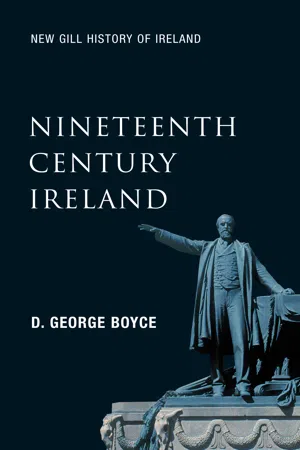
Nineteenth-Century Ireland (New Gill History of Ireland 5)
The Search for Stability in the 'Long Nineteenth Century' – The 1798 Rebellion, the Great Potato Famine, the Easter Rising and the Partition of Ireland
- 435 pages
- English
- ePUB (mobile friendly)
- Available on iOS & Android
eBook - ePub
Nineteenth-Century Ireland (New Gill History of Ireland 5)
The Search for Stability in the 'Long Nineteenth Century' – The 1798 Rebellion, the Great Potato Famine, the Easter Rising and the Partition of Ireland
About this book
The elusive search for stability is the subject of Professor D. George Boyce's Nineteenth-Century Ireland, the fifth in the New Gill History of Ireland series.
Nineteenth-century Ireland began and ended in armed revolt. The bloody insurrections of 1798 were the proximate reasons for the passing of the Act of Union two years later. The 'long nineteenth century' lasted until 1922, by which the institutions of modern Ireland were in place against a background of the Great War, the Ulster rebellion and the armed uprising of the nationalist Ireland. The hope was that, in an imperial structure, the ethnic, religious and national differences of the inhabitants of Ireland could be reconciled and eliminated.
Nationalist Ireland mobilised a mass democratic movement under Daniel O'Connell to secure Catholic Emancipation before seeing its world transformed by the social cataclysm of the Great Irish Potato Famine. At the same time, the Protestant north-east of Ulster was feeling the first benefits of the Industrial Revolution. Although post-Famine Ireland modernised rapidly, only the north-east had a modern economy. The mixture of Protestantism and manufacturing industry integrated into the greater United Kingdom and gave a new twist to the traditional Irish Protestant hostility to Catholic political demands. In the home rule period from the 1880s to 1914, the prospect of partition moved from being almost unthinkable to being almost inevitable.
Nineteenth-century Ireland collapsed in the various wars and rebellions of 1912–22. Like many other parts of Europe than and since, it had proved that an imperial superstructure can contain domestic ethnic rivalries, but cannot always eliminate them.
Nineteenth-Century Ireland: Table of Contents
Introduction
- The Union: Prelude and Aftermath, 1798–1808
- The Catholic Question and Protestant Answers, 1808–29
- Testing the Union, 1830–45
- The Land and its Nemesis, 1845–9
- Political Diversity, Religious Division, 1850–69
- The Shaping of Irish Politics (1): The Making of Irish Nationalism, 1870–91
- The Shaping of Irish Politics (2): The Making of Irish Unionism, 1870–93
- From Conciliation to Confrontation, 1891–1914
- Modernising Ireland, 1834–1914
- The Union Broken, 1914–23
- Stability and Strife in Nineteenth-Century Ireland
Information
Table of contents
- Cover
- Title Page
- Dedication
- Contents
- Note on Terminology
- Introduction
- Chapter 1: The Union: Prelude and Aftermath, 1798–1808
- Chapter 2: The Catholic Question and Protestant Answers, 1808–29
- Chapter 3: Testing the Union, 1830–45
- Chapter 4: The Land and its Nemesis, 1845–9
- Chapter 5: Political Diversity, Religious Division, 1850–69
- Chapter 6: The Shaping of Irish Politics (1): The Making of Irish Nationalism, 1870–91
- Chapter 7: The Shaping of Irish Politics (2): The Making of Irish Unionism, 1870–93
- Chapter 8: From Conciliation to Confrontation, 1891–1914
- Chapter 9: Modernising Ireland, 1834–1914
- Chapter 10: The Union Broken, 1914–23
- Chapter 11: Stability and Strife in Nineteenth-Century Ireland
- References
- Bibliography to the Second Edition
- Bibliography to the First Edition
- Acknowledgments
- Copyright
- About the Author
- About Gill & Macmillan
Trusted by 375,005 students
Access to over 1.5 million titles for a fair monthly price.
Study more efficiently using our study tools.
Frequently asked questions
Yes, you can cancel anytime from the Subscription tab in your account settings on the Perlego website. Your subscription will stay active until the end of your current billing period. Learn how to cancel your subscription
No, books cannot be downloaded as external files, such as PDFs, for use outside of Perlego. However, you can download books within the Perlego app for offline reading on mobile or tablet. Learn how to download books offline
Perlego offers two plans: Essential and Complete
- Essential is ideal for learners and professionals who enjoy exploring a wide range of subjects. Access the Essential Library with 800,000+ trusted titles and best-sellers across business, personal growth, and the humanities. Includes unlimited reading time and Standard Read Aloud voice.
- Complete: Perfect for advanced learners and researchers needing full, unrestricted access. Unlock 1.5M+ books across hundreds of subjects, including academic and specialized titles. The Complete Plan also includes advanced features like Premium Read Aloud and Research Assistant.
We are an online textbook subscription service, where you can get access to an entire online library for less than the price of a single book per month. With over 1.5 million books across 990+ topics, we’ve got you covered! Learn about our mission
Look out for the read-aloud symbol on your next book to see if you can listen to it. The read-aloud tool reads text aloud for you, highlighting the text as it is being read. You can pause it, speed it up and slow it down. Learn more about Read Aloud
Yes! You can use the Perlego app on both iOS and Android devices to read anytime, anywhere — even offline. Perfect for commutes or when you’re on the go.
Please note we cannot support devices running on iOS 13 and Android 7 or earlier. Learn more about using the app
Please note we cannot support devices running on iOS 13 and Android 7 or earlier. Learn more about using the app
Yes, you can access Nineteenth-Century Ireland (New Gill History of Ireland 5) by D. George Boyce in PDF and/or ePUB format, as well as other popular books in History & 19th Century History. We have over 1.5 million books available in our catalogue for you to explore.