- 187 pages
- English
- ePUB (mobile friendly)
- Available on iOS & Android
eBook - ePub
Make That Grade Organisational Behaviour
About this book
New edition of this concise overview of organisational behaviour for quick reference or fast and effective exam revision.
Focussing on key themes and developments, this enhanced edition applies theoretical concepts to real-life situations, highlights definitions and key concepts, and provides chapter summaries and short revision questions for each topic.
Includes chapters on person perception, attitudes in the workplace, learning, personality, stress management, leadership, group dynamics, organisational conflict and organisational communication.
Suitable for anyone who needs an overview of organisational behaviour for work or study. Particularly relevant to students taking exams for Organisational Behavioural modules at college and university level, and those taking short courses in Organisational Behaviour, Front Line Management, People Management and Human Resource Management.
Information
1
INTRODUCTION TO ORGANISATIONAL BEHAVIOUR
INTRODUCTION TO ORGANISATIONAL BEHAVIOUR
Objectives
This chapter will help you to:
- Describe the nature of organisational behaviour.
- Understand the goals of organisational behaviour.
- Appreciate the benefits of understanding the behaviour of people in the workplace.
1.1 Organisational behaviour defined
Organisational behaviour is the study of organisations and the people who work in them.
People tend to take the influence that organisations have on their lives for granted, even though they affect everything that people do. Organisations have a very significant and powerful effect on individuals. People are educated by organisations, buy food and clothing and many other goods and services from organisations, work in organisations and are regulated by government organisations. Therefore, the relationships that people have with organisations include being an employee, a customer, a competitor, a supplier, an owner and/or an investor. How many organisations have had an effect on you today?
Moorhead and Griffin (2012) have defined organisational behaviour as:
the study of human behaviour in organisational settings, the interface between human behaviour and the organisation, and the organisation itself.
According to Buchanan and Huczynski (2010), organisational behaviour is ‘the study of the structure, functioning and performance of organizations and the behaviour of groups and individuals within them’. The aim of organisational behaviour is to achieve a better understanding of human behaviour in organisations, thereby enhancing the effectiveness of organisations. An understanding of organisational behaviour is both critical and central to the task of management.
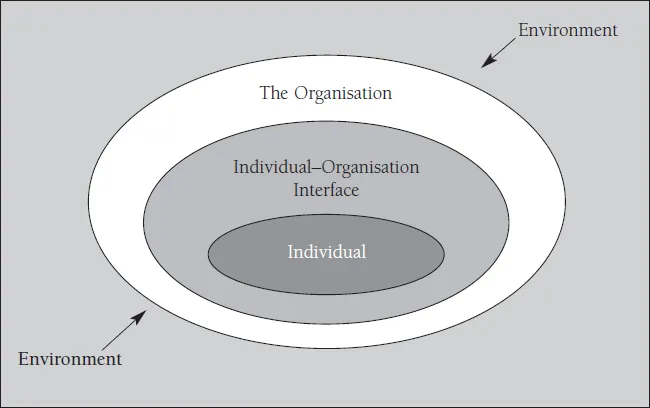
Figure 1.1 The areas of study in organisational behaviour
The study of organisational behaviour (OB) can be divided into three parts:
- Individual processes in organisations – The focus of this aspect of OB is on the individual employee and their personal characteristics, experiences and background. Areas under investigation include perception, attitudes, learning, personality, motivation and stress. An insight into these individual processes provides an understanding of the reasons why people behave the way they do in the workplace. The importance of understanding why people behave the way they do is fundamental to the study of OB. As stated by Buchanan and Huczynski (2010), ‘organizations do not “behave”. Only people can be said to behave.’
- Interpersonal processes in organisations – This area of OB examines the impact that the individual has on the organisation and that the organisation has on the individual. At this level, the focus of the study of organisational behaviour is on the dynamics of interaction between managers and co-workers and on formal policies and procedures. Aspects of study include group dynamics and teamwork, leadership, conflict and communication.
- Organisational processes – Organisations exist before and after individuals join and leave them and groups are formed and disband. At this level of analysis, the structure and functioning of the organisation is examined. Areas for consideration include organisational design, organisational change and development and organisational culture.
The study of the behaviour of organisations and the people within them is very interesting, complex and dynamic. It is important that the environment or context in which the organisation exists is considered at all times. The environment will present opportunities and threats. Organisations are influenced by social, cultural, physical, political and economic environments. In order to be effective, an organisation must have an insight into the current and future environment in which it operates.
1.2 Goals of organisational behaviour
The goals of organisational behaviour are:
- To explain the factors that influence the behaviour of people in the workplace.
- To make predictions about the consequences of particular types of behaviour.
- To control the behaviour of employees to improve organisational effectiveness.
Buchanan and Huczynski (2010) have defined organisations as social arrangements for achieving controlled performance in undertaking collective goals. An organisation is a group of people who are arranged and managed to achieve collective goals. Organisations are made up of people: some workplaces consist of a few employees, others many. Employees communicate with one another to undertake their tasks. They work together to achieve the shared objectives and collective goals of the organisation. In the workplace employees cannot do what they want to, when and how they want to do it; they must follow the rules and regulations. Their performances are therefore controlled. Employees are informed about what time to start and end work, the required uniform, the nature of the task to be undertaken and their roles and responsibilities. Controlled performance leads to the effective and efficient functioning of the organisation.
The concept of control is central to the success of an organisation. It is also the factor that distinguishes an organisation from other social groups. Control involves:
- Setting performance standards, such as attendance rates, the quality and quantity of production, customer service levels.
- Measuring actual performance by monitoring the behaviour of employees.
- Comparing standard performance with actual performance.
- Taking corrective action, if necessary, such as providing additional staff training and development programmes, revising pay rates, redesigning jobs, implementing new policies and procedures.
1.3 Study of organisational behaviour
The study of organisational behaviour emerged as a result of a combination of a number of disciplines within the social sciences, including:
- Psychology – The focus of psychology is on understanding the behaviour of individuals in a variety of environments. Research in this area has made a significant contribution to our understanding of areas such as learning, personality and stress.
- Sociology – This involves the study of society and human social interaction and has provided an insight into patterns of social relationships, social action and culture.
- Political science – Through the study of the political arena, an understanding of power and organisational politics is gained.
- Management – The aim of management is to make the most efficient use of human and material resources. Research in this area has led to an understanding of the different approaches to management that have been adopted and the value and contributions that these approaches have made to modern organisations.
The study of organisational behaviour is rich and dynamic. The areas under investigation are like a tapestry. Each part is woven into the next and plays a role in providing an understanding of the performance of an organisation at a particular time. Organisations are made up of parts which interconnect. Each person has an effect on and is affected by each other person. The formation of groups influences the nature of interaction and the experience of working in a particular organisation. Organisational factors such as change and culture have a strong overriding influence on the individuals and the groups that make up the workforce. Finally, it is very important to consider the impact of the external operating environment on the organisation.
To fully understand the behaviour of people at work, the whole picture needs to be seen and appreciated: the factors relating to the individual; the individual as part of a group; the group as part of a wider organisation and the organisation as part of the environment. Therefore, the study of organisational behaviour is complex, but very exciting.
Over the years, research into organisational behaviour has focused on many questions, but due to the diversity of people, the range of their experiences and the fact that no two workplaces are exactly the same, few definitive answers to these questions have been arrived at. The questions asked include:
- What causes employees to behave the way they do?
- What motivates employees?
- Why do some people perform better than others?
- How does stress affect people in the workplace?
- Can conflict benefit an organisation?
- What is the most effective style of leadership?
1.4 Conclusion
The continuing challenge of organisational behaviour is to understand people and to meet the wide range of...
Table of contents
- COVER
- TITLE PAGE
- DEDICATION
- CONTENTS
- 1 INTRODUCTION TO ORGANISATIONAL BEHAVIOUR
- 2 PERCEPTION
- 3 ATTITUDES IN ORGANISATIONS
- 4 LEARNING
- 5 PERSONALITY
- 6 STRESS IN THE WORKPLACE
- 7 MOTIVATION
- 8 LEADERSHIP
- 9 GROUPS AND TEAMS
- 10 CONFLICT IN ORGANISATIONS
- 11 COMMUNICATION IN ORGANISATIONS
- 12 ORGANISATIONAL CHANGE
- REFERENCES
- GLOSSARY
- COPYRIGHT PAGE
- ABOUT THE AUTHOR
- ABOUT GILL & MACMILLAN
Trusted by 375,005 students
Access to over 1.5 million titles for a fair monthly price.
Study more efficiently using our study tools.
Frequently asked questions
Yes, you can cancel anytime from the Subscription tab in your account settings on the Perlego website. Your subscription will stay active until the end of your current billing period. Learn how to cancel your subscription
No, books cannot be downloaded as external files, such as PDFs, for use outside of Perlego. However, you can download books within the Perlego app for offline reading on mobile or tablet. Learn how to download books offline
Perlego offers two plans: Essential and Complete
- Essential is ideal for learners and professionals who enjoy exploring a wide range of subjects. Access the Essential Library with 800,000+ trusted titles and best-sellers across business, personal growth, and the humanities. Includes unlimited reading time and Standard Read Aloud voice.
- Complete: Perfect for advanced learners and researchers needing full, unrestricted access. Unlock 1.5M+ books across hundreds of subjects, including academic and specialized titles. The Complete Plan also includes advanced features like Premium Read Aloud and Research Assistant.
We are an online textbook subscription service, where you can get access to an entire online library for less than the price of a single book per month. With over 1.5 million books across 990+ topics, we’ve got you covered! Learn about our mission
Look out for the read-aloud symbol on your next book to see if you can listen to it. The read-aloud tool reads text aloud for you, highlighting the text as it is being read. You can pause it, speed it up and slow it down. Learn more about Read Aloud
Yes! You can use the Perlego app on both iOS and Android devices to read anytime, anywhere — even offline. Perfect for commutes or when you’re on the go.
Please note we cannot support devices running on iOS 13 and Android 7 or earlier. Learn more about using the app
Please note we cannot support devices running on iOS 13 and Android 7 or earlier. Learn more about using the app
Yes, you can access Make That Grade Organisational Behaviour by Michele Kehoe in PDF and/or ePUB format, as well as other popular books in Business & Human Resource Management. We have over 1.5 million books available in our catalogue for you to explore.