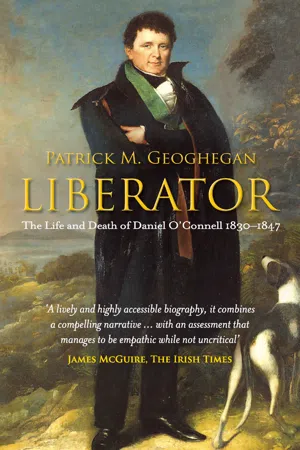
In this sequel to his critically acclaimed King Dan, Patrick Geoghegan examines the latter part of O'Connell's life and career.
Daniel O'Connell, often referred to as The Liberator, was an Irish political leader in the first half of the 19th century. One of the most remarkable historical figures in Irish history, he campaigned for Catholic Emancipation, including the right for Catholics to sit in the Westminster Parliament, and repeal of the Act of Union which combined Great Britain and Ireland.
| ‘THE MAN WHO DISCOVERED IRELAND’: O’CONNELL REVISITED
‘Yesterday one of my children brought me her book of animals and, pointing to a boa constrictor, asked me its name, and I told her it was an O’Connell.’1
(FREDERICK MARRYAT, DIARY OF A BLASÉ, 1836)
‘Who has not heard of the Liberator?’ asked a Scottish clergyman in 1841.2 Following the winning of Catholic emancipation in 1829 it seemed an unnecessary question to ask. Such was O’Connell’s international fame that in 1830, when the Belgian parliamentarians voted on their new king, three of them voted for O’Connell.3 In later years O’Connell liked to joke that if the election had been held at a later time, and if he had stood against Leopold, then he was convinced he’d have ‘run the fellow close enough’. A French captain of artillery once told the bishop of Ardagh that some of his compatriots liked to imagine that O’Connell had been born in France rather than merely having gone there for his education. ‘Ah,’ the captain sighed, ‘if he had been a native of our country, we would have made him king of the French!’4 Of all the stories of his international reputation told in his lifetime, O’Connell himself particularly enjoyed that of a coachman from Heidelberg in Germany. The coachman was asked by an Irish visitor if he had ever heard of O’Connell. ‘I have,’ the coachman replied. ‘He is the man who discovered Ireland.’5
Vanity had always been a key part of O’Connell’s character, and the winning of emancipation and the fame and adulation that came with it only encouraged him in his vice. Whenever he met Catholic children he liked to ask them if they knew who he was, before telling them ‘that it was I who emancipated you’.6 O’Connell’s popularity throughout the Irish countryside was enormous. One time during the Repeal agitation in the 1840s, O’Connell was travelling by carriage and stopped to have the horses changed. A crowd gathered to watch him, and one old beggar woman with a crutch approached the carriage and pleaded with O’Connell to shake hands with her. He did so and the effect on the woman was immediate. She threw her crutch into the air and exclaimed in delight, ‘I’ve touched his honour’s hand—I’m young again!’7 Similarly, on another occasion, O’Connell spent some days at the house of two English women. Every night they sang a song in his honour, to the tune of ‘God save the king’, and when one woman had a painful swollen face she applied O’Connell’s gold-laced travelling cap to it to see if it would heal her. Visitors to Ireland were often surprised by the extent of O’Connell’s popularity. One time an Englishman was travelling with O’Connell to Glencullen when they encountered a funeral. The mourners recognised O’Connell and, despite the solemnity of the occasion, broke into ‘a vociferous hurrah’.8 The Englishman was astonished and made a comment about how odd it was to have a political hurrah at a funeral. But the mourners replied that ‘the corpse would have doubtless cheered lustily too, if he could’.
During his lifetime O’Connell’s autograph was widely sought. In general he was happy to oblige, although he found the constant writing tedious. The king of Bavaria was anxious to secure his autograph and asked his minister in England to obtain it. O’Connell sent him some lines from one of his favourite poems, John Dryden’s defence of the Roman Catholic faith, ‘The hind and the panther’, and the king was delighted to get something written by the hand ‘of that energetical character, inseparable for ever from the history of our age’.9 However, O’Connell refused a request from the tsar of Russia, and later made this public, declaring that he would not show this courtesy to such a man as Tsar Nicholas because of his tyrannical policies. In later years there was a popular anecdote that O’Connell had once responded to the request for an autograph with the lines ‘Sir, I never send autographs. Yours, Daniel O’Connell.’10 Old age made the act of writing difficult. When his friend William O’Neill Daunt visited O’Connell in January 1847 he was asked whether he wanted any autographs. Daunt answered in the affirmative. ‘Well then’, said O’Connell, laughing, ‘I’ll get my secretary to write as many as you want!’11
At the first royal levée after emancipation, O’Connell went up to kiss the hands of King George IV. As he approached, the king muttered, ‘There is O’Connell! God damn the scoundrel!’12 The story made the newspapers and was later confirmed to O’Connell by the duke of Norfolk. O’Connell seemed supremely unconcerned and liked to boast that he was ‘the best-abused man in the British dominions’.13 Thomas Moore, for example, liked to say that O’Connell was a curious mixture of ‘high and low, formidable and contemptible, mighty and mean’.14 When discussing him one evening over dinner, Moore was advised by the noted humorist Sydney Smith that the only way to deal with such a man would be ‘to hang him up, and erect a statue to him under his gallows’. Moore approved of this ‘balancing of the account’. Once, a friend asked O’Connell if he had ever been upset by the constant attacks. ‘Not a bit,’ insisted O’Connell. ‘I knew the scoundrels were only advertising me by their abuse.’15
After his death, O’Connell would be criticised for his apparent dismissal of the Irish language. At a St Patrick’s Day dinner in London in 1833 he discussed the decline of the language among the peasantry. O’Connell revealed that he was ‘sufficiently utilitarian not to regret its gradual abandonment’.16 Reflecting on the building of the tower of Babel, O’Connell admitted that although the Irish language was a source of real national pride, the English language was ‘the medium of all modern communication’ and therefore he could ‘witness without a sigh the gradual disuse of the Irish’. These lines should be seen in their correct context: as a commentary on how English was the language needed to succeed, and a prediction that it was also the language of the future. O’Connell’s love of the Irish language was clear. He always regretted not changing the spelling of his surname to ‘O’Conal’ after the winning of emancipation, believing that the other spelling was an English imposition.17 And he always delighted in speaking Irish. During one Repeal rally at Skibbereen in Co. Cork, when government reporters gathered to record his every word, he enjoyed discomfiting them by delivering the entire speech in Irish.18
Returning to Co. Clare for his re-election campaign in 1829, O’Connell was greeted by vast crowds and ‘all down the line of road from Dublin to Limerick his progress was a continued triumph’.19 At every point where there was an opportunity to see him, men, women, and children could be seen ‘running at the top of their speed, and waving hats and fragments of garments, or green boughs, shouting all the while at the top of their voices’.20 It was noted that ‘the poor old women’ were particularly obsessed with O’Connell. Some of them would throw aside, ‘for the moment, their load of years’, and ‘skip and jump as merrily as the youngest there’. However, the majority would drop on their knees as the carriage approached and, ‘raising their aged hands and eyes to heaven, were to be heard praying fervently, and invoking blessings and mercies upon the man who was labouring to upraise a fallen nation, and to vindicate an oppressed creed’. As O’Connell approached Ennis, one elderly woman, working in her cabbage garden, ‘threw down her spade and looked around for something green to wave in honour of the Liberator’.21 There was nothing suitable, so she grabbed a bunch of nettles and held them over her head as she ran towards the carriage, shouting, ‘Long life to O’Connell, the man of the people.’
Although O’Connell was not expected to be opposed in 1829, he still insisted on taking every precaution so as not to be taken by surprise. All the canvassing and polling arrangements were made in advance, ‘as though a desperate contest was imminent’, and it was believed that this level of preparedness frightened off any would-be challengers.22 Entering the town of Ennis, O’Connell was greeted with white flags at every turn. At first he was confused about what this meant, but was reassured that these were ‘the veritable green flags of the great election of the preceding year, faded and bleached’ by the passing of time. Re-elected unopposed, O’Connell was carried by chair throughout the countryside, before retiring to Derrynane to rest and prepare for the new parliamentary session. There was some criticism in Britain of his aggressive language in this period, but shrewder observers recognised what he was doing. As the diarist Charles Greville noted, ‘Had he never been violent, he would not be the man he is, and Ireland would not have been emancipated.’23
Back in Dublin in January 1830, O’Connell was presented with an address by the Trades’ Political Union. Each trade in the city marched with its own leaders and banners to his house at Merrion Square and formed in squares in front of his house. Then their president, and staff of vice-presidents, entered the house and presented O’Connell with the address from the balcony of the house. His response was almost drowned by the ‘ringing cheers’ of the enormous crowd which had gathered around the square. A few days later, O’Connell set out by carriage by Kingstown, to travel by boat to England and take his seat in parliament.A crowd cheered him at every point of the journey, ‘blessing and wishing him success in the new career about to open to him’.24
Whenever he wanted to escape from the pressures of work, O’Connell would return home to Derrynane. There he alternated days of relaxation and hunting with days of study and research. If it was raining, or a work day, he usually rose between eight a.m. and nine a.m. Mass was said at nine a.m. in his private chapel, and after attending he would collect the newspapers and post that were delivered by special relays of mounted postboys. O’Connell would begin reading these materials over breakfast, and spend an hour or two afterwards ‘wading through his correspondence and the heap of newspapers that he daily received’.25 Afterwards, he would work in his study for three or four hours, writing letters or dictating them to a secretary. At four p.m., unless the weather prohibited it, he would go outside in his dressing-gown and cap, and walk along the beach between Derrynane Abbey and the sea. At these times he would appear to be in great thought, and suggest ‘by the sudden and involuntary motion of the arm, that some vivid thought of Ireland’s wrongs had flashed across his mind’. His family were reluctant to join him on these occasions, allowing him time to reflect in private.
The next day, ‘the scene was changed’.26 Shortly after dawn, O’Connell’s huntsmen would knock on his door and tell him ‘to be stirring and not lose the fine morning’. For O’Connell the great attraction of Derrynane was the opportunity to go ‘hare-hunting through the neighbouring mountains on foot’.27 Within a few minutes he would be dressed and ready to go, carrying a ‘tall wattle, or long stick, such as is commonly used in mountain-walking there’. There was no question of having breakfast before setting out. Rather, all kinds of breakfast—‘Irish, Scotch, and foreign’—were packed up in baskets, and carried with the huntsmen. Nothing would be eaten until at least two hares had been killed, much to the frustration of any less enthusiastic or more hungry hunters. A spot in some mountain ravine would be chosen for the meal, preferably near a mountain stream, and sheltered from the wind. The breakfast would be eaten with enthusiasm, with much banter and joking, ‘and the merriest of all was Daniel O’Connell’. Work would then intervene, as his servants would track him down and deliver that day’s postbags, and he would quickly read the most important letters. But once the hounds cried out after catching the scent of more hares, all politics would be forgotten, and he would set out once more. He would remain hunting until it became dark, and then return home ‘the freshest of the party’.28 There would be a large late dinner, and O’Connell would be in high spirits from the excitement of the day, ‘and he unlocked all his treasures of anecdote and historical and professional reminiscence’.
This would be the routine for the rest of O’Connell’s time at Derrynane. By the next morning ‘the eager huntsman had relapsed into the studious and absorbed politician’. Twenty-four hours later he would be transformed back into a huntsman, and so it would go on until a Sunday, which would be given over to prayer, exercise, and the settling of quarrels among the tenantry. He had no interest in fishing or shooting and, because he suffered from sea-sickness in his later years, had no wish to go out on a boat.29 Fox-hunting was not possible because of the mountainous terrain, but in any case he thought it poor sport compared to hunting hares on foot. ‘I am the only fellow who understands how to hunt rationally,’ he liked to boast, and his beagles were trained to perfection to track the hares. To collect his thoughts, he loved long walks, accompanied by a favourite dog, and he would walk for miles and ‘gaze on the seemingly illimitable stretch of ocean below’. Thus ‘passed away the few weeks of relaxation enjoyed by the Arch-Agitator’.30
Derrynane was open to anyone who accepted its hospitality, whether Catholic or Protestant, Irish or foreign, Repealer or anti-Repealer. One writer left an account of sitting down to dinner at a table set for thirty-three people, Irish, English, Scottish, French, German, and American. One evening a stranger was announced—a young Englishman—who stated that his pony had lost a shoe and he was unable to proceed on his journey. O’Connell rose from the head of the table to welcome him, exclaiming, ‘You will oblige us by staying here, sir,’ and adding as a joke, ‘we are indeed infinitely obliged to your pony’.31 In a profile of O’Connell, published anonymously in London in 1839, the writer was generous in his description of O’Connell’s hospitality: ‘in private life I believe he is a very magnificent fellow’.32 It had been claimed in The Times tha...
Table of contents
Cover
Reviews of King Dan
Title
Introduction
Prologue
Part I
Part II
Abbreviations
References
Bibliography
Images
Copyright
About the Author
Acknowledgments
About the Publisher
Other Ebooks Available
Trusted by 375,005 students
Access to over 1.5 million titles for a fair monthly price.
Study more efficiently using our study tools.
Frequently asked questions
Yes, you can cancel anytime from the Subscription tab in your account settings on the Perlego website. Your subscription will stay active until the end of your current billing period. Learn how to cancel your subscription
No, books cannot be downloaded as external files, such as PDFs, for use outside of Perlego. However, you can download books within the Perlego app for offline reading on mobile or tablet. Learn how to download books offline
Perlego offers two plans: Essential and Complete
Essential is ideal for learners and professionals who enjoy exploring a wide range of subjects. Access the Essential Library with 800,000+ trusted titles and best-sellers across business, personal growth, and the humanities. Includes unlimited reading time and Standard Read Aloud voice.
Complete: Perfect for advanced learners and researchers needing full, unrestricted access. Unlock 1.5M+ books across hundreds of subjects, including academic and specialized titles. The Complete Plan also includes advanced features like Premium Read Aloud and Research Assistant.
Both plans are available with monthly, semester, or annual billing cycles.
We are an online textbook subscription service, where you can get access to an entire online library for less than the price of a single book per month. With over 1.5 million books across 990+ topics, we’ve got you covered! Learn about our mission
Look out for the read-aloud symbol on your next book to see if you can listen to it. The read-aloud tool reads text aloud for you, highlighting the text as it is being read. You can pause it, speed it up and slow it down. Learn more about Read Aloud
Yes! You can use the Perlego app on both iOS and Android devices to read anytime, anywhere — even offline. Perfect for commutes or when you’re on the go. Please note we cannot support devices running on iOS 13 and Android 7 or earlier. Learn more about using the app
Yes, you can access Liberator Daniel O'Connell by Patrick M. Geoghegan in PDF and/or ePUB format, as well as other popular books in History & Historical Biographies. We have over 1.5 million books available in our catalogue for you to explore.