- 178 pages
- English
- ePUB (mobile friendly)
- Available on iOS & Android
eBook - ePub
About this book
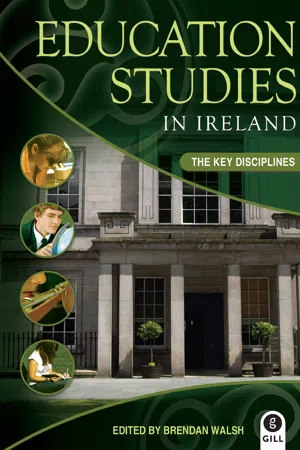
A unique book providing a critical overview of the foundation disciplines of education. This book presents a comprehensive introduction to the five key disciplines that form the foundation of the study of education: Philosophy of Education, History of Education, Sociology of Education, Curriculum Studies, Psychology of Education.
Information
Topic
EducationSubtopic
Education GeneralContents
Cover
Title Page
Foreword Sheelagh Drudy, University College Dublin
Introduction Brendan Walsh, Dublin City University
Chapter One: Philosophy of Education
Aidan Seery, Trinity College Dublin
Introduction and definitions
A working ‘concept’ of education
Philosophy of education and the subject areas
Understanding learners-models of self
The purposes of education in actions and agency
The ethics of teaching and learning and the professional code
Summing up
Recommended reading
Chapter Two: History of Education in Ireland
Brendan Walsh, Dublin City University
Education in ancient and medieval Ireland
Schooling in 16th-century Ireland
The17th century
The 18th century
The 19th century
Moulding the system: the role of the Catholic Church
Intermediate (secondary) education
Schooling in independent Ireland
The Investment in Education report
The Programme for Action in Education 1984–1987
The green paper Education for a Changing World
The National Education Convention
The white paper Charting our Education Future
The Teaching Council
Recommended reading
Chapter Three: Curriculum Studies
Rose Malone, National University of Ireland, Maynooth
What is curriculum?
Curriculum in Ireland: the Junior Certificate
The Junior Certificate in the future
The curriculum in Ireland at senior cycle
Recommended reading
Chapter Four: Sociology of Education
James O’Higgins-Norman, Dublin City University
Introduction
Education and social cohesion
Education as meritocracy
Education as cultural capital
Education and religion
Education, gender and sexuality
Recommended reading
Chapter Five: Psychology of Education
Geraldine Scanlon, Dublin City University
What is Psychology?
Research in psychology and its application to education
Theoretical perspectives on development
School-wide positive behaviour support
Social learning theory
Cognitive theories
Developmental perspectives on cognitive development
Additional factors for consideration in cognition
Individual differences
The context of adolescence
Psychosocial development
Recommended reading
Copyright Page
About the Editor
About Gill & Macmillan
Foreword
The chapters in this book, Education Studies in Ireland: Key Disciplines, provide most useful analyses and overviews of the key theories and findings relevant to teacher education in the fields of philosophy, history, curriculum studies, sociology and psychology. The relevance of these to professional practice is clear and each chapter provides a guide to further reading. Each forms part of the building blocks for what is now generally accepted as the aim of teacher education programmes, i.e. the development of the reflective practitioner.
The quality of teaching is fundamental to the future of Irish society, especially to social cohesion, to citizenship, to competitiveness and to economic recovery. High-quality teaching is inextricably linked to teacher education – initial, induction and in-career. The nature and content of teacher education have been the subject of intense discussion and debate at both national and international levels for the past decade. Indeed, a number of key policy documents at European level have put teacher education at the heart of the development of the knowledge economy. Inevitably, there has been a variety of policy positions in different jurisdictions concerning what should comprise the content and approaches within teacher education programmes. One of the issues which has been intensely debated is whether the ‘foundation disciplines’ (sometimes referred to as the ‘education sciences’) should continue to have an important place in teacher education. Europe-wide studies of teacher education programmes illustrate that the foundation disciplines form an essential component of study.
In Ireland, since the establishment of the Registration Council in 1926, the foundation disciplines of philosophy of education, psychology of education, sociology of education, history of education and curriculum studies have come to form core and mandatory elements of all recognised teacher education programmes. The Teaching Council which was established in 2006 has a statutory role in the accreditation and review of teacher education programmes. As one of its early tasks, the council set about a review and revision of the regulations for initial teacher education. The revised regulations built upon those of the Registration Council. In addition to the foundation disciplines mentioned above, the new regulations also include meeting the diverse needs of pupils, including children with special educational needs, disadvantaged pupils and intercultural education, as well as ICT. As will be seen in the various chapters of this book, the diverse needs of pupils have traditionally been explored in research in the sociology and psychology of education. They are also integrated in the other foundation disciplines, as well as in the professional and practicum elements of programmes.
Why have the foundation disciplines been so highly valued by Irish teacher education? Part of the answer to this lies in the rationale provided by both the Registration and Teaching Councils. This rationale is that the foundation disciplines enable the student teacher to build a conceptual framework, which would help her/him to develop an informed and coherent theory of education for practical teaching and future professional work. The affirmation of the importance of the foundation disciplines has also been evident in the comments of external examiners (mainly from universities outside Ireland) on initial teacher education programmes.
The position of many of those who argue in favour of the importance of the foundation disciplines in teacher education is two-fold. Firstly, it is based on a philosophy of education that asserts the value of a critical and democratic professionalism in which teacher education would provide students with relevant teaching competences/capabilities and skills, but would also enable them to have the professional and theoretical insights, and the flexibility, to adapt their practice to changing pupil and educational contexts. Secondly, the position is based on an approach to professional practice that is research and evidence based. For this, the teacher, as a professional, requires a familiarity with the findings of research and with educational theory in order to inform professional practice. Furthermore, this approach envisages that the teacher can be actively engaged in interrogating and researching her/his own practice in order to develop and meet the needs of pupils more fully in rapidly changing circumstances.
Dr Brendan Walsh, the editor, and all of the contributors are to be commended for this very useful volume on the foundation disciplines of education. It will be a valuable resource for student teachers, in-career teachers, policy-makers and the general public.
Sheelagh Drudy
Emeritus Professor of Education
University College Dublin
December 2010
Introduction
The purpose of this book is to provide students, beginning teachers and educational professionals engaged in non-school settings with a comprehensive, critical overview of the foundation disciplines of education. All educational practice is informed by a large body of theory, some of which has its origins in the work of educators who lived many centuries ago. Because educational practice is always evolving, the theory informing it is always being examined and updated, resulting in the constant creation of new knowledge. Yet, despite the ever-widening scope of educational practice, a number of key concepts and bodies of knowledge remain that inform and enrich the endeavour. Any meaningful engagement with the study of education requires critical immersion in these disciplines. To deny this is to declare that educational practice is devoid of theoretical foundation. The chapters that follow, then, introduce the reader to the key foundational bodies of knowledge that inform the study of education; in doing so, they provide a clear, comprehensive, critical and engaging overview of the five key disciplines.
In Chapter One, Aidan Seery notes that, in recent years, the foundation studies of education have increasingly come under pressure. This is largely due to policy-makers and so-called interested parties (such as industrialists and business leaders) becoming frustrated with educators’ insistence upon the importance not only of education as a practice, but of the theoretical foundations that underpin it. Education is not, educators insist, simply a process of ‘doing’, rather one of ‘becoming’ or ‘flourishing’, of, to paraphrase Michael Oakeshott, ‘becoming human’. Such understandings are perhaps under threat as never before as official rhetoric concerning the value of education, not as a worthwhile human endeavour but as an economic imperative, almost drown out profounder concerns founded upon centuries of reflection, experience and professional commitment. It should be remembered, argues Seery, that education has intrinsic values and characteristics and that these may be quite at variance with the values that a society or economy might suggest for it. In other words, education, like law or medicine, has its own integrity, its own theory and practice aside from any social, economic or political requirements that others may wish to foist upon it. This means that teachers (and what they do) have their own professional integrity as educators, first and foremost. Reflecting upon this, Seery suggests that, as educators, we should be vigilant.
As Walsh indicates in Chapter Two, education has been the ideological battlefield of religion, nationalism, economics and a plethora of ‘isms’ over the centuries. Indeed, outside parties are, historically, unsympathetic to the claim that education is characterised by its own intrinsic aims and purposes. This is, we suggest, worth reflecting on, as the student or beginning teacher seeks to develop and articulate a defence of his/her practice.
By becoming immersed in the theory of education, student teachers not only acquire its vernacular, the language educationalists employ to speak specifically about our profession, but come to understand the particular culture of education as a practice. In common with other disciplines, education has its own history, its theoretical antecedents and culture that have developed over millennia. In choosing to teach, we take part in a conversation that stretches to the beginning of human history. There is, therefore, a vital and often brilliant body of theoretical knowledge informing what we do. Anything less than willing engagement with that body of knowledge will impoverish our practice and mean, ultimately, that our students get less than they deserve.
The philosophy of education, as with philosophy generally, is a key, foundational discipline. Many students approach it with trepidation, perhaps, because of a misunderstanding of the nature of philosophy. In this book, Aidan Seery (School of Education, TCD) provides a comprehensive, analytical and accessible introduction to philosophy as a body of knowledge and its particular application to education. Engaging with this discipline is crucial for those seeking a genuine encounter with educational thought and practice. Philosophical enquiry tends to promote critical questioning: why, for example do we educate? Surely it is incumbent upon education professionals to be able to articulate a defensible response to this question; to be able to explain their choice of profession. ‘Who should we educate?’ ‘What should we teach?’ ‘Why should we teach one discipline, or parts of it, and not another?’ Reflecting upon these questions may help to clarify certain moral, political or pedagogical principles at which we had not previously even guessed. While guiding the reader through the most important concepts, Seery also writes of education as a practice and its implications for the human family. Returning to Aristotle’s notion of education as eudaimonia (‘flourishing’), the reader is invited to think seriously about the purposes of education; is it, after all, simply a technical engagement, a matter of ‘getting’ children to learn prescribed knowledge or is it something more, something to do with becoming more human? If so, then we are involved in a momentous engagement with far-reaching consequences.
In surveying the evolution of schooling in Ireland, Brendan Walsh (School of Education Studies, DCU) details how our present system was shaped by the events of previous centuries. History is a complex and contested discipline and the version presented here is but one telling of the story. For example, a text such as this cannot hope to deal with the personal or oral history of pupils or teachers, nor can it do justice to the various readings of history, such as feminist, colonial, class and so forth. Indeed, the version presented here is largely concerned with policy and structure; it presents the macro version of the evolution of schooling and serves as a clear, complete overview of the key stages in that development, setting it in its contemporaneous social and religious context. The evolution of the system after independence is traced and the major policy decisions and their consequences detailed and explained. A critical awareness is crucial here. For example, while a policy document may be a historic fact, the aspirations articulated within may not; in other words, ‘saying it, doesn’t make it so’! Chapter Two, then, accounts for the development of the school system in Ireland from its earliest articulation in ancient Ireland to the advent of the Teaching Council Act of 2001.
Chapter Three examines curriculum content as an aspect of education that has profound pedagogical and political consequences. Rose Malone (School of Education, NUI Maynooth) examines the pedagogical implications of curriculum content and theory. As Malone points out, understandings of what constitutes the curriculum are contested. Chapter Three provides a survey of the curriculum in Ireland, including recent developments, particularly those from the 1990s that resulted in significant changes. Malone also explains the complexities of curriculum, including the ‘hidden’ curriculum and the relationship between it and assessment. Finally, Malone provides a comprehensive survey of the junior- and senior-level curriculum in Ireland and provides fictional case studies, enabling the reader to see, at first hand, the various inflexions and challenges presented by students and teachers from different backgrounds and dispositions.
In Chapter Four, James O’Higgins-Norman (School of Education Studies, DCU) provides a comprehensive account of both the development of the sociology of education and of recent developments in education in Ireland. O’Higgins-Norman explains the work of pioneering sociologists, such as Durkheim and Weber, showing how their early work influenced and shaped contemporary sociological thought. Key concepts, such as social cohesion, meritocracy and education as social capital are explained and critiqued. O’Higgins-Norman also provides a thought-provoking section on the present state of religion in education in Ireland and discusses the relationship between Churches, state and curriculum in terms of contemporary realities rather than ideological assumptions. Finally, O’Higgins-Norman provides an overview of the contested role of sexuality within educational dis...
Table of contents
- Cover
- Title page
- Contents
- Copyright Page
- About the Editor
- About Gill & Macmillan
Trusted by 375,005 students
Access to over 1.5 million titles for a fair monthly price.
Study more efficiently using our study tools.
Frequently asked questions
Yes, you can cancel anytime from the Subscription tab in your account settings on the Perlego website. Your subscription will stay active until the end of your current billing period. Learn how to cancel your subscription
No, books cannot be downloaded as external files, such as PDFs, for use outside of Perlego. However, you can download books within the Perlego app for offline reading on mobile or tablet. Learn how to download books offline
Perlego offers two plans: Essential and Complete
- Essential is ideal for learners and professionals who enjoy exploring a wide range of subjects. Access the Essential Library with 800,000+ trusted titles and best-sellers across business, personal growth, and the humanities. Includes unlimited reading time and Standard Read Aloud voice.
- Complete: Perfect for advanced learners and researchers needing full, unrestricted access. Unlock 1.5M+ books across hundreds of subjects, including academic and specialized titles. The Complete Plan also includes advanced features like Premium Read Aloud and Research Assistant.
We are an online textbook subscription service, where you can get access to an entire online library for less than the price of a single book per month. With over 1.5 million books across 990+ topics, we’ve got you covered! Learn about our mission
Look out for the read-aloud symbol on your next book to see if you can listen to it. The read-aloud tool reads text aloud for you, highlighting the text as it is being read. You can pause it, speed it up and slow it down. Learn more about Read Aloud
Yes! You can use the Perlego app on both iOS and Android devices to read anytime, anywhere — even offline. Perfect for commutes or when you’re on the go.
Please note we cannot support devices running on iOS 13 and Android 7 or earlier. Learn more about using the app
Please note we cannot support devices running on iOS 13 and Android 7 or earlier. Learn more about using the app
Yes, you can access Education Studies in Ireland by Brendan Walsh in PDF and/or ePUB format, as well as other popular books in Education & Education General. We have over 1.5 million books available in our catalogue for you to explore.