eBook - ePub
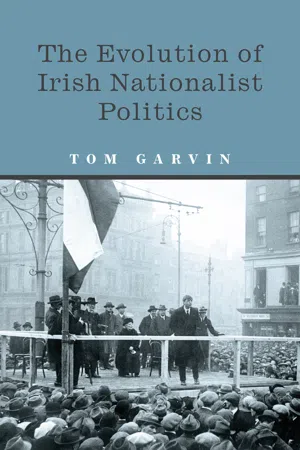
The Evolution of Irish Nationalist Politics
Irish Parties and Irish Politics from the 18th Century to Modern Times
- 272 pages
- English
- ePUB (mobile friendly)
- Available on iOS & Android
eBook - ePub
The Evolution of Irish Nationalist Politics
Irish Parties and Irish Politics from the 18th Century to Modern Times
About this book
Professor Tom Garvin's classic work studies the growth of nationalism in Ireland from the middle of the eighteenth century to modern times.
It traces the continuity of tradition from earlier organisations, such as the United Irishmen and the agrarian Ribbonmen of the eighteenth century, through the followers of Daniel O'Connell, the Fenians and the Land League in the nineteenth century to the Irish political parties of today, including Sinn Féin, Fianna Fáil, Labour Party and Fine Gael.
The dual nature of Irish nationalism is shown in sharp focus. Despite the secular and liberal leanings of many Irish leaders and theoreticians, their followers were frequently sectarian and conservative in social outlook. This book demonstrates how this dual legacy has influenced the politics of modern Ireland.
The Evolution of Irish Nationalist Politics: Table of Contents
- Irish parties and Irish politics
The Irish republic: post-colonial politics in a western European state
Political culture and political organisation
Geography, economics and method
- The origins of Irish popular politics
Roots of Irish popular nationalism
The beginnings of urban radical political organisation, 1750–1800
Agrarianism, religion and revolution, 1760–1800
- The development of nationalist popular politics, 1800–48
Secret societies before the Famine: the rise of Ribbonism
Political mobilisation in pre-Famine nationalist Ireland
- Secret societies and party politics after the Famine
The social background
Electoral politics after the Famine
The recrudescence of republicanism: Fenianism and the Agrarians
The IRB and Irish politics after the Land War
- Agrarianism, nationalism and party politics, 1874–95
Political mobilisation and the agrarian campaign
The development of the Irish National League
The Parnell split: the collapse of the Irish National League
- The reconstruction of nationalist politics, 1891–1910
The rebuilding of the parliamentary party
The rise of the Hibernians
- The new nationalism and military conspiracy, 1900–16
The development of cultural nationalism and the origins of Sinn Féin
Fenians, Volunteers and insurrection
- Elections, revolution and civil war, 1916–23
The rise of Sinn Féin
The electoral landslide of December 1918
The Republic of Ireland, 1919–23
- The origins of the party system in independent Ireland
The ancestry of the Irish party system
The legitimation of the state and the building of political parties
- An analysis of electoral politics, 1923–48
Parties and elections in the Irish Free State
Turnout, 1922–44
Sinn Féin III/Fianna Fáil
Cumann na nGaedheal/Fine Gael
The Labour Party
The farmers' parties
The break-up of the Treaty party system
- The roots of party and government in independent Ireland
The central place of party in Irish politics
Party and the physical force tradition
The evolution of the Irish state
Party and government in independent Ireland
- Some comparative perspectives
Liberal democracy
The party system in comparative perspective
Information
01 | IRISH PARTIES AND IRISH POLITICS |
THE IRISH REPUBLIC: POST-COLONIAL POLITICS IN A WESTERN EUROPEAN STATE
The political parties of the Irish Republic are somewhat exotic entities. The country’s party system, and its style of popular politics in general, are untypical of Western liberal democracies in many ways. The Republic is a Catholic country, but has no Communist Party of any size; it uses proportional representation, but has only three major political parties and has avoided the disintegrative effects associated with PR elsewhere; it is historically a poor country but has succeeded in achieving stable democratic political life; it is the inheritor of a long revolutionary tradition, but its parties defy attempts to arrange them in the usual left-to-right order.1
Not only do Irish parties defy conventional typologies, but the stability and peacefulness of the Irish state since 1923 contrast oddly with the incessant turmoil of the country’s pre-independence history. The probable reasons for this anomaly are complex and need not be gone into here in any detail; obviously, the internal stability of the Republic is partly due to the country’s exceptional ethnic and religious uniformity, to the role of the Catholic Church in social and political life, to the country’s exceptional isolation and to economic stagnation coupled with emigration.
Democracy’s survival in Ireland also owes much to certain institutional factors, however. In the first place, the new state inherited a well-developed administrative apparatus from the British and started life with a large and well-trained corps of professional administrators. Secondly, the Catholic Church in Ireland was unusually fortunate in that it was a popular church with relatively few aristocratic allies and therefore had relatively little of an anti-democratic past to live down. Lastly, Irish political parties have succeeded in organising public opinion in support of the new state, thus heading off any large-scale hostility to that state and its institutions. The unusual ability of the post-independence politicians and party activists to build large and coherent cross-class political parties was crucial to the development of an ordered popular politics after 1922; it was possibly the main reason why democratic politics in Ireland did not disintegrate into instability and confusion, as happened in so many other new states. This organisational ability was, I shall argue, the product of an unusually long experience in building highly disciplined popular political organisations.
A general theme of this book, then, is the traditional character of mass politics in Ireland. Unlike many new states, the custom of electing leaders and the habit of mobilising everybody in the community for political action were deeply ingrained in the political culture. Another general theme of the book is the anti-colonial character of Irish popular politics, a feature which also makes the country unusual in Western Europe. An important source of confusion in interpreting the politics of the Republic is the habit of either treating the country as hopelessly unique or, at best, as a rather peculiar Western European country. The Republic is only a fringe member of the European group, as few of these countries have had extensive experience of external rule. Unlike most Western European countries, Ireland is, in a sense, a new country, and its state institutions are also unusually recent in origin by European standards. Other superficially comparable secession states in Europe such as Finland, Iceland or, perhaps, Norway were never submerged institutionally and culturally to the same extent.2 Ireland cannot be easily slotted into the group of ‘post-British’ countries represented by the United States and the ‘old’ dominions any more than it can be included among the Western European group.3 In these settler states, the aboriginal populations had become insignificant, whereas in Ireland, outside Ulster, the ‘aboriginals’ won, at the price of extensive assimilation with the colonial invaders; modern Ireland is culturally hybrid and represents a successful, if not totally harmonious, synthesis of native and British cultural themes.
The rhetorical anti-imperialism of Irish politics after independence tended to obscure the fact that the institutions of the new state were themselves in large part the product of the imperialists; the Irish state machine is new, and its origins are colonial, not native. The present-day Irish state is the direct descendant of the British state in Ireland and, more distantly, it is the descendant of the medieval kingdom of Ireland. It owes nothing to Gaelic antecedents, an historical irony which is compounded by the official myth of the Republic, which has asserted the state’s historical legitimacy as the successor state to a half-imaginary Gaelic polity of the pre-conquest period.4 The spuriousness of this claim to continuity points to two central characteristics of the Irish state: its newness and its need for legitimation. A joint product of an emergent peasant people and of colonial administrators, its combination of traditional nationalist symbolism with underlying newness is typical of many post-colonial states.
The party system is similarly post-colonial. The principal cleavage does not divide right from left, as in most Western countries, nor does it divide secular and confessionalist tendencies, although these themes exist in subordinated and fragmented forms. Irish parties are divided from each other over issues of national and cultural identity, over relationships with the ex-imperial power and over what might best be described as different strategies toward national development. All of these divisions are softened by a fundamental nationalist consensus from which few dissociate themselves. All parties in the system are extremely pragmatic, a pragmatism forced upon them by half a century of electoral competition, and their organisational ancestry was a long one even at the time of independence. All parties are the beneficiaries of long traditions of quasi-military popular political organisation, traditions which can be traced back to the middle of the nineteenth century and even to the eighteenth.
Despite the system’s resemblances to post-colonial systems elsewhere, there are, of course, important differences. In the first place, Irish experience of colonial rule came very early; if England was the first national state, then Ireland was the first colony of such a state. Also, the Irish experience of colonial rule was particularly long and, perhaps, particularly intense, dating as it did from the intrusion of the Tudor state into Gaelic and Old English tribal and feudal society in the sixteenth century. Thirdly, because it developed so early, ethnic identity in Ireland, whether Protestant or Catholic, became identified with religious affiliation rather than with the kinds of linguistic or racial distinction which were made popular by nationalist ideologues in the nineteenth century. These religion-based identities came to be guarded and perpetuated by well-organised Reformation and Counter-Reformation churches. Fourthly, the emergence of aggressive and large-scale political movements based on the lower classes occurred while the country was still pre-industrial and, in part, pre-commercial. Fifthly, the Irish case was unusual because the country was physically close to the empire’s centre, a fact which prompted the attempt to convert it from a colony with a separate administrative and political identity to an integrated periphery of the imperial state itself. Lastly, the nationalist political leaders—and also the anti-nationalist political leaders—were permitted a foothold inside the imperial parliament itself instead of being either suppressed or isolated in a separate colonial assembly; Ireland became part of British domestic politics after 1800.
Despite these idiosyncracies, it is appropriate to view Irish political development as an evolution from colonial to independent status. In the twentieth century, the internal politics of countries which have undergone such an evolution are usually characterised by large-scale mobilisation of the public through parties or through substitutes for parties such as churches, conspiracies, armies or even sporting associations. Where elections are allowed and offer some prospect of a share in political power, a common outcome is the entry into the political arena of the middle and poorer sections and the breaking of the political monopoly of the traditional aristocracy. This development is often accompanied by the penetration of political organisation into the countryside and the mobilisation of the rural classes. The typical popular electoral movement unites urban middle- or working-class leaders with an increasingly humble and rural following. The typical ideology is nationalist, usually with a heavy admixture of traditional religious sentiment, populism and, in more recent cases, socialism.5
This mobilisation of the countryside for politics is often sudden and dramatic. The ‘Green Uprising’, as Huntington calls it, has usually been more important in countries which developed popular politics in the twentieth century and which achieved independence since 1945 than in those European and European-settled countries which received independence before 1918. In these older political systems, industrialisation and commercialisation had usually proceeded far enough to ensure the social and political dominance of the city over the countryside and popular radicalism was usually channelled into socialist and trade union-based parties. In underdeveloped countries of the mid-twentieth century, however, the mobilisation of the countryside has been important and often decisive, the form it took shaping the form of subsequent popular politics; typically, urban politicians became the leaders of rural-based political parties. If popular government was established, it tended to be supported by rural groups, and radical opposition tended to be centred in the towns. Even if political and property relations in the countryside are relatively egalitarian, it is a long time before government feels constrained to make concessions to town groups; in political systems which have experienced a ‘Green Uprising’, the countryside dominates national politics for a long time.6 The United States was unusual among ‘early modernisers’ in experiencing a significant ‘Green Uprising’ in the nineteenth century, and this was the underlying reason for the absence of socialist politics on a mass scale there. The same explanation for a similar absence could be used for nationalist Ireland.
This summary calls to mind much of the development of popular politics in nationalist Ireland after 1790. In Ireland, the ‘Green Uprising’ had several phases and was preceded by a long period in which urban-based radicalism filtered out into the countryside and by an even longer period of endemic agrarian unrest. The first phase of the ‘Green Uprising’ was represented by the series of mass movements led by Daniel O’Connell between 1823 and 1847. During this period, the farmers and peasantry were mobilised under clerical and middle-class leadership against the Anglo-Irish aristocracy for the first time. The decisive phase of the ‘Green Uprising’ was the series of great agrarian-nationalist campaigns which began in 1879. O’Connell’s campaigns and the later ones all benefited from and were heavily influenced by a tradition of militant proto-political organisation, popular and conspiratorial in character, which was already old in 1823. The effect of the open political campaigns was to spread a traditional form of political organisation over the country and through all social classes. Before 1790, popular political organisations had been secretive and small scale, and generally confined to the towns of the eastern littoral, while peasant organisation in inland areas was pre-political; by 1890, popular political organisation dominated the entire countryside. After independence in 1922, this pattern was re-echoed. Acceptance of the Anglo-Irish Treaty was more immediate in the long-mobilised east than in the more recently mobilised west and in the towns than in the countryside. Between 1922 and 1933 a final phase of the ‘Green Uprising’ occurred and was marked by the ascent to power of the nationalist-populist party of Eamon de Valera, Fianna Fáil, a party which was, classically, led by urban nationalists but supported most fervently by poorer rural and small-town voters.
This mobilisation of rural and humble support behind the anti-colonial movement also has the effect of strengthening some traditionalist forces and social values associated with rural society, often to the chagrin of the more advanced nationalist or socialist ideologues. A general, if usually partial, retreat from secular to sacred values occurs and is reflected in the rhetoric and policies of the political leaders. The popular acceptability of the post-independence regime itself comes to depend to an important extent on the degree to which it can be seen as being loyal to traditional values. Typically, there are attempts to create a continuity with traditional religious values or with the symbols of pre-conquest society.7 Loyalty to a real or mythical past and respect for religion and tradition become politically important after independence, particularly in the electorally crucial areas; rural disaffection is more dangerous to the regime than urban unrest, and to be surrounded by a hostile countryside is the most dangerous circumstance any government can be in.8
POLITICAL CULTURE AND POLITICAL ORGANISATION
Four aspects of Irish political development receive particular attention in this book. These aspects are the origins of Irish political culture, the development of popular political organisation, the growth of ‘public opinion’ and lastly, the development of the machinery of the state. As the organisation of the argument is essentially chronological, these aspects are treated together for each period, only the development of the state apparatus receiving a separate chapter to itself.
Political culture is the psychological dimension of the political system and consists of the ‘attitudes, beliefs, values and skills’ which are current in a political community.9 It is learned, either informally through parents and peers or through formal secondary institutions such as schools and churches. In rural societies, and in pre-literate societies in particular, political culture can be expected to ‘breed true’ over the generations, given the perennial character of many of the problems of such societies and the continuing validity of traditional solutions. Political culture can also be recreated by the individual as he acquires direct experience of the political life of his community. It is perhaps most usefully thought of as the ‘memory’ of the political system.10
The standard sketches of Irish political culture suggest that it is ‘village’ if not still ‘peasant’ in character, conformist, pragmatic, loyal and authoritarian.11 These descriptions are not inaccurate, but do not sufficiently emphasise a wider cultural trait, that of communal solidarity. This tradition of solidarity generates pragmatism within a conformist consensus and has made possible the extraordinary discipline and monolithism of the major Irish political parties during their most successful phases. This cultural reflex of deferring to symbols and values thought to be connected with the community’s well-being and preservation has its roots in a tradition of militant cultural and community defence which goes back to the eighteenth century. Irish popular nationalism also derives much of its extraordinary endurance, imperviousness to outside criticism and dislike of internal disagreement from this tradition; it is not for nothing that the ‘split’ is the original sin of Irish politics, and it is also no coincidence that splits, when they do occur, tend to become incurable as two or more rival solidarities are erected, each side pronouncing anathemas on the other.
A second general theme is the development of the militant, pragmatic, disciplined mass political party as the characteristic Irish political institution. Irish people have shown considerable aptitude for the construction of large and flexible political organisations involving large numbers of people. I suggest in later chapters that the connections between the development of political parties in nationalist Ireland and pre-existing ‘paramilitary’ organisations of local defence are very strong.
A third and closely related theme is that of public opinion, in particular the development of nationalism as the dominant ideology of Irish Catholics in the nineteenth century. I will argue that Irish nationalism has older roots than is sometimes suggested and that it is a blend of religious communalism, a particularism due to the traditional geographical and political separateness of the country, class discontents and certain residual but vigorous tribal and feudal traditions dating back to the seventeenth century or even earlier. These older sources of a sense of separateness harmonised well with the growth of class-based separatisms in the towns in the late eighteenth century.
Lastly, I deal with the growth of the state machine. This apparatus, a product of nineteenth-century modernisers, was centralised and efficient by the standards of the period and contrasted strangely with the ramshackle governmental apparatus of eighteenth-century Ireland. Prior to 1800, the country was scarcely governed at all; there was no true police force, no equivalent of the English parochial welfare system, no recognised educational system for Catholics, no security of tenure and, most importantly, no physical means, such as a well-developed military force, by which the government could perform its most primitive Hobbesian task of guaranteeing the physical safety of all groups. The absence of an army meant social peace in England; in Ireland it meant that no community was free from fear. By way of contrast, after the extraordinary state-building efforts of the nineteenth century, Ireland was governed...
Table of contents
- Cover
- Title page
- Contents
- Preface
- Chapter 1: Irish parties and Irish politics
- Chapter 2: The origins of Irish popular politics
- Chapter 3: The development of nationalist popular politics, 1800–48
- Chapter 4: Secret societies and party politics after the Famine
- Chapter 5: Agrarianism, nationalism and party politics, 1874–95
- Chapter 6: The reconstruction of nationalist politics, 1891–1910
- Chapter 7: The new nationalism and military conspiracy, 1900–16
- Chapter 8: Elections, revolution and civil war, 1916–23
- Chapter 9: The origins of the party system in independent Ireland
- Chapter 10: An analysis of electoral politics, 1923–48
- Chapter 11: The roots of party and government in independent Ireland
- Chapter 12: Some comparative perspectives
- Notes
- Epigraphs
- List of tables
- List of figures
- Copyright
- About the Author
- About Gill & Macmillan
Trusted by 375,005 students
Access to over 1.5 million titles for a fair monthly price.
Study more efficiently using our study tools.
Frequently asked questions
Yes, you can cancel anytime from the Subscription tab in your account settings on the Perlego website. Your subscription will stay active until the end of your current billing period. Learn how to cancel your subscription
No, books cannot be downloaded as external files, such as PDFs, for use outside of Perlego. However, you can download books within the Perlego app for offline reading on mobile or tablet. Learn how to download books offline
Perlego offers two plans: Essential and Complete
- Essential is ideal for learners and professionals who enjoy exploring a wide range of subjects. Access the Essential Library with 800,000+ trusted titles and best-sellers across business, personal growth, and the humanities. Includes unlimited reading time and Standard Read Aloud voice.
- Complete: Perfect for advanced learners and researchers needing full, unrestricted access. Unlock 1.5M+ books across hundreds of subjects, including academic and specialized titles. The Complete Plan also includes advanced features like Premium Read Aloud and Research Assistant.
We are an online textbook subscription service, where you can get access to an entire online library for less than the price of a single book per month. With over 1.5 million books across 990+ topics, we’ve got you covered! Learn about our mission
Look out for the read-aloud symbol on your next book to see if you can listen to it. The read-aloud tool reads text aloud for you, highlighting the text as it is being read. You can pause it, speed it up and slow it down. Learn more about Read Aloud
Yes! You can use the Perlego app on both iOS and Android devices to read anytime, anywhere — even offline. Perfect for commutes or when you’re on the go.
Please note we cannot support devices running on iOS 13 and Android 7 or earlier. Learn more about using the app
Please note we cannot support devices running on iOS 13 and Android 7 or earlier. Learn more about using the app
Yes, you can access The Evolution of Irish Nationalist Politics by Tom Garvin in PDF and/or ePUB format, as well as other popular books in History & Irish History. We have over 1.5 million books available in our catalogue for you to explore.