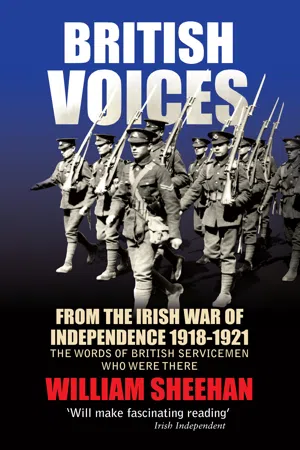
?Ireland's War of Independence generated a wealth of published material but very little from a British perspective. Yet many British servicemen left accounts of their time in Ireland from 1918 to 1921. They describe military operations, the IRA, the Irish, the actions of their own forces, morale and relationships with local communities. There is Brigadier Vinden's strange tale of a drinking session with Michael Collins and humour in the sending of Gaelic-speaking Highlanders into a public house to eavesdrop in the belief that Sinn Féiners always spoke Irish to each other. The author has gone deep into British military archives to unearth these never-published accounts. Supplemented with unpublished photographs from the Imperial War Museum and the Irish National Library, these accounts form a landmark oral history told through the personal experiences of men from across the ranks.
eBook - ePub
British Voices of the Irish War of Independence
The words of British servicemen in Ireland 1918–1921
- English
- ePUB (mobile friendly)
- Available on iOS & Android
eBook - ePub
British Voices of the Irish War of Independence
The words of British servicemen in Ireland 1918–1921
About this book
Information
Subtopic
Historical BiographiesIndex
HistoryCHAPTER ONE
Private J.P. Swindlehurst
Details
This chapter comes from a diary in the possession of the Imperial Museum in London, containing an account of Private J.P. Swindlehurst’s service with the 2nd Battalion Lancashire Fusiliers in India from November 1919 to December 1920, and with the 1st Battalion Lancashire Fusiliers. While in India, he took part in the suppression of riots between Muslims and Hindus in Amritsar in October 1920. On his return to the United Kingdom, he was transferred to the 1st Battalion, and sent to Dublin. What follows is an account of his time there, including his views on Ireland, the IRA and military service in Dublin.
Diary
7 January
12 Noon
7 January
12 Noon
WE HAVE JUST been told the most welcome news, I don’t think, we are entraining for Ireland at six o’clock tonight. You should see the faces, it’s a wonder we don’t step on them, they are so long. I don’t know whether to post this on home or wait until I arrive in Dublin, there might be something of interest to record, especially if the Sinn Féiners start to be funny. We have a rumour going the rounds, that the favourite joke of the Irishmen, is get you to stand a bottle of Guinness, drink your health, and then crash you on the head with the empty bottle. We now know what the rifles and the other warlike equipment which have been issued, are for.

7.30pm Crewe
We entrained earlier than expected and at the moment we are stood in Crewe Station with all the doors locked, and an army of ‘Red Caps’ patrolling the platforms; but three lads have just done a dash and got clean away, good luck to them.
12.45am Midnight
Holyhead looks a desolate place at this time of the morning. We are just about to board two fast steamers bound for Dublin, after a flying train ride through the night. None of us had a chance to get out through the windows, we seem to have flashed through stations as if there was a war on and the enemy was winning. The wind blows chill, a blanket would come in useful just now.
3am
I have just extracted myself out of a heap of lads curled up round a ventilator to try and keep out the biting wind, and icy cold spray. This boat is doing a move and no mistake, I can just make out sparks flying out of the funnel of our other ship, it looks like a race, at the moment it is a dead heat. It’s warmer walking about.
8 January, Dublin
We arrived at Arrans Quay on the Liffey at 9 this morning. All Dublin seemed to be out en fźte to see us arrive, I bet they got a shock, we looked and felt terrible, cold, hungry and fed up to the teeth. StewedBully and dried bread didn’t improve our spirits, but the tea has been better. The CO of the 1st Bn. of the Lancashire Fusiliers gave us a welcome, told us what we had come for, and said we would all feel better when we had had a good sleep and a general clean up, he never said a truer word. We have come over here to finish our time, doing guards, curfew patrols, street patrols, and heaven knows what else. Ship Street Barracks, Great Dame Street is the new address, and it’s raining, what a life.

The men stationed here regaled our ears with some lurid things that take place daily. The Black and Tans seem to do a lot of bloodthirsty deeds, but the Sinn Féiners don’t seem far behind. I thought of chucking this, it might not be possible to get time to write any experiences, but I’ll see later. On the backs down is the best place just now, Gilby at the moment has started to drive the pigs home so I’m going to do the same.
9 January
Gilby and I have just arrived back from the city. After we had cleaned up etc., passed the doctor, had a lecture at the same time, that the ‘Colleens’ are likely to put in our way and a hundred and one little formalities to go through, not forgetting the tin hat, to stop the empty bottles of ‘Guinness’, we were given a pass out until 9.30. The time is now 8.45, we thought it better to get back, after what happened to us. We were along Sackville Street admiring some ‘civvy boots’, when someone came up behind us and told us to ‘stick your hands up’ at the same time we both felt two hard things sticking into our backs. The voice spoke Irish all right, but we never saw a face, we were told look to the front and answer politely, and no harm would come. It seemed to be a long while before he finished questioning us, of all the questions, were we married? – where had we come from? – How long were we going to be here? – and I don’t know what else. To say we were alarmedis putting it mildly, there seemed to be a general hold-up around us, all seemed to become very quiet. Our pockets were taffed from behind and after explaining what the contents were, the voice said ‘Away wid yez Tommy down the road a bit, and you don’t look back at all, now go’, we didn’t stop it would have been foolish to look back, so we made our way back to barracks. We have since heard, that a Sergeant out of the 1st Batt has been brought in shot in the stomach, he showed fight, silly chap, its no use when the odds are against you, I felt the situation keenly at the time, but what’s the use. We must have given the Sinn Féin element something to think about, it appears quite a lot of us have been held up in different parts of the city. Dublin seems to be on our first acquaintance a rotten place to be in, people hurry along the streets, armoured cars dash up and down, bristling with machine guns. We have two extremely fast cars with Rolls Royce engines, we had a talk to the drivers this morning, and were told they are kept in readiness to catch the elusive Michael Collins when news of his whereabouts comes to hand. He must be famous, £500 is being offered dead or alive for his capture, but all the Black and Tans (who by the way seem to be all the out of work demobbed officers and men who can’t settle down) and CID men from Scotland Yard, can’t get hold of him. The men who style themselves as Black and Tans walk about like miniature arsenals, a brace of revolvers on each hip, bandoliers of ammunition slung around, and a short musket to finish off the ensemble. They dash about in cars with wire-netting covers at all hours of the day and night, bent on some raid, reprisal, or the capture of some Sinn Féiners. The wire-netting on the cars is to prevent bombs being thrown in amongst the occupant, an occurrence which seems to have been frequently done quite recently. The CO has a few words about being on active service, and being liable to be called out at any moment – what a coincidence, a sergeant has just been round and collared twenty men to hold up the centre of Dublin, along with a lot more, six lorries, with twenty men in each are just about to leave, Gilby has clicked. I have been detailedto mount guard at the City Hall for 48 hours at 12 noon tomorrow, so I must finish off for tonight, things are happening sooner than we expected.


12 January
The time is six in the evening, we have just had tea, the first guard is over. I feel a bit tired, it will be nice to undress and sleep right through till morning. How time drags, we do two hours on and four off, it feels the other way about, you hardly seem to have closed your eyes when it’s time to go on again. It’s a fine big building we have been in, but badly knocked about, bullet marks all over the place, rooms ransacked, mirrors and furniture smashed to bits. The central hall has a statue of Parnell taking up a prominent place in the centre, some of the attackers or defenders, I don’t know which, appear to have bled rather profusely around it, the marble base and floor was badly bloodstained. The Sergeant in charge told us seven men were shot down near Parnell’s statue, so things have been bad about ten days ago. The first night passed quietly, just a few distant shots to be heard, all the city goes still at curfew which is ten o’clock. Once we heard hurrying footsteps dodging the curfew lorries, but little else happened. Not so last night, opposite our place is the newspaper office of the Dublin Times .At about two o’clock when the presses were going full speed ahead with the morning news, two open cars drew up, and out jumped a dozen Sinn Féiners who began to shoot the place up. In about two minutes all the windows had gone, we overlooked them and could see the workmen hiding behind the machines, out of the way of flying bullets. The place is only five minutes from barracks, and the noise of the firing brought a party of Black and Tans on the scene, the result of the fight was two killed and three wounded, one Sinn Féiner deceased and two wounded, the rest were Black and Tans. We had them laid out in our place whilst the ambulances came and cleared them to mortuary and hospital respectively. The wounded Sinn Féiners came in for a lot ofquestioning from the CID, they were only young men, but typically Irish. The ‘Virgin Mary’ stood witness ten thousand times to the truthfulness of the answer, no amount of threats to shoot them brought any further news to what the CID men wanted, so they carted them off. I have since thought if we hadn’t been there, that the Black and Tans would have done them in, they seemed very bitter, especially since one of their confederates lay stiffening on the floor. It does seem awful that there are men who will stoop to such dastardly actions as taking their own countrymen out of their beds at dead of night, and shoot them down out of hand, just because they have a different view to theirs, on how the country should be governed. The rest of the day until we were relieved passed peacefully enough, hundreds of sightseers came to look at the shattered windows. But the police took charge and kept the crowds moving, and life goes on as if nothing happened, although one can sense the undercurrent of alarm and anxiety in most of the faces of the passers-by. The constant shootings, hold-ups and raids are leaving their marks, one can tell by the earnest whispered conversations, the darting furtive glances, and the ever on the alert look, that many don’t know what will happen next. We were on the main street when a lorry backfired, and instinctively people dodged into doorways, some stood still, but it just shows, that the greater part of the population are living in a reign of terror. If their sympathies are with the Sinn Féiners the moment may come when the Black and Tans appear and take them off for a grilling or worse. On the other hand their own countrymen may come and extract vengeance for a lack of sympathy to their cause. Even if they are strictly neutral and are content to let things alone, they may be shot down at any moment by a stray bullet from rival factions whenever they meet. Taken on the whole Dublin is the last place on earth where I would like to live if I had a choice, but then I aren’t Irish, that accounts for a lot.


13 January
Mail came to most of us from home, they all seem surprised at our coming here, well we are ourselves. Little has happened that we know of, it just seems to be a constant repetition of guards and other duties, we are more or less resigned to the situation. I have been detailed for guard in Jury’s Hotel in Great Dame Street, our party, ten of us take over after dinner tomorrow. It is the headquarters of Dublin CID the lads say it is a hot place, we shall have to see. Gilby and I have had a pass out, but only for two hours, we had some chips for supper, but they were awful, done in olive oil or else wagon grease, I think it was the latter, we couldn’t manage them.
16 January
The time is 5pm of the 16th, we on the Jury Guard have just had tea, incidents have been quiet and murderous in turn. The reception hall acted as guard room, a form and two chairs was all the furniture we had, the floor was our table and bed combined. I say bed, but it is my way of naming the condition of repose one can get on a marble tiled floor when we weren’t on sentry duty. The days and nights have been a constant repetition of comings and goings. Secret Service men and detectives kept us on alert to admit them, the pass word on the first day was ‘Gin’ and altered every few hours to every drink that could be thought of. Prisoners were brought in occasionally, a few looked about all in, covered in blood, minus teeth, and numerous other injuries. After a grilling in one of the upper rooms, we could hear groans and curses coming down the stairway, a dull thump indicated someone had taken a count, they took them off to Mountjoy Prison on the outskirts. One of the CID men took the Sergeant and I up in some of the rooms. This is the place where eleven out of thirteen officers were murdered in their beds on November 11 last year. In Dublin, time is now reckoned as since or before ‘Bloody Sunday’ which that day has been called. Most of the rooms were in the same state as left that morning, walls andcarpets besplattered with blood, it must have been a ghastly business. Since then, the perpetrators have been hunted down. Three have been caught and are now in ‘Mountjoy’ along with a few hundred others, awaiting trail by ‘Court Martial’. The nights have been full of alarms, shots, and bombs awakened the echoes, mostly after midnight. Early this morning I was on sentry at the main entrance behind the iron gate, when the noise of a motor and running footsteps caused my pal and I to look out for trouble. We got it, the runner was a secret service man being pursued by Sinn Féiners in the car.

They dropped him with a fusillade of shots, when he was about two yards from the doorway. His impetuous roll, knocked us into the hall, when were going to reply to them. In a few seconds they were gone, leaving a bomb in the roadway which failed to explode. The victim was luckily only slightly wounded, one through the leg and another through his hand. We don’t know where he had been but a big party of men moved out armed to the teeth at dawn, so he must have got some information which was acted upon. It appears most of the Sinn Féin element hide out amongst the hills, and come into the city by various routes after dark, bent on some errand of murder, revenge or raid. They can get in easily enough, but it’s the getting out that causes the trouble. Our men, Black and Tans, police and CID all hunt them down, when the deed has been done.
20 January
This account appears to be getting a little disjointed regarding the sequence of dates, but it can’t be helped. On the night of the 16th when we were thinking of getting to bed, we were ordered out on ‘Curfew Patrol’ in a big army lorry. Five minutes after ten o’clock we set out to round up the stragglers who should have been indoors. We caught twenty men and women, mostly men without homes, women of the streets, one or two drunken cabbies, but none were armed. You should have heard the wonderful excuses, some were going to the doctor, oneman had forgot to feed his hens, and was going along he said ‘to see if they were asleep’. On the banks of the Liffey we chased a woman in and out streets, she screamed curses at us interposed with numerous kicks until we dumped her in the ‘Bridewell’ to go before the bench on the following morning. Some of the rowdy ones we sat on to keep quiet, our ancestors, ourselves and future generations were roundly cursed as only an Irishman can do. The 19th saw us on the streets patrolling the poorest quarters, whilst the CID searched the houses, nothing much happened, a few women spat at us, but that didn’t hurt. A few prisoners was the result. A party of LFs got into trouble, the NCO in charge was taking a suspicious man away when the Sinn Féin came to the rescue, and in the subsequent exchange of shots, some children were killed playing in the streets. We are now called the ‘Rubber Footed Murderers’, owing to some of the dandies of the battalion wearing rubber soled walking outboots. It is a very regrettable occurrence, the City is blazened with posters, and leaflets describing the scene, I’m glad I wasn’t on that party. By way of recompense the military authorities offered a military funeral but is has been refused. All pass outs have been cancelled to prevent the rougher element taking reprisals. The time is 9.30 on the 20th inst and we have just arrived back from a surprise hold-up of all civilians in Sackville Street. Fifty men in charge of an officer were ordered out in three motor lorries. I was in the one that went along the Liffey and arrived at the end of Sackville Street where a monument to Parnell stands. The other two lorries went up Great Dame Street arriving at the other end of the street at the same moment. The officer fired a shot, and yelled through a megaphone for everyone to stand still in the name of the King. We had the job of shepherding the unwilling ones along to be searched. The chap I was detailed off with was the comedian in the concert party in India, he was happy, answering the silly questions from nervous women. No one had anything to fear if they were not carrying arms or sediti...
Table of contents
- PREFACE
- INTRODUCTION
- CHAPTER ONE Private J.P. Swindlehurst
- CHAPTER TWO Brigadier Frederick Clarke
- CHAPTER THREE Brigadier F.H. Vinden
- CHAPTER 4 Commander B. De L’Faunce
- CHAPTER 5 Flying Officer F.C. Penny
- CHAPTER 6 Vice Admiral H.T. Baillie Grohman
- CHAPTER 7 Captain R.D. Jeune
- CHAPTER 8 Lieutenant General A.E. Percival
- CHAPTER 9 Field Marshal Bernard Law Montgomery
- CHAPTER 10 Lieutenant Colonel Evelyn Lindsay Young
- Chapter 11 Major General Douglas Wimberley
- CHAPTER 12 Lieutenant Colonel Hughes-Hallett
- CHAPTER THIRTEEN Major Reginald Graham
- CHAPTER FOURTEEN Major Gerald Stone
- CHAPTER FIFTEEN Major General Hawes
- FURTHER READING
- LIST OF ILLUSTRATIONS
- LIST OF ABBREVIATIONS AND ACRONYMS
- TO MY FATHER
Trusted by 375,005 students
Access to over 1.5 million titles for a fair monthly price.
Study more efficiently using our study tools.
Frequently asked questions
Yes, you can cancel anytime from the Subscription tab in your account settings on the Perlego website. Your subscription will stay active until the end of your current billing period. Learn how to cancel your subscription
No, books cannot be downloaded as external files, such as PDFs, for use outside of Perlego. However, you can download books within the Perlego app for offline reading on mobile or tablet. Learn how to download books offline
We are an online textbook subscription service, where you can get access to an entire online library for less than the price of a single book per month. With over 1.5 million books across 990+ topics, we’ve got you covered! Learn about our mission
Look out for the read-aloud symbol on your next book to see if you can listen to it. The read-aloud tool reads text aloud for you, highlighting the text as it is being read. You can pause it, speed it up and slow it down. Learn more about Read Aloud
Yes! You can use the Perlego app on both iOS and Android devices to read anytime, anywhere — even offline. Perfect for commutes or when you’re on the go.
Please note we cannot support devices running on iOS 13 and Android 7 or earlier. Learn more about using the app
Please note we cannot support devices running on iOS 13 and Android 7 or earlier. Learn more about using the app
Yes, you can access British Voices of the Irish War of Independence by William Sheehan in PDF and/or ePUB format, as well as other popular books in History & Historical Biographies. We have over 1.5 million books available in our catalogue for you to explore.