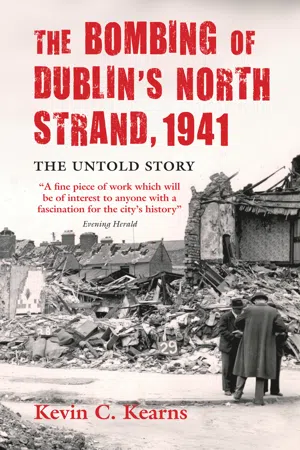
On the Whit bank holiday weekend of 1941, the neutral Irish capital was suddenly and inexplicably bombed by the German Luftwaffe.
On a gloriously starry night four bombs fell, the last and most devastating at precisely 2:05 a.m. on 31 May. There was a thunderous explosion and the earth quaked. Tremors were felt as far away as Enniskerry and Mullingar. Panic and pandemonium reigned in a "city seized with fear".
Destruction was astonishing – homes and shops in the North Strand were largely demolished, 2,250 buildings in the city suffered some bomb damage, over forty people were killed, about 100 seriously injured, many more wounded. Hospitals and morgues filled within hours. Almost 2,000 people were rendered homeless refugees.
It would later be determined that in terms of destructive performance a monstrous "perfect bomb" had done the deed.
For two-thirds of a century, no book was written on what the Evening Herald proclaimed a "Night of Horror".
Later called a "seismic event" in Dublin's history. Finally, near the end of the century both the Irish Military Archive and Dublin City Archive declassified their documents on the bombing – some stamped "Secret" for sixty years.
At last, the theories and myths long surrounding the mysterious incident would be examined in the light of real evidence. But the heart of a book on so human a tragedy is the oral historical testimony of survivors, rescuers and observers who provide graphic eyewitness accounts. This is a narrative social history of immense human drama.
Even to have attempted a policy of neutrality … looks like a vast confidence trick. That it worked is still largely a matter for wonder and thanksgiving.
(BERNARD SHARE, The Emergency)
We felt very far away from the war, very remote. We weren’t part of it … we were neutral! Comfort, yeah.
(NICK HARRIS, 91)
Air-raid shelters—they were a joke!
(MARGARET LADRIGAN, 81)
“STOP PRESS—WAR DECLARED!” The news was blared through her tenement window in Lower Gardiner Street by “lorries going around with loudspeakers.” Seven-year-old Mary Cooke scrambled down the stairs and plunged outside to see what the commotion was all about. People were filling the streets, talking excitedly. The Brits and the Jerries were “going at it,” she was told. “Oh, I remember that day the war started!”
Everyone remembers. The news was being spread wildly across the city by legions of newsboys with their piercing cries of “Herald or Mail! Read all about it!” Around the Liberties, recalls Máirín Johnston, “even people who couldn’t read what was on them” were buying papers, relying on others to interpret for them. After absorbing the news about the outbreak of war everyone wanted to know what it meant for Ireland. Children became worried on seeing adults turn so serious after putting their newspaper down. Twelve-year-old Phil O’Keeffe felt anxious and decided to ask her father if she should be frightened. His reassuring words put her young mind at ease:
The war is far away. It will never touch us … the war’ll not get within an ass’s roar of us.1
Dev would see to that. Everyone was counting on him.
The Taoiseach, Éamon de Valera, had seen war clouds gathering on the horizon years earlier. Germany’s enormous military build-up and Hitler’s threatening rhetoric were alarming to surrounding countries. In an address to the League of Nations in 1936 de Valera reasoned that small countries were essentially defenceless against the military might of the great powers. If war erupted, the best they could do was to declare their neutrality, hope that it would be respected, then struggle against any pressures to be drawn into the conflict by the belligerents. In reality, the security of neutral countries depended on the will of the powerful warring states.
In September 1939, when war reared its ugly head, a state of national emergency was declared, and de Valera announced that the Irish state would be neutral. The policy of neutrality meant that Ireland would not align itself with any of the belligerents. With an expanding war raging around Ireland—on land and sea and in the skies—it was astonishingly bold to believe that a mere declaration of neutrality would keep the country secure and at peace. It would require great political and diplomatic skill. That it would last successfully for more than five years, against vast odds, was part political mastery, part pure miracle.
If the policy of neutrality was complex and delicate for the Government to uphold, the concept was simple enough for ordinary citizens. To most Irish people it meant “take no sides,” “stay out of it,” “play it safe”—the most common phrases heard in the streets. Let the Germans, the British and other European countries settle their disputes.
For de Valera, “staying out of it” was not quite so easy. Both Britain and Germany had interests in Ireland and saw real benefits in having the country join their side. From the outset of the war, Churchill was irked at de Valera’s refusal to participate in the struggle for freedom throughout Europe. From a purely practical viewpoint he wanted to reclaim the use of the three strategic “treaty ports” of Cóbh, Castletown Bearhaven and Lough Swilly. These would be valuable for refuelling British naval vessels, for re-supplying, and for refuge from German submarines. De Valera stubbornly refused. Hitler too wanted to acquire Irish ports for his navy; he also saw strategic value in being able to install air bases on Irish soil from which his pilots could easily strike Britain at close range.
Both belligerents coaxed and pressured de Valera to align with them. Churchill promised a united Ireland if he would take up with the British. De Valera rejected the offer, believing that the British would be in no position to make good their offer, that the Ulster Unionists would surely block the way. Similarly, Hitler tried to tempt de Valera into supporting Germany by offering to play a role in settling the problem of partition once the British had been defeated. He even promised to give Ireland weapons with which to help fend off any invasion by Britain, which was a genuine worry at the time. Again, de Valera declined.
All the while, behind the cordial offers of assistance to de Valera was the veiled threat by both countries that they might ultimately decide to invade and take control of Ireland. This reality made it all the more difficult for the Taoiseach to carry out his skilful tight-rope act as the war progressed. But people had faith in his extraordinary ability to keep them wrapped safely in his neutrality blanket.
De Valera, however, understood quite well the fragility of his neutrality policy. As early as 1937 the German Minister in Ireland, Dr Eduard Hempel, personally told him of Hitler’s expressed interests in Ireland. When the war began, however, Hempel gave de Valera a strong assurance that the German Foreign Minister, Joachim von Ribbentrop, had vowed that he would respect Ireland’s neutrality—as long as de Valera faithfully adhered to the terms of absolute non-intervention, meaning no acts of interference or support of any sort. De Valera assured Hempel that he understood perfectly.
In May 1940, when France fell to the Germans and the two small neutral countries of Belgium and the Netherlands were invaded, it was a sobering blow to de Valera and his Government, confirming his prediction of 1936 about the vulnerability of neutral countries. What did it mean for Ireland? In fact there had been more worry about a British invasion than a German one. Churchill, it was thought, might decide that he had better act before Hitler in taking over Irish territory. As Bernard Share asserts, there was now genuine fear of a real invasion, at least among many in the Government and the military:
The fall of France in May 1940 altered the picture. The invasion of territorial waters, or of Irish territory, by one or other of the belligerents no longer seemed a matter for humorous speculation.3
Among ordinary citizens there had indeed been plenty of humour, even derision, directed at Ireland’s neutrality, at the “Emergency”, and the paltry Defence Forces. Clara Gill, now seventy-nine, remembers well how men at her father’s public house on the North Circular Road got great amusement out of making jokes about Ireland’s status, how British or German troops might march into the country at mere whim. Open ridicule was heard in pubs all over the city. The risk of invasion was not taken seriously by the majority of citizens, rather it was fodder for joking and banter.
There was a prevalent feeling of remoteness, smug security. “We never bothered about the war then,” said Agnes Daly, now eighty-one, of North Clarence Street. “You didn’t think the war would ever come here.” Even when France fell and the neutral Low Countries were invaded, most Irish people were not a bit rattled. Indeed, as “Britain was blacked-out and blitzed, life in Ireland went on in an almost defiantly normal way.”4
To de Valera and other members of the Government this complacency created a dangerously false sense of security. On 1 July 1940, following the fall of France, Seán MacEntee, Minister for Industry and Commerce, openly criticised the “illusion of security” so pervasive throughout Ireland. His message was one of reality:
Destroy the illusion that while all the world rocked about them they might feel themselves secure and live unmolested.5
MacEntee’s concerns were hardly unfounded. Ireland had no real air force, no tank corps, little infantry or heavy artillery with which to defend itself. The army still had many First World War rifles, with which it would have to repel any German Panzer divisions sweeping ashore. As Tony Gray speculated, “whether the Irish armed forces could have held an invading army at bay for more than a few hours at best is debatable.”6 Despite MacEntee’s admonition, many people tended to see such warnings as unnecessarily alarmist.
____
At least Ireland could expand its defensive capability. The Air-Raid Precautions Act (1939) provided for the organising of citizens to participate in duties of guarding against aerial attack. Designated ARP wardens had the responsibility to “ensure that warning of expected air attacks be given to all citizens in their area. The means of achieving this was the use of the air-raid siren system.”7 They were to periodically carry out siren tests to make certain people knew the sound of the alert and what it meant. Wardens also had the duty of directing citizens into air-raid shelters and enforcing compliance with black-outs, if they were imposed. ARP wardens were issued with a helmet and an armband, which they wore proudly. Although the ARP service “attracted a hard core of enthusiastic volunteers, the populace at large remained apathetic.”8
This apathy troubled de Valera, especially after German troops had stormed into France and the Low Countries. On 1 June 1940 he decided to address the people candidly in a national radio broadcast about his dual concerns of public apathy and weak defence. People from Co. Donegal to Co. Kerry gathered around their radio sets to listen to his words. “Our greatest danger here is complacency,” he told them, “a complacency begotten by the fact that in the past we had not to defend ourselves directly.”9 Though the British had occupied Ireland for centuries, they had also prevented any other invaders from conquering the country. With independence, however, “the fact slowly began to sink in that, for the first time in seven hundred years, Ireland was on her own.”10 For the Irish to be oblivious of this reality while a brutal war was being waged all around them was both naïve and dangerous.
In his address de Valera announced the formation of the Local Security Force (LSF) as a reserve force for the Garda Síochána. He explained the need for citizens’ service and appealed for recruits. His forceful, persuasive speech stirred patriotic zeal. Recruiting forms were sent to Garda stations, and within days 44,870 volunteers had signed up. Recruitment was going so well that on 22 June the new force was divided into an “A” section, to act as auxiliary to the army, and a “B” section to supplement the Garda in policing duties. Several months later the “A” group was placed under army control and renamed the Local Defence Force (LDF). By August more than 148,000 enthusiastic patriots had answered their nation’s call to duty. By the time Christmas arrived, however, this number had declined sharply to about 84,000. Some 60,000 or so eager recruits quickly lost their enthusiasm when they learnt that membership in the force was not exactly what they had anticipated. They had expected to be properly outfitted with a uniform, boots, and real weapons. When they found out that they had to wear their civilian clothes, to drill in their own shoes, wearing only an armband and a cap (if they got even that), they had a hard time taking it seriously.
For those volunteers who stuck it out, marching in front of amused onlookers could be embarrassing. The father of the novelist Roddy Doyle, Rory Doyle, recalls joining the LDF in 1940 only to find that “we had no arms or equipment … we drilled with pick-axe handles and shovels.”11 Observers often made jokes about them. It was dispiriting. The poet Paddy Kavanagh’s caustic quip that Ireland’s volunteer defence forces “would be hard put to defend a field of potatoes against an invasion of crows” did not endear him to many.12
One LDF volunteer, Frank Matthews, tells of his disappointment. “We were woefully equipped, we performed with wooden rifles.”13 Then one day they got their hands on real weapons. One of the platoon leaders somehow showed up with “a gift of sixty Brown Bess flintlock muskets and two brass flintlock blunderbusses, with a supply of powder and ball.”14 The muskets had originally been issued to the Louth Militia, about 1798. Recruitment declined, and members faded away as “the initial enthusiasm had been tempered by the equipment shortage, organisational muddles … and morale was suffering.”15
Clearly any invasion, real or imagined, had to be handled by the regular army. During 1940 rumours of a British or a German attack were commonly heard, a number of which were taken seriously by the army and police. One persistent rumour in Dublin had the belligerent naval vessels steaming straight up the River Liffey into the ...
Table of contents
Cover
Title
Bomb Area Reference Map
Prologue
Section One
Section Two
Section Three
Section Four
Section Five
Section Six
Notes
Bibliography
Images
Copyright
About the Author
Dedication
Acknowledgements
About the Publisher
Other Ebooks Available
Trusted by 375,005 students
Access to over 1.5 million titles for a fair monthly price.
Study more efficiently using our study tools.
Frequently asked questions
Yes, you can cancel anytime from the Subscription tab in your account settings on the Perlego website. Your subscription will stay active until the end of your current billing period. Learn how to cancel your subscription
No, books cannot be downloaded as external files, such as PDFs, for use outside of Perlego. However, you can download books within the Perlego app for offline reading on mobile or tablet. Learn how to download books offline
Perlego offers two plans: Essential and Complete
Essential is ideal for learners and professionals who enjoy exploring a wide range of subjects. Access the Essential Library with 800,000+ trusted titles and best-sellers across business, personal growth, and the humanities. Includes unlimited reading time and Standard Read Aloud voice.
Complete: Perfect for advanced learners and researchers needing full, unrestricted access. Unlock 1.5M+ books across hundreds of subjects, including academic and specialized titles. The Complete Plan also includes advanced features like Premium Read Aloud and Research Assistant.
Both plans are available with monthly, semester, or annual billing cycles.
We are an online textbook subscription service, where you can get access to an entire online library for less than the price of a single book per month. With over 1.5 million books across 990+ topics, we’ve got you covered! Learn about our mission
Look out for the read-aloud symbol on your next book to see if you can listen to it. The read-aloud tool reads text aloud for you, highlighting the text as it is being read. You can pause it, speed it up and slow it down. Learn more about Read Aloud
Yes! You can use the Perlego app on both iOS and Android devices to read anytime, anywhere — even offline. Perfect for commutes or when you’re on the go. Please note we cannot support devices running on iOS 13 and Android 7 or earlier. Learn more about using the app
Yes, you can access The Bombing of Dublin's North Strand by German Luftwaffe by Kevin C. Kearns in PDF and/or ePUB format, as well as other popular books in History & Irish History. We have over 1.5 million books available in our catalogue for you to explore.