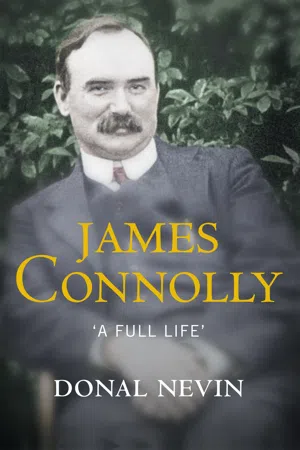
'Hasn't it been a full life, Lillie, and isn't this a good end?', were James Connolly's last words to his wife in Dublin Castle in the early hours of 12 May 1916 just before his execution for his part in leading the Easter Rising.
James Connolly, the son of Irish immigrants, was born in Edinburgh. The first fourteen years of his life were spent in Edinburgh and the next seven years in the King's Liverpool Regiment in Ireland. In 1889, he returned to Edinburgh where he was a socialist activist and organiser for seven years. In 1896, at the age of 28, he was invited to Dublin as socialist organiser, founding the Irish Republican Socialist Party and editing The Workers' Republic.
Connolly spent seven years in America between 1903 and 1910, returning to Ireland in 1910 as organiser of the Socialist Party of Ireland. Connolly was appointed Ulster Organiser of the Irish Transport and General Workers' Union by James Larkin, succeeding him as acting general secretary in October 1914. As Commander of the Irish Citizen Army, Connolly joined with leaders of the Irish Republican Brotherhood in the Easter Rising in 1916, becoming Commandant-General of the Dublin Division of the Army of the Republic and Vice-President of the Provisional Government of the Irish Republic.
For their part in the Easter Rising, Connolly and thirteen of his fellow revolutionaries were executed in Kilmainham Gaol by the British government. Connolly, the last to be executed, was wounded in the Rising and had to be strapped to a chair to face the firing squad.
This biography deals with Connolly's activities as soldier, agitator, propagandist, orator, socialist organiser, pamphleteer, trade union leader, insurgent, and traces the evolution of his political thinking as social democrat, revolutionist, syndicalist, revolutionary socialist, insurrectionist. It is based largely on Connolly's prolific writings in twenty-seven journals in Scotland, England, Ireland, France and America, and some 200 letters which are particularly revealing of his relationships with colleagues. James Connolly is the very best survey of Connolly's remarkable life and times.
James Connolly, A Full Life: Table of Contents
Preface by Des Geraghty
- PART I Edinburgh 1868–1882
- PART II Ireland 1882–1889
- PART III Edinburgh 1889–1896: Social Democrat
- PART IV Dublin 1890–1903: Revolutionist
- PART V America 1903–1910: Syndicalist
- PART VI Writings
- PART VII Ireland 1910–1916 The Red and the Green: Revolutionary Socialist–Insurrectionist
- PART VIII Revolutionary Thinker
- APPENDICES
For a’that and a’that It’s coming yet for a’that That man to man the world o’er Shall brithers be for a’that.
ROBERT BURNS
C’est la lutte finale, Groupons-nous et demain L’Internationale sera le genre humain.
Is í an troid scoir í a bhráithre Éirimís chun gniomh an tInternationale Snaidhm comhair an cine daonna.
EUGENE POTTIER (TRANSLATION BY MÁIRTÍN Ó CADHAIN)
What is this the sound and rumour? What is
this that all men hear,
Like the wind in hollow valleys when the storm
is drawing near.
Like the rolling on of ocean in the eventide of fear?
’Tis the people marching on.
WILLIAM MORRIS
Chapter 1
CHILD OF THE COWGATE
In W.P. Ryan’s The Irish Labour Movement from the ’Twenties to our own Day, published in 1919, it is stated that Connolly was born near Clones in Co. Monaghan on 5 June 1870 and that his family emigrated to Edinburgh in 1880. Ryan knew Connolly well as a friend and colleague and as a contributor to his paper, The Peasant. When Ryan’s son, Desmond, came to write the first biography of Connolly in 1924 he repeated that he had been born in Clones in 1870 and that he had passed ten years of his childhood in the north of Ireland. Desmond, who was in his early twenties when he wrote James Connolly: His Life, Work and Writings, knew Connolly and was with him in the GPO in Easter Week 1916 when he acted as secretary to Patrick Pearse. In 1951 he told Desmond Greaves that his father had collected much of the material for the book and that it was given to him when he fell ill and had to relinquish his job as a journalist with the Freeman’s Journal.
So it was that the myth of Connolly’s birth in Monaghan in 1870 came to be accepted as fact despite many fruitless searches of birth records. The details of the actual birth place and birth date of James Connolly were ultimately discovered by Desmond Greaves and published, along with a facsimile of Connolly’s birth entry, in the Irish Democrat in March 1951. In an article in the same journal in 1968, Greaves recalled his search.1 In 1951, he had gone to Edinburgh to try and trace Connolly’s early connections with that city. The then secretary of the Trades Council showed him the minutes for the years 1891–6 which contained many references to a J. Connolly. The City Treasurer showed him the City Council’s minutes for the same period. Here it was indicated that a John Connolly had been dismissed for political reasons from his job as a carter. There was nothing about James. He next visited Len Cotton, secretary of the Socialist Labour Party, a man then in his early seventies who had preserved all the records of the SLP. A search of the files of The Socialist (the organ of the SLP, first issued in 1902) revealed nothing about Connolly’s early life. Cotton sent Greaves to Charles Geddes, a leading figure in the setting up of the SLP, who introduced him to an old man, John Conlon, a once close friend of John Connolly. Conlon lived at the top of a spiral staircase lit by dim gaslights which he said had been installed as a result of one of James Connolly’s campaigns. He spoke about John Connolly (James’ brother), who had enlisted and gone to India under the name of John Reid, and about the Scottish Land and Labour League ‘that we all came from’. He asked Greaves, ‘with a bright twinkle in his eye: Did you ever hear where James Connolly was born?’ Turning to Geddes he said, ‘He was born in the Cowgate.’ A search of the birth entries revealed that Connolly was born on 5 June 1868, in the Cowgate, Edinburgh. Afterwards, an old friend of John Leslie who had introduced Connolly to socialist politics in Edinburgh in 1890, H.A. Scott, searched the census records and established that the birth entry referred to the right man. Greaves later discovered that H.W. Lee had given Edinburgh as Connolly’s birthplace in his History of the Social Democratic Federation.
According to Greaves, John Connolly and Mary McGinn, both twenty-three years old, were married by Fr Alexander O’Donnell of St Patrick’s Church in the Cowgate, Edinburgh, in the priest’s house at 17 Brown Square on 20 October 1856.2 The two witnesses, Myles Clarke and Mary Carthy, being illiterate, each signed the register with a cross. Little is known of the newly-married couple’s parents. John Connolly described himself as an agricultural labourer and Mary McGinn, a domestic servant. The surviving parents were Mary Connolly (born Markie) and James McGinn, a labourer. The deceased parents were John Connolly, a farm labourer and Maria McGinn (maiden name Burns). John Connolly was born in Ireland and James McGinn and his wife, Bridget Boyle, in Co. Monaghan. By 1858, John Connolly was living at 6 Kingstable, Edinburgh and was employed by the Corporation as a manure carter. Three years later he was involved in a scavengers’ strike which secured for the workers a wage of fifteen shillings a week. His first son, also named John, was born on 31 January 1862. A second son, Thomas, was born in Campbell’s Close, Cowgate on 27 April 1866. The youngest son, James, was born in lodgings at 107 Cowgate on 5 June 1868. Later the family went to live at No. 2A Kingstable, Edinburgh. The Cowgate, a continuation of the Grassmarket, was in the Old Town, close to Edinburgh University. St Patrick’s parish, Little Ireland, as it was called, was a densely-packed parish in which 14,000 Irish immigrants lived in poverty in slum tenements where disease was rampant. (The site of the tenement in which Connolly was born is now the Herriot Watt University.)
The three sons went to school at St Patrick’s on the Cowgate. John spent some years in various employments and at about 14 years of age enlisted in the army. Thomas Connolly worked for a time in Edinburgh as a compositor’s labourer. Nothing is known about his subsequent employment. It is likely that he emigrated.
The well-researched information about James Connolly’s early years given by Greaves in The Life and Times of James Connolly indicates that the first verifiable job held by him was in a bakery at the age of ten but it has been suggested that before that he had spent a year or so in the office of the Edinburgh Evening News where his older brother worked. W.P. Ryan tells the story that when the Factory Inspector visited the works, James was put sitting on a high stool behind a case of type. The stratagem was discovered and he was dismissed as he was not yet of the age at which boys could legally be employed.3 His work in the bakery seems to have lasted about two years. W.P. Ryan, who appears to have got his information from John Leslie, an associate of James’ brother, John, states that as a result of the rigours of his work in the bakery, his health failed. He then got a job in a mosaic tiles depot, working there for about a year.
James Connolly’s boyhood in Edinburgh was one of deprivation, harsh poverty, grim housing conditions and hard toil. He had little schooling and from the age of nine earned paltry wages to help keep the family above the bread-line. Such conditions were the common lot of the children of casual labourers in the cities of Britain, as in Dublin and Belfast, in the 1870s.
Little is known about Connolly’s uncles or aunts. W.P. Ryan refers to an uncle, an old Fenian, influencing him on Irish affairs. There seems to be little foundation for this family tradition. Ina Connolly, a daughter of James Connolly, refers to her grandfather’s brother being obliged to flee to Scotland where he found work with Edinburgh Corporation and that it was through him that John Connolly obtained employment with the Corporation. She remembered her uncle, Peter Connolly, visiting the family in Belfast in 1912 when he sought to persuade her father to go with him to Co. Monaghan in order to sign over the small family holding to him as the lease had run out. Her father refused to go as he was then involved in a strike in Larne.4
Little imagination is required to conjure up an image of the brutally hard times endured by the Connolly family in their various lodgings and tenements in Edinburgh in the last three decades of the nineteenth century. Mary Connolly, chronically bronchial, died at the age of 58 in 1891. John survived a further nine years, dying of a cerebral haemorrhage in 1900. He had suffered a serious accident in 1889 and subsequently worked as a caretaker of a public convenience in the Haymarket. His last years were spent in great poverty. There are no records to indicate James Connolly’s relationship with his mother who had died little more than a year after her son’s return to Edinburgh after an absence of some seven years. Nora Connolly, James Connolly’s second eldest daughter, remembered her grandfather as ‘a tall man with a red curly beard’ when she visited him in 1898 with her father. She remembered too her father rushing from Dublin when his father became terminally ill, and staying until after the funeral.5
In The Harp (June 1908), Connolly described how as a boy ‘his father would set him to do ten minutes work and find him an hour after, sitting dreaming, with the job not yet commenced.’ He told his daughter, Nora, how ‘the light of the fire served as illumination and when the fire was going out, I couldn’t read.’ Nora also recalled her father speaking of his experience while working in the bakery where the work lasted from six in the morning till late at night: ‘the few shillings I could get were needed at home. Often I would pray fervently that I would find the place burnt down when I got there.’ At night he suffered nightmares. It was the conditions he endured as a boy that probably caused his squint and poor eyesight; his short stature and his slimness into his thirties, and stoutness in middle age, may have been caused by a glandular disorder, according to Connolly’s biographer, Austen Morgan, who added that he bore signs too of having had rickets as a result of vitamin deficiency in his early years.6 Sean O’Casey, in Drums Under the Window, described Connolly as having ‘a rather awkward carriage’ with bow legs adding to the waddle in his walk.7
The 1881 British census return from 2A King’s Stables, Edinburgh where the Connolly family resided, shows four persons in the household: John (a 47-year-old carter born in Ireland), Mary (his wife, aged 44 and also born in Ireland), Thomas (a son, printer-compositor apprentice, aged 15), and James (a son, baker’s apprentice, aged 13). Both Thomas and James were registered as born in Edinburgh. (The third son, John, had by this time enlisted in the British army.)
Source: Fintan Lane, Saothar 28, 2003.
PART II
Ireland 1882–1889 Soldier
The standing army in any country is a tool in the hands of the oppressor of the people and is a generat...
Table of contents
Cover
Title Page
Epigraphs
Contents
James Connolly
Preface by Des Geraghty
Introduction and Acknowledgements
Part I: Edinburgh 1868–1882
Chapter 1: Child of the Cowgate
Part II: Ireland 1882–1889: Soldier
Chapter 2: In the Service of the Queen
Part III: Edinburgh 1889–1896: Social Democrat
Chapter 3: Capitalism and Class Struggle
Chapter 4: The Making of a Socialist
Part IV: Dublin 1896–1903: Revolutionist
Chapter 5: Forerunners
Chapter 6: Irish Socialist Republican Party
Chapter 7: The End and the Means
Chapter 8: Agitate Educate Organise
Chapter 9: The Workers’ Republic
Chapter 10: The Politics of Labour
Chapter 11: Agitator
Chapter 12: Split
Part V: America 1903–1910: Syndicalist
Chapter 13: Socialist Labor Party of America
Chapter 14: Industrial Workers of the World
Chapter 15: Irish Socialist Federation
Chapter 16: Socialist Party of America
Chapter 17: Call of Erin
Part VI: Writings
Chapter 18: Labour, Nationality and Religion
Chapter 19: Labour in Irish History
Chapter 20: Songs of Freedom
Part VII: Ireland 1910–1916, The Red and the Green: Revolutionary Socialist – Insurrectionist
Chapter 21: Socialist Party of Ireland
Chapter 22: Irish Transport and General Workers’ Union
Chapter 23: Industrial Unionism
Chapter 24: Political Action
Chapter 25: Connolly–Walker Controversy
Chapter 26: Uprising
Chapter 27: Home Rule
Chapter 28: War
Chapter 29: Successor to Larkin
Chapter 30: The Re-Conquest of Ireland
Chapter 31: Irish Citizen Army
Chapter 32: The Time is Ripe
Chapter 33: Banners of Revolt
Chapter 34: Signposts to the Revolution
Chapter 35: Preparations for Insurrection
Chapter 36: Easter Week
Chapter 37: Aftermath
Part VIII: Revolutionary Thinker
Chapter 38: Connolly and Catholicism
Chapter 39: Recollections
Chapter 40: Assessment
Appendices
II. Writings of James Connolly
III. Irish Citizen Army and the Easter Rising
IV. Connolly and the British Army
V. Connolly in Fiction and Drama
Notes and References
Sources
Bibliography
Abbreviations
Tributes
By the same author
Copyright
About the Author
About Gill & Macmillan
Trusted by 375,005 students
Access to over 1.5 million titles for a fair monthly price.
Study more efficiently using our study tools.
Frequently asked questions
Yes, you can cancel anytime from the Subscription tab in your account settings on the Perlego website. Your subscription will stay active until the end of your current billing period. Learn how to cancel your subscription
No, books cannot be downloaded as external files, such as PDFs, for use outside of Perlego. However, you can download books within the Perlego app for offline reading on mobile or tablet. Learn how to download books offline
Perlego offers two plans: Essential and Complete
Essential is ideal for learners and professionals who enjoy exploring a wide range of subjects. Access the Essential Library with 800,000+ trusted titles and best-sellers across business, personal growth, and the humanities. Includes unlimited reading time and Standard Read Aloud voice.
Complete: Perfect for advanced learners and researchers needing full, unrestricted access. Unlock 1.5M+ books across hundreds of subjects, including academic and specialized titles. The Complete Plan also includes advanced features like Premium Read Aloud and Research Assistant.
Both plans are available with monthly, semester, or annual billing cycles.
We are an online textbook subscription service, where you can get access to an entire online library for less than the price of a single book per month. With over 1.5 million books across 990+ topics, we’ve got you covered! Learn about our mission
Look out for the read-aloud symbol on your next book to see if you can listen to it. The read-aloud tool reads text aloud for you, highlighting the text as it is being read. You can pause it, speed it up and slow it down. Learn more about Read Aloud
Yes! You can use the Perlego app on both iOS and Android devices to read anytime, anywhere — even offline. Perfect for commutes or when you’re on the go. Please note we cannot support devices running on iOS 13 and Android 7 or earlier. Learn more about using the app
Yes, you can access James Connolly, A Full Life by Donal Nevin in PDF and/or ePUB format, as well as other popular books in Política y relaciones internacionales & Biografías históricas. We have over 1.5 million books available in our catalogue for you to explore.