- 212 pages
- English
- ePUB (mobile friendly)
- Available on iOS & Android
eBook - ePub
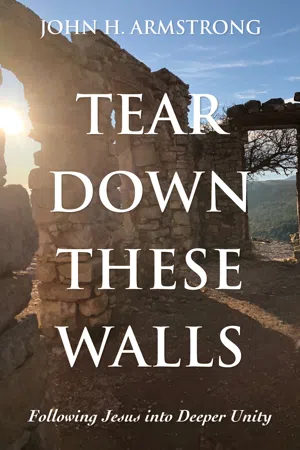
About this book
"I am praying not only for these disciples but also for all who will ever believe in me through their message. I pray that they will all be one, just as you and I are one--as you are in me, Father, and I am in you. And may they be in us so that the world will believe you sent me" (John 17:20-21, NLT).
For most Christians these words of Jesus seem like an unreachable ideal. Or they promise spiritual unity without a visible demonstration between real people. Some even read these words with a sense of fear seeing this text used for a compromise agenda. How should we understand this prayer offered for all who follow Jesus?
What if Jesus really intended for the world to "believe" the gospel on the basis of looking at Christians who live deep unity in a shared relationship with him? What if there is way of understanding what Jesus desired so that we can begin anew to tear down the many walls of division that keep the world from seeing God's love in us? Is our oneness much bigger and deeper than we could imagine?
John Armstrong has devoted three decades to the work of Christian unity. His story and ministry have encouraged many around the world and now they are reflected in this memoir of a life devoted to unity.
Information
Topic
Theology & ReligionSubtopic
Christian DenominationsChapter One
The Road to the Future
You can best think about the future of the faith after you have gone back to the classical tradition.
—Robert E. Webber
No one dare do contemporary theology until they have mastered classical Christian thought.
—Karl Barth
The church today is undergoing a significant transition. In the early twenty-first century, the great shift in the growth and vitality of Christianity has moved from Europe and North America to the global East and South, e.g., Asia, Africa, and Latin America. Religious historian Philip Jenkins has given a compelling vision of what the wider Christian future might look like in his important book The Next Christendom: The Coming of Global Christianity.3 He shows, through historical narrative and contemporary data, how rapidly these new expressions of the ancient Christian faith are growing.
The late Phyllis Tickle said the church was passing through a long multigenerational shift. She examined massive transitions in culture and in church life and practice, and how these changes came to be. Her passion was to tackle the big questions about where we seem to be going. Anyone interested in the future of the church in America can find many things in her book The Great Emergence to stimulate better understanding of our present and near future.4
How life for the Christian church will be different in the years ahead may well depend on how the church responds to this story of unity. There is only one thing we can be sure of: The past is a prelude to the future and our Christian future will be very different than the post-Reformation world of modern Western church history.
The Past Can Lead Us to the Future
There is no doubt that new patterns of Christian faith and life are emerging in the church. I welcome these patterns, but I believe they desperately need to be rooted in the past—the Word of God understood as the story of God’s love for us, the creeds rightly used, life as a sacramental mystery, and the deeply rooted practices of spiritual formation. I believe the famous Catholic theologian Karl Rahner got this right: “The devout Christian of the future will either be a ‘mystic,’ one who has experienced ‘something,’ or he will cease to be anything at all.”5 We will see why this is so in the chapters that follow. God’s purpose must be embraced and loved.
This thesis was captured by my friend and teacher Robert Webber in the words “ancient-future faith.”6 This is a way of saying the church must be deeply rooted in the past if it is to rightly embrace real hope for the future.
The incarnation of Jesus Christ in human history is our story. Christianity’s view of the universe and human destiny rests upon historical events. Christians have always privileged these central facts and thus they have been universally recognized. These facts include the life, character, and teaching of Jesus. Yet above all other facts Christians have believed that the death, burial, resurrection, ascension, and coming again of Jesus are central to our faith. These are more than mere facts, but they are nevertheless essential facts (1 Corinthians 15:3–4). The true calling of the church, rooted in good theology and faithful ministry, must always start here.
From the very beginning Christians have confessed a faith that believes we are spiritually united with the glorified Christ through the gift of the Holy Spirit. This union results in our collective story, a story rooted in oneness. But our modern story often confuses us, and thus the church gives mixed signals. Our historical past sometimes embarrasses us, especially if we know our profound inconsistencies. To be faithful to our history and confession the church must understand that she is simultaneously just and sinful. Because we are sinful, the church has embraced and promoted practices that reveal our gross failure to follow Jesus: war, misogyny, injustice, anti-Semitism, colonialism, slavery, racism, et al. We have to be honest about our story. We have lived as if the central facts we confess are not really central. Nevertheless, as people of faith in Jesus, this story remains “our” story, with all our brokenness and failure.
In large portions of American Protestantism, Christian conversion is seen almost exclusively as an individual event. A sinner comes under the conviction of sin and is born again by asking Jesus into their heart. But in early Christianity, the central truth of spiritual birth was this: The new birth was a divine mystery of pure grace that introduced you to a family of forgiven siblings. Conversion was understood as a pilgrimage, not a one-time ticket to heaven. True faith is never discovered in your personal religious feelings but in these central historical facts that lead us to a life-changing experience of shared faith. Therefore, if we refuse to come to grips with our past, our present and future may not be distinctively Christian at all. The result will be new forms of man-made religion, with a host of bad ideas married to the spirit of our age. This will result in recycled heresies.
For almost two thousand years, Christians have lived this great mystery of apostolic faith, a mystery passed on through stories, sermons, creeds, and common practices such as baptism and the Lord’s Supper. All of these were understood as expressions of their one faith. But in spite of these rock-solid facts, American Christians have a unique predilection to approach the Christian faith as if what we know today is vastly more relevant than what previous generations knew. This is naïve at best, dangerous at worst. It has led a generation of Christians to assume they know perfectly well who Jesus is, apart from any instruction in the ancient Christian tradition. As a result, America has become the primary breeding ground for new religions and a wide array of Christian sects. We have exported these spiritual novelties to Africa, Asia, and Latin America, resulting in thousands of new denominations and splinter groups and an almost unimaginable number of not-so-Christian churches and movements. Something about all this tribalism rightly disturbs younger Christians.
Building one’s faith and life on various passages of the Bible, understood primarily through private experience, has resulted in nothing less than a confusing cacophony of Christian noise. This situation is precisely what I will challenge. The walls we have created around these projects must be torn down. But unless we understand what went wrong in the first place, we will be far more likely to leave these walls in their place. I will make a case for how the one church of Jesus Christ, ministering out of its spiritual unity in Christ and rooted in both history and core orthodoxy, can best live the faith and effectively serve Christ’s mission.
The Scripture Is God’s Supreme Witness to Christ
My foundational premise is that Scripture bears witness to the living Christ, who is the full and final revelation of God. Christ has promised to build his church (Matthew 16:18). Though Christians clearly do not agree about every aspect of how to confess this “once-for-all” faith, we all agree the church must be rooted in Scripture. All the great traditions of historical, incarnational, and confessional Christianity, East and West, flow from the church engaging actively with Scripture. But Scripture alone, without human life and community consensus, has been subjected to every human whim and fancy. History demonstrates the dangers of such an appr...
Table of contents
- Title Page
- Foreword
- Introduction
- Chapter 1: The Road to the Future
- Chapter 2: My Long Slow Journey to Catholicity
- Chapter 3: My Search for an Elusive Truth
- Chapter 4: The Jesus Prayer for Our Unity
- Chapter 5: Our Greatest Apologetic
- Chapter 6: Christ the Center
- Chapter 7: The Four Classical Marks of the Church
- Chapter 8: Can Our Unity Be Restored?
- Chapter 9: Sin Destroys Our Unity
- Chapter 10: Sectarianism: Our Real Enemy
- Chapter 11: Why the Church Still Matters
- Chapter 12: For Christ and His Kingdom
- Chapter 13: The Search for the Ideal Church
- Chapter 14: Healing Schism through Costly Love
- Chapter 15: Envisioning New Ways to Live as One: The “New Ecumenism”
- Chapter 16: Missional-Ecumenism
- Chapter 17: Learning to Live Missional Lives
- Chapter 18: Building Relational Bridges for Unity
- Chapter 19: Models of Missional-Ecumenism
- Chapter 20: Costly Love, Costly Unity
- Glossary
- Appendix
- Bibliography
Trusted by 375,005 students
Access to over 1.5 million titles for a fair monthly price.
Study more efficiently using our study tools.
Frequently asked questions
Yes, you can cancel anytime from the Subscription tab in your account settings on the Perlego website. Your subscription will stay active until the end of your current billing period. Learn how to cancel your subscription
No, books cannot be downloaded as external files, such as PDFs, for use outside of Perlego. However, you can download books within the Perlego app for offline reading on mobile or tablet. Learn how to download books offline
Perlego offers two plans: Essential and Complete
- Essential is ideal for learners and professionals who enjoy exploring a wide range of subjects. Access the Essential Library with 800,000+ trusted titles and best-sellers across business, personal growth, and the humanities. Includes unlimited reading time and Standard Read Aloud voice.
- Complete: Perfect for advanced learners and researchers needing full, unrestricted access. Unlock 1.5M+ books across hundreds of subjects, including academic and specialized titles. The Complete Plan also includes advanced features like Premium Read Aloud and Research Assistant.
We are an online textbook subscription service, where you can get access to an entire online library for less than the price of a single book per month. With over 1.5 million books across 990+ topics, we’ve got you covered! Learn about our mission
Look out for the read-aloud symbol on your next book to see if you can listen to it. The read-aloud tool reads text aloud for you, highlighting the text as it is being read. You can pause it, speed it up and slow it down. Learn more about Read Aloud
Yes! You can use the Perlego app on both iOS and Android devices to read anytime, anywhere — even offline. Perfect for commutes or when you’re on the go.
Please note we cannot support devices running on iOS 13 and Android 7 or earlier. Learn more about using the app
Please note we cannot support devices running on iOS 13 and Android 7 or earlier. Learn more about using the app
Yes, you can access Tear Down These Walls by John H. Armstrong in PDF and/or ePUB format, as well as other popular books in Theology & Religion & Christian Denominations. We have over 1.5 million books available in our catalogue for you to explore.