A veteran US frogman recounts his experiences in World War II and the risky pre-invasion missions of the Underwater Demolition Teams.
?
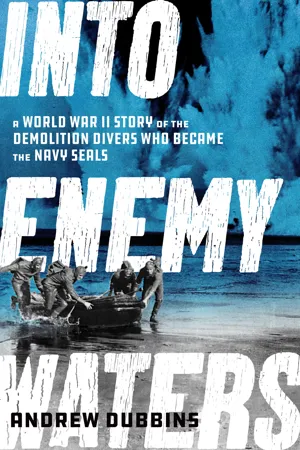
Into Enemy Waters is the story of World War II's most elite and daring unit of warriors, the direct precursors to the Navy SEALs, told through the eyes of its last living member, ninety-five-year-old George Morgan.
Morgan was just a wiry, seventeen-year-old lifeguard from New Jersey when he joined the Navy's new combat demolition unit, tasked to blow up enemy?coastal defenses ahead of landings by Allied forces. His first assignment: Omaha Beach on D-Day.
When he returned stateside, Morgan learned that his service was only beginning. Outfitted with swim trunks, a dive mask, and fins, he was sent to Hawaii and then on to deployments in the Pacific as a member of the elite and pioneering Underwater Demolition Teams. GIs called them "half fish, half nuts." Today, we call them frogmen—and Navy SEALS.
Led by maverick Naval Reserve Officer Draper Kauffman, Morgan would spend the fierce final year of the war swimming up to enemy controlled beaches to gather intel and detonate underwater barriers. He'd have to master the sea, muster superhuman grit, and overcome the demons of Omaha Beach.
Moving closer to Japan, the enemy's island defenses were growing more elaborate and its soldiers more fanatical. From the black sand beaches of Iwo Jima to the shark infested reefs of Okinawa, to the cold seas of Tokyo Bay, teenaged George Morgan was there before most, fighting for his life. And for all of us.
Perfect for fans of?
Unbroken,?
The Right Stuff, and?
Band of Brothers.
Praise for
Into Enemy Waters
"A compelling narrative full of World War II fireworks." —
Kirkus Reviews
"A rousing history. . . . Drawing on extensive interviews with Morgan, Dubbins creates a vivid and fast-moving narrative of courage and sacrifice under the most extreme conditions. WWII buffs will be thrilled." —
Publishers Weekly
"This well-researched book is both visceral and uplifting, telling of a time of great courage, integrity and camaraderie." —Jill?Heinerth,?author of
Into The Planet: My Life as a Cave Diver
eBook - ePub
Into Enemy Waters
A World War II Story of the Demolition Divers Who Became the Navy SEALS
- 304 pages
- English
- ePUB (mobile friendly)
- Available on iOS & Android
eBook - ePub
Into Enemy Waters
A World War II Story of the Demolition Divers Who Became the Navy SEALS
About this book
Information
Topic
StoriaSubtopic
Biografie in ambito storico
1.
The
Crash
The
Crash
At the rate World War II veterans are dying—an average of 234 a day—it is estimated that all of them will be deceased by 2036. That is why I feel privileged to shake the hand of George Morgan, one of the last surviving frogmen of World War II. It’s August 15, 2020, coincidentally the seventy-fifth anniversary of V-J Day (Victory over Japan Day), and we’re meeting for the first time at George’s vacation home in the mountains of eastern Arizona. George seems to me much younger than his ninety-three years, spry and quick witted, with broad shoulders, handsome glasses, and thick gray hair curling out from beneath his navy blue ballcap, which says “World War II Frogman” in gold letters. His only health issue, he tells me, is COPD, a condition that limits the flow of air in and out of the lungs. Holding and controlling his breath was once his superpower as a frogman—now, his breathing is short and shallow. He gurgles sometimes and gasps for air after long stretches of talking.
COVID-19 is racing through Arizona, and George knows that if he catches the virus, he likely will not survive it. Both of us are fully vaccinated, but I insist that we sit outside on his backyard patio as an added precaution. His yard abuts a golf course, and many of the golfers wave to George as they walk by, because he and his wife, Patricia, are in the habit of letting them pick apples from their tree. Patricia, a kind and cheerful woman, was the one who answered the phone when I called for the first time.
I asked: “Is there a George Morgan there, who served in the Navy in World War II?”
“Yes, sir,” she said, “the frogman!”
I was giddy to hear it, having called at least a dozen wrong “George Morgans.”
Very protective of George, Patricia brings us out two glasses of Pepsi with ice in case we get thirsty. The drink tastes cold and refreshing, especially in the Arizona summer heat.
I was surprised to find George living in the arid Southwest, so far inland. When I first discovered his story—via an oral history video recorded by the National WWII Museum—I’d pictured the old frogman living by the ocean somewhere, perhaps taking daily swims or watching the sun set over the water. But George tells me he’s barely set foot in the ocean since the war. “I had enough of that,” he says.
I went into my reporting with a romanticized vision of the World War II frogmen, picturing their derring-do and underwater heroics akin to a John Wayne adventure movie. The reality of the war, as I would come to learn from George through our many conversations, just as he had learned as a teenager, was something much different, much darker. I could tell from our initial phone calls that he was reluctant to speak about his combat experiences. “I’ve spent seventy-some-odd years trying to forget all that,” he told me. So, during our first meeting in Arizona, we talk mostly about his childhood.
George Morgan came into the world in 1927 in Lyndhurst, New Jersey, a small township between the Passaic and Hackensack Rivers, which meander through New Jersey’s swampy lowlands before merging at the northern end of Newark Bay and emptying into the Atlantic.
He was born in the master bedroom of his parents’ modest, middle-class home, the first child of Alfred and Grace Morgan. Alfred, then twenty-five, was a short, gregarious businessman who worked for a stock brokerage firm on Wall Street called Marks and Graham. He always wore a bow tie and smoked a pipe, which to young George made him look like a steam engine chugging down the street.
Grace, twenty-six, was a big-framed woman, shy and soft-spoken. Alongside her work as a homemaker, Grace volunteered with the Red Cross, translating novels from print into braille for the blind. She pressed the dots into the page by hand with a stylus, George falling asleep to the faint tapping sound.
The Morgan family was happy, prosperous, and comfortable. That is, until October 24, 1929—the day of the Great Stock Market Crash.
The Roaring Twenties had been a period of wild speculation and rapid stock market expansion. But by the end of the decade, rising unemployment and declining production had left stocks in dramatic excess of their actual value. At the same time, low wages, a sharp spike in consumer debt, and an ongoing agricultural slump had further destabilized the American economy. On October 24, known as Black Thursday, panicked investors sent the Dow Jones Industrial Average plummeting.
Clients stampeded into Alfred’s office on Wall Street trying to sell their stocks, only to find them worthless. Alfred was so busy servicing frantic customers (every transaction had to be recorded by hand back then) that he slept at his desk for two nights straight.
Billions of dollars were lost in the crash, and many investors were left penniless. Down the block from Alfred’s office, one destitute businessman leaped from a seventh-floor ledge, striking a car parked on Wall Street and dying on impact. Across the country, other investors would do the same after watching their paper fortunes vanish overnight.
Three days after the crash, Alfred returned home to Grace and George in Lyndhurst. Disheveled and exhausted from overwork, Alfred unstrung his bow tie and delivered some grim news: his company was broke, and he was out of a job.
The crash set off one of the most catastrophic economic crises in American history: the Great Depression. Banks and businesses shuttered, and unemployment spiked from under 4 percent of the American workforce in 1929 to 25 percent in 1933.
Among the jobless were Alfred’s father and brother, who moved their families in with George’s. Seven people now resided in the two-bedroom house: George, his parents, his grandparents, his uncle and aunt. And not one of them had a steady job.
Alfred found part-time work as a door-to-door salesman, hawking various products like fabric and kitchen knives. But few people in the neighborhood could afford food let alone cutlery.
During nightly dinners, George noticed that his father rarely ate a meal. He suspected Alfred was visiting soup kitchens during the day to fill up to ensure there’d be enough for everyone else at suppertime. Often, men came knocking on the family’s back door asking for food. Grace—a devout Presbyterian, who believed strongly in charity—would always answer the door and talk to the scruffy, desperate men. She sometimes had a little food to give them, but most of the time there was none to spare.
Soon, Alfred could no longer afford the mortgage, and the bank foreclosed on the family’s home. Alfred found an apartment for rent on the opposite side of Lyndhurst. The bank had already repossessed the family’s Chevrolet, so they had to use George’s red wagon and an old baby carriage to haul their luggage across the bleak, downtrodden streets of Lyndhurst to the new apartment.
The apartment was situated on the top floor of a two-story house, with a Polish family renting the downstairs. In a space even tinier than their old house, the seven Morgans lived practically on top of one another. The family grew even more crowded in 1931 when George’s little brother, Robert, was born. George had to share a room with the screaming infant. To escape the noise and smell of dirty diapers, he developed a habit of riding around the neighborhood on his beloved tricycle.
During one such adventure, five-year-old George was pedaling down the sidewalk, his feet spinning like a cartoon character, when his path was abruptly blocked by a coal truck reversing into a driveway. George skidded to a stop and waited. As the stinky truck was lumbering backward toward him, George suddenly realized: he was too close. The truck’s back tires struck his tricycle’s front wheel, flipping George onto the ground underneath the truck.
It was dark and noisy as George lay on his back beneath the truck, with coal dust showering his clothes and face. The truck’s reversing wheels were mere inches from his head—on the verge of crushing him—when the truck screeched to a stop. A pedestrian, as if by a miracle, had spotted George on the ground and screamed in horror at the driver to stop.
George left his wrecked trike on the ground, took the woman’s hand, and walked with her back to his apartment. He expected to be in big trouble, but his parents were more relieved than anything. His mother hugged him tightly, then washed his sooty face.
“That was my first experience of almost buying the farm,” George tells me almost ninety years later, shaking his head at the memory.
During those trying days of the Depression, every member of the Morgan family chipped in however they could. George’s uncle took a job as a repo man. The difficult work involved scouring the city for cars that were behind on payments and seizing them. George’s grandmother found work as a practical nurse, and his grandfather—a Spanish-American War veteran who hadn’t held a steady job since—tried his hand at real estate. Still residing with George and his parents, Grandpa Morgan hung a large sign out front of the house—“George E. Morgan, Realtor”—until a local policeman informed him that he needed a license to sell real estate and forced him to take the sign down.
By age seven, George decided it was time for him to start pulling his weight as well. His first job was selling magazines, like the Saturday Evening Post and Ladies’ Home Journal. He earned thirty-five cents a month, which he promptly gave to his mother to go toward the family.
Soon after that, George convinced a local confectionary store owner to give him a newspaper route. For one dollar a week, George delivered a hundred newspapers a day. They included all the local papers—the New York Times, New York Daily News, and Daily Mirror. There was also an Italian newspaper called Il Progresso (The Progressor), and a German one, the New Yorker Staats-Zeitung (commonly called The Staats), which in the early 1930s covered the rise of a fiery young politician named Adolf Hitler.
George found other jobs in those days, including stacking pins at the local bowling alley, slapping labels on paint cans, and delivering laundry and groceries to people’s homes. The delivery jobs fetched up to forty cents a day in tips, which George proudly handed over to his mother every evening.
George’s favorite job was fetching baseballs at the local ballpark. Lyndhurst’s semipro team couldn’t afford new balls, so whenever players slugged a foul ball into the neighborhood, the manager gave local kids like George a quarter to chase it down.
Like many boys his age, George was a baseball fanatic. His favorite team was the Brooklyn Dodgers; he never missed a game on the radio. But as much as it pained him to admit it, his favorite players were a pair of crosstown rival Yankees: Babe Ruth and Lou Gehrig.
Whenever he had a few hours off work, he’d play baseball at the local sandlot, developing a reputation as a crafty pitcher. He was too skinny to throw heat but taught himself to throw “junk” pitches—curves, changeups, and sinkers. The pitches zigged and zagged, spun and sputtered past the bats of his exasperated pals.
George’s second love after baseball was swimming. He learned to swim at the YMCA pool, but his usual spot was the Passaic River. It was illegal to swim there since nearby towns dumped their garbage in the river. But George and his friends—desperate to cool off in the summer heat—ran right past those “No Swimming” signs. George also did some swimming with the Boy Scouts on trips up to New Jersey’s Lake Tamarack, which froze over in winter but was cool and refreshing in summer.
A committed Scout, George’s green sash was covered in merit badges. In addition to swimming, he took pride in his accomplishments in signaling, knots, lifesaving, camping, cooking, semaphore, Morse code, and weather forecasting. For his weather badge, his father had recommended talking to one of their neighbors, Benjamin Perry. Mr. Perry served as the chief meteorologist at the New York City Weather Bureau and had briefed Charles Lindbergh before his historic first flight across the Atlantic in the Spirit of St. Louis. He taught George about cold and warm fronts, barometric pressure, storms, lunar phases, and constellations, and quizzed him on forecasts using weather maps from work.
Mr. Perry’s son, Harold, was similarly scientifically minded and once invited George up to the attic to show him a contraption he’d built.
“Now, I want you to sit in that chair,” he told George. “You see that thing over there, next to the wall?” Harold pointed to a flat, rectangular screen connected by a jumble of wires to some kind of a circuit. “Now, j...
Table of contents
- Cover Page
- More Praise for Into Enemy Waters
- Into Enemy Waters
- Title Page
- Copyright
- Dedication
- Contents
- Map
- Prologue
- Part I The Atlantic
- Part II The Pacific
- Part III Into Enemy Waters
- Part IV The Last Island
- Epilogue
- Acknowledgments
- Sources
- About the Author
Trusted by 375,005 students
Access to over 1.5 million titles for a fair monthly price.
Study more efficiently using our study tools.
Frequently asked questions
Yes, you can cancel anytime from the Subscription tab in your account settings on the Perlego website. Your subscription will stay active until the end of your current billing period. Learn how to cancel your subscription
No, books cannot be downloaded as external files, such as PDFs, for use outside of Perlego. However, you can download books within the Perlego app for offline reading on mobile or tablet. Learn how to download books offline
Perlego offers two plans: Essential and Complete
- Essential is ideal for learners and professionals who enjoy exploring a wide range of subjects. Access the Essential Library with 800,000+ trusted titles and best-sellers across business, personal growth, and the humanities. Includes unlimited reading time and Standard Read Aloud voice.
- Complete: Perfect for advanced learners and researchers needing full, unrestricted access. Unlock 1.5M+ books across hundreds of subjects, including academic and specialized titles. The Complete Plan also includes advanced features like Premium Read Aloud and Research Assistant.
We are an online textbook subscription service, where you can get access to an entire online library for less than the price of a single book per month. With over 1.5 million books across 990+ topics, we’ve got you covered! Learn about our mission
Look out for the read-aloud symbol on your next book to see if you can listen to it. The read-aloud tool reads text aloud for you, highlighting the text as it is being read. You can pause it, speed it up and slow it down. Learn more about Read Aloud
Yes! You can use the Perlego app on both iOS and Android devices to read anytime, anywhere — even offline. Perfect for commutes or when you’re on the go.
Please note we cannot support devices running on iOS 13 and Android 7 or earlier. Learn more about using the app
Please note we cannot support devices running on iOS 13 and Android 7 or earlier. Learn more about using the app
Yes, you can access Into Enemy Waters by Andrew Dubbins in PDF and/or ePUB format, as well as other popular books in Storia & Biografie in ambito storico. We have over 1.5 million books available in our catalogue for you to explore.