eBook - ePub
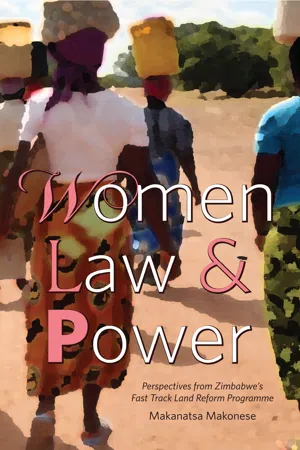
Women Law and Power
Perspectives from Zimbabwe's Fast Track Land Reform Programme
- 166 pages
- English
- ePUB (mobile friendly)
- Available on iOS & Android
eBook - ePub
About this book
Without adequate protection and consideration from the state, women were left out of Zimbabwe's Fast Land Reform Programme at the turn of the century. Leaving them to fight for land in a murky, convoluted system will not address women's rights to it. Giving specific ethical and legal attention to women's rights and needs is the only way to guard against land and other resources begin co-opted by the privileged and those with the requisite social, financial and political capital. Some commentators have argued that Zimbabwean women were better off identifying with Zimbabwean men as as blacks in taking land from the former white farmers than to concentrate on their needs as women during the FTLRP. The primary battle was to take the land from the white farmer, after which a secondary battle by women to take land from men would ensue. Twenty years after the commencement of the FTLRP, the question remains whether the secondary battle by black women to take over land from black men has started and whether there are any chances that such a battle will ever be fought and won.
Information
1
Introduction
Introduction
1.1 Introduction
As reflected in my own life, the land question has been an enduring issue in the history of Zimbabwe. From pre-colonial times to the modern-day post-colonial State of Zimbabwe, the land issue has dominated political, social and economic discourse. The implications regarding women’s rights to access land generally, and agricultural land in particular have been immense. Given the long history of land and its political, economic and social impact on Zimbabweans, this book seeks to interrogate the land question in Zimbabwe with a focus on the Fast Track Land Reform Programme (FTLRP)1 and how the policy and legal frameworks governing the programme as well as access, ownership and control patterns impacted the agricultural land rights of different categories of women.
The categorisation of women in this study is based on different characteristics such as marital and social status, political affiliation and age. It looks at the land rights of married, divorced, widowed and single women, farmworker women, young and older women, women as wives and daughters as well as women in different political formations. The underlying consideration is that when discussing women and access to agricultural land, women should not be lumped together as a homogenous group. My research focused on women as individuals but also as members of systems, societies, families and communities, and with the realisation that the discrimination that they face is not frozen in time, space or circumstances. At the same time, there is need to explore the collective discrimination faced by women because they are women and the differentiated discrimination or privileges that women experience because of their different social, economic, political and even marital positions. The comparison between women in different social and status groups is therefore useful in exploring the sameness2 and difference3 between women. This helps to explain how women from certain social and status categories may suffer from discrimination on the basis of their gender, their ethnic background and their socio-economic situation, leading to intersectional discrimination.4 This will help in explaining why, when the FTLRP was implemented, many women were left out, and how and why the few women who benefitted manoeuvred a complex politically charged and male-dominated process.
1.2 Why the Fast Track Land Reform Programme
In this book, I interrogate the land question and women’s access to land in Zimbabwe using the lens of the FTLRP.5 This epoch in the history of Zimbabwe presented both continuities and discontinuities in the women’s land rights conversation in the country. The former arose from the fact that gender-skewed land rights, wrought by the same century-old system, were not addressed by the FTLRP; the latter arose from the programme’s stated objective to transform a century old, racially skewed land ownership pattern. As it dismantled the colonial hold on African land, the continuity of the colonial patriarchal systems that subordinated women and perpetuated their minority manifested through the post-colonial government’s allocation of most of the land to the country’s mostly black men to the exclusion of the majority women.6 Laws to implement the FTLRP when they were enacted failed to specifically recognise gender-based discrimination in access to land as a historical disadvantage faced by women.
The book provides a multi-level and multi-layered analysis of the land question and its impact on women’s rights to equality in accessing agricultural land. My particular focus begins in 2000, during which the FTLRP was initiated and ends in 2021 when this book was finalised. Throughout I consider the role of the law and the legal framework, in particular the received common law and how it defined land rights in relation to large-scale agricultural land to the eventual exclusion of the majority black population from access to prime agricultural land. The law also defined land value and gave titled ownership to the white colonial settlers, whilst confining the black people to the native areas/reserves (now called communal land), where the land belonged to the State and held no commercial value. In both instances, the subject of land and property was inescapably linked to the rights of men and their power and control over women. Women could only expect to benefit from land or property as appendages of their male relatives. As such, the crosscutting themes in this book are law, power and the FTLRP and how these interacted to determine women’s access to land relative to men.
For example, the challenges that women currently face in customary law in Zimbabwe and most of Africa regarding lack of recognition in land ownership and control, were similarly prevalent and widely recognised in European countries including Britain until the later decades of the nineteenth century. Research shows that in Britain:
Married women were … legally considered subordinate to their husbands, and a woman’s land automatically became the property of her husband on marriage. Married women were not legally entitled to own landed property until the passing of the Married Women’s Property Act in 1870 and the Married Women’s Property Rights Act in 1882. However, single and widowed women were able to buy and sell land and participate in the ‘outer’ world of business, in contrast to the ‘inner’ world of the domestic household.7
Given that it was during this period that the colonisation of Africa was at its peak, it is not surprising that what was passed off as customary law in Zimbabwe and the rest of Africa and the relationship of women to land, was distorted to largely mirror the prevailing relationships in Europe at the time. In relation to the role of chiefs in land administration under colonialism, Cousins notes that ‘In central and southern Africa, this ‘feudal’ model fitted well with British ways of thinking about states and societies. It also linked British land law and colonial contexts, and served the interests of regimes seeking to acquire land for settlers’ (Cousins, 2008:8).
The interests between white and African males converged when it came to the need to suppress women and their rights, and the desire to maintain control over women and promote male hegemony in the social and political arena. As traditional leaders [and men in general] lost their land and power to the white colonial masters, one way of pacifying them was to give them control over women and children with the argument that this was in line with customary law and traditional practices. This led to the marginalisation of women in various aspects of their lives including in family relations and property rights such as land rights. Schmidt notes that:
During the colonial era in Southern Rhodesia, African Chiefs, headmen, and other senior men, European capitalists and the colonial State collaborated in their efforts to control the behaviour of African women. Whilst African men sought to reassert their waning authority over women, their services and their offspring, European men had a different agenda. In the economic realm, they were concerned with obtaining cheap African male labour. If it took the regulation of female sexual practices to achieve this objective, the State was prepared to pass laws to that effect (Schmidt, 1992:121).
This viewpoint is shared by Chanock, who argues that:
But the African Law of modern Africa was born in and shaped by the colonial period. I think it can be shown that in the areas of criminal law and family law, African law represents the reaction of older men to a loss of control over wrongdoing generally and, as more acutely felt, to a loosening control over women (Chanock, 1978:80).
Effectively according to Chanock, the version of customary law that has been adopted in Zimbabwe and other African countries following colonialism was far removed from the customary law that was practiced in pre-colonial society. It was in fact an ‘invented’ version of customary law, which has been used to undermine the rights that women otherwise enjoyed in pre-colonial Zimbabwe and Africa. Building on this argument Banda notes that:
African men, (in collusion with the white colonial governments) fearful of losing power and control over women restated a version of customary law rooted less in fluidity of daily practice but more in an assertion of a draconian version of custom that kept women in their places (Banda, 2005:18).
Other researchers on the development of African law such as Hellum’s study of women’s human rights and legal pluralism in Zimbabwe share the same view. Hellum, on the basis of court records from the Native Court of Appeal of Southern Rhodesia, observes (underlines) the independence that African women showed by running away from their male chaperons such as fathers, brothers and husbands to go to the mines, towns and mission stations as a threat to male patriarchal control. This led the African male elders and chiefs to collaborate with the colonial regime with the aim of regaining control over their wives and daughters with the help of the colonial State (Hellum, 1999:112). This control over women was not confined to their sexuality and reproductive capacity but touched on other aspects of their lives with the intention of making women entirely dependent on men.
The challenge in this collusion between the African men and European settlers was that, in colonies such as Southern Rhodesia, ‘harmonising the African and European systems of social control became an exclusively European responsibility’ (Mittlebeeler, 1976:10). This resulted in serious distortions of African custom and practices. The law-making process extended to women’s productive labour on the land and reproductive labour in which they produced and raised labour for their husbands’ families and for the colonial state. To achieve this, women had to be economically dependent on their husbands and the elders of the clan. One way of ensuring this was to deny them access to land in their own right whilst guaranteeing that they worked on their husbands’ or clan land. Law-making on marriages was used to achieve these objectives. In the British Colony of Southern Rhodesia laws such as the Native Marriages Ordinance of 1901 and 1917 and the Native Adultery Punishment Ordinance of 1916 were used to control women’s sexual and reproductive rights. Through the Native Marriage Ordinance, the marriage registration certificate was used as a pass document and women without the certificate could not be allowed on the mines, European farms or town areas. As a result, those without the certificate could easily be identified and sent back to their native areas (Schmidt, 1986:10). This meant that the movement of women was strictly limited and they could only move with the consent of their husbands, and in the case of unmarried women, their fathers or other male guardians.
The Native Adultery Punishment Ordinance provided that:
Any native who commits adultery with a native married woman, or who induces a native married woman to leave her husband for the purpose of illicit sexual intercourse, or harbours her for the like purpose, against the will of her husband, shall be guilty of an offence, and upon conviction shall be liable to a fine not exceeding £100, or, in default of payment of any fine inflicted, to imprisonment with hard labour for a period not exceeding one year. Any native woman who is a consenting party to any of the above acts shall be liable to the like penalties.8
This law and its provisions were meant to give African men the satisfaction that if they left their wives in their native areas whilst they went in search of paid employment, their wives would be protected thus ensuring labour for the colonial state. The Attorney General of Southern Rhodesia, Mr Clarkson Henry Tredgold9 in support of this law suggested that this was supported by the native males who felt that ‘their whole family life is being disturbed and that they dare not leave their homes in search of labour’..10 The Native Registration Act of 1935 controlled women’s movement, which could only be sanctioned with the consent of their husbands or some male authority, with the colonial government justifying this law on the basis of custom. This led to the confinement of women to the native reserves where they worked their husbands’ and clan land and produced and raised the much-needed family and colonial labour. The colonial state also concentrated available ‘native’ land in the hands of the men through laws such as the Land Apportionment Act, 1930 and the Native Land Husbandry Act, 1951.
These controls over women brought together white males and black males, even though with completely different agendas (Schmidt, 1991:756). With economic interests at heart on the part of the white settlers and the need to ...
Table of contents
- Cover
- Title Page
- Copyright
- Contents
- Notes on the author
- Acknowledgements
- Preface
- 1. Introduction
- 2. Zimbabwe’s Land Policy, Law and Institutional Framework: From Colonialism to 2020
- 3. Women’s Land Rights as a Human Right
- 4. Impact of Violence on Women’s Rights to Access Land under the Fast Track Land Reform Programme
- 5. Power and Law at Family, Local and National Levels 76
- 6. Women, Power and Decision-Making for Access to and Control over Land
- 7. Conclusion
Trusted by 375,005 students
Access to over 1.5 million titles for a fair monthly price.
Study more efficiently using our study tools.
Frequently asked questions
Yes, you can cancel anytime from the Subscription tab in your account settings on the Perlego website. Your subscription will stay active until the end of your current billing period. Learn how to cancel your subscription
No, books cannot be downloaded as external files, such as PDFs, for use outside of Perlego. However, you can download books within the Perlego app for offline reading on mobile or tablet. Learn how to download books offline
Perlego offers two plans: Essential and Complete
- Essential is ideal for learners and professionals who enjoy exploring a wide range of subjects. Access the Essential Library with 800,000+ trusted titles and best-sellers across business, personal growth, and the humanities. Includes unlimited reading time and Standard Read Aloud voice.
- Complete: Perfect for advanced learners and researchers needing full, unrestricted access. Unlock 1.5M+ books across hundreds of subjects, including academic and specialized titles. The Complete Plan also includes advanced features like Premium Read Aloud and Research Assistant.
We are an online textbook subscription service, where you can get access to an entire online library for less than the price of a single book per month. With over 1.5 million books across 990+ topics, we’ve got you covered! Learn about our mission
Look out for the read-aloud symbol on your next book to see if you can listen to it. The read-aloud tool reads text aloud for you, highlighting the text as it is being read. You can pause it, speed it up and slow it down. Learn more about Read Aloud
Yes! You can use the Perlego app on both iOS and Android devices to read anytime, anywhere — even offline. Perfect for commutes or when you’re on the go.
Please note we cannot support devices running on iOS 13 and Android 7 or earlier. Learn more about using the app
Please note we cannot support devices running on iOS 13 and Android 7 or earlier. Learn more about using the app
Yes, you can access Women Law and Power by Makanatsa Makonese in PDF and/or ePUB format, as well as other popular books in Politics & International Relations & African History. We have over 1.5 million books available in our catalogue for you to explore.