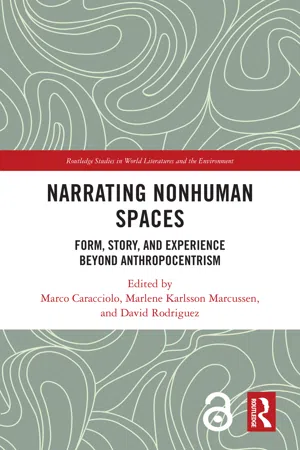
Recent debates about the Anthropocene have prompted a re-negotiation of the relationship between human subjectivity and nonhuman matter within a wide range of disciplines. This collection builds on the assumption that our understanding of the nonhuman world is bound up with the experience of space: thinking about and with nonhuman spaces destabilizes human-scale assumptions. Literary form affords this kind of nonanthropocentric experience; one role of the critic in the Anthropocene is to foreground the function of space and description in challenging the conventional link between narrative and human (inter)subjectivity. Bringing together New Formalism, ecocriticism, and narrative theory, the included essays demonstrate that literature can transgress the strong and long-established boundary of the human frame that literary and narrative scholarship clings to. The focus is firmly on the contemporary but with strategic samplings in earlier cultural texts (the American transcendentalists, modernist fiction) that anticipate present-day anxieties about the nonhuman, while at the same time offering important conceptual tools for working through them.
eBook - ePub
Narrating Nonhuman Spaces
Form, Story, and Experience Beyond Anthropocentrism
- 240 pages
- English
- ePUB (mobile friendly)
- Available on iOS & Android
eBook - ePub
Narrating Nonhuman Spaces
Form, Story, and Experience Beyond Anthropocentrism
About this book
Information
Part 1
Objects and the Resources of Description
1 Containment and Empathy in Katherine Mansfield’s and Virginia Woolf’s Short Stories
Laura Oulanne
DOI: 10.4324/9781003181866-1
she could see little bits of her yellow dress in the round looking-glass which made them all the size of boot-buttons or tadpoles; and it was amazing to think how much humiliation and agony and self-loathing and effort and passionate ups and downs of feeling were contained in a thing the size of a threepenny bit.(Woolf 54)
Human beings are often conceptualized as containers for thoughts and feelings. We see ourselves, in theory and in everyday life, as vessels further contained by the clothes and built spaces we inhabit, yet in fact our experience may extend to encompass these material containers and the world beyond them. Clothes and material spaces can separate bodies and minds from one another and create spaces of isolation; however, in the two short stories discussed in this essay, containment also becomes associated with relationality and affective connection. “Miss Brill” (1920) by Katherine Mansfield and “The New Dress” (1927) by Virginia Woolf exemplify modernist thematics such as the limits of knowledge, empathy, and sympathy between human beings, but they also have a less frequently addressed focus on the affective relationship between human characters and nonhuman things and spaces. The stories invite empathetic engagement even if their characters, like Woolf’s Mabel Waring above, describe themselves as “things” verging on nonhuman. I propose that the “passionate ups and downs of feeling” that the reader of these stories is invited to engage with do not appear as the property of individual minds sealed off from others, but as affects that arise in the encounters of human and nonhuman bodies.
This essay aims to point out the formal and affective affordances of the texts for an anti-anthropocentric understanding of empathy, affectivity, and the mind. By describing the formal features of a text, as exemplified recently by the work of Caroline Levine, it is possible to make visible the way meanings are constrained, but also enabled, by literary forms. Similarly, from a cognitive perspective explored by Terence Cave, “redescribing” literary texts from the point of view of their affordances for conceptual and embodied sense-making yields insight into the plurality of interpretation. I take affect, which both Cave’s and Levine’s accounts of form and affordance risk overlooking, to be an integral part of the literary form. This essay “redescribes” the affective form and content of Mansfield’s and Woolf’s short stories to investigate the phenomena of containment and empathy that the stories set in conversation with one another. My readings suggest that containment as a material condition and a literary form elicits empathy, while it does not work as a model for the mind or the human individual. Thereby I also take a step toward a new reading of empathy and solipsism in modernist fiction.
Containment is a way of both conceptualizing and experiencing space. Here the term is used in three senses: concrete, material container-spaces such as rooms, boxes, and clothes in the fictional worlds of the two stories; containment as a schema of embodied origin involved in thinking (conceptualizing time, life, or the human individual as a container, for instance); and containment as a formal feature of narratives, manifested in circular structures and closure. These senses are interconnected: the metaphorical use of the schema in abstract thinking is based on our everyday experience of concrete containers (Lakoff and Johnson 2)1 and the understanding of stories as containers of events and meaning draws on such schematic thinking. Katrin Dennerlein suggests that containment is our main way of conceiving of space in fiction, based on the evolutionary importance of container spaces (62); on the other hand, relying merely on this schema risks affirming an anthropocentric focus and neglecting dynamic and networked models of space, as has been shown by Marlene Karlsson Marcussen (60). The following readings show that the schema of containment also affords non-anthropocentric, dynamic and relational understandings of space, reading, and experience.2
The conceptual areas of empathy and sympathy have been tangled since the early uses of both terms. “Sympathy” predates “empathy” and began to take on its contemporary distinctive meaning, namely “feeling for” as opposed to “feeling with” or “feeling into” (Einfühlung), around the time of writing of the modernist texts studied here. Within the limits of this chapter, it is not possible to delve into the conceptual nuances, and empathy is here used as an umbrella term for a variety of phenomena of intersubjective affectivity involving a sense of “feeling with.” However, I draw especially on phenomenological approaches3 that focus on empathy as a sense of another’s feeling or mood gained by virtue of their embodied expression (Zahavi 55, Zahavi and Rochat 545). To encompass even nonhuman bodies, Jane Bennett’s work on the notion of sympathy in Walt Whitman’s poetry offers an opportunity to broaden this complex notion to involve nonhuman spaces and things. A focus on embodiment and the challenge to views of empathy as projection, amalgamation of minds, or conscious mind-reading complements the discussion of empathy in fiction—especially when the position of the nonhuman world is foregrounded.
These approaches to fellow-feeling allow for a new point of view into the discussion of empathy and modernist fiction. Meghan Marie Hammond has charted the preoccupation of modernist writers with the “problem of other minds,” producing texts that discuss forms of fellow feeling but being “never at ease” with it (1–2, 20). Kirsty Martin discusses sympathy in modernist fiction as a multifaceted, cognitive and embodied phenomenon and also points out moments of sympathy with the nonhuman world depicted by Woolf, Vernon Lee, and D.H. Lawrence. Martin reads emotion as a cognitive phenomenon as a bridge between the individual and the (material) world and shows how the authors, contrary to some received notions, are engaged with sympathy but portray the affective relations between the individual, others, and the world as troubled and ethically challenging (10, 16–17). Both studies draw on a variety of theories of empathy and note modernist writers’ resistance to mind-body dualism (Hammond 54, Martin 24). Yet they often resort to a cognitivist model of emotion centered around the human individual, which also appears as the basis of the ethical problematic of empathy and sympathy. I propose that the investigation of sympathy and empathy in modernism could profit from the comparison of phenomenological and new materialist approaches to empathy and sympathy as an alternative to thinking through internalist and individualist metaphorical language, which many modernist authors, too, seem to be struggling away from. I follow Martin in drawing attention to the way the texts I read actually display multiple forms of affective interaction between the human and the nonhuman, realized in an experience of lived space and bodies, but suggest that the stories support approaches to empathy that may remain ethical without privileging the human individual.
Like Martin, Bennett addresses the vitalist tradition of sympathy in noting that in addition to a moral sentiment akin to pity, sympathy has persistently been described as a “vital force operating on bodies from without,” a “more-than-human atmospheric force,” and it is as such as it often appears in the poetry of Walt Whitman (Influx & Efflux 27, 29). Additionally, early uses of the notion of “empathy,” including its firs English usage in the psychological aesthetics of Vernon Lee, often actually discuss empathetic relations between humans and nonhuman objects (Lee, Beautiful 61–69, Martin 46, Titchener 417).4 Furthermore, phenomenological studies of the related phenomenon of affective incorporation have shown how nonhuman, inanimate things such as clothes and instruments are involved in affective states, not solely as objects of intention but as parts of the human lived body, as it were; things may enforce or sustain an affective state but also contribute to its emergence (Colombetti 238–41). The upshot of all these approaches is that affects arise not (only) from an individual psyche, but in interaction with others and also with spaces and things, by virtue of the embodied being-in-the-world that defines human experience. This also changes how the “sharing” of affect can be understood.
This point of departure is in line with David Herman’s observation of modernism as not an inward turn but a turn outwards, toward the lived world. According to Herman, “mental states have the character they do because of the world in which they arise, as a way of responding to possibilities (and exigencies) for acting afforded by that world” (253). Thereby the “problem of other minds” in modernism should not merely be seen as based on the access to or the inscrutability of emotions hidden within the individual, but an issue of how human and nonhuman existents share the lived world. Instead of repeating the metaphor of the human being as a sealed container for emotions, I suggest that we pay attention to “actual,” material container-spaces in the fictional worlds of the stories and their affordances for imaginative, affective engagement, as well as to the affordances of the literary form as a container. This shift reveals how they work to construct affective forms of intersubjectivity/interobjectivity that suggest an ethical alternative to the dualist model of the individual sealed off from the world.
Mansfield’s Boxes, Cupboards, and Universal Empathy
Katherine Mansfield is known for her creative, impressionistic experimentations with the short story form. As Ellen Burton Harrington suggests, many modernist short stories are spatial rather than temporal pieces of fiction and foreground the description of a situation over a succession of events (5). Therefore they are intriguing from the point of view of the container as a material and literary form. The relationship between empathy and short fiction has been seen as a difficult one: short stories often frustrate the reader’s desire to feel with characters, and several researchers have characterized Mansfield’s work as stories of separation and alienation (Hammond 91, 94; Head 110; Kokot 71). I am proposing an alternative reading of a popular story by Mansfield, in which a sense of universal community, however problematic, emerges beside the isolation of human individuals by virtue of the form of the story and its depiction of material spaces.5
“Miss Brill” is narrated in third person but speckled with free direct and indirect discourse, focalized by the eponymous English teacher living in a French town. The story is a brief account of her Sunday visit to a public park. Its discourse begins when Miss Brill is already outdoors, but it recalls her earlier departure from her apartment, which has involved putting on a piece of fur. In the park, Miss Brill follows the actions of her fellow strollers with keen, compassionate interest, which grows into a sense of blissful unity and belonging she feels when listening to a band. The ecstatic moment is cut short when she overhears a young couple making abusive comments about her; she promptly returns home, passing by the bakery she usually delights in visiting on Sundays, and puts the fur back into its box.
Only at the end of the story do we learn more details about Miss Brill’s apartment: it is described as a “little dark room” and compared to a cupboard (Mansfield 114). The parallelization of living quarters and a cupboard has already occurred slightly earlier, as Miss Brill reflects on the other people in the park: “They were odd, silent, nearly all old, and from the way they stared they looked as though they’d just come from dark little rooms or even—even cupboards!” (111). The short story is structured as a series of movements between fictional spaces, which coincide with the affective structure of the text: out of small, nested containers toward an open space accompanied by a liberated feeling; a rupture in this experience and a swift movement back into the containing space. The dominant impression of its whole, formed retrospectively, is a circular structure consisting of in-and-out movements in space rather than a linear progression. Thus, the form of the story resembles the containers presented in it.
The beginning of the story foregrounds both Miss Brill’s special relationship with a nonhuman thing and the presence of concrete container spaces:
Miss Brill put up her hand and touched the fur. Dear little thing! It was nice to feel it again. She had taken it out of its box that afternoon, shaken out the moth-powder, given it a good brush, and rubbed the life back into the dim little eyes. “What has been happening to me?” said the sad little eyes.(110)
The small fur is a “dead” thing that retains some of its earlier animal shape. It is animated in Miss Brill’s imagination: life can be rubbed “back into” its glass eyes, and emotions and verbal thoughts are attributed to it. It is not given life as the animal it once was, but rather personified as a thing to which human language is attributed; thus, there is an ontological instability to the core of the affectionate relationship between Miss Brill and the fur. It is also clear from the beginning that the fur participates in the affective structure of the story built around experiences that can be read into its human protagonist. The “actual” feelings of Miss Brill could be seen as either psychologically projected onto the fur or metonymically expressed by this leitmotif. I suggest that the “feeling with” that occurs between the woman and nonhuman things is actually at the core of the affective experiences evoked in the story. Phenomenologically considered, clothes are minimal containing spaces for the human body, yet they can also be incorporated into affective experience (Colombetti 238–41). The fur is carried close to the body and can be imagined to form part of the everyday clothes defining the body’s outline, yet Miss Brill also engages with it as a separate thing. In both cases, it is an integral part of the feelings Miss Brill goes through as the story progresses.
The cupboard-space of Miss Brill’s home and the box-space that is home to her animated fur are contrasted with the atmospheric phenomena of joy and openness of the park, all acted out between human beings and nonhuman things. When approaching the park, stroking her fur, Miss Brill feels something “sad—no, not sad exactly—something gentle” moving in her bosom. In the park, she notes that “the band sounded louder and gayer” (Mansfield 110) than on other Sundays and wonders whether the conductor is wearing a new coat; things appear more festive than usual. Miss Brill extends the affectionate interest she displayed for her fur to other people, who also become defined by clothes. There is a meeting between characters she calls an “ermine toque” and “a gentleman in grey,” which ends in the gentleman humiliatingly snubbing the lady, all of which Miss Brill follows with fascination. The people appear to her as actors in a play, and they are typified by way of naming the...
Table of contents
- Cover
- Half-Title
- Series
- Title
- Copyright
- Contents
- List of Contributors
- Acknowledgements
- Introduction
- PART I Objects and the Resources of Description
- PART II Catastrophic Narrative Environments
- PART III Scales and Limits of Narrative
- Index
Trusted by 375,005 students
Access to over 1.5 million titles for a fair monthly price.
Study more efficiently using our study tools.
Frequently asked questions
Yes, you can cancel anytime from the Subscription tab in your account settings on the Perlego website. Your subscription will stay active until the end of your current billing period. Learn how to cancel your subscription
No, books cannot be downloaded as external files, such as PDFs, for use outside of Perlego. However, you can download books within the Perlego app for offline reading on mobile or tablet. Learn how to download books offline
Perlego offers two plans: Essential and Complete
- Essential is ideal for learners and professionals who enjoy exploring a wide range of subjects. Access the Essential Library with 800,000+ trusted titles and best-sellers across business, personal growth, and the humanities. Includes unlimited reading time and Standard Read Aloud voice.
- Complete: Perfect for advanced learners and researchers needing full, unrestricted access. Unlock 1.5M+ books across hundreds of subjects, including academic and specialized titles. The Complete Plan also includes advanced features like Premium Read Aloud and Research Assistant.
We are an online textbook subscription service, where you can get access to an entire online library for less than the price of a single book per month. With over 1.5 million books across 990+ topics, we’ve got you covered! Learn about our mission
Look out for the read-aloud symbol on your next book to see if you can listen to it. The read-aloud tool reads text aloud for you, highlighting the text as it is being read. You can pause it, speed it up and slow it down. Learn more about Read Aloud
Yes! You can use the Perlego app on both iOS and Android devices to read anytime, anywhere — even offline. Perfect for commutes or when you’re on the go.
Please note we cannot support devices running on iOS 13 and Android 7 or earlier. Learn more about using the app
Please note we cannot support devices running on iOS 13 and Android 7 or earlier. Learn more about using the app
Yes, you can access Narrating Nonhuman Spaces by Marco Caracciolo, Marlene Karlsson Marcussen, David Rodriguez, Marco Caracciolo,Marlene Karlsson Marcussen,David Rodriguez in PDF and/or ePUB format, as well as other popular books in Literature & Literary Criticism. We have over 1.5 million books available in our catalogue for you to explore.