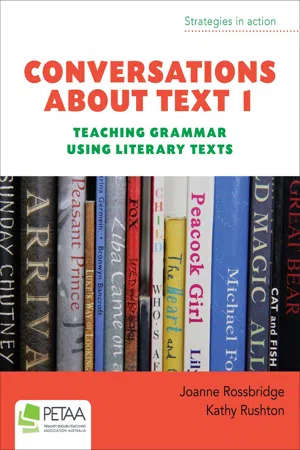
Conversations About Text 1: Teaching Grammar using Literary Texts focuses on teaching grammar in the context of literary texts in the primary school and middle years. Common issues are addressed, specifically in the area of teaching grammar and how these relate to both learning to use language and learning about language. Throughout the book, classroom practitioners share their strategies, programs and units of work that demonstrate how to work with literary texts.
eBook - ePub
Conversations aboutext 1
Teaching grammar using literary texts
- English
- ePUB (mobile friendly)
- Available on iOS & Android
eBook - ePub
About this book
Information
Topic
EducationSubtopic
Education GeneralChapter One
Introduction
Why grammar?
Knowledge about grammar is knowledge about the building blocks of language. We have written this book in response to the needs we, and the teachers we have worked with, have identified over the last decade for a practical text-based approach to the teaching of grammar. In each chapter, that follows, teachers share their experiences of teaching a grammatical feature within the context of teaching about literature. The focus of this book is therefore on teaching grammar in the context of literary texts in the primary and middle years. We concentrate on the teaching of literary texts as the context in which grammar is taught to support meaning. Knowledge about grammar is only useful if students use it to read and write, and recognise how authors, including themselves, can use language to make meaning.
As a result of the NAPLAN, BST and ELLA tests many teachers have recognised the need to learn more about the grammatical features of texts. Familiarity with grammar is essential when using language for a range of purposes and audiences as this knowledge supports appropriate choices. Grammatical knowledge supports students to develop reading and writing in all curriculum areas. (Rushton, 2002)
This is the rationale for a grammar course, 'Grammar and Teaching’, which we have taught for the NSW Department of Education and Training and which has now run for eight consecutive years since 2002. With over 200 teachers participating, we have met and worked with some outstanding teachers whose work appears in this book. Many of the teachers who have successfully completed the course were and are leaders in their schools and many had completed courses in grammar as part of their preservice training. The need that they and other teachers have identified for knowledge about grammar has not diminished over the years, even when grammar is being taught as part of preservice training. Indeed the development of national benchmarking through NAPLAN and of the new national curriculum will ensure that the need will expand as teachers all over Australia will become familiar with the NAPLAN criteria and the implications for teaching. We have worked as ESL teachers and consultants in classrooms, since the last century (!) but there is still a growing need for support in implementation rather than an understanding of basics.
While our aim is not to focus on the basics, many teachers do need to review or address grammar for the first time. The two texts which we use and recommend are A grammar Companion by Beverley Derewianka and Grammar and Meaning by Louise Droga and Sally Humphrey. The former provides very useful lists which can be used as the basis of classroom charts and the latter has the extra bonus of providing examples with answers. The authors of these useful texts are experienced academics and educators who have described the features we refer to in this book in an easy-to-read fashion with references to texts that real students have written as well as the texts they will be reading in primary school. Some of the teachers presenting their work in this book are graduates of our grammar course and others have taught themselves using these recommended grammar books. In either case we are very happy to bring the work of these outstanding teachers to a wider audience.
What's the difference between talking and writing and where does reading fit in?
Recognising how language develops and especially understanding the difference between spoken and written language can really help teachers and their students.
The written language presents a SYNOPTIC view. It defines its universe as product rather than as process. Whether we are talking about a triangle, the layout of a house, or the organization of a society, the written language encodes it as a structure or, alternatively, as a chaos – but either way, as a thing that exists. In principle we can freeze it, attend to it, and take it in as a whole. The cost of this perspective may be some simplifying of the relationship among its parts, and a lesser interest in how it got the way it is, or in where it is going next. (Halliday, 1985:97)
If teachers are easily able to identify the building blocks of language such as verbal groups, noun groups and the phrases and clauses that can add more meaning to the verb or noun, they are better able to help students deconstruct texts they are reading or writing. The ability to identify and recognise the building blocks of written language forms the basis of both comprehending and responding to texts verbally and in writing. Writing is defined by its lexical density and lexical items are often called 'content words', as opposed to spoken language which is more grammatically intricate. Grammatical items being those words that link the lexical items in oral and written language. The fact that in oral language we usually present phenomena in a continuous flow, rather than crafting lexically dense utterances, is very apparent when young students write. Students will often produce unpunctuated texts which recount a series of events, featuring material processes/action verbs like went, played and relational processes like was, has and joined by simple conjunctions like and or then. Exemplified by the very familiar – We went to the park. We played on the swings. We had fun and then we went home.
As the concept of the sentence belongs to the written not oral form of our language, understanding the way language is grouped within the sentence, the clause pattern, is the basis of understanding how to manipulate language and how to move from more spoken to more written forms by building complex noun groups (Rossbridge, 2008) and utilising a range of verbal groups. Teaching about grammar should always be in the context of developing skills and understandings about reading or writing. From this it will be made clear that there is a need to develop a metalanguage, the language used to talk about language, for both teachers and students in order for expectations to be reached for learning to use language and learning about language.
Pedagogy and the relationship between talking/listening, reading and writing
Understanding that spoken and written language have different characteristics but that each occurs in a particular context to achieve a purpose, can influence pedagogical choices teachers make in their classrooms. This becomes apparent as teachers share their practices in the chapters that follow.
Principles surrounding the teaching of grammar will include:
• focusing on language in the context of texts
• using grammatical understandings to assist students to both engage with and produce meaning from texts
• explicit use of a metalanguage shared by teachers and students when discussing grammatical choices
• creating space for students to talk about language.
In viewing grammar as a resource or tool for making and discussing meanings there is more likelihood that meanings will be considered across levels of text rather than only at a word or sentence level with more avenues for discussion and critical reflection on language occurring. Viewing grammar as a tool as opposed to a description of rules impacts upon how it is taught, the way it is talked about and even who does the talking in the classroom.
The role of talking and listening in the classroom is twofold in that we need to use student language as a resource but also use the mode of oral communication to 'talk' about language choices, in order to move students along the continuum from spoken to written language. The spoken language students bring to school is very valuable as it represents not only their language skills but also their background experiences (Gibbons, 2002). The creation of many 'talk' opportunities for both talk as process and talk as reflection (Jones, 1996) provides students with contexts for using both 'spoken-like' and 'written-like' language. If this is coupled with explicit discussion using knowledge about language and associated metalanguage to make students conscious of language as a resource for making meaning then explicit teaching occurs.
Throughout the teaching examples within the following chapters talk will be a dominant feature in regards to 'how to teach'. The result is collaborative classrooms where students have several opportunities to reflect and reuse language in varying contexts (Dufficy, 2005 and Gibbons, 2002). The talk around literary texts and their meanings using a metalanguage for describing language choices results in a deeper understanding of literature and also the development of a language to reflect on students' own choices, be they spoken or written.
In using the metaphor of scaffolding (Hammond, 2001) a relationship between language, learning and thinking exists. In supporting students, classrooms are alive with 'talk' by both teachers and students as the construction of meaning is constantly negotiated. The implication is that classrooms are learning environments rich in metalanguage, substantive communication and higher order thinking and other elements of quality teaching frameworks as teachers and students delve into the meanings in texts.
In seeing language as a system in which meanings are socially constructed, it is clear that there is an interrelationship between the skills of talking, listening, reading and writing. The use of oral language is critical in the development of written language. The use of oral language gives students a way in to talk about language use and meanings in texts before producing their own meanings through written text. Again, good models of literature need to prevail as they not only provide models of language use but also ideas, taking students beyond their own experiences and giving insight into cultures and values at particular points in time.
Getting the message across: learning how to play with language for a range of audiences and purposes
By learning how language works for different purposes with different audiences in various positions of power, grammar can be seen as a network of interrelated systems (Lock, 1996) across all modes of communication including spoken, written, visual and multimedia (Unsworth, 2001).
In basing conversations about texts on a functional model of language (Halliday, 1985) and a sociocultural approach to teaching (Dufficy, 2005) the tools for talking about grammar move far beyond knowing and identifying nouns, verbs and adverbs. Suddenly we have a range of options for talking about the choices writers and speakers make in relation to their purposes. We can start to consider three simultaneous meanings that occur in texts. In asking the following questions we can look at the constituents in clauses across texts and how they make meaning:
What is the text about?
The noun groups/participants, verbal groups/processes and adverbials/ circumstances will tell us about who or what is involved in the actions and under what circumstances.
What is the relationship between the reader and writer or listener and speaker?
The use of features including various clause types, personal pronouns to address the reader and modality assist in establishing a particular relationship between the writer/speaker and reader/listener.
How is the text organised as a whole?
The use of cohesive devices including pronoun reference, lexical items, repetition, synonyms and antonyms will ensure a text 'hangs' together well. Theme of clause can also be considered as what comes at the beginning of the clauses serves to alert the reader to key aspects of the overall text organisation.
As students and teachers develop a metalanguage for discussing how meanings are achieved they can then start to 'play' with features in their own texts. We can use this understanding about choices made by students when writing texts, either jointly or independently. This is particularly useful when editing and reworking texts as the discussion can centre around the language choices and how appropriate they are, considering the broad context, the purpose of the text and the needs of the audience. If students were to write a text for students of their own age the choices would differ to those if the audience was significantly younger. Similarly the familiarity of the audience with the content of the text would also influence the choices of the writer or speaker. Consequently when conversing with students it is critical that we are always explicit about the purpose of the text and the target audience. This is of particular importance when considering literary texts as the dominant purpose tends to be to entertain and engage the reader and it is drawing upon the grammatical tools or resources that assist in doing so. In saying this, it is important that such features are clearly modeled through the use of quality literature and that the choice of texts motivates and engages students whilst encouraging participation in higher order thinking (Pantaleo, 2009).
Once upon a time – Telling, understanding and responding to stories
Engaging young students in reading is vital as poor and unmotivated readers spend less time reading as they grow older and therefore compound the problem (Lokan, 2001; Stanovich, 1986). In The Programme for International Student Assessment (PISA) report (2000) Lokan has noted a correlation between engagement in reading and literacy achievement:
The engagement with reading scale was significantly related to reading literacy achievement. With a measure of attitudes, it is usually not possible to disentangle whether positive attitudes lead to better performance, or the other way around, or a mixture of both. Efforts to raise students' appreciation of books and motivation to spend time reading should surely be of benefit, irrespective of which of them causes the other. (Lokan, 2001:xi)
Teachers therefore need to be able to read and analyse quality children's literature that will engage young readers and provide a model and a stimulus for writing from word to text level. Quality children's literature can support students to learn about how authors play with literary genres, language, images and words (Gleeson, 2007).
The teacher needs to be familiar with the building blocks of language so that students can be supported to manipulate them in the creative process of responding to a text. A response to a text can be written or oral, and it can and should include the visual and dramatic arts: students should sing, dance, act, paint ... and express themselves!
If quality children's literature is used there will be layers of meaning and complexities to be explored at all levels of the text from word level to text level from vocabulary to genre. A range of strategies for understanding character development and the relationships between plot, setting and character can be employed to engage students in solving the puzzles set by the author. Metaphor and symbolism also provide challenging ideas for students to engage with in activities like Readers' Theatre (Hertzberg, 2009), drama (Ewing and Simons, 2004) or literature circles (Day, 2003).
Teaching about grammar in this context helps to develop higher order thinking as it provides a problem for students to solve. It also develops substantive communication and the use of metalanguage by encouraging students to discuss how the author has engaged the reader.
Reading and writing narratives and responses to texts
Literary texts encompass a range of different texts written for a range of purposes. They are often found in the English domain within the school context but can cross into a number of other learning areas. Culturally, literary texts are highly valued as they are symptomatic of the values, attitudes and beliefs of the culture or subculture in which they are produced. This is evident in the draft of the Australian Curriculum (ACARA, 2010) in which literature is highlighted as one of the three interrelated strands with a variety of literary texts identified including narrative, drama, poetry and literary recounts. For students it is important that we can distinguish between each and the use of grammar provides us with the tools for doing so.
When reading literary texts responses can include not only literal and inferential meanings but also a critical response regarding the viewpoint of the author. Using grammar as a tool gives students access to the range of potential meanings in texts. For example, an author's view about particular groups can be considered by looking at which character/s perform the actions in texts or have actions done to them. For instance, in many traditional tales a female character may be mainly described while the male characters undertake the acting, thinking, saying and feeling. This can be seen through the relationship between the actors represented by the noun group and the actions represented by the verbal groups/processes. Thus, we can see that in looking at the language features in texts we can start to talk explicitly about literary elements such as plot, character and theme employing skills such as interpreting, appreciating and evaluating.
When we teach students to write literary texts we may focus on typical stages such as orientation, complication and resolution as in the case of narrative. Often students are quite comfortable in stating the text structure of typical text types however it is also important to move above the level of text structure and clearly consider the purpose and audience of the text whilst also moving below the level of text structure to consider the choices constructed at the group and clause level and how these relate to the purpose of the text. Again in the case of narrative we might see a focus on extended noun groups to describe characters in the orientation stage of a text with a greater focus on events and their circumstances during the complication stage as characters ne...
Table of contents
- Cover Page
- Copyright
- Contents
- Acknowledgements
- 1 Introduction
- 2 The Verbal Group
- 3 The Noun Group
- 4 Other Elements of the Clause-Adverbials and Theme
- 5 Sentence Structure
- 6 Theme and Narrative Structure
- 7 Nominalisation and Active/Passive Voice
- 8 Grammatical Knowledge to Respond to Whole Texts – Cohesion
- Bibliography
Trusted by 375,005 students
Access to over 1.5 million titles for a fair monthly price.
Study more efficiently using our study tools.
Frequently asked questions
Yes, you can cancel anytime from the Subscription tab in your account settings on the Perlego website. Your subscription will stay active until the end of your current billing period. Learn how to cancel your subscription
No, books cannot be downloaded as external files, such as PDFs, for use outside of Perlego. However, you can download books within the Perlego app for offline reading on mobile or tablet. Learn how to download books offline
Perlego offers two plans: Essential and Complete
- Essential is ideal for learners and professionals who enjoy exploring a wide range of subjects. Access the Essential Library with 800,000+ trusted titles and best-sellers across business, personal growth, and the humanities. Includes unlimited reading time and Standard Read Aloud voice.
- Complete: Perfect for advanced learners and researchers needing full, unrestricted access. Unlock 1.5M+ books across hundreds of subjects, including academic and specialized titles. The Complete Plan also includes advanced features like Premium Read Aloud and Research Assistant.
We are an online textbook subscription service, where you can get access to an entire online library for less than the price of a single book per month. With over 1.5 million books across 990+ topics, we’ve got you covered! Learn about our mission
Look out for the read-aloud symbol on your next book to see if you can listen to it. The read-aloud tool reads text aloud for you, highlighting the text as it is being read. You can pause it, speed it up and slow it down. Learn more about Read Aloud
Yes! You can use the Perlego app on both iOS and Android devices to read anytime, anywhere — even offline. Perfect for commutes or when you’re on the go.
Please note we cannot support devices running on iOS 13 and Android 7 or earlier. Learn more about using the app
Please note we cannot support devices running on iOS 13 and Android 7 or earlier. Learn more about using the app
Yes, you can access Conversations aboutext 1 by Joanne Rossbridge,Kathy Rushton in PDF and/or ePUB format, as well as other popular books in Education & Education General. We have over 1.5 million books available in our catalogue for you to explore.