This book draws on research and theory, as well as classroom examples, to explain how to teach primary school students with diverse needs to use multiple strategies to spell. The work is linked to the Australian Curriculum: English and also includes the assessment of spelling. A valuable resource for primary and pre-service teachers for understandings, based on research and theory, which will help them choose and use appropriate pedagogical strategies (also provided in the book) to teach spelling to children with diverse needs, including children from EAL/D backgrounds and those with difficulties and disabilities that impact on spelling.
- English
- ePUB (mobile friendly)
- Available on iOS & Android
eBook - ePub
A closer look at spelling in the primary classroom
About this book
Information
Topic
EducationSubtopic
Education General1
Foundations and theories of spelling development
This book takes a closer look at spelling, the teaching and learning of which is considerably more complex than is often assumed. Research indicates that the ability to spell does not develop naturally through immersion in writing and reading experiences (Farrall, 2012), nor can it be effectively acquired through the rote learning of words. In order to spell well, children need to learn how to strategically use knowledge about phonology, orthography, morphology and etymology. It is also a visual activity that involves the laying down and retrieval of visual representations of words and word parts in the memory. Children also need to learn how to use the metalanguage associated with spelling – words like phoneme, syllable, affixes and morpheme – as this will help them talk and think about spelling strategies. Thus, spelling is a language activity and also a thinking activity. Ideally, it should also be a meaningful activity that is engaged in with a positive attitude.
It would be impossible to learn how to spell every word in the English language separately through memorisation, so children need to learn how the spelling system works and how to make generalisations, and this is best done when integrated with the teaching of phonological awareness, phonics, word study, vocabulary, writing and reading. It takes time to learn how to spell, but good spellers gradually develop automaticity or fluency in spelling high-frequency and known words, which allows them to dedicate their attention to the higher level cognitive processes involved in writing.
In this book we draw on the theoretical and research literature, as well as classroom examples, to explain how to teach primary school-aged children to use multiple strategies to spell. We also consider the assessment of spelling, as well as how to assist those who have difficulties in learning to spell. In doing this, we question the notion that spelling always develops in a predictable, hierarchical sequence, starting with the use of phonology (sounds), through to the use of morphology and etymology (word meanings and origins).
Evidence-based teaching of spelling
Teachers are often asked to use evidence-based approaches in their teaching. In this book, we review what the research says about the teaching of spelling. This research constitutes one important form of evidence, which will help teachers develop sound rationales for their teaching of spelling, and will help them make informed decisions in their day-to-day and moment-by-moment teaching of spelling. We also stress the importance of using assessment data as a form of evidence to enable teachers to accurately target their spelling instruction. As this book is limited in scope and compact in size, we are unable to go into great depth in a number of areas. For this reason, we have provided a comprehensive list of references at the end of the book, that readers can refer to if they wish to learn more about any of the areas discussed.
Does spelling still matter?
Like other elements of literacy, spelling can be seen as a socio-cultural practice (Oakley, 2005). Children need to know that good spelling is a social expectation and a means of clear communication. Good spelling is often regarded as an indicator of people’s intelligence and academic ability. The findings of research by Figueredo and Varnhagen (2005) indicate that spelling errors negatively affect readers’ perceptions of a writer’s ability and of the quality of the writing. Furthermore, there appears to be a public perception that spelling standards in Australia (and in many other English speaking countries) are too low and perhaps even declining, and this is reflected in newspaper headlines such as those shown in Figure 1.1. NAPLAN results from 2014 indicate that, indeed, many Australian students do not meet the minimum standard in spelling. The results from both Years 3 and 5 indicate that 7.3 per cent of children in Australia were below the (low) minimum standard. This means that many thousands of children are struggling. NAPLAN data shows that Aboriginal children and children in non-metropolitan areas are more likely to be below the minimum standard, as are the children of less educated parents. (See the following website for the full report <http://www.nap.edu.au/verve/_resources/National_Assessment_Program_Literacy_and_Numeracy_national_report_for_2014.pdf>).
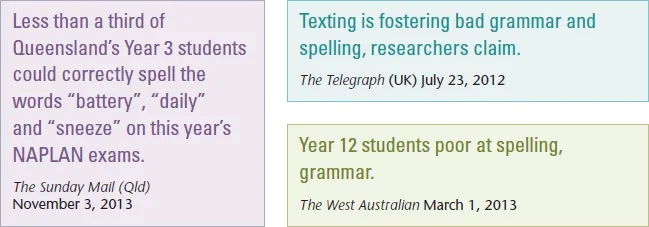
Figure 1.1
Newspaper headlines about poor spelling standards
Not only is a person’s ability to spell used as an indicator of their intelligence, academic ability, credibility, work ethic and attention to detail, but it also impacts negatively on the quality of their written expression. If the spelling is poor the person’s writing is likely to be less comprehensible and accurate. In addition, learning how to spell facilitates the learning of vocabulary and reading (Vellutino, Tunmer, Jaccard & Chen, 2007) as all of these components of literacy share similar foundational knowledge. So, contrary to some arguments, children do still need to learn to spell, and technological tools such as spellcheckers and predictive text tools have not yet removed this necessity. These issues are elaborated further in this chapter.
Quality of written expression
As already noted, accurate spelling is an important aspect of writing because written text is more difficult to comprehend when it contains words that are misspelt. Furthermore, the inability of people to spell certain words can lead to them avoiding the use of these words in their writing, thus limiting their writing vocabulary to words that they know how to spell – and this can make their writing uninteresting and lacking in precision. Moreover, when writers have to apply too much cognitive effort to determine the spelling of words, their ability to create clear, creative and coherent texts is hindered; the need to think too hard about spelling means less attention can be paid to other (higher order) processes of writing (Graham & Santangelo, 2014). Research findings by Graham, Harris and Chorzempa (2002) indicate a link between learning to spell and the development of other aspects of writing competency. In their study, additional spelling instruction resulted in greater progress in sentence-writing skills and text production. This may be because greater spelling fluency reduces cognitive load (Sweller, 1988) when composing texts.
Worryingly, difficulties in mastering spelling skills may lead young children to shun writing and develop a fixed mindset that they cannot write, resulting in obstructed writing development (Graham, Harris & Chorzempa, 2002). This leads to difficulties in communicating knowledge in a range of curriculum areas and in out-of-school situations.
Learning to read
Research provides evidence of the link between learning to spell and enhanced reading ability (Conrad, 2008; Ehri, 2000 cited in Moats, 2005; Graham, Harris & Chorzempa, 2002; Hook & Jones, 2002). Many aspects of reading development rely on the same underlying linguistic knowledge and cognitive processes as spelling. In learning to spell, students develop their knowledge and memory of letter–sound relationships and of the orthographic patterns that comprise written words. They rely on the same knowledge for decoding and word recognition when reading. The ability to efficiently associate sounds with letters and clusters of letters leads to rapid and accurate identification of words. Word recognition also requires the ability to break words down by units of meaning (morphemes – base and root words, prefixes, suffixes, etc.), an ability that is part of the development of morphemic knowledge when learning to spell. Other areas of learning to spell that are important to the reading skills of decoding and word re...
Table of contents
- Cover
- Title
- Copyright
- Contents
- Acknowledgements
- 1. Foundations and theories of spelling development
- 2. Meaningful and differentiated spelling instruction
- 3. Learning to spell – the beginnings
- 4. Towards spelling competency and fluency
- 5. Assessment of spelling
- 6. Students who have additional needs in spelling
- Appendix – Spelling rules
- References
- Website references
Trusted by 375,005 students
Access to over 1.5 million titles for a fair monthly price.
Study more efficiently using our study tools.
Frequently asked questions
Yes, you can cancel anytime from the Subscription tab in your account settings on the Perlego website. Your subscription will stay active until the end of your current billing period. Learn how to cancel your subscription
No, books cannot be downloaded as external files, such as PDFs, for use outside of Perlego. However, you can download books within the Perlego app for offline reading on mobile or tablet. Learn how to download books offline
Perlego offers two plans: Essential and Complete
- Essential is ideal for learners and professionals who enjoy exploring a wide range of subjects. Access the Essential Library with 800,000+ trusted titles and best-sellers across business, personal growth, and the humanities. Includes unlimited reading time and Standard Read Aloud voice.
- Complete: Perfect for advanced learners and researchers needing full, unrestricted access. Unlock 1.5M+ books across hundreds of subjects, including academic and specialized titles. The Complete Plan also includes advanced features like Premium Read Aloud and Research Assistant.
We are an online textbook subscription service, where you can get access to an entire online library for less than the price of a single book per month. With over 1.5 million books across 990+ topics, we’ve got you covered! Learn about our mission
Look out for the read-aloud symbol on your next book to see if you can listen to it. The read-aloud tool reads text aloud for you, highlighting the text as it is being read. You can pause it, speed it up and slow it down. Learn more about Read Aloud
Yes! You can use the Perlego app on both iOS and Android devices to read anytime, anywhere — even offline. Perfect for commutes or when you’re on the go.
Please note we cannot support devices running on iOS 13 and Android 7 or earlier. Learn more about using the app
Please note we cannot support devices running on iOS 13 and Android 7 or earlier. Learn more about using the app
Yes, you can access A closer look at spelling in the primary classroom by Grace Oakley,Janet Fellowes in PDF and/or ePUB format, as well as other popular books in Education & Education General. We have over 1.5 million books available in our catalogue for you to explore.