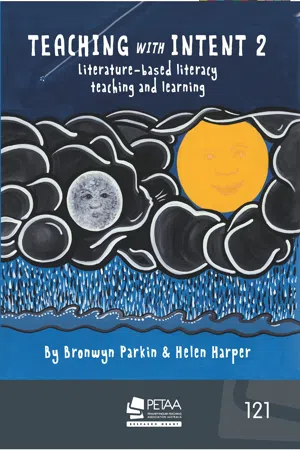
The prize winning Teaching with Intent 2: Literature-based literacy teaching and learning is the second of two books produced as a product of a PETAA Research Grant.'Why another book about literacy pedagogy? Because now, more than ever, we need to be inclusive of all students: we need to draw in those students at risk of being relegated to the margins of classrooms and of learning. And we need to do this in a way that is authentic to ourselves as teachers, communicating our joy of literature, of reading, writing and telling stories.'With many students falling behind their peers, struggling to decode and draw inferential meanings from text, Teaching with Intent 2 describes a highly effective approach to teaching language and literacy that's anchored in storytelling. Parkin and Harper developed their version of this literature-based program over years of professional practice in the classroom with marginalised students.It involves a sequence of pedagogic strategies that allow teachers to carefully build their students' knowledge about text, language, reading and writing — thoroughly explained in this book, with practical guidance to help you apply the ideas successfully in your own classroom.
- English
- ePUB (mobile friendly)
- Available on iOS & Android
eBook - ePub
About this book
Information
Topic
ÉducationSubtopic
Éducation généralePART 1
INTRODUCTION
CHAPTER 1 | Theory and purpose | 2 |
CHAPTER 2 | Text selection | 8 |
CHAPTER 3 | Text analysis | 16 |
CHAPTER 1
Theory and purpose
Narrative is a key genre to explore in building students’ literacy. The approach we present in this book is literature-based, with teaching and learning activities centred on one example of quality literature for a period of time, from a few weeks to a term. While it is necessary to look at many other text genres throughout schooling, working with quality narratives is an important first step and a bridge to other kinds of writing – particularly for marginalised students, who need explicit instruction in how texts work, and for students with little confidence in composing written text.
Quality children’s stories engage the reader at an interpersonal, emotional and sensory level. They invite the reader to make personal connections with people and events: with characters, settings and plots. It can be much easier to get emotional buy-in from students through a good story than it would be through, say, a text about geography or about the structure of the Australian government. Even when students are not able to decode text independently, they can identify with the universal human emotions represented through text and illustrations, which helps them access meanings more easily. The emotional response is a hook to reading in general and an important entry point into future academic reading.
We can also draw on our awareness of readers’ emotional responses as we build writing skills. Learning the technical tricks that writers use to pull their readers into the narrative helps students to gain interest in the writer’s skill. Reluctant writers can enjoy and develop confidence in writing creatively for effect, for example by creating suspense, describing nasty (or likeable) characters, or by building settings that evoke particular feelings in the reader. Learning about how writers choose words to create these effects gives students access to the satisfying meanings that are available to literate people when they engage with literature.
Certainly, as students move through their schooling, the various curriculum areas require students to use more analytic and expository genres. These need to be taught independently of narrative. But the rich language of quality narrative texts provides a bridge to more academic English, offering resources for studying complex grammatical patterns, expanded vocabulary and stylistic resources. The language in good narrative texts tends to sit somewhere between everyday spoken language and abstract scientific or academic language. Although the grammars in literature are not identical to the grammars of scientific and other factual texts, they serve to help students build the repertoire they will need for purposeful written communication across the academic disciplines.
The literature-based literacy teaching and learning sequence (or teaching sequence) presented in this book is a version, and a continuation, of the text-based scaffolding approaches to teaching language and literacy that have been developed over the past 40 to 50 years, largely in Australian settings (Derewianka & Jones, 2016; Hammond & Gibbons, 2005; Rose, 2016; Rose & Martin, 2012). Our version is developed from the Accelerated Literacy program, formerly known as Scaffolding Literacy, which was developed by Brian Gray and Wendy Cowey at the Schools and Community Centre at the University of Canberra (Gray, Cowey, & Axford, 2003).
The Accelerated Literacy program is a literature-based approach that began as an initiative to support literacy education for marginalised learners. Initially the program focused on developing the literacy skills of Aboriginal students in remote schools, and it was later implemented in low socio-economic schools with disadvantaged students in most Australian states (Cowey, 2005; Gray, 2007). Since then it has been used widely and effectively in mainstream schools, and is appropriate for students at all levels of ability.
One of the strengths of this program, over its many iterations, has been the ongoing reflexive and respectful collaboration between practitioners and researchers. As teachers and authors, we see ourselves straddling both these roles. This book builds on a version of the Accelerated Literacy approach that’s a product of our own practice, experience and research.
THE ELEMENTS OF OUR APPROACH
We are teaching literate language
The teaching sequence requires us to think carefully about the language resources in the text we are studying. And the knowledge about language that we draw on comes from systemic functional linguistics (Halliday, 1975; Halliday & Matthiessen, 2004). It is the same linguistic framework that informs the Australian Curriculum: English.
One of the key insights we take from systemic functional linguistics is that the language of written texts differs significantly from everyday spoken language. Through the teaching sequence we can work systematically to build new language for students, drawing on the literate language of text and working from familiar oral language to the less familiar written forms. We want all students to be able to tune into the particular ways of thinking about experience and representing experience that are inherent in written texts.
Ultimately our goal is to help students read, comprehend and write using this literate language. We need to make knowledge about language explicit, including knowledge about the purposes of writing stories (for example, to entertain the reader), and knowledge about grammar and vocabulary that is different from ways of speaking (Gibbons, 2015; Gray, 2007; Martin, 2013; M. J. Schleppegrell, 2004).
The teaching sequence creates a macro-scaffold
Developing students’ academic language proficiency means helping them build knowledge about language and text cumulatively, over time (R. Alexander, 2017; Martin & Maton, 2013; Schleppegrell & O’Hallaron, 2011). Throughout this process the teaching sequence is an overarching structure of support. This support or ‘scaffolding’ operates, first, at the macro level of planning for the intentional, purposeful sequencing of tasks and lessons (Hammond & Gibbons, 2005; Parkin & Harper, 2018).
The teaching sequence, or macro-scaffold, is a ‘designed-in’ format that supports teachers and students to track where they’ve been and where they’re going (Derewianka & Jones, 2016; Hammond, 2001). The predictable format is like a map of the learning: beginning with a text orientation (that is an invitation to all to engage with the story), reading the text together, examining the structures and intentions of the author’s language choices, and then applying that knowledge to writing.
Learning is a shared responsibility
The teaching sequence is built on the assumption that learning is a shared responsibility between teacher and students. This idea derives from the thinking of Lev Vygotsky and sociocultural theorists, that in order to learn children need the support of a ‘culturally informed other’ (Rogoff & Wertsch, 1984; Vygotsky, 1986; Wertsch, 1985b; Wood, Bruner, & Ross, 1976). In this view, thinking doesn’t belong to the individual, but is shared among members of a community.
In our case, as teachers of language and literacy, we share the thinking of people who are experienced at reading literature. It is our responsibility as the ‘know...
Table of contents
- Cover
- Title Page
- Copyright
- Contents
- Foreword
- Acknowledgements
- PART 1: Introduction
- Part 2: The teaching and learning sequence
- PART 3: Consolidation and Transfer
- APPENDIX 1: Text analysis template
- APPENDIX 2: Spelling record template
- APPENDIX 3: Focus passage planner
- References
- Index
- Back cover
Trusted by 375,005 students
Access to over 1.5 million titles for a fair monthly price.
Study more efficiently using our study tools.
Frequently asked questions
Yes, you can cancel anytime from the Subscription tab in your account settings on the Perlego website. Your subscription will stay active until the end of your current billing period. Learn how to cancel your subscription
No, books cannot be downloaded as external files, such as PDFs, for use outside of Perlego. However, you can download books within the Perlego app for offline reading on mobile or tablet. Learn how to download books offline
Perlego offers two plans: Essential and Complete
- Essential is ideal for learners and professionals who enjoy exploring a wide range of subjects. Access the Essential Library with 800,000+ trusted titles and best-sellers across business, personal growth, and the humanities. Includes unlimited reading time and Standard Read Aloud voice.
- Complete: Perfect for advanced learners and researchers needing full, unrestricted access. Unlock 1.5M+ books across hundreds of subjects, including academic and specialized titles. The Complete Plan also includes advanced features like Premium Read Aloud and Research Assistant.
We are an online textbook subscription service, where you can get access to an entire online library for less than the price of a single book per month. With over 1.5 million books across 990+ topics, we’ve got you covered! Learn about our mission
Look out for the read-aloud symbol on your next book to see if you can listen to it. The read-aloud tool reads text aloud for you, highlighting the text as it is being read. You can pause it, speed it up and slow it down. Learn more about Read Aloud
Yes! You can use the Perlego app on both iOS and Android devices to read anytime, anywhere — even offline. Perfect for commutes or when you’re on the go.
Please note we cannot support devices running on iOS 13 and Android 7 or earlier. Learn more about using the app
Please note we cannot support devices running on iOS 13 and Android 7 or earlier. Learn more about using the app
Yes, you can access Teaching with intent 2 by Bronwyn Parkin,Helen Harper in PDF and/or ePUB format, as well as other popular books in Éducation & Éducation générale. We have over 1.5 million books available in our catalogue for you to explore.