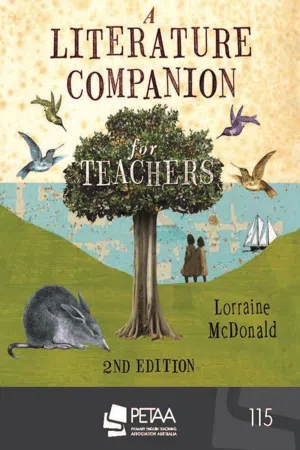
The enriched revision and update of Lorraine McDonald's best selling title includes up-to-date Australian Curriculum links and coverage along with new research, a new chapter on evaluating literary texts, and much more.Nonfiction texts have been added as examples of quality mentor texts, along with updated examples where appropriate of narratives and picture books.
TheAustralian Curriculum: Englishdefines literature this way:
The term ‘literature’ includes literary texts from across a range of historical and cultural contexts thatare valued for their form and style and are recognised as having enduring or artistic value. While the nature of what constitutes literary texts is dynamic and evolving, they are seen as having personal, social, cultural and aesthetic value and potential for enriching students’ scope of experience.
The appreciation of literature, Key ideas, Australian Curriculum: English
THE VALUE OF NARRATIVE
Literature and narrative hold privileged positions in our educational culture. That narrative is ‘a primary act of mind’ is a well-known observation (Hardy, 1977). It is through narratives, Hardy argues, that we live our lives: ‘For we dream in narrative, daydream in narrative … we make up stories about ourselves and others, about the personal as well as the social past and future’ (p. 13). Hardy contends that narrative is the core of our lived experience, as our human way of knowing who we are (see also Arizpe, Farrell & McAdam, 2013).
The French literary theorist and philosopher Roland Barthes affirms the primacy of narrative this way:
Narrative is present in myth, legend, fable, tale, novella, epic, history, tragedy, drama, comedy, mime, painting, … stained glass windows, cinema, comics, news items, conversation … Narrative is present in every age, every place, every society; it begins with the very history of mankind … it is simply there, like life itself …
Barthes, 1977, p. 79
Here, the narrative form is seen to permeate every aspect of our lives, in words, images and speech – and has been part of our nature since the beginning of human history.
Narrative re-imagines the world for young people and, in so doing, suggests ways of thinking about the attitudes, values and beliefs of the culture presented in the text. Clare Bradford, an Australian scholar of international renown, examines what kind of society, behaviours and attitudes our contemporary narratives are imagining for the future. Her studies (2007, 2008) reveal that many stories of race and immigration reproduce Anglocentric, colonial beliefs and attitudes, which become ‘naturalised’ and ‘normal’ ways of thinking in contemporary children’s literature. Narratives have the power to be subtle ‘game-changers’ in how the beliefs and attitudes they espouse contribute to the ways young people form their identities: teaching awareness of how narratives re-imagine the world is crucial to the way literature is approached for Australia’s future citizens.
Other Australian scholars such as Alyson Simpson have highlighted the need for students to be ‘excited about reading’, which encompasses much more than just ‘learning to read’ (2008, p. 6). She states, ‘the effect of … staged learning [as in reading programs] is that it kills enthusiasm for reading’ (2008, p. 6). Students need to choose and read a wide range of quality literary texts. When supported by an enthusiastic and knowledgeable adult, their learning and excitement will merge, as this is ‘how texts teach what readerslearn’ (Meek, 1988, p. 1). However, as Maureen Walsh reminds us, today’s digital technologies create ‘the challenge of maintaining students’ motivation to continue to read books and to engage in sustained reading of … literature’ (2011, p. 7).
In Australia, as in other Western nations, the narrative form is one of the text types that students learn to compose from a very early age, despite being the most complex for young people to write. The comparatively simple narrative structure students are asked to follow is intended to support developing writers to use language in imaginative ways. While the simple structure is evident in quality narrative/literary texts, it is somewhat reductive when equated to the nuanced complexities of an award-winning novel or picturebook for young people. When teachers share quality narratives with their students they offer models for what is possible so that together they can consider how the writing techniques and language use offers insights into what counts as a quality ‘story’.
It is not enough to simply teach children to read; we have to give them something worth reading. Something that will stretch their imaginations – something...
Table of contents
Cover
Title Page
Copyright Page
Dedication
Contents
Foreword
Acknowledgements
Part One: The Art and Craft of Literary Texts
Part Two: Creating Literary Texts
Part Three: Extending Literary Knowledge
References
Acknowledgements
Index
Trusted by 375,005 students
Access to over 1.5 million titles for a fair monthly price.
Study more efficiently using our study tools.
Frequently asked questions
Yes, you can cancel anytime from the Subscription tab in your account settings on the Perlego website. Your subscription will stay active until the end of your current billing period. Learn how to cancel your subscription
No, books cannot be downloaded as external files, such as PDFs, for use outside of Perlego. However, you can download books within the Perlego app for offline reading on mobile or tablet. Learn how to download books offline
Perlego offers two plans: Essential and Complete
Essential is ideal for learners and professionals who enjoy exploring a wide range of subjects. Access the Essential Library with 800,000+ trusted titles and best-sellers across business, personal growth, and the humanities. Includes unlimited reading time and Standard Read Aloud voice.
Complete: Perfect for advanced learners and researchers needing full, unrestricted access. Unlock 1.5M+ books across hundreds of subjects, including academic and specialized titles. The Complete Plan also includes advanced features like Premium Read Aloud and Research Assistant.
Both plans are available with monthly, semester, or annual billing cycles.
We are an online textbook subscription service, where you can get access to an entire online library for less than the price of a single book per month. With over 1.5 million books across 990+ topics, we’ve got you covered! Learn about our mission
Look out for the read-aloud symbol on your next book to see if you can listen to it. The read-aloud tool reads text aloud for you, highlighting the text as it is being read. You can pause it, speed it up and slow it down. Learn more about Read Aloud
Yes! You can use the Perlego app on both iOS and Android devices to read anytime, anywhere — even offline. Perfect for commutes or when you’re on the go. Please note we cannot support devices running on iOS 13 and Android 7 or earlier. Learn more about using the app
Yes, you can access A literature companion for teachers 2nd edition by Lorraine McDonald in PDF and/or ePUB format, as well as other popular books in Education & Education General. We have over 1.5 million books available in our catalogue for you to explore.