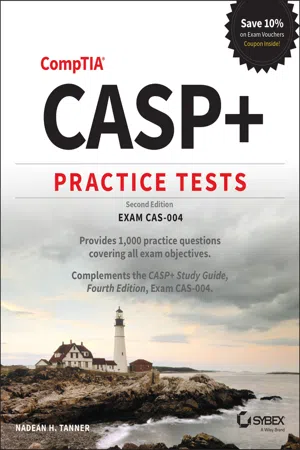
CASP+ CompTIA Advanced Security Practitioner Practice Tests
eBook - ePub

CASP+ CompTIA Advanced Security Practitioner Practice Tests

Exam CAS-004

  1. English
  2. ePUB (mobile friendly)
  3. Available on iOS & Android
eBook - ePub

CASP+ CompTIA Advanced Security Practitioner Practice Tests

Exam CAS-004

About this book

Prepare for success on the challenging CASP+ CAS-004 exam

Inthe newly updated Second Edition of CASP+ CompTIA Advanced Security Practitioner Practice Tests Exam CAS-004, accomplished cybersecurityexpertNadean Tannerdeliversan extensive collection of CASP+preparation materials, including hundreds of domain-by-domain test questions and two additional practice exams.

Prepare for the new CAS-004 exam, as well asa new career in advanced cybersecurity, with Sybex's proven approach tocertification success.You'll get ready for the exam, to impressyour next interviewer, and excel at your first cybersecurity job.

This book includes:

  • Comprehensive coverage of allexam CAS-004 objectivedomains, including security architecture, operations, engineering, cryptography, and governance, risk, and compliance
  • In-depthpreparation for test success with 1000 practice exam questions
  • Access to the Sybex interactive learning environment and online test bank

Perfect for anyone studying for the CASP+ Exam CAS-004, CASP+ CompTIA Advanced Security Practitioner Practice Tests Exam CAS-004 is also an ideal resource for anyone with IT security experience who seeks to brush up on their skillset or seek a valuable new CASP+ certification.

Frequently asked questions

Yes, you can cancel anytime from the Subscription tab in your account settings on the Perlego website. Your subscription will stay active until the end of your current billing period. Learn how to cancel your subscription.
No, books cannot be downloaded as external files, such as PDFs, for use outside of Perlego. However, you can download books within the Perlego app for offline reading on mobile or tablet. Learn more here.
Perlego offers two plans: Essential and Complete
  • Essential is ideal for learners and professionals who enjoy exploring a wide range of subjects. Access the Essential Library with 800,000+ trusted titles and best-sellers across business, personal growth, and the humanities. Includes unlimited reading time and Standard Read Aloud voice.
  • Complete: Perfect for advanced learners and researchers needing full, unrestricted access. Unlock 1.4M+ books across hundreds of subjects, including academic and specialized titles. The Complete Plan also includes advanced features like Premium Read Aloud and Research Assistant.
Both plans are available with monthly, semester, or annual billing cycles.
We are an online textbook subscription service, where you can get access to an entire online library for less than the price of a single book per month. With over 1 million books across 1000+ topics, we’ve got you covered! Learn more here.
Look out for the read-aloud symbol on your next book to see if you can listen to it. The read-aloud tool reads text aloud for you, highlighting the text as it is being read. You can pause it, speed it up and slow it down. Learn more here.
Yes! You can use the Perlego app on both iOS or Android devices to read anytime, anywhere — even offline. Perfect for commutes or when you’re on the go.
Please note we cannot support devices running on iOS 13 and Android 7 or earlier. Learn more about using the app.
Yes, you can access CASP+ CompTIA Advanced Security Practitioner Practice Tests by Nadean H. Tanner in PDF and/or ePUB format, as well as other popular books in Computer Science & Certification Guides in Computer Science. We have over one million books available in our catalogue for you to explore.

Chapter 1
Security Architecture

THE CASP+ EXAM TOPICS COVERED IN THIS CHAPTER INCLUDE:
  • Domain 1: Security Architecture
    • 1.1 Given a scenario, analyze the security requirements and objectives to ensure an appropriate, secure network architecture for a new or existing network.
      • Services
        • Load balancer
        • Intrusion detection system (IDS)/network intrusion detection system (NIDS)/wireless intrusion detection system (WIDS)
        • Intrusion prevention system (IPS)/network intrusion prevention system (NIPS)/wireless intrusion prevention system (WIPS)
        • Web application firewall (WAF)
        • Network access control (NAC)
        • Virtual private network (VPN)
        • Domain Name System Security Extensions (DNSSEC)
        • Firewall/unified threat management (UTM)/next-generation firewall (NGFW)
        • Network address translation (NAT) gateway
        • Internet gateway
        • Forward/transparent proxy
        • Reverse proxy
        • Distributed denial-of-service (DDoS) protection
        • Routers
        • Mail security
        • Application programming interface (API) gateway/Extensible Markup Language (XML) gateway
        • Traffic mirroring
        • Switched port analyzer (SPAN) ports
        • Port mirroring
        • Virtual private cloud (VPC)
        • Network tap
        • Sensors
        • Security information and event management (SIEM)
        • File integrity monitoring (FIM)
        • Simple Network Management Protocol (SNMP) traps
        • NetFlow
        • Data loss prevention (DLP)
        • Antivirus
      • Segmentation
        • Microsegmentation
        • Local area network (LAN)/virtual local area network (VLAN)
        • Jump box
        • Screened subnet
        • Data zones
        • Staging environments
        • Guest environments
        • VPC/virtual network (VNET)
        • Availability zone
        • NAC lists
        • Policies/security groups
        • Regions
        • Access control lists (ACLs)
        • Peer-to-peer
        • Air gap
      • Deperimeterization/zero trust
        • Cloud
        • Remote work
        • Mobile
        • Outsourcing and contracting
        • Wireless/radio frequency (RF) networks
      • Merging of networks from various organizations
        • Peering
        • Cloud to on premises
        • Data sensitivity levels
        • Mergers and acquisitions
        • Cross-domain
        • Federation
        • Directory services
      • Software-defined networking (SDN)
        • Open SDN
        • Hybrid SDN
        • SDN overlay
    • 1.2 Given a scenario, analyze the organizational requirements to determine the proper infrastructure security design.
      • Scalability
        • Vertically
        • Horizontally
      • Resiliency
        • High availability
        • Diversity/heterogeneity
        • Course of action orchestration
        • Distributed allocation
        • Redundancy
        • Replication
        • Clustering
      • Automation
        • Autoscaling
        • Security Orchestration, Automation and Response (SOAR)
        • Bootstrapping
      • Performance
      • Containerization
      • Virtualization
      • Content delivery network
      • Caching
    • 1.3 Given a scenario, integrate software applications securely into an enterprise architecture.
      • Baseline and templates
        • Secure design patterns/types of web technologies
        • Storage design patterns
        • Container APIs
        • Secure coding standards
        • Application vetting processes
        • API management
        • Middleware
      • Software assurance
        • Sandboxing/development environment
        • Validating third-party libraries
        • Defined DevOps pipeline
        • Code signing
        • Interactive application security testing (IAST) vs. dynamic application security testing (DAST) vs. static application security testing (SAST)
      • Considerations of integrating enterprise applications
        • Customer relationship management (CRM)
        • Enterprise resource planning (ERP)
        • Configuration management database (CMDB)
        • Content management system (CMS)
        • Integration enablers
        • Directory services
        • Domain name system (DNS)
        • Service-oriented architecture (SOA)
        • Enterprise service bus (ESB)
      • Integrating security into development life cycle
        • Formal methods
        • Requirements
        • Fielding
        • Insertions and upgrades
        • Disposal and reuse
        • Testing
        • Regression
        • Unit testing
        • Integration testing
        • Development approaches
        • SecDevOps
        • Agile
        • Waterfall
        • Spiral
        • Versioning
        • Continuous integration/continuous delivery (CI/CD) pipelines
        • Best practices
        • Open Web Application Security Project (OWASP)
        • Proper Hypertext Transfer Protocol (HTTP) headers
    • 1.4 Given a scenario, implement data security techniques for securing enterprise architecture.
      • Data loss prevention
        • Blocking use of external media
        • Print blocking
        • Remote Desktop Protocol (RDP) blocking
        • Clipboard privacy controls
        • Restricted virtual desktop infrastructure (VDI) implementation
        • Data classification blocking
      • Data loss detection
        • Watermarking
        • Digital rights management (DRM)
        • Network traffic decryption/deep packet inspection
        • Network traffic analysis
      • Data classification, labeling, and tagging
        • Metadata/attributes
      • Obfuscation
        • Tokenization
        • Scrubbing
        • Masking
      • Anonymization
      • Encrypted vs. unencrypted
      • Data life cycle
        • Create
        • Use
        • Share
        • Store
        • Archive
        • Destroy
      • Data inventory and mapping
      • Data integrity management
      • Data storage, backup, and recovery
        • Redundant array of inexpensive disks (RAID)
    • 1.5 Given a scenario, analyze the security requirements and objectives to provide the appropriate authentication and authorization controls.
      • Credential management
        • Password repository application
        • End-user password storage
        • On premises vs. cloud repository
        • Hardware ke...

Table of contents

  1. Cover
  2. Table of Contents
  3. Title Page
  4. Copyright
  5. Dedication
  6. Acknowledgments
  7. About the Author
  8. About the Technical Editor
  9. Introduction
  10. Chapter 1: Security Architecture
  11. Chapter 2: Security Operations
  12. Chapter 3: Security Engineering and Cryptography
  13. Chapter 4: Governance, Risk, and Compliance
  14. Chapter 5: Practice Test 1
  15. Chapter 6: Practice Test 2
  16. Appendix: Answers to Review Questions
  17. Index
  18. End User License Agreement