Bloomsbury World Englishes offers a comprehensive and rigorous description of the facts, implications and contentious issues regarding the forms and functions of English in the world. International experts cover a diverse range of varieties and topics, offering a more accurate understanding of English across the globe and the various social contexts in which it plays a significant role. With volumes dedicated to research paradigms, language ideologies and pedagogies, the collection pushes the boundaries of the field to go beyond traditional descriptive paradigms and contribute to moving research agendas forward.
Volume 1: Paradigms analyzes the ways in which we make sense of English as a global language, its many varieties and how these come into contact and interact with other languages. It moves the field beyond existing 'models' that are no longer sufficient to describe English(es) in the era of globalization.
eBook - ePub
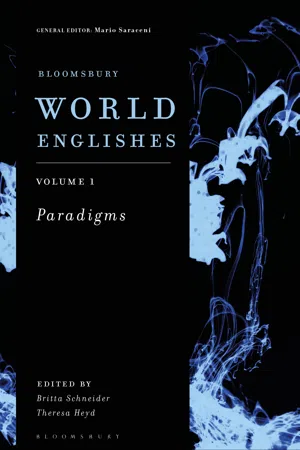
Bloomsbury World Englishes Volume 1: Paradigms
- 320 pages
- English
- ePUB (mobile friendly)
- Available on iOS & Android
eBook - ePub
Bloomsbury World Englishes Volume 1: Paradigms
About this book
Information
PART ONE
Reflecting Research Paradigms of World Englishes
Chapter 1
World Englishes
Approaches, Models and Methodology
Kingsley Bolton
1 Introduction
This chapter sets out to present an overview of the field of World Englishes (WE), as a field of academic research and publication, tracing the development of various approaches to World Englishes from the 1980s to the present, discussing various theoretical ‘models’ of approaches to the study of English worldwide, as well as commenting on the methodologies of WE researchers. In this context, the notion of ‘approach’ might be understood as referring to the general theoretical perspective adopted by a researcher or group of researchers in the field, whereas the term ‘model’ in linguistics might be broadly understood as referring to an abstract representation of a language or elements of a linguistic system. Since the 1980s, the World Englishes scholarship has succeeded in creating a paradigm shift in linguistics, thereby transforming English studies as an area of international research and scholarship. Before the 1980s, discussions of English worldwide usually highlighted a distinction between ‘native’ versus ‘non-native’ speakers, and employed terms such as ‘English as a Native Language’ (ENL), ‘English as a Second Language’ (ESL) and ‘English as a Foreign Language’ (EFL), in order to classify particular varieties of English. Since the early 1980s, however, ‘World Englishes’, with its inclusive plural, has increasingly become the standard term to refer to the study of varieties of English worldwide. Since the 1980s, many linguists worldwide have engaged with the study of ‘Englishes’ from a pluricentric perspective, as in ‘English languages’, ‘international Englishes’, ‘new Englishes’, ‘varieties of English’ and ‘World Englishes’. Of all these designations, the best-established term in the literature is ‘World Englishes’, and the last three decades have seen the rise of this discipline (or sub-discipline) in linguistics as a site for substantial scholarly research and publication. There are now a number of academic journals, including Asian Englishes, English Today, English World-Wide and World Englishes, devoted to this field, numerous book-length studies dealing with research in this area, as well as the International Association for World Englishes (IAWE), which regularly organizes international conferences in the United States and across the globe (Seargeant 2012).
2 Approaches to World Englishes
The term ‘World Englishes’ has both a narrower and wider application. The narrower application of the term refers to the approach to the study of English worldwide pioneered by Braj B. Kachru and a group of closely related scholars. The wider application of the concept also includes a wide range of other approaches including those of English studies, corpus linguistics, the sociology of language, features-based and dialectological studies, pidgin and creole research, ‘Kachruvian’ linguistics, lexicographical approaches, popular accounts, critical linguistics, futurological approaches as well as current work on English as a lingua franca (ELF). All these approaches are summarized in Table 1.1.
The English studies approach dates from the 1960s and the work of Randolph Quirk, and is associated with the Survey of English Usage at University College London, including David Crystal and Sidney Greenbaum. Their work in the UK was complemented by the efforts of a number of German scholars including Görlach (1995) and Schneider (2007), as well as research in the field of corpus linguistics, including work on the International Corpus of English (ICE) project (ICE 2019) and the Global Web-based English Corpus (GloWbE) (Davies and Fuchs 2015). Both the English studies approach and corpus linguistics also utilise a ‘features-based approach’, where salient features of Englishes at the levels of phonology, lexis and grammar are identified and described (Trudgill and Hannah [1982] 2013; Schneider et al. 2004; Kortmann et al. 2004); which in turn has influenced Schneider’s (2003, 2007) formulation of the Dynamic Model of postcolonial Englishes. Sociolinguistic approaches to WE have included (i) ‘the sociology of language’ (Fishman, Conrad and Rubal-Lopez 1996), (ii) the ‘linguistic features’ (and dialectological) approach (Trudgill and Hannah [1982] 2013), (iii) pidgin and creole studies and (iv) ‘socially realistic’ studies of WE (Kachru [1982] 1992a: 304). However, the term ‘World Englishes’, in its plural form, is most closely associated with the work of Braj Kachru. An important aspect of the Kachruvian perspective was that the threefold distinction between ENL, ESL and EFL was ideologically loaded, and he instead proposed a diasporic model that distinguished between the ‘Inner Circle’ (including the United Kingdom, United States, Canada, Australia and New Zealand), the ‘Outer Circle’ (postcolonial societies such as Nigeria, Kenya, India, Philippines and Singapore) and the ‘Expanding Circle’ (for instance, Brazil, China, Germany and Japan). Popular writers publishing ‘trade books’ on English worldwide have included McCrum, MacNeil and Cram (1986), Crystal (1997, 2004) and Horobin (2016). In counterpoint to such popular studies, Phillipson’s (1992) monograph, Linguistic Imperialism, has inspired a number of critical scholars over the following years. The futurology perspective is best exemplified in the publications of Graddol (1997, 2006, 2010), while research on English as an International Language (EIL) includes the work of such scholars as Smith (1976, 1981), Strevens (1980), McKay (2002) or Matsuda (2017). The EIL framework also influenced the development of English as a lingua franca (ELF), given that these may be seen as ‘not competing but complementing paradigms’ (Jenkins 2018: 12). Finally, the last two decades have also seen a growing interest in approaches to WE utilizing insights derived from the field of cultural linguistics (Sharifian 2015).
3 World Englishes and Disciplinary Debates
TABLE 1.1 Approaches to World Englishes
Approach | Focus | Timeline |
English studies | The analysis of varieties of English from synchronic and historical perspectives, against a tradition of English Studies (Anglistik), dating from the late nineteenth century, for example the work of Otto Jespersen, Daniel Jones and Henry Sweet, concerned with levels of linguistic description. | 1960s–present |
English corpus linguistics | The accurate and detailed linguistic descriptions of World Englishes from a features perspective. | 1990–present |
‘Features-based’ approaches | The description of English through dialectological and variationist methodologies. Situated against the long tradition of British and European dialectology. | 1980s–present |
The sociology of language | Research on English in relation to such issues as language maintenance/shift and ethnolinguistic identity. | 1960s–present |
Kachruvian studies | The promotion of a pluricentric approach to World Englishes, highlighting both the ‘sociolinguistic realities’ and ‘bilingual creativity’ of Outer Circle (and Expanding Circle) societies. | 1980s–present |
Pidgin and creole studies | The description and analysis of ‘mixed’ languages and the dynamics of linguistic hybridization in language contact settings. | 1930s–present |
Applied linguistics | The exploration of the implications of World Englishes for language learning and teaching. | 1960s–present |
Lexicography | The codification of vocabularies of English worldwide, linked to particular post-colonial societies and issues of linguistic autonomy. | 1980s–present |
Popularizers | The publication of books on English worldwide aimed at a mass reading public. | 1980s–1990s |
Critical linguistics | The expression of resistance to the linguistic imperialism and cultural hegemony of English, in tandem with resistance to Anglo-American political power. | 1990s–present |
Linguistic futurology | The discussion of future scenarios for the spread of English and English language teaching worldwide. | 1997–present |
English as an international language (EIL) | The broad study of English as an international and/or auxiliary language. A term variously used to refer to the uses of English(es) in diverse contexts across/between/in the Three Circles worldwide. | 1976–present |
English as a lingua franca (ELF) | An approach to English focusing on those contexts, for example universities and international businesses, where English is used as a common language by speakers of different nationalities and linguistic backgrounds. | Late 1990s–present |
Cultural linguistics | Research on cross-cultural communication and cultural schemas in the context of World Englishes. | 2000s–present |
Adapted from: Bolton 2020
Over the last four decades, the World Englishes approach to English worldwide has succeeded in creating a major paradigm shift in academic English studies internationally. The study of World Englishes is now recognized as a branch of linguistics at many universities worldwide, and to a large extent has now established itself as a discipline in its own right, with its own educational programmes and discourse community. In this context, it can now be argued that
there is now a stable body of knowledge that constitutes a subject entitled World E nglishes studies, and . . . that there has been a paradigm shift in the way that the academic mainstream now focuses on the teaching and research of diverse varieties of English [which] affects not only sociolinguisti...
Table of contents
- Cover
- Half-Title
- Series
- Title
- Contents
- LIST OF ILLUSTRATIONS
- LIST OF CONTRIBUTORS
- Introduction
- PART ONE REFLECTING RESEARCH PARADIGMS OF WORLD ENGLISHES
- PART TWO POSTNATIONAL FRAMINGS, DISCOURSES AND PERSPECTIVES
- PART THREE EMPIRICAL CASES: TRANSNATIONAL TIES AND NEW LOCALIZATIONS
- INDEX
- Copyright
Trusted by 375,005 students
Access to over 1.5 million titles for a fair monthly price.
Study more efficiently using our study tools.
Frequently asked questions
Yes, you can cancel anytime from the Subscription tab in your account settings on the Perlego website. Your subscription will stay active until the end of your current billing period. Learn how to cancel your subscription
No, books cannot be downloaded as external files, such as PDFs, for use outside of Perlego. However, you can download books within the Perlego app for offline reading on mobile or tablet. Learn how to download books offline
We are an online textbook subscription service, where you can get access to an entire online library for less than the price of a single book per month. With over 1.5 million books across 990+ topics, we’ve got you covered! Learn about our mission
Look out for the read-aloud symbol on your next book to see if you can listen to it. The read-aloud tool reads text aloud for you, highlighting the text as it is being read. You can pause it, speed it up and slow it down. Learn more about Read Aloud
Yes! You can use the Perlego app on both iOS and Android devices to read anytime, anywhere — even offline. Perfect for commutes or when you’re on the go.
Please note we cannot support devices running on iOS 13 and Android 7 or earlier. Learn more about using the app
Please note we cannot support devices running on iOS 13 and Android 7 or earlier. Learn more about using the app
Yes, you can access Bloomsbury World Englishes Volume 1: Paradigms by Britta Schneider,Theresa Heyd,Mario Saraceni in PDF and/or ePUB format, as well as other popular books in Languages & Linguistics & English Language. We have over 1.5 million books available in our catalogue for you to explore.