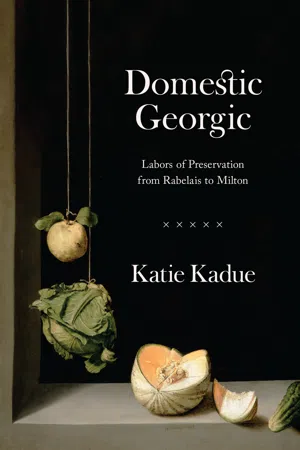
Inspired by Virgil's Georgics, this study conceptualizes Renaissance poetry as a domestic labor.
When is literary production more menial than inspired, more like housework than heroics of the mind? In this revisionist study, Katie Kadue shows that some of the authors we credit with groundbreaking literary feats—including Michel de Montaigne and John Milton—conceived of their writing in surprisingly modest and domestic terms. In contrast to the monumental ambitions associated with the literature of the age, and picking up an undercurrent of Virgil's Georgics, poetic labor of the Renaissance emerges here as often aligned with so-called women's work. Kadue reveals how male authors' engagements with a feminized georgic mode became central to their conceptions of what literature is and could be. This other georgic strain in literature shared the same primary concern as housekeeping: the necessity of constant, almost invisible labor to keep the things of the world intact. Domestic Georgic brings into focus a conception of literary—as well as scholarly and critical—labor not as a striving for originality and fame but as a form of maintenance work that aims at preserving individual and collective life.
- English
- ePUB (mobile friendly)
- Available on iOS & Android
eBook - ePub
About this book
Information
Publisher
University of Chicago PressYear
2021Print ISBN
9780226797496
9780226797359
eBook ISBN
9780226797526
Chapter 1
Rabelais in a Pickle
Fixing Flux in Le Quart Livre
Je suys, moiennant un peu de Pantagruelisme (vous entendez que c’est certaine gayeté d’esprit conficte en mespris des choses fortuites), sain et degourt, prest à boire si voulez. (I am, by means of a little pantagruelism [that is, you know, a certain merriness of mind pickled in contempt for things fortuitous] well and sprightly and ready for drink if you are.)
Rabelais, Le Quart Livre
Ce n’est pas tout de cultiver l’arbre fruictier, & bien l’avoir entretenu, qui n’en sçait garder & conserver le fruict. (It’s not enough to cultivate a fruit tree and to have maintained it well if you don’t know how to keep and conserve its fruit.)
Charles Estienne, L’agriculture et maison rustique
If any early modern French figure is thought to have had his eyes fixed on the far-off future, it would perhaps be Michel de Nostredame, better known as Nostradamus, the astrologer whose Les Prophéties (1555) have been credited with foreseeing world-historical events centuries later. But Nostradamus was also a physician, an apothecary, and the author of a two-part treatise on cosmetics and confitures, also first published in 1555, that aimed to prevent rather than predict disasters, to keep the ordinary catastrophes of aging and decay at bay. Addressed primarily to female readers eager to learn the best ways to preserve their beauty, their harvests, and their health, the Excellent & moult utile opuscule à touts necessaire, qui desirent avoir cognoissance de plusieurs exquises receptes begins its second section with a recipe for candying lemon peel. The process is very long and very boring: you must precisely chop the lemon, slice the peels at a certain thickness, wash them, soak them in salted water for two days, change the water to fresh water and change it again every day for nine days, boil the mixture, remove the peels from the pot and dry them, place them in a quantity of honey or sugar syrup (to be prepared separately), leave them overnight, boil them again in the syrup, remove them from the syrup while it boils again, put them back in the syrup for three days, boil them again, and only a month later will you find out if your labors succeeded (“au bout d’un moys aviseres sil va bien”). Mind-numbing as this repetitive work seems to be, it also requires constant surveillance and judgment. Nostradamus frequently interrupts himself with anxious parenthetical reminders, warning the reader of potential pitfalls as much as providing positive instruction. Don’t throw away the seeds; don’t forget this important step; be careful so it doesn’t break; watch out so it doesn’t burn.1
It is unlikely that Rabelais had this particular preparation of écorces de citron confites in mind when in the prologue to the Quart Livre (1552) he defined the ethical stance of Pantagruelism as “a certain merriness of mind pickled [conficte] in contempt for things fortuitous,” though perhaps Nostradamus shared his recipe while the two men were both students at the Montpellier medical school in 1530.2 And yet the logic of culinary preservation, in some ways more than that of heavy-drinking hedonism, informs both the ethics and the style of Rabelais’s four books, particularly the last two. Rabelais has long been considered a celebrant of fluidity, fecundity, and flux, the creator of a world of permeable boundaries, mutating bodies, and interminable outpourings of wine and words. Yet this chapter will argue that an attention to the periodic suspension of that famous Rabelaisian flow is as important to understanding Rabelais and his humanism as a celebration of the flow itself. Echoing the rhythms of preservative domestic labor on both stylistic and thematic levels, Rabelais’s prose evokes and embodies a domestic georgic ethos that aims not at the breaking of new ground or the boundless progress of human imagination but at the constant management, or tempering, of material and intellectual life through periodic suspensions of its activity, as in the pickling of “merriness of mind” with an acerbic agent like “contempt.” What Michel Jeanneret, discussing the famous “frozen words” episode with which this chapter concludes, pejoratively calls the “tombeau pétrifié” (petrified tomb) of the printed book is better understood, in Rabelais’s textual world, as a temporary and potentially salutary petrification.3
Dead Stones: Cultivating Petrification
To begin again in another state of suspension: in the opening pages of the Quart Livre, just when the prologue’s story is getting started, we are abruptly taken to Olympus, where we find Jupiter’s faculty of judgment paralyzed. Having recently and conclusively resolved a series of geopolitical conflicts, the king of the gods finds himself at a loss, “en grande perplexité,” when it comes to the quarrel between two scholars at the University of Paris, Pierre Rameau and Pierre Galland.4 The solution to this standstill, proposed by Priapus, is for Jupiter to do what he did the last time he found himself faced with such an aporia: to turn both parties into stone, thus suspending the question indefinitely. This method worked well then—when a fox, fated to be caught by no other animal, encountered a dog, fated to catch any other animal it came across—and seems especially fitting here, as Jupiter has just compared the pair of Pierres to a howling dog and a crafty fox. This sense of coincidence solidifies into poetic justice when Priapus reminds Jupiter that both men to be made into pierres are already Pierres in name, and they could conveniently join a third troublemaking homonym, the so-called Pierre de Coingnet, already a fixture in the corner of the walls of Notre Dame de Paris, in a triangular coterie of “trois pierres mortes” (551). Though Jupiter rejects this advice—such a literally monumental memorial is just what these narcissistic academics want—the outcome still, in a way, leaves the two Pierres petrified into perpetuity. Distracted first by the general state of human affairs and the related problem of Olympus’s shortage of thunderbolts and then by the shouts from earth of the woodcutter at the center of the prologue’s narrative, both Jupiter and the narrator abandon the question altogether, leaving Rameau and Galland stuck in their standoff indefinitely.
If these proposed dead stones, the bloodless remains of bitter factionalism, have been thought to fit anywhere in the Rabelaisian edifice, it is as negative exempla. Edwin Duval has argued that these imagined monuments to intramural incivility, wedged into the walls of an “anti-community” built on “anticaritas,” are the antithesis of the cheerfully reasonable Pantagruelist spirit we have come to know and love over the course of the previous books. By bringing civil war into the heart of humanism—once thought to be France’s best hope against civil war—the factions of the University of Paris petromachie stand in opposition to the living stones (lapides vivi) with which Peter, that rock on which the church was built, would have Christians construct a living house for God. Duval finds these stony threats met throughout Rabelais’s books by the author’s call for literal life, pointing to Panurge’s promise in the Tiers Livre to produce pierres vives, or children, in lieu of sterile stone buildings, and more generally to Rabelais’s emphasis on sexual union as the half-serious answer to all threats of division.5 Lawrence Kritzman, writing from a psychoanalytic perspective, finds Priapus’s petrification proposal “inauthentic” and “artificial,” an improper “immobilization and reification” of movement that wants to be free.6 Kritzman extends his diagnosis to the author, describing Rabelais’s polysemic play on the word pierre and “petrification” as an expression of his “fear of choosing” that leaves him stuck “between ideological extremes, the unfortunate victim of repression.”7
But petrification and its domestic cousins—pickling, preserving, and other forms of culinary and medicinal suspension—are, in Rabelais’s case, neither simply symptoms of pathological indecision nor heresies to be quickly and simply stamped out. As this chapter will show, provisional or indefinite immobilizations are central to the ethics and aesthetics of a writer usually associated with irrepressible life. Life is frequently and undramatically repressed—pickled—in Rabelais, on the level of the sentence as well as of the narrative. The indeterminacy of meaning in his work is thus not only the result of a delightful polysemy. It also comes from a deep sense of the contingency of the future and of the maintenance work needed to sustain both the basic conditions for linguistic and literary production and the potential for local and collective transformation.
For Duval, the deadening specter of “anticaritas” cast by the pierres mortes crucially sets the Quart Livre apart from the hopeful humanist vision that came before, and others have located similar shifts from celebrations of vital energies to ominous spectacles of calcification in Rabelais’s books. Jeanneret finds Mikhail Bakhtin’s famous account of Rabelais’s empowering excess, which he agrees is a fair characterization of Pantagruel (1532) and Gargantua (1534), to ring false for the Tiers Livre (1546) and the Quart Livre (1552), where Victor Hugo’s almost equally famous view of Rabelaisian debauchery as didactically disgusting might make for a more valid interpretation.8 In the Tiers Livre, published at a moment when lively debate over the future of Christianity was giving way to uncompromising entrenchments and the early signs of civil war, Rabelais’s previously joyous excess, Jeanneret observes, begins to take on a different hue. The uncomplicated embrace of material and intellectual abundance of the first two books—what Jeanneret calls the euphoric mode of “très”—gives way to the sinister tone of “trop,” the nagging sense in the last two of the authentic books, often insinuated by the grown-up Pantagruel, that there is indeed such a thing as “too much.”9
Given that the Quart Livre ends with Panurge covered in his own excrement, ignoring Pantagruel’s pleas to clean himself up, and inviting everyone to drink, Jeanneret takes as a foregone conclusion that Pantagruel’s mature role as the voice of moderate reason ends up doing little to keep the messiness of the body in check. Even if the last two authentic books defend “mediocrité”—variously understood as mediocritas, sophrosune, temperance, modesty, or the charitable inclusivity of “Pantagruelism”—as a virtue, their author’s excessive style (the never-ending descriptions, the bloated lists) undermines any nominal commitment to that virtue.10 Ultimately, Jeanneret concludes, excess always triumphs: the body’s appetites will not be controlled, and if food, wine, and sex are no longer available for innocent and unlimited enjoyment, excess will instead come out verbally, producing text with inexhaustible significations and defying those who would reduce Rabelais’s “polyphonique” text to a museum of determinate meanings.11 In interpretations like these, Rabelais holds onto his literary reputation as irrepressible, boundary breaking, infinitely productive, and infinitely capacious, an author whose work could be described, as in Jules Michelet’s influential estimation, as “the sphinx or the chimera, a monster with a hundred heads, with a hundred tongues, a harmonious chaos, a farce of infinite range, a marvelously lucid drunkenness, a profoundly wise folly.”12
However much his philosophical interests moved to moderation, Rabelais’s artistic spirit would thus still seem far afield of the domestic georgic concern with temperance and the mundane maintenance work of “tempering” the materials of life, preserving them by temporarily suspending them.13 A cosmopolitan humanism would seem to drift far from domestic cares; a comical approach to menial labor, as when Epistémon enjoys the spectacle of Homeric heroes doing scullery work in the underworld, would not suggest a respect for its value; and readers have often found in Rabelais a purely pastoral fantasy of a natural economy that renews itself perfectly automatically, through passive or reflexive verbs, with no active maintenance, intervention, or culturing required. As Jeanneret puts it, channeling Bakhtin, “excess is recycled in the regenerative process of natural energies,” so that “everything circulates and is transformed.”14 But acknowledging the great pleasure Renaissance humanists took in the novel abundance of textual material and the playful manipulation of language does not require denying that they also found importance, and even pleasure, in the (even if only provisional, and even if precisely through play) ordering and fixing of that material.15 Even though organic processes and bodily functions are natural, and even though Rabelais is inclined to celebrate them, he approaches these processes and functions as contingent on management and control. That control, however, often goes unnoticed, the more so the more one is swept up in the celebration. Jeanneret’s approving reading of the famous torche-cul episode in Gargantua as an unembarrassed embrace of the body’s natural processes, for example, ignores that the young giant’s experiments are engineered entirely toward managing the results of defecation after the fact, rather than taking pure immediate pleasure in the activity.16 Grandgousier’s pride in his son, however exuberant, is due not to his profligate production of waste but to his superlative hygiene. After hearing of the number of innovative methods—rose petals, a basket, pearls, a pigeon—Gargantua has found by laborious and painful (and, yes, humorous) experimentation to clean up after himself, his father marvels that his son had so well ordered things (“avoit donné tel ordre”) that he was the cleanest boy in all the land (“en tout le pays n’estoit guarson plus nect que luy” [65]).
Rabelais operates stylistically and affectively as well as ethically and philosophically under the sign of economical order, rather than that of wasteful excess, and the domestic georgic labor of tempering operates as a cultural form that bridges material and textual practices of organizing, altering, preserving, and moderating. Maintaining Rabelais’s textual economy often involves the temporary freezing and fixing of meaning and material in ways that recall the freezing and fixing techniques of domestic labor, tasks typically designated for women as among the small matters (“menues affaires”) of the house.17 When the abstract concept of moderation is refined into a materially grounded practice of temperance—the tempering of materials, like confected lemon peels, through labor, sweetener or salt, and time—the relevant question becomes not how much is too much but rather the more basic question of what to do about superfluous material, whether très or trop, abundant or excessive, textual or otherwise.18 Whether having more than one needs at a given time is a blessing or a curse, those extra resources need to be managed, and this process often involves freezing, pickling, and other mortifying operations. Though the question of resource management emerges periodically throughout the four books, it is most urgent in the Tiers and Quart Livre, where the consumption of food and wine becomes increasingly tempered, in quality if not in quantity: the processing of food and other organic material by maceration, fermentation, and careful storage becomes more important than its simple consumption, in a way that draws attention to Rabelais’s careful management—rather than gleeful explosion—of language.19 This management occurs on the level of the sentence, on a microscopic and contingent level. Using contemporary conceptions of medicinal and culinary preservation to temper existing scholarly ac...
Table of contents
- Cover
- Title Page
- Copyright Page
- Contents
- Introduction
- 1: Rabelais in a Pickle
- 2: Spenser’s Secret Recipes
- 3: Correcting Montaigne
- 4: Marvell in the Meantime
- 5: Milton’s Storehouses
- Conclusion
- Acknowledgments
- Notes
- Bibliography
- Index
Trusted by 375,005 students
Access to over 1.5 million titles for a fair monthly price.
Study more efficiently using our study tools.
Frequently asked questions
Yes, you can cancel anytime from the Subscription tab in your account settings on the Perlego website. Your subscription will stay active until the end of your current billing period. Learn how to cancel your subscription
No, books cannot be downloaded as external files, such as PDFs, for use outside of Perlego. However, you can download books within the Perlego app for offline reading on mobile or tablet. Learn how to download books offline
Perlego offers two plans: Essential and Complete
- Essential is ideal for learners and professionals who enjoy exploring a wide range of subjects. Access the Essential Library with 800,000+ trusted titles and best-sellers across business, personal growth, and the humanities. Includes unlimited reading time and Standard Read Aloud voice.
- Complete: Perfect for advanced learners and researchers needing full, unrestricted access. Unlock 1.5M+ books across hundreds of subjects, including academic and specialized titles. The Complete Plan also includes advanced features like Premium Read Aloud and Research Assistant.
We are an online textbook subscription service, where you can get access to an entire online library for less than the price of a single book per month. With over 1.5 million books across 990+ topics, we’ve got you covered! Learn about our mission
Look out for the read-aloud symbol on your next book to see if you can listen to it. The read-aloud tool reads text aloud for you, highlighting the text as it is being read. You can pause it, speed it up and slow it down. Learn more about Read Aloud
Yes! You can use the Perlego app on both iOS and Android devices to read anytime, anywhere — even offline. Perfect for commutes or when you’re on the go.
Please note we cannot support devices running on iOS 13 and Android 7 or earlier. Learn more about using the app
Please note we cannot support devices running on iOS 13 and Android 7 or earlier. Learn more about using the app
Yes, you can access Domestic Georgic by Katie Kadue in PDF and/or ePUB format, as well as other popular books in Literature & English Literary Criticism. We have over 1.5 million books available in our catalogue for you to explore.