eBook - ePub
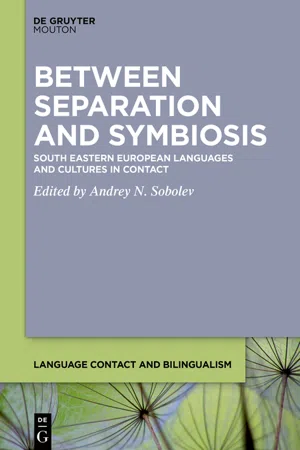
Between Separation and Symbiosis
South Eastern European Languages and Cultures in Contact
- 340 pages
- English
- ePUB (mobile friendly)
- Available on iOS & Android
eBook - ePub
Between Separation and Symbiosis
South Eastern European Languages and Cultures in Contact
About this book
No detailed description available for "Between Separation and Symbiosis".
Information
Publisher
De Gruyter MoutonYear
2021Print ISBN
9781501520723
9781501516641
Edition
1eBook ISBN
9781501509216
Maxim L. Kisilier
Reconstructing Past Coexistence: Problems and Mysteries in the Multilingual History of Tsakonia, Greece
Abstract: This chapter118 is about the historical development of Tsakonian and the unique aspects of its current situation. Tsakonian is one of the most mysterious Modern Greek dialects that is generally considered to be a direct descendant of Ancient Greek Doric Laconian which developed in separation and isolation. It has a number of rare features that can scarcely be explained from the point of view of Greek dialectology and historical grammar. These involve phonetics (such as (/ʒ/ or /ʃ/ < /ri/ or /nd/ < /z/) and morphosyntax (e. g., absence of a synthetic present and imperfect, and special regulations in the placement of pronominal clitics). Such features cannot be found elsewhere in Modern Greek dialects. Linguistic descriptions of Tsakonian are almost always accompanied with the statement that Tsakonian is the only (sic!) Modern Greek dialect which does not originate from the Hellenistic Koiné. But it is not clear how that fact, even if true, would explain the “strange” features of Tsakonian as their connection with Ancient Laconian are still to be demonstrated. A logical explanation would be interaction with other languages during the Byzantine and Post-Byzantine periods since toponymic and lexical data suggest that Greeks were not the only residents of the region. Still the possibilities for reconstructing any details are very limited. Unlike previous studies, this chapter demonstrates that Tsakonian in its evolution was not entirely independent of the influence of other languages and dialects. At least during the last two centuries Tsakonian had constant contact only with Standard Modern Greek. The study of earlier stages of Tsakonian demands that the researcher hypothesize some past contact situation but not to be content just with a pure description of the contemporary state of the art. While presenting the rare and amazing interplay of archaisms and innovations that make Tsakonian what it is, the goal of this paper is somewhat challenging. On one hand, I intend to discuss the limits and possibilities of reconstructing past contact and, on the other hand, to show why the contact-oriented approach may be important for Tsakonian studies. This chapter is mostly based on data collected by the author between 2010 and 2019 in Tsakonian-speaking villages of Peloponnese (Greece).
1Introduction
While describing multilingualism and multiculturalism, researchers are generally aware of the languages and cultures that are involved in contact. It is possible to trace which elements are borrowed and donated, and the direct observation and description of the language and cultural contact in synchrony may become a good basis for subsequent historical analysis.119 Sometimes historical evidence supported by linguistic data and description of certain traditions enable the reconstruction of the past coexistence of various languages and cultures. For example, Azov Greeks until the end of the 20th century had contacts only with Russian, but in the Crimea where they lived before moving to the Azov steppe they had to communicate with the local Crimean Tatar majority.120 There are thus a large number of lexical borrowings from Tatar in the dialect of Azov Greeks (Kisilier 2008: 157) and several traditions of Tatar origin in their culture (Novik 2009: 68–71).
Untill recently, the majority of Modern Greek dialects have been traditionally analysed without any reference to possible language contacts as if they had existed in a linguistic vacuum without any influence from the outside.121 Moreover, scholars tried to reconstruct a hypothetical past state of affairs when the dialect, as they believed, must have been much purer. For instance, Peter Trudgill (2003: 48) suggests that “any classification of traditional Greek dialects that aims at portraying and summarising the full extent of our knowledge of the geographical configuration of these dialects should ideally be based on a description of the situation existing between, say, 1820 and 1920, when they were at their fullest extent, rather than on the situation today”. However, it has become clear that the interaction of Modern Greek dialects with other languages is not a specific feature of the 20th century with its two World Wars, extensive migrations resulting from the Asia Minor Catastrophe of 1922, economic crises, and the processes of urbanization (cf. Pappas 2017), but started long before. Now it is almost a commonplace to study Grico and Grekaniko in South Italy (Ledgeway 2013), Greek dialects of Dropull (Kisilier, Novik & Sobolev 2016) and Himara (Joseph, Ndoci & Dickerson 2019) in Southern Albania, and Cappadocian (Janse 2019), Pontic (Sitaridou & Kaltsa 2014), and Propontis Tsakonian (Melissaropoulou 2018; 2019) in Asia Minor taking into account long and intensive contacts with local languages. Much less has been done in the field of language contacts within Greece itself (cf. Adamou 2008).
Unlike the aforementioned varieties of Greek, [Peloponnesian] Tsakonian, the Modern Greek dialect discussed in this chapter, has been always regarded as a separate “free-of-any-contact” language which even managed to escape the influence of Hellenistic Koiné (Kontosopoulos 2010: 191) and thereby to preserve multiple Ancient Doric features.122 However, not all peculiarities of Tsakonian can be indisputably identified as Ancient Doric. Nor they are typical for Byzantine Greek, Standard Modern Greek or other Modern Greek varieties. Contemporary Tsakonian has no clear signs of intensive language contacts but this does not mean that it could not have interacted with other languages, non-dialect Greek inclusive, in the past. In the early 20th century, Dirk Christiaan Hesseling (1907: 153–168) suggested that Tsakonian should be treated as a creole language, which appeared as a result of contacts between the Dorians and the speakers of Ural-Altaic. His hypothesis was angrily rejected by the most famous specialist in Tsakonian Michael Deffner, who even called a meeting оf the local community “to condemn the anthellenic outrage” (Nicholas 2009).
The goal of this chapter is not to prove Hesseling’s point of view – the data we have at our disposal makes that hardly possible. Rather, I intend to demonstrate that:
| (a) | Tsakonians were not separated from other nations and other Greeks and Tsakonian was not isolated over the scope of its history; |
| (b) | it could have had contacts with different languages and with non-dialect Greek123 (by means of education and folklore); |
| (c) | a contact-oriented approach may help to explain some linguistic peculiarities of Tsakonian. |
Taking into account that some readers may have only vague ideas about Tsakonian, in Section 4 I shall provide general information on the dialect and make a br...
Table of contents
- Cover
- Title Page
- Copyright
- Editor’s Preface
- Contents
- Contemporary Language Contacts in the Balkans: Situations and Outcomes
- Separation and Symbiosis between Slavs and Albanians as Continuum of Linguistic Contact Situations: New Challenges for New Data
- Mutual Understanding among Albanians, Slavs and Aromanians in Prespa, North Macedonia: Perfect Tense as a Perfect Tool
- “Balanced Language Contact” in Social Context: Velja Gorana in Southern Montenegro
- Symbiosis Suspectus: Palasa in Himara, Albania
- Minority within a Minority: Iabalcea and Carașova in Romania
- Evidence for Past Coexistence: Romance Stratum in Croatian Glagolitic Sources from Krk, Croatia
- Reconstructing Past Coexistence: Problems and Mysteries in the Multilingual History of Tsakonia, Greece
- Convergence and Failure to Converge in Relative Social Isolation: Balkan Judezmo
- Balkan Sprachbund Theory as a Research Paradigm
- Abbreviations
- Index of names
- Index of places
- Authors’ profiles
Trusted by 375,005 students
Access to over 1.5 million titles for a fair monthly price.
Study more efficiently using our study tools.
Frequently asked questions
Yes, you can cancel anytime from the Subscription tab in your account settings on the Perlego website. Your subscription will stay active until the end of your current billing period. Learn how to cancel your subscription
No, books cannot be downloaded as external files, such as PDFs, for use outside of Perlego. However, you can download books within the Perlego app for offline reading on mobile or tablet. Learn how to download books offline
Perlego offers two plans: Essential and Complete
- Essential is ideal for learners and professionals who enjoy exploring a wide range of subjects. Access the Essential Library with 800,000+ trusted titles and best-sellers across business, personal growth, and the humanities. Includes unlimited reading time and Standard Read Aloud voice.
- Complete: Perfect for advanced learners and researchers needing full, unrestricted access. Unlock 1.5M+ books across hundreds of subjects, including academic and specialized titles. The Complete Plan also includes advanced features like Premium Read Aloud and Research Assistant.
We are an online textbook subscription service, where you can get access to an entire online library for less than the price of a single book per month. With over 1.5 million books across 990+ topics, we’ve got you covered! Learn about our mission
Look out for the read-aloud symbol on your next book to see if you can listen to it. The read-aloud tool reads text aloud for you, highlighting the text as it is being read. You can pause it, speed it up and slow it down. Learn more about Read Aloud
Yes! You can use the Perlego app on both iOS and Android devices to read anytime, anywhere — even offline. Perfect for commutes or when you’re on the go.
Please note we cannot support devices running on iOS 13 and Android 7 or earlier. Learn more about using the app
Please note we cannot support devices running on iOS 13 and Android 7 or earlier. Learn more about using the app
Yes, you can access Between Separation and Symbiosis by Andrey N. Sobolev in PDF and/or ePUB format, as well as other popular books in Languages & Linguistics & Historical & Comparative Linguistics. We have over 1.5 million books available in our catalogue for you to explore.